Spotlight on Chinatown Child Development Center Photo Credit: Asian - - PowerPoint PPT Presentation

spotlight on chinatown child development center
SMART_READER_LITE
LIVE PREVIEW

Spotlight on Chinatown Child Development Center Photo Credit: Asian - - PowerPoint PPT Presentation

Behavioral Health Services: Children, Youth, & Families System of Care Stories of API Children & Youth Spotlight on Chinatown Child Development Center Photo Credit: Asian Pacific Fund Vincy Chow, LCSW, Director of CCDC Farahnaz


slide-1
SLIDE 1

Vincy Chow, LCSW, Director of CCDC Farahnaz Farahmand, Ph.D., Assistant Director of CYF Ritchie Rubio, Ph.D., Director of Practice Improvement & Analytics of CYF

Stories of API Children & Youth

Spotlight on Chinatown Child Development Center

Behavioral Health Services:

Children, Youth, & Families System of Care

August 20, 2019

SF Health Commission Meeting in Chinatown

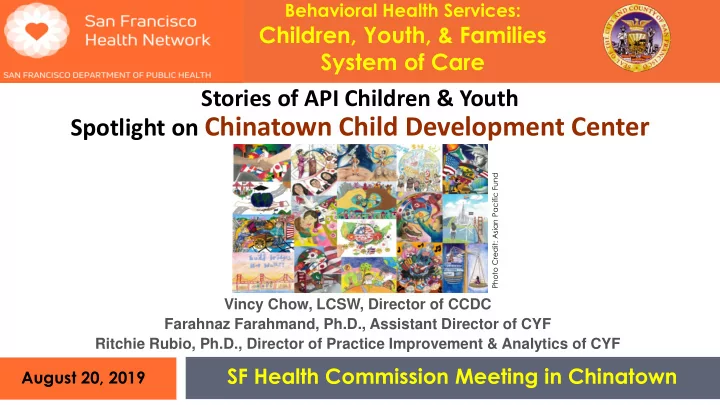
Photo Credit: Asian Pacific Fund

slide-2
SLIDE 2

Children/Youth Currently Served within CYF

Primary Language of Children and Youth

slide-3
SLIDE 3

CYF Mental Health Services Penetration Rates 2018 to 2019

slide-4
SLIDE 4

Strengths

CANS 2010 – 2018 (N = 10,592)

Education is a prominent strength among Asian youth. Spirituality/Religiosity is prominent for NHOPI. Relationship Permanence is a prominent strength for API youth compared to

  • ther groups.

Top 3 Strengths

slide-5
SLIDE 5

Risk Behaviors

CANS 2010 – 2018 (N = 10,592)

Asian youth have low frequency of risk

  • behaviors. Suicide Risk

ranks third. Danger to Others is a more frequent risk behavior for NHOPI youth.

Top 3 Risks

slide-6
SLIDE 6

Children/Youth in Crisis

2015 to 2018

Asian youth ranks second in their frequency

  • f accessing

crisis services

slide-7
SLIDE 7

A Story of Crisis by an Asian Youth

“Client reported experiencing command hallucinations, paranoia and disorganized behavior. Client expressed ‘feeling hopeless and out of control’ and ‘I feel like someone else is controlling my mind and body’. Mother reports client has been under a lot of stress due to high academic demand and possible bullying.” – Crisis Eval “Client is generally dismissive of the need for medication and of the idea that she is ill... She admits to being stressed

  • ut by interactions on social media and worries a lot about her school work.”

– Psychiatry Eval “She didn’t understand how meeting with this [therapist] was helpful and that she was wasting her time from studying… She requested being seen for a shorter duration… She worries about falling behind at school and not getting into a good UC… Client talked about needing support and a space to talk but was also frustrated that all the services and therapies were taking too much of her time away from school.” – Tx Therapist

slide-8
SLIDE 8

▪CYF: Seek & Serve (CYC) ▪MHSA: API Youth Family

Support Services (CYC)

▪MHSA: API Mental Health

Collaborative (RAMS)

▪LEGACY & CCDC Outreach

API Population Focused Strategies

slide-9
SLIDE 9

Chinatown Child Development Center (CCDC)

➢ First established in 1972 ➢ Comprehensive, outpatient community

behavioral health clinic of the Department

  • f Public Health

➢ Serves children and adolescents, up to 18

years of age, who are residents of San Francisco and who have Medi-Cal, Healthy Kids Healthy Families, or no insurance coverage (Medi-Cal eligible)

slide-10
SLIDE 10

Mission Statement

CCDC’s mission is to promote the social-emotional well-being of children, youth, and their families in San Francisco by providing comprehensive mental health services which are easily accessible and linguistically and culturally appropriate.

slide-11
SLIDE 11

Multi-disciplinary and Multi-lingual Staff

➢ CCDC prides itself in the ability to provide services that

are linguistically and culturally appropriate via a multidisciplinary staff who speak English, Cantonese, Mandarin, and Vietnamese.

➢ Multi-disciplinary staff consist of Clinical Social Workers,

Marriage and Family Therapists, Clinical Psychologists, Psychiatrists, Health Workers, etc.

slide-12
SLIDE 12
slide-13
SLIDE 13

CCDC Services

➢ Individual, group, and family therapy ➢ Collateral contacts with parents and

significant others;

➢ Case management services; ➢ Medication support services ➢ Psychological testing ➢ Infant Parent Group ➢ School-based therapy services ➢ Consultation for community-based

  • rganizations
slide-14
SLIDE 14

CCDC Therapy Interventions STEP Survey 2019 (N = 14)

slide-15
SLIDE 15

CCDC CANS Strengths Outcomes July to March 2019

CCDC children and youth have maintained strengths in Cultural Identity, Education, and Relationship

  • Permanence. They have

developed strengths in Vocational, Interpersonal, and Family domains.

slide-16
SLIDE 16

CCDC CANS Needs Outcomes July to March 2019

CCDC children and youth have most improved on the following needs: Adjustment to Trauma (i.e., Dysregulation); Anger Control; and Anxiety.

slide-17
SLIDE 17

Linkage to Community Resources

Case Management Services

➢ Occupational Therapy ➢ LEGACY: Peer Support Program ➢ Seneca DBT Program ➢ Felton PREP and BEAM programs ➢ Therapeutic Behavioral Services ➢ Transgender Health Services ➢ Community mentorship program ➢ Transitions to different levels of care and

programs (Transitional Age Youth Program, adult outpatient clinic)

slide-18
SLIDE 18

Community Involvement

➢ Since 2007, with funding from the Mental

Health Services Act, CCDC in collaboration with the Chinatown Public Health Center implemented the Disabilities Access Clinic (DAC)

➢ Provides specialty mental health services

for children and adolescents with disabilities at their primary care clinic

➢ Improves coordination among medical,

psychiatric, and social services providers

slide-19
SLIDE 19

CCDC Community Partners

➢ Chinatown Disaster

Preparedness Committee

➢ NICOS Chinese Health

Coalition

➢ Asian Alliance Against

Domestic Violence

➢ APA Family Support

Services

➢ Community Youth

Center of SF

➢ Network for a Healthy

California—Chinese Project (with Chinatown Public Health Center)

➢ Asian Youth Advocacy

Network

➢ Asian & Pacific Islander

Health Parity Coalition

➢ SF Youth Works

slide-20
SLIDE 20

Potential Barriers to Treatment

➢ Stigma: Saving face makes it difficult to acknowledge mental illness and to seek

help

➢ Distrust of the system:

  • Ethnic minorities have been subject to poor treatment, discrimination and

racism in America

  • Transgenerational experience of trauma in immigrant populations: pre-

migration, migration, encampment, post-migration

➢ Lack of understanding or awareness of Western concept of mental illness,

symptoms of mental illness, services available, and how to access the services

➢ May depend on socio-economic status and educational level

  • Lack of language and culturally sensitive mental services

Bith-Melander et al., Intl J of Envir Res and Public Health, 2017

slide-21
SLIDE 21

Efforts to Reduce the Barriers

Reducing the Stigma

➢ CCDC participates in annual health fairs

and community events

➢ Clinical work to focus on impairing

behaviors rather than the disorder Building Trust

➢ CCDC’s community and school

relationships lead to referrals

➢ Referrals from previous clients and

parents, a trusted source

➢ Continue to address and resolve any on-

going barriers

➢ Knowledge and linkage to community

resources Psychoeducation:

Depending on education level and socio-economic background, some families may need more health education than others Language & Culture Increasing awareness of Western concept

  • f mental illness and services available,

along with improving access

Collaboration with primary care

Collaboration with schools

School-based services

CCDC clinicians offer presentations at community events

Peer support: CCDC Infant Parent group, LEGACY
slide-22
SLIDE 22

Thank You!

Vincy.Chow@sfdph.org Farahnaz.Farahmand@sfdph.org Ritchie.Rubio@sfdph.org