Sponsored Search Using Landing Pages for Sponsored Search Ad - - PDF document

sponsored search using landing pages for sponsored search
SMART_READER_LITE
LIVE PREVIEW

Sponsored Search Using Landing Pages for Sponsored Search Ad - - PDF document

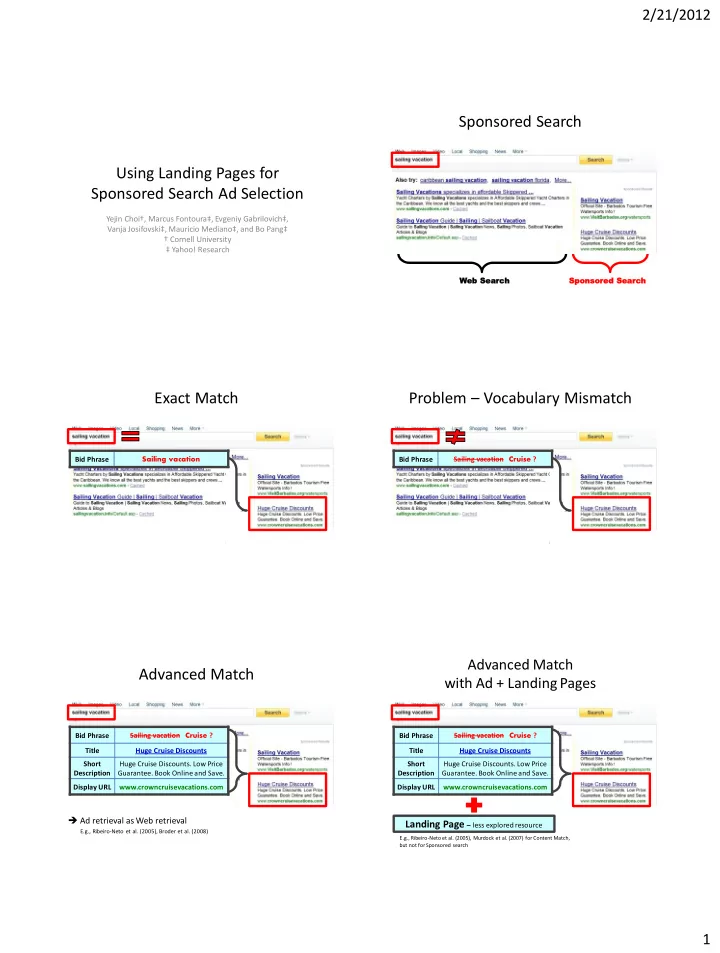
2/21/2012 Sponsored Search Using Landing Pages for Sponsored Search Ad Selection Yejin Choi, Marcus Fontoura, Evgeniy Gabrilovich, Vanja Josifovski, Mauricio Mediano, and Bo Pang Cornell University Yahoo! Research Web


slide-1
SLIDE 1

2/21/2012 1

Using Landing Pages for Sponsored Search Ad Selection

Yejin Choi†, Marcus Fontoura‡, Evgeniy Gabrilovich‡, Vanja Josifovski‡, Mauricio Mediano‡, and Bo Pang‡ † Cornell University ‡ Yahoo! Research

Spons ponsor

  • red

ed Sear earch ch Web eb Sear earch ch

Sponsored Search

Bid Phrase Sailing vacation

Exact Match

Bid Phrase Sailing vacation Cruise ?

Problem – Vocabulary Mismatch

Bid Phrase Sailing vacation Cruise ? Title Huge Cruise Discounts Short Description Huge Cruise Discounts. Low Price

  • Guarantee. Book Online and Save.

Display URL www.crowncruisevacations.com

 Ad retrieval as Web retrieval

E.g., Ribeiro-Neto et al. (2005), Broder et al. (2008)

Advanced Match

Bid Phrase Sailing vacation Cruise ? Title Huge Cruise Discounts Short Description Huge Cruise Discounts. Low Price

  • Guarantee. Book Online and Save.

Display URL www.crowncruisevacations.com

Landing Page – less explored resource

Advanced Match with Ad + Landing Pages

E.g., Ribeiro-Neto et al. (2005), Murdock et al. (2007) for Content Match, but not for Sponsored search

slide-2
SLIDE 2

2/21/2012 2

Benefit of Analyzing Landing Pages

  • Reducing the vocabulary gap

– between the ad and the query

  • Detecting Ad spam

How to make the best use of noisy Landing Pages?

 Extractive Summarization Task  What is a good summary?

How to make the best use of noisy Landing Pages?

 Extractive Summarization Task  What is a good summary? Two Hypotheses:

1. Summary in the context of advertisement intent

 In-Context Term Selection

2. Intrinsic summary, independent from an ad

 Out-of-Context Term Selection

Extractive summarization of Landing Pages

 In-context Term Selection

– Using Ad

 In-context Term Selection

– Using Ad + Enriched Ad Context

 Out-of-context Term Selection

Extractive summarization of Landing Pages

 In-context Term Selection

– Using Ad

 In-context Term Selection

– Using Ad + Enriched Ad Context

 Out-of-context Term Selection

Bid Phrase Cruise Title Huge Cruise Discounts Short Description Huge Cruise Discounts. Low Price

  • Guarantee. Book Online and Save.
slide-3
SLIDE 3

2/21/2012 3

In-Context Term Selection

Extract Relevant Regions (RR):

In-Context Term Selection

Extract Relevant Regions (RR):

  • 1. Build Ad Vector

– TF-IDF vector of an Ad

  • Ad = (bid phrase, title, short description)
  • 2. Locate Candidate Regions

– Text span of landing pages in [-5, +5] window

  • 3. Select Relevant Regions

– Cosine Similarity (Ad Vector, Candidate Region) > d

Bid Phrase Cruise Title Huge Cruise Discounts Short Descript ion Huge Cruise Discounts. Low Price Guarantee. Book Online and Save. Ad Vector a := TF-IDF vector of an Ad Bid Phrase Cruise Title Huge Cruise Discounts Short Descript ion Huge Cruise Discounts. Low Price Guarantee. Book Online and Save. Ad Vector a := TF-IDF vector of an Ad Bid Phrase Cruise Title Huge Cruise Discounts Short Descript ion Huge Cruise Discounts. Low Price Guarantee. Book Online and Save. Ad Vector a := TF-IDF vector of an Ad Cosine similarity (Ad vector, candidate region) > d Bid Phrase Cruise Title Huge Cruise Discounts Short Descript ion Huge Cruise Discounts. Low Price Guarantee. Book Online and Save. Ad Vector a := TF-IDF vector of an Ad Relevant Regions (RR)

slide-4
SLIDE 4

2/21/2012 4

Extractive summarization of Landing Pages

 In-context Term Selection

– Using Ad

 In-context Term Selection

– Using Ad + Enriched Ad Context

 Out-of-context Term Selection

In-Context Term Selection

with Enriched Ad Context

  • 1. Construction of Co-occurrence Vectors

– from Ad Corpus (half million ads)

Bid Phrase Cruise Title Huge Cruise Discounts Short Descript ion Huge Cruise Discounts. Low Price Guarantee. Book Online and Save. Bid Phrase Cruise Title Huge Cruise Discounts Short Descript ion Huge Cruise Discounts. Low Price Guarantee. Book Online and Save. Bid Phrase Cruise Title Huge Cruise Discounts Short Descript ion Huge Cruise Discounts. Low Price Guarantee. Book Online and Save. Bid Phrase Cruise Title Huge Cruise Discounts Short Descript ion Huge Cruise Discounts. Low Price Guarantee. Book Online and Save.

Co-occurrence Vector for “mattress”

 queen(5.64), shopping(2.2), brand(2.5) , store(2.44) serta(7.64), sealy(7.79), visco(7.75), platform(4.74), products(1.94), cover(4.1), outlet(3.46), allergen(6.63), etc

 weighted by Point-wise Mutual Information (PMI)

 Provides related or relevant words – Not synonyms

Co-occurrence Vector for “mattress”

 queen(5.64), shopping(2.2), brand(2.5) , store(2.44) serta(7.64), sealy(7.79), visco(7.75), platform(4.74), products(1.94), cover(4.1), outlet(3.46), allergen(6.63), etc

 weighted by Point-wise Mutual Information (PMI)

 Provides related or relevant words – Not synonyms

Co-occurrence Vectors for Ad

 How to use co-occurrence vectors to enrich ad context?

 One co-occurrence vector for each word in an Ad.  Need to combine multiple co-occurrence vectors

In-Context Term Selection

with Enriched Ad Context

  • 1. Construction of Co-occurrence Vectors

– from Ad Corpus

  • 2. Composition of Co-occurrence vectors

– In order to make Enriched Ad Context – “Compositional Semantic Vectors (CSV)”

slide-5
SLIDE 5

2/21/2012 5 Compositional Semantic Vector (CSV)

  • Composition of Vector Space Models

– Mitchell and Lapata (2008) – Compositional Semantics (Montague, 1973) “Principle of Compositionality”

Compositional Semantic Vector (CSV)

  • Composition of Vector Space Models

– Mitchell and Lapata (2008) – Compositional Semantics (Montague, 1973) “Principle of Compositionality” – Given a set of co-occurrence vectors – The composed meaning can be obtained by

Compositional Semantic Vector (CSV)

  • 1. Component-wise

vector addition:

  • 2. Component-wise

vector multiplication:

Compositional Semantic Vector (CSV)

  • 1. Component-wise

vector addition:

  • 2. Component-wise

vector multiplication:

  • 3. Component-wise

vector multiplication with smoothing:

“cruise”=

(…, ship, sailing, vacation, beach, …,

“cruise”=

(…, ship, sailing, vacation, beach, …, Tom, Katie, Holmes, scientology, …)

 Two different meanings (Polysemy) of “cruise” !

slide-6
SLIDE 6

2/21/2012 6

“cruise”=

(…, ship, sailing, vacation, beach, …, Tom, Katie, Holmes, scientology, …)

“sailing”=

(…, yacht, vacation, adventure, beach, charters, Islands, Caribbean, …)

“cruise”=

(…, ship, sailing, vacation, beach, …, Tom, Katie, Holmes, scientology, …)

“sailing”=

(…, yacht, vacation, adventure, beach, charters, Islands, Caribbean, …)

“cruise & sailing”=

(…, ship, yacht, vacation, beach, Islands, Caribbean, …)

In-Context Term Selection

with Enriched Ad Context

  • 1. Construction of Co-occurrence Vectors

– from Ad Corpus

  • 2. Composition of Co-occurrence vectors

– In order to make Enriched Ad Context – “Compositional Semantic Vectors (CSV)”

  • 3. Extract Relevant Regions using

– Ad Vector – “Compositional Semantic Vectors (CSV)”

Bid Phrase Cruise Title Huge Cruise Discounts Short Descript ion Huge Cruise Discounts. Low Price Guarantee. Book Online and Save. Ad Vector a := TF-IDF vector of an Ad Cosine Similarity (Ad vector, candidate region) > d Bid Phrase Cruise Title Huge Cruise Discounts Short Descript ion Huge Cruise Discounts. Low Price Guarantee. Book Online and Save. Ad Vector a := TF-IDF vector of an Ad csv : compositional semantic vector of an Ad Cosine Similarity (Ad vector, candidate region) + Cosine Similarity (CSV, candidate region) > d+

Ad Retrieval System

  • Based on Broder et al. (2008)
  • Terms in Relevant Regions as extra features
slide-7
SLIDE 7

2/21/2012 7

Data

  • Test:

– 22500 query-ad pairs

  • Development:

– 3600 query-ad pairs

  • Excluding query-ad pairs

– without valid landing pages – URL queries

Data

  • Human judgment

– Perfect (10.0) – Excellent (7.0) – Good (3.0) – Fair (0.5) – Bad (0.0)

  • Test:

– 22500 query-ad pairs

  • Development:

– 3600 query-ad pairs

  • Excluding query-ad pairs

– without valid landing pages – URL queries

Evaluation

  • Discounted Cumulative Gain (DCG)
  • Normalized DCG (NDCG)

0.55 0.56 0.57 0.58 0.59 0.6 0.61 0.62 Baseline RR RR-csv (Ʃ) RR-csv (Π) RR-csv (Π) (smoothed)

NDCG @ 1

+ +

+ : statistically significant gain over baseline (Wilcoxon test)

* * *

* : statistically significant gain over baseline (paired t-test)

0.49 0.495 0.5 0.505 0.51 0.515 Baseline RR RR-csv (Ʃ) RR-csv (Π) RR-csv (Π) (smoothed)

NDCG @ 3

+

+ : statistically significant gain over baseline (Wilcoxon test) * : statistically significant gain over baseline (paired t-test)

*

Extractive summarization of Landing Pages

 In-context Term Selection

– Using Ad

 In-context Term Selection

– Using Ad + Enriched Ad Context

 Out-of-context Term Selection

slide-8
SLIDE 8

2/21/2012 8

Out-of-Context Term Selection

  • 1. First N unique words

– Anagnostopoulos et al. (2007)

  • 2. Best N unique words

– Using TF-IDF weighting

  • 3. All words

0.49 0.495 0.5 0.505 0.51 0.515 Baseline First Best All RR-csv (Π) (smoothed)

NDCG @ 3

+

+ : statistically significant gain over baseline (Wilcoxon test) * : statistically significant gain over baseline (paired t-test)

*

Quality of CSV ( ) ?

Having seen that csv ( ) effective in extracting relevant regions in landing pages…

Quality of CSV ( ) ?

Having seen that csv ( ) effective in extracting relevant regions in landing pages…

 N best words in csv ( ) as extra features? (instead of landing page driven features)

0.55 0.56 0.57 0.58 0.59 0.6 0.61 0.62 Baseline csv RR-csv(Π) (smoo)

NDCG @ 1

0.49 0.495 0.5 0.505 0.51 0.515 0.52 Baseline csv RR-csv(Π) (smoo)

NDCG @ 3

+

*

+

*

+

*

+

*

+ : statistically significant gain over baseline (Wilcoxon test) * : statistically significant gain over baseline (paired t-test)

Conclusion

  • We quantify the benefit of using the landing

pages for sponsored search.

– In-context extractive summarization – Out-of-context extractive summarization

  • Compositional vector space models to enrich

the ad context.

– To extract relevant regions from landing pages – To complement ads

slide-9
SLIDE 9

2/21/2012 9

Thank You!