SPIDER MITE INTERRELATIONSHIP. Douglas Walsh, Frank Zalom, Douglas - - PDF document

spider mite interrelationship
SMART_READER_LITE
LIVE PREVIEW

SPIDER MITE INTERRELATIONSHIP. Douglas Walsh, Frank Zalom, Douglas - - PDF document

STSAWE!ERRY CULTIVAR A * SOIL FUMIGATION, SPIDER MITE INTERRELATIONSHIP. Douglas Walsh, Frank Zalom, Douglas Shaw, and Norman Welch University of California, Davis with methyl bromide/ chloropicrin on Soil fumigation vigorous plant


slide-1
SLIDE 1

STSAWE!ERRY CULTIVAR

A

*

SOIL FUMIGATION, SPIDER MITE INTERRELATIONSHIP. Douglas Walsh, Frank Zalom, Douglas Shaw, and Norman Welch University of California, Davis Soil fumigation with methyl bromide/ chloropicrin on strawberries promotes vigorous plant growth. A recurring

  • bservation in our studies is that vigorous strawberry plants

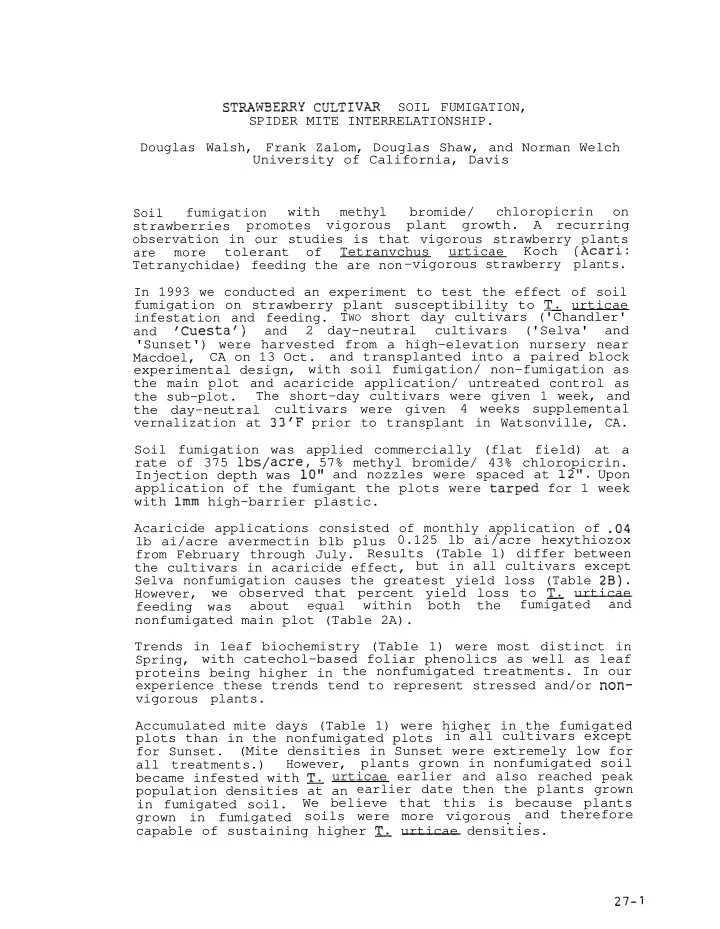
are more tolerant of Tetranvchus urticae Koch (Atari: Tetranychidae) feeding the are non-vigorous strawberry plants. In 1993 we conducted an experiment to test the effect of soil fumigation on strawberry plant susceptibility to T. urticae infestation and feeding. TWO short day cultivars ('Chandler' and 'Cuesta') and 2 day-neutral cultivars ('Selva' and 'Sunset') were harvested from a high-elevation nursery near Macdoel, CA on 13 Oct. and transplanted into a paired block experimental design, with soil fumigation/ non-fumigation as the main plot and acaricide application/ untreated control as the sub-plot. The short-day cultivars were given 1 week, and the day-neutral cultivars were given 4 weeks supplemental vernalization at 33'F prior to transplant in Watsonville, CA. Soil fumigation was applied commercially (flat field) at a rate of 375 lbs/acre, 57% methyl bromide/ 43% chloropicrin. Injection depth was 10" and nozzles were spaced at 12". Upon application of the fumigant the plots were tarped for 1 week with lmm high-barrier plastic. Acaricide applications consisted of monthly application of .04 lb ai/acre avermectin blb plus 0.125 lb ai/acre hexythiozox from February through July. Results (Table 1) differ between the cultivars in acaricide effect, but in all cultivars except Selva nonfumigation causes the greatest yield loss (Table 2B). However, we observed that percent yield loss to T. urticae feeding was about equal within both the fumigated and nonfumigated main plot (Table 2A). Trends in leaf biochemistry (Table 1) were most distinct in Spring, with catechol-based foliar phenolics as well as leaf proteins being higher in the nonfumigated treatments. In our experience these trends tend to represent stressed and/or non- vigorous plants. Accumulated mite days (Table 1) were higher in the fumigated plots than in the nonfumigated plots in all cultivars except for Sunset. (Mite densities in Sunset were extremely low for all treatments.) However, plants grown in nonfumigated soil became infested with T. urticae earlier and also reached peak population densities at an earlier date then the plants grown in fumigated soil. We believe that this is because plants grown in fumigated soils were more vigorous and therefore

. .

capable of sustaining higher T. urticae densities.

27-l

slide-2
SLIDE 2

Table 1: Effects of Soil Fumigation and Acaricide Treatment on Four Commercial Strawberry Cultivars. Cultivar: Chandler Fruit Mite

Yield&-SD

DayskSD

_-

Thru 6/2 Fumigated Sprayed 1307i: 27 - Fumigated Control 1000+242* 470454800 Nonfumigated Sprayed 514+ 73** - Nonfumiqated Control 3835 23** 2253+1020

F=

  • P<

Cultivar: Selva Fumigated Sprayed Fumigated Control Nonfumigated Sprayed Nonfumigated Control F=

P<

Cultivar: Cuesta Fumigated Sprayed 1423+ 70 Fumigated Control 8122159* 22.502 1.632 0.0058 0.3163 Fruit Yield&SD 896+101 696+346 7072 11 572+ 82 1.035 0.4671 Fruit Yield+SD Non Non F=

P<

Treated 544+ 15** Control 3252

1** 57.24 0.001

Cultivar: Sunset Fruit Yield&SD Fumigated Sprayed 1330+ 9 Fumigated Control 1230+64 Nonfumigated Sprayed 446+52** Nonfumigated Control 401+30** F= 253.938

P< 0.0001

Mite Days+SD Thru 6/2 3692+3094 855+ 133 2.499 0.1986 Mite DaystSD Thru 6/2 Leaf Protein 4/l 12467 12047 25142** 26975** 18.42 0.0083 Foliar

4/l 11994 8970

22671-k

19657* 13.468 0.0148 Leaf Protein 4/l 9350 Foliar 4 / 1 14179 11404 13281 28977** 20441* 28380** 18750 216.214 17.419 0.0001 0.0093 Leaf Protein 4/l 10885 Foliar 4/l 12497 13384 22695** 19410** 16.254 0.0105 9236+2228** 12880 26904** 2765+1388* 28809** 20.605 715.131 0.0068 0.0001 Mite Leaf DaystSD Protein Thru 6/2 4/l 8463 740+368 11214 25809** 8022101 26928** 3.839 84.583 0.113 0.0004 */Significant at 95%, **/ at 99% by Scheffe's F-test Foliar 4/l 9559 12449 20392* 20906* 28.032 0.0038 Table 12. Fumigation and acaricide application effects on fruit yield (grams per plant), T. urticae density, leaf proteins and catechol based foliar phenolics (nanomoles per gram wet leaf weight) on 4 commercial strawberry cultivars. 27-2

slide-3
SLIDE 3

Table 2A: Percent yield reduction as a result of mite feeding within the main fumigation/nonfumigated treatment. Chandler Cuesta Selva Sunset Fumigated 23.527 42.993 22.278 7.516 Nonfumigated 25.462 35.262 19.024 10.190 Table 2B: Percent Yield reduction between the subplot acaricide treatment/ untreated control grow-n in nonfumigated soil (ie. fumigation effect). Sprayed Control Chandler Cuesta Selva Sunset 60.635 62.056 21.050 61.749 61.630 56.561 17.744 67.412 27-3