The Interrelationship between ISTN lake, Babakan lake and the - - PowerPoint PPT Presentation

the interrelationship between istn lake
SMART_READER_LITE
LIVE PREVIEW

The Interrelationship between ISTN lake, Babakan lake and the - - PowerPoint PPT Presentation

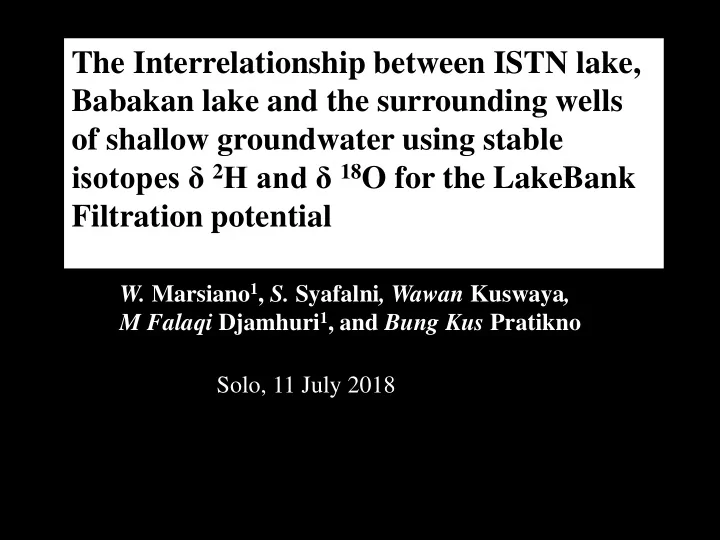
The Interrelationship between ISTN lake, Babakan lake and the surrounding wells of shallow groundwater using stable isotopes 2 H and 18 O for the LakeBank Filtration potential W. Marsiano 1 , S. Syafalni , Wawan Kuswaya , M Falaqi Djamhuri


slide-1
SLIDE 1
  • W. Marsiano1, S. Syafalni, Wawan Kuswaya,

M Falaqi Djamhuri1, and Bung Kus Pratikno

The Interrelationship between ISTN lake, Babakan lake and the surrounding wells

  • f shallow groundwater using stable

isotopes δ 2H and δ 18O for the LakeBank Filtration potential

Solo, 11 July 2018

slide-2
SLIDE 2
  • For a better understanding of the lakebank filtration process

in the shallow groundwater system, research was conducted around the ISTN lake and Babakan lake basin, with random sampling techniques for stable isotopes (δ18O and δ2H) analysis in conjunction with pH and TDS evaluations which can explain the interrelationship between the lakes water and the shallow groundwater around lakes

  • The objective of this research is to study the lakebank

filtration potential of shallow groundwater as a sustainable drinking water resource for urban and rural areas

7/17/2018 2

slide-3
SLIDE 3

D1 D2 D3 S1 S2 S3 R1 R2 R3 R4 R5 R7 R9 R10 R6 R8

Babakan Lake ISTN Lake

  • Fig. 1. Sampling locations for ISTN lake, Babakan lake and

surrounding shallow groundwater

slide-4
SLIDE 4
  • Fig. 2. Isotope exchange processes that modify the isotopic

composition of meteoric water[8]

slide-5
SLIDE 5

Table 1. Results of δ 18O and δ 2H & Water Quality Analysis for ISTN lake, Babakan lake and the shallow groundwater of the area surrounding ISTN and Babakan lakes

Sample Code Sampling Time pH EC (μS/cm) TDS (ppm) δ 2H ‰ δ18O ‰ D1 06-Jan-17 7.08 328 175

  • 47.0±2.0
  • 6.23±0.19

D2 06-Jan-17 7.10 330 173

  • 44.2±1.7
  • 6.16±0.20

D3 06-Jan-17 7.09 335 174

  • 42.7±1.2
  • 6.38±0.57

S1 29-Des-16 7.08 337 175

  • 36.6±0.8
  • 5.56±0.17

S2 29-Des-16 7.08 333 176

  • 37.4±0.2
  • 5.02±0.23

S3 29-Des-16 7.08 334 177

  • 39.8±2.7
  • 4.32±0.24

R1 29-Des-16 4.87 430 280

  • 43.7±1.1
  • 5.23±0.22

R2 29-Des-16 4.76 210 137

  • 40.4±0.5
  • 5.42±0.18

R3 29-Des-16 4.46 370 237

  • 37.4±0.8
  • 4.89±0.39

R4 29-Des-16 5.48 120 78

  • 43.6±1.6
  • 5.73±0.33

R5 29-Des-16 6.83 340 218

  • 40.2±2.2
  • 6.25±0.05

R6 06-Jan-17 6.01 410 267

  • 42.4±0.3
  • 7.25±0.20

R7 06-Jan-17 6.46 270 120

  • 48.9±0.7
  • 8.67±0.32

R8 06-Jan-17 7.02 90 59

  • 39.7±1.0
  • 7.11±012

R9 06-Jan-17 4.68 240 155

  • 41.4±1.9
  • 6.72±035

R10 06-Jan-17 4.74 200 128

  • 45.5±1.9
  • 7.18±030
slide-6
SLIDE 6

δH2 = 7.8δO18 + 13 δH2 = 2.016δO18 - 29.57 δH2 = 2.016δO18 - 21.4 δH2 = 2.016δO18 - 37.72

  • 70
  • 60
  • 50
  • 40
  • 30
  • 20
  • 10
  • 12
  • 10
  • 8
  • 6
  • 4
  • 2

δH2 ؉

δO18 ؉

LMWL Sampel upper lower Linear (LMWL) Linear (Sampel) Linear (upper) Linear (lower)

  • Fig. 3. Correlation δ2H and δ18O from water Samples of ISTN

lake, Babakan lake and the area surrounding shallow groundwater

  • f ISTN lake and Babakan lake
slide-7
SLIDE 7

Conclusions

  • 1. From the stable isotopes δ2H and δ18O show a favorable

relationship between the water of lakes and the water from the wells of the residents surrounding the lake. This clearly shows that the well water (shallow groundwater) of the area surrounding ISTN lake and Babakan lake is from the two lakes and so should be protected from environmental pollution.

  • 2. For water quality analysis indicated by TDS sampels which

have total dissolved solids in range of fresh water (less than 1000 ppm) and very good for drinking water criteria.

  • 3. And from pH evaluation of some samples, the well water

needs to be improved by doing advanced processing before consumption.