Space Debris and Collision Risk in the Orbital Commons Giacomo - - PowerPoint PPT Presentation

space debris and collision risk in the orbital commons
SMART_READER_LITE
LIVE PREVIEW

Space Debris and Collision Risk in the Orbital Commons Giacomo - - PowerPoint PPT Presentation

This paper The economics of orbit use Three results Discussion Space Debris and Collision Risk in the Orbital Commons Giacomo Rondina Akhil Rao UC San Diego CU Boulder This paper The economics of orbit use Three results Discussion


slide-1
SLIDE 1

This paper The economics of orbit use Three results Discussion
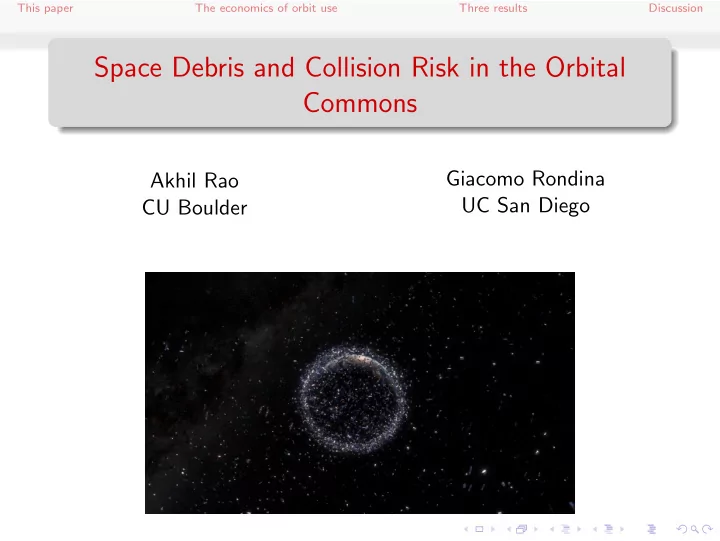
Space Debris and Collision Risk in the Orbital Commons

Akhil Rao CU Boulder Giacomo Rondina UC San Diego

slide-2
SLIDE 2

This paper The economics of orbit use Three results Discussion

Motivation

slide-3
SLIDE 3

This paper The economics of orbit use Three results Discussion

Research questions

slide-4
SLIDE 4

This paper The economics of orbit use Three results Discussion

What do we know?

slide-5
SLIDE 5

This paper The economics of orbit use Three results Discussion

Framework

Satellite and debris accumulation, St+1 = St(1 − L(St, Dt)) + Xt Dt+1 = Dt(1 − δ) + G(St, Dt) + µLXt Discrete time dynamic optimization: launch today if discounted stream of satellite returns starting tomorrow is larger than the launch cost Perfect competition, constant returns, immortality, and open access We compare open access to a sole owner of the entire fleet Kessler syndrome is occurring if κ(Dt) > 0, where κ(Dt) = −δDt + G(0, Dt)

slide-6
SLIDE 6

This paper The economics of orbit use Three results Discussion

A firm’s problem

Words Equilibrium condition

slide-7
SLIDE 7

This paper The economics of orbit use Three results Discussion

The fleet owner’s problem

Words Optimality condition

slide-8
SLIDE 8

This paper The economics of orbit use Three results Discussion

Open access and optimal incentives to reduce congestion

Open access firms respond to risk, but not optimally: they don’t internalize the risks their own satellites pose

slide-9
SLIDE 9

This paper The economics of orbit use Three results Discussion

Open access and optimal incentives to reduce congestion

Open access fleets are too large and not as valuable; higher debris stocks are costlier

slide-10
SLIDE 10

This paper The economics of orbit use Three results Discussion

Lower costs and Kessler syndrome under open access

Proposition 10 All else equal, sustained decreases in launch costs will eventually cause Kessler syndrome

slide-11
SLIDE 11

This paper The economics of orbit use Three results Discussion

Lower costs and Kessler syndrome under open access

Open access: Launch until risk = excess return Launch cost ↓ = ⇒ excess return ↑ = ⇒ eqm set shifts → Eqm set will eventually be pushed to Kessler region

slide-12
SLIDE 12

This paper The economics of orbit use Three results Discussion

Open access dynamics: instability

../images/decay_increase_1.png

slide-13
SLIDE 13

This paper The economics of orbit use Three results Discussion

Open access dynamics: instability

slide-14
SLIDE 14

This paper The economics of orbit use Three results Discussion

Orbit management is an economic problem

1 Launch rates and debris are endogenous

Modeling debris with exogenous launch is looking at the symptoms and ignoring the cause

2 Open access is an inefficient way to manage orbits

Not just debris, too many satellites

3 Congestion creates incentives to limit debris growth, but not

enough

Open access can cause Kessler syndrome in LEO

slide-15
SLIDE 15

This paper The economics of orbit use Three results Discussion

Thank you! email: akhil.rao@colorado.edu