Southern California in-situ observations NOAA CORC and upwelling - - PowerPoint PPT Presentation

southern california in situ observations
SMART_READER_LITE
LIVE PREVIEW

Southern California in-situ observations NOAA CORC and upwelling - - PowerPoint PPT Presentation

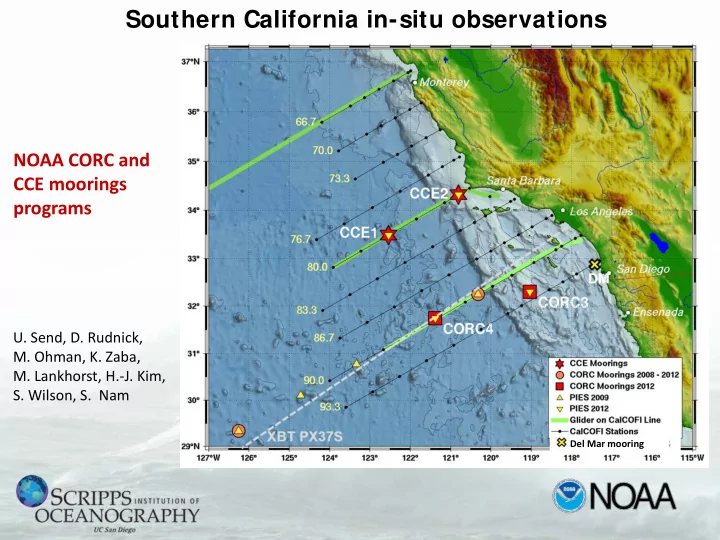
Southern California in-situ observations NOAA CORC and upwelling CCE moorings (CCE2) programs Core-CC current shelf (CCE1) (Del Mar) U. Send, D. Rudnick, M. Ohman, K. Zaba, M. Lankhorst, H.-J. Kim, S. Wilson, S. Nam Del Mar mooring


slide-1
SLIDE 1

Southern California in-situ observations

  • U. Send, D. Rudnick,
  • M. Ohman, K. Zaba,
  • M. Lankhorst, H.-J. Kim,
  • S. Wilson, S. Nam

Core-CC current (CCE1) upwelling (CCE2) shelf (Del Mar)

Del Mar mooring

NOAA CORC and CCE moorings programs

slide-2
SLIDE 2

Large-scale view from gliders (see also Zaba&Rudnick poster)

Anomalous warming starts beginning of 2014, over large region.

slide-3
SLIDE 3

Shallow/ surface-intensified in average over large area off So Cal

Line 66.7 Line 80 Line 90

slide-4
SLIDE 4

Warming trend in anomaly may already have started in prior years

slide-5
SLIDE 5

NCEP NAM model: high surface heat flux/ low wind stress since 2013

Suggests warming by anomalous surface heat flux and reduced upwelling

slide-6
SLIDE 6

Localized views from moorings:

SFU NO3 O2 15m anomalies at CCE2 mooring 0-30m T anomalies at Del Mar mooring

slide-7
SLIDE 7

The warm anomaly developed already during a cooling phase:

  • Higher surface heat fluxes ?
  • Reduced upwelling ?
  • Advection from offshore (downwelling) ?
  • I ncreased advection from south ?

the cooling requires upwelling

CCE2 layer-average T CCE2 0-30m average T anomaly

0-30m 10-50m 30-60m

slide-8
SLIDE 8

Moorings can measure the upwelling circulation

  • alongshore/cross-shore well defined
  • upper layer offshore for 6 months,

then relaxation-like poleward flow

  • deeper layers always poleward
  • Upper layer nearly always offshore flow

negligible downwelling, also not in 2014

  • Break in slope mid-year
  • 2014 had ongoing offshore flow
  • Similar at Del Mar mooring

CCE2 progressive vector diagram 2013

East-west displacement [km] North-south displacement [km]

slide-9
SLIDE 9

Cross-shelf shear is highly correlated with wind (2deg to the south)

2014 average of upwelling circulation was not anomalously low

CCE2 velocities in offshore direction

CCE2 shear correlation with wind stress

Negative alongshelf windstress 2⁰ to south upwelling shear

slide-10
SLIDE 10

NCEP NARR model along-shelf wind stress anomaly 1deg away from the coast more upwelling less upwelling

more upwelling less upwelling

Upwelling winds in NARR model not anomalously low (except north of Pt. Conception from summer 2014).

(confirmed by NDBC buoy south

  • f Pt. Conception)
slide-11
SLIDE 11

I ntegrated upper-layer poleward flow (displacement)

CCE2 progressive vector diagram 2013

East-west displacement [km] North-south displacement [km]

CCE2 cumulative poleward flow (18m depth)

Poleward displacement [km]

Poleward after end of upwelling season (seasonal relaxation).

Large anomalous upper- layer poleward flow in 2013, 2014, 2015

slide-12
SLIDE 12

Del Mar CCE2 CCE1 North-South water mass index shows more southern water in 2012/ 2013

slide-13
SLIDE 13

Jan’13 Jan’14 Northward advection WILL bring warmer

  • water. Note N/S

and E/W gradients which are lost in anomaly maps. CORC state estimate also shows long enough poleward flow off Baja California to reach Pt. Conception (B.Cornuelle/G. Gopalakrishnan) SST suggestive of northward flow before warming

slide-14
SLIDE 14

Recap and pressing questions:

  • Upwelling continues during anomalous warming phase (i.e. not warming by onshore flow)
  • Upwelling (overturning) circulation (and winds) apparently not weaker in 2014
  • Anomalous alongshore advection brings anomalous warm water into region (near the coast),

already in preceding years

  • Different starting conditions for upwelling season
  • Surface heat fluxes probably larger in 2014, but different models give different answers:

If surface heat flux forcing is atmospheric, how did poleward flow propagate/get generated ?

NCEP NAM model Colors: NCEP NARR model

Model net surface heat fluxes