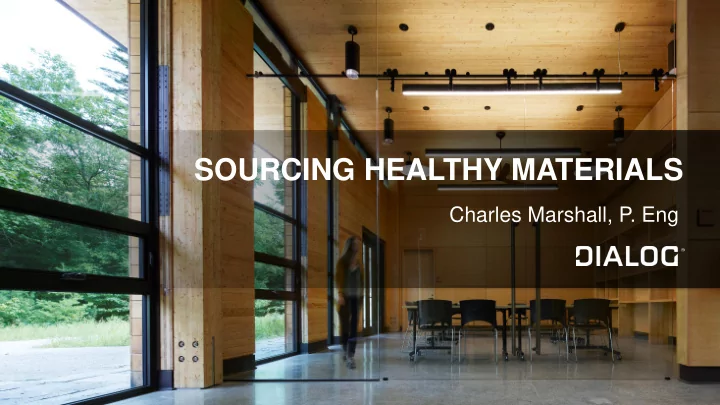
SLIDE 1
SOURCING HEALTHY MATERIALS
Charles Marshall, P. Eng
SLIDE 2
Our mission: To meaningfully improve the wellbeing of our communities and the environment we all share.
SLIDE 3
Selecting Materials: Consider the environmental impact of extraction, processing, and decommissioning Contribute to human healthy and quality of the indoor environment Make a positive social impact Create enduring design: attractive, durable, and cost effective
SLIDE 4
The Bill Fisch Forest Stewardship and Education Centre
SLIDE 5
SLIDE 6
SLIDE 7
The Living Building Challenge: Materials Requirements
Carbon neutral building Appropriate sourcing of local & indigenous materials Responsible sourcing: 100 % FSC certified wood Eliminate worst-in-class RED LIST materials with the greatest impact to human and ecosystem health
SLIDE 8 THE RED LIST:
- Asbestos
- Cadmium
- Chlorinated and Chlorosulfonated Polyethlene
- Chlorofluorocarbons (CFCs)
- Chloroprene (Neoprene)
- Formaldehyde (added)
- Halogenated Flame Retardants
- Hydrochlorofluorocarbons (HCFCs)
- Lead (added)
- Mercury
- Petrochemical Fertilizers and Pesticides
- Phthalates
- Polyvinyl Chloride (PVC)
- Wood treatments containing Creosote, Arsenic or Pentachlorophenol
THE RED LIST:
- Asbestos
- Cadmium
- Chlorinated and Chlorosulfonated Polyethlene
- Chlorofluorocarbons (CFCs)
- Chloroprene (Neoprene)
- Formaldehyde (added)
- Halogenated Flame Retardants
- Hydrochlorofluorocarbons (HCFCs)
- Lead (added)
- Mercury
- Petrochemical Fertilizers and Pesticides
- Phthalates
- Polyvinyl Chloride (PVC)
- Wood treatments containing Creosote, Arsenic or Pentachlorophenol
SLIDE 9
SLIDE 10
SLIDE 11
SLIDE 12
SLIDE 13
SLIDE 14
SLIDE 15
SLIDE 16
Working with our suppliers Explain: What we’re trying to do. What we need, exactly. How to find the information that we’re asking for. Why we’re asking for it.
SLIDE 17
What’s changed?? Transparency and disclosure: transitioning from ‘nice to have’ to ‘must have’ LEED v4: brought EPDs and HPDs to the mainstream Awareness and resources are growing.
SLIDE 18 Where to find information:
- 1. Talk to suppliers! Do your research
- 2. Take advantage of resources in the industry
SLIDE 19
SLIDE 20
SLIDE 21
SLIDE 22
SLIDE 23
What we’re doing: Be aware of the materials impact of our projects Research to keep informed and up-to-date Build capacity in our firm: understand the issues
SLIDE 24
What we’re doing: Clearly identify our selection criteria Use the resources that are available: databases, certifications, filing systems Choose designs, assemblies, and products that minimize damaging impacts and improve health and wellbeing
SLIDE 25
Thank You