Solid State Physics (Major, 8 ECTS) 1 physicist over 3 in US - - PowerPoint PPT Presentation

solid state physics major 8 ects
SMART_READER_LITE
LIVE PREVIEW

Solid State Physics (Major, 8 ECTS) 1 physicist over 3 in US - - PowerPoint PPT Presentation

Solid State Physics (Major, 8 ECTS) 1 physicist over 3 in US declares to be a condensed matter physicist (CMP) CMP: solids, amorphous materials, liquids, soft materials 20 CMP physics Nobel prizes + 5 in chemistry This course


slide-1
SLIDE 1

Solid State Physics (Major, 8 ECTS)

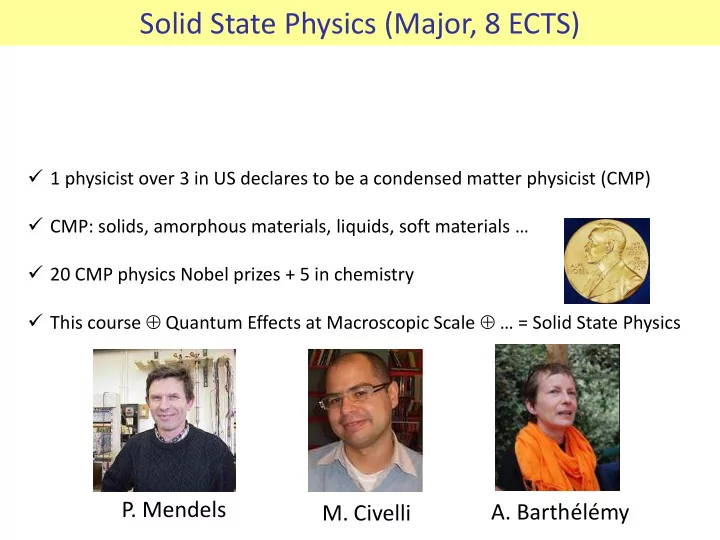
 1 physicist over 3 in US declares to be a condensed matter physicist (CMP)  CMP: solids, amorphous materials, liquids, soft materials …  20 CMP physics Nobel prizes + 5 in chemistry  This course ⊕ Quantum Effects at Macroscopic Scale ⊕ … = Solid State Physics

  • M. Civelli
  • A. Barthélémy
  • P. Mendels
slide-2
SLIDE 2

SSP: some milestones, electronic properties Transistor: electronic devices, nano-devices

slide-3
SLIDE 3

SSP: some milestones, electronic properties Superconductivity → SQUID, MRI, levitation

slide-4
SLIDE 4

Les supraconducteurs SSP: some milestones, electronic properties

slide-5
SLIDE 5

Step 1: periodic structures

Polonium CuO2 plane

slide-6
SLIDE 6

Step 2: From individual atoms to CMP… Energy bands…

Solide Atome

slide-7
SLIDE 7

Hamiltonian: let’s model!

slide-8
SLIDE 8

Exploring the k space: e- ↔ plane wave (k)

hv e-

φ

θ

Crystal

slide-9
SLIDE 9

Graphene

2010

slide-10
SLIDE 10

Transport properties

e-

slide-11
SLIDE 11

Philippe Mendels Fabrice Bert

Summary

Course prerequisites and corequisites: Fundamentals of Quantum Mechanics. Book : Quantum Mechanics by C. Cohen-Tannoudji, B. Diu,

  • F. Laloë (vol. I and II), Ed Wiley

Fundamentals of Statistical Physics. Book : Statistical Mechanics by K. Huang, Ed Wiley. Concepts

  • f Statistical Physics needed for this course can be easily learnt in parallel.

Contents: I Basic model of metals : the free electron gas I-5 Scanning tunneling microscope I-6 Quantization of levels in a magnetic field: quantum oscillations II Crystalline Solids II-1 Structures: crystal lattice and primitive unit cell II-4 Diffraction in practice: lab. X-rays, synchrotron and neutron facilities, electronic microscopy: from formulas to hands on experiments II-5 Beyond crystals: introduction to amorphous solids and soft matter III- Electronic structure of solids IV- Dynamics of electrons V- Electrons at the nanoscale V-1 Coulomb blockade V-2 Band tailoring: heterostructures VI- Semiconductors VI-1 General introduction: Silicium, Germanium, III-V and II-VI families VI-5 Towards applications: diode , LED, solar cells, …
slide-12
SLIDE 12

Philippe Mendels Fabrice Bert

Magnetism

Agnès Barthélémy

slide-13
SLIDE 13

From individual spins to magnets

slide-14
SLIDE 14

~ + 80%

I V ( Orsay, 1 9 8 8 , systèm e Fe/ Cr)

Giant magnetoresistance

2007

slide-15
SLIDE 15

Basics in magnetism : from atomic magnetism to collective magnetism Macroscopic properties : domains, walls, magnets Spintronics, magnetic recording

Magnetism

slide-16
SLIDE 16

Fundamental concepts in physics: condensed matter physics quantum physics Nanoscience : nanophysics nanodevices

M2 openings

slide-17
SLIDE 17

PHY564B Nanomaterials and electronic applications (Minor, 4ECTS) This module introduces recent developments in the field of silicon- and carbon-based semiconducting nanomaterials, as well as their principal electronic applications.

The following subjects are addressed:

  • Disordered semiconductors: amorphous, nano- and polycrystalline silicon
  • Silicon nanowires, carbon nanotubes, graphene: structure and synthesis
  • Characterization techniques for nanomaterials: near-field spectroscopies, etc.
  • Electronic applications: photovoltaics, flat panel displays, transistors, sensors, etc.

Requirements : Fundamentals of quantum and statistical physics Si nanowires graphene structure nanowire transistor

contact: razvigor.ossikovski@polytechnique.edu

slide-18
SLIDE 18

Quantum Effects at Macroscopic Scale (Minor, 6 ECTS)

  • P. Simon & M. Ferrier

1st part : Quantum information and quantum computing

  • 2 Quantum communication and quantum computing
  • 1 Quantum systems with a small number of degrees of freedom
  • A qubit, contrary to a bit is

continuous valued, describable by a direction on the Bloch sphere  quantum superposition of states

  • Quantum teleportation
  • EPR paradox and Bell inequalities
  • qubits, computing and decoherence

Spins in a magnetic field  NMR

slide-19
SLIDE 19

Quantum Effects at Macroscopic Scale (Minor, 6 ECTS)

1st part : Superconductivity, superfluids and condensate

  • 1 Bose-Einstein Condensation and superfluidity
  • 2 Superconductivity : macroscopic aspects, microscopic theory, and thermodynamics

Bose-Einstein Condensation in a Rb gas observed in Boulder by Cornell &Wiemann Fountain effect: consequence of the superfluidity of Helium-4

slide-20
SLIDE 20

So# ¡Condensed ¡Ma,er ¡

slide-21
SLIDE 21

Whar ¡is ¡so# ¡ma,er ¡

20

slide-22
SLIDE 22

Whar ¡is ¡so# ¡ma,er ¡

20

SM ¡Scale ¡

slide-23
SLIDE 23

A ¡lot ¡of ¡stuff ¡we ¡are ¡familiar ¡with… ¡

slide-24
SLIDE 24
slide-25
SLIDE 25

Microscopic ¡ Descrip=on ¡ Macroscopic ¡ Descrip=on ¡

slide-26
SLIDE 26

Microscopic ¡ Descrip=on ¡ Macroscopic ¡ Descrip=on ¡

Sta=s=cal ¡Mechanics ¡

slide-27
SLIDE 27

Microscopic ¡ Descrip=on ¡ Macroscopic ¡ Descrip=on ¡

Sta=s=cal ¡Mechanics ¡

slide-28
SLIDE 28

Lucasian ¡Chair ¡of ¡Mathema=cs ¡

Isaac ¡Newton ¡ 1669 ¡ 33 ¡Years ¡ Mathema=cs ¡ ¡ And ¡Physics ¡ Paul ¡Dirac ¡ 1932 ¡ 37 ¡Years ¡ Physics ¡ Stephen ¡Hawking ¡ 1979 ¡ 30 ¡Years ¡ Physics ¡

slide-29
SLIDE 29

New ¡Lucasian ¡Chair ¡of ¡Mathema=cs ¡

Mike ¡Cates ¡ 2015 ¡ ¡ Sta=s=cal ¡Mechanics ¡and ¡So# ¡Condensed ¡ Ma,er ¡ “The ¡field ¡of ¡so# ¡ma,er ¡is ¡highly ¡ interdisciplinary, ¡bringing ¡together ¡methods ¡ from ¡areas ¡such ¡as ¡elas=city, ¡fluid ¡mechanics, ¡ sta=s=cal ¡mechanics, ¡and ¡computa=onal ¡

  • science. ¡ ¡In ¡recent ¡years ¡it ¡has ¡expanded ¡to ¡

address ¡many ¡problems ¡in ¡biology, ¡including ¡ the ¡proper=es ¡of ¡cellular ¡cytoskeletons ¡and ¡ collec=ve ¡behaviour ¡of ¡mo=le ¡cells” ¡ ¡ ¡

slide-30
SLIDE 30

This ¡so# ¡ma,er! ¡ ¡

Computer ¡simula.on ¡ Experiment ¡ Theory ¡

FUNDAMENTAL ¡SCIENCE ¡ APPLICATIONS ¡