Solar Air-Conditioning Systems in small - medium scale applications - - PowerPoint PPT Presentation

solar air conditioning systems
SMART_READER_LITE
LIVE PREVIEW

Solar Air-Conditioning Systems in small - medium scale applications - - PowerPoint PPT Presentation

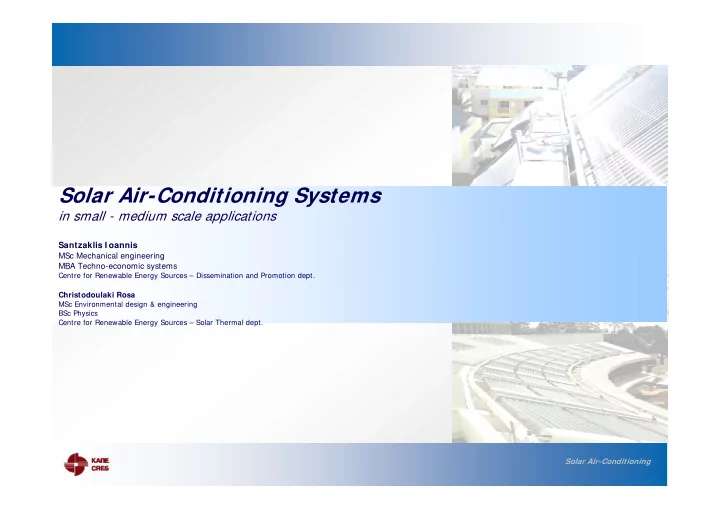
Solar Air-Conditioning Systems in small - medium scale applications Santzaklis I oannis MSc Mechanical engineering MBA Techno-economic systems Centre for Renewable Energy Sources Dissemination and Promotion dept. Christodoulaki Rosa MSc


slide-1
SLIDE 1

Solar Air-Conditioning

Solar Air-Conditioning Systems

in small - medium scale applications

Santzaklis I oannis

MSc Mechanical engineering MBA Techno-economic systems

Centre for Renewable Energy Sources – Dissemination and Promotion dept. Christodoulaki Rosa MSc Environmental design & engineering BSc Physics Centre for Renewable Energy Sources – Solar Thermal dept.

slide-2
SLIDE 2

Solar Air-Conditioning

The problem

  • Ozone layer depletion

CO2 higher now than in last 400,000 years CO2 emissions are expected to increase 20-fold from 1990 to 2010, only in the EU

  • IPCC predicts temperature rise of 1.5 - 5.8 degrees

Humans: 150,000 deaths directly attributable to climate change in 2000 Climatic zones shifting 7 times quicker than plants can follow

  • New directives on air quality

2008/50/EC, ‘Ambient air quality and cleaner air for Europe’ 2008/1/EC, ‘Integrated pollution prevention and control’

  • Inefficient conventional a/c units
  • VCS operate at a temperature colder than the supply air

dew-point temperature, so the air is overcooled and needs reheating before entering indoors

  • Energy consumption in commercial and residential

buildings: 40% of Europe’s energy bill

  • Global increase in air-conditioning demand
slide-3
SLIDE 3

Solar Air-Conditioning

  • Higher living / working standards
  • Adverse outdoor conditions in urban environments
  • Reduced prices of air-conditioning units
  • Installed a/c has increased 5-fold in the last 20 years in Europe
  • Total a/c floor space: 30 million m2 in 1980, over 150 million m2 in 2000.
  • Annual energy use of room a/c was 6 TJ in 1990, estimated 160 TJ in 2010.

Global sales of air conditioning units, 2000-2008 (Millions)

Total Australia Africa

  • S. America
  • N. America
  • M. East

Europe Asia 68.654 65.663 62.970 60.422 58.147 54.379 46.840 44.834 41.874 963 913 868 825 815 712 671 593 512 978 944 915 885 850 814 700 758 664 2.592 2.530 2.473 2.418 2.331 2.243 2.036 1.939 2.109 12.905 12.897 12.889 12.881 12.876 13.075 12.910 11.894 12.322 6.118 5.694 5.382 5.087 4.799 4.359 3.412 2.918 2.907 2.717 2.660 2.604 2.515 2.366 2.218 1.804 1.730 1.673 34.881 32.524 30.340 28.312 26.430 23.650 17.761 16.637 13.897 7.500 7.500 7.500 7.500 7.679 7.307 7.546 8.367 7.791 Japan 2008 2007 2006 2005 2004 2003 2002 2001 2000

JRAIA (Japan Refrigeration and Air Conditioning Industry Association)

We need an a/ c system that controls temperature and provides air of high quality, with high efficiency and low CO2 emissions!

slide-4
SLIDE 4

Solar Air-Conditioning

  • Radiation supply from sun carries a 5

billion year guarantee

  • Annually, the sun provides 1.5* 1018

kWh, that is more than 10,000 times

the energy that human race needs.

The solution : Solar-driven air-conditioning

Source: Planning & Installing Solar Thermal Systems: A guide for installers, architects & engineers, EarthScan publications

slide-5
SLIDE 5

Solar Air-Conditioning 200 400 600 800 1000 1200

J a n u a r F e b r u a r M ä r z A p r i l M a i J u n i J u l i A u g u s t S e p t e m b e r O k t

  • b

e r N

  • v

e m b e r D e z e m b e r

10 30 50 70 90 110 130 150 170 190

Jan Feb March April May June Jul Aug Sept Oct Nov Dec

W/m²

kW

Cooling loads Cooling Cooling loads loads Radiation Radiation Radiation Heating loads Heating Heating loads loads 1000 W/m2 700 W/m2 Solar radiation is in tune with air conditioning demand

Source : TECSOL for SOLAIR project

slide-6
SLIDE 6

Solar Air-Conditioning

Μηνιαία Άμεση και Διάχυτη Ακτινοβολία (Αθήνα)

50 100 150 200 250 Ιαν Φεβ Μαρ Απρ Μάι Ιουν Ιουλ Αυγ Σεπ Οκτ Νοε Δεκ kWh/m² Άμεση Ακτινοβολία Διάχυτη Ακτινοβολία

Όλική Ημερίσια Οριζόντια Ακτρινοβολία (Αθήνα)

100 200 300 400 500 600 700 800 900 0:00 2:24 4:48 7:12 9:36 12:00 14:24 16:48 19:12 21:36 W/m²

Δεκέμβριος (0°) Μάρτιος (0°) Ιούνιος (0°) Δεκέμβριος (31°) Μάρτιος (31°) Ιούνιος (31°) Δεκέμβριος (60°) Μάρτιος (60°) Ιούνιος (60°)

  • Annual solar irradiance (sum of

direct and diffuse) in Greece is approximately 1,600 kWh/ m2.

  • This amount of energy,

corresponds to 160 lt oil.

  • Daily solar irradiance for 3

representative dates (in winter, summer and spring) is shown in the next diagram.

  • The area that receives the biggest

amount of radiation has an inclination of 600 in December and 00 in June.

Source : CRES, PVGIS

slide-7
SLIDE 7

Solar Air-Conditioning

RESULTS OF INCIDENT RADIATION ON COLLECTORS (FROM TSOL) Place: Athens Azimuth: G Inclined, Specific[kWh/m²] acording to collectors inclination (in degrees °) From: To: 10 20 25 30 35 40 45 50 55 60 65 70 75 80 85 90 1/ 1/ 1/ 2/ 66 80 91 96 100 104 107 109 111 112 113 112 111 109 107 104 100 1/ 2/ 1/ 3/ 75 84 91 93 96 97 99 99 99 99 98 96 94 91 88 84 80 1/ 3/ 1/ 4/ 104 112 116 118 119 119 119 118 116 114 111 108 104 99 94 89 83 1/ 4/ 1/ 5/ 146 151 152 152 151 149 147 143 139 134 129 123 116 108 101 92 84 1/ 5/ 1/ 6/ 182 183 181 178 175 170 165 159 153 145 137 128 119 109 100 90 79 1/ 6/ 1/ 7/ 200 200 195 191 185 180 173 166 158 149 139 128 118 108 96 85 75 1/ 7/ 1/ 8/ 213 214 210 205 199 194 187 180 171 162 151 139 128 117 105 91 80 1/ 8/ 1/ 9/ 200 206 206 204 202 199 194 188 182 174 165 155 144 132 121 109 96 1/ 9/ 1/10/ 156 168 176 179 180 181 180 178 175 171 166 161 154 146 138 128 118 1/10/ 1/11/ 106 120 130 134 138 140 142 143 142 142 140 137 134 130 125 119 113 1/11/ 1/12/ 66 77 86 90 94 96 99 100 101 102 102 101 99 97 95 92 88 1/12/ 1/ 1/ 53 63 72 76 79 82 85 87 88 89 89 89 88 87 85 83 80 Sum YEAR 1567 1658 1706 1716 1718 1711 1697 1670 1635 1593 1540 1477 1409 1334 1252 1165 1075 hotels season:1/4 to 1/11 1203 1242 1250 1243 1230 1213 1188 1157 1120 1077 1027 971 913 850 784 714 645 heating season: 1/11 to 1/4 364 416 456 473 488 498 509 513 515 516 513 506 496 484 468 450 430 "winter": 1/12 to 1/3 194 227 254 265 275 283 291 295 298 300 300 297 293 287 280 270 260

Optimum collector angle: depends on the geographical location and the system’s type of use.

  • Winter use: geographical latitude of area + 150
  • Summer use: geographical latitude of area - 150
  • Annual use: collector angle = geographical latitude

Source : T-SOL

slide-8
SLIDE 8

Solar Air-Conditioning

Energy yield Optimum angle: 1700-1800 kWh/m2 Horizontal surface: 1300-1400 kWh/m2

Source : PVGIS

slide-9
SLIDE 9

Solar Air-Conditioning

Properties

  • Middle cost: more expensive than

unglazed, but cheaper than vacuum

  • Higher operation temperature
  • Thermal insulation on back & edges
  • Fragile, heavier: 20-32 kg/m2
  • Absorber: black paint or spectral-

selective coating (black chrome, black nickel, blue titanium)

  • Spectral-selective coating: conversion of

short-wave solar radiation into heat (light absorption capacity) is optimized, while thermal emissions are kept low. Absorption rate: 90-95%, emission rate 5-15%

  • Stagnation temperature: 160-2000C

Applications

  • Space heating
  • Solar air conditioning (selective coating)

Standard flat plate collectors

Planning & Installing Solar Thermal Systems: A guide for installers, architects & engineers, EarthScan publications

slide-10
SLIDE 10

Solar Air-Conditioning

Properties

  • High cost
  • Minimal convection thermal losses (tube pressure < 10-5

bar)

  • Low radiation losses
  • High efficiency, even with low radiation
  • Low weight
  • Average annual efficiency 45-50% (with 1000kWh/m2

irradiation, the energy yield is 450-500kWh/m2a

  • Stagnation temperature: 200-3500C

Applications

  • Solar air conditioning
  • Industrial applications (steam generation)

Vacuum collectors

Planning & Installing Solar Thermal Systems: A guide for installers, architects & engineers, EarthScan publications

slide-11
SLIDE 11

Solar Air-Conditioning Cross section of heat pipe wet connection

Cross section of heat pipe dry connection

Vacuum types

  • Direct-flow: Internal U-tube, South-
  • riented.

Concentrated: Double tube (external

tube: absorber surface, internal tube: U- type), 2 external reflector surfaces

  • Heat-pipe:

Horizontal absorber area placed inside a vacuum tube. The tube is connected to an evacuated heat pipe with a solution inside. The solution evaporates (Τevaporation=250C) and its heat is transferred through a heat exchanger in the medium. Dry connection: the heat transfer takes

place from the condenser via the tube wall to the medium, so defective tubes are replaced without emptying the solar circuit)

Wet connection: the condenser is

immersed in the medium, so defective tubes are replaced by emptying the solar circuit.

Flow External glass tube Internal glass tube Metallic wafer for heat transfer Return Reflector Vacuum area Concentrated vacuum collector

Planning & Installing Solar Thermal Systems: A guide for installers, architects & engineers, EarthScan publications

slide-12
SLIDE 12

Solar Air-Conditioning

Solar a/c, industry Hot water, space heating, solar a/c Pool heating, Hot water Pool heating

Application

850 Vacuum 700 Flat plate (selective coating) 650 Flat plate (black paint) 300 Unglazed

Performance (kWh/ m² a) Collector type Collectors comparison

slide-13
SLIDE 13

Solar Air-Conditioning

Vacuum Flat plate

Performance

Temperature difference collector - environment

DHW & space heating Pool heating Industrial applications Unglazed

Planning & Installing Solar Thermal Systems: A guide for installers, architects & engineers, EarthScan publications

slide-14
SLIDE 14

Solar Air-Conditioning

Solar-driven air-conditioning systems Characteristics

 Air conditioning load in tune with the solar radiation  Solar systems can be integrated in existing air-conditioning units (fan coils, floor heating systems)  Small scale solar a/c systems: under research  Small scale chillers (<30kW): High initial cost, 2,000 €/kW.

Systems

  • Open cycle DEC

Production of air conditioned air Dehumidification and evaporative cooling

  • Closed cycle

Production of chilled water for space cooling through fan coil, chilled ceiling, floor heating Absorption (liquid) Adsorption (solid)

slide-15
SLIDE 15

Solar Air-Conditioning

Source : EU Altener Project Climasol

slide-16
SLIDE 16

Solar Air-Conditioning

Initial cost – Collector area needed, 2007. Open systems Liquid DEC: 4500 €/kW, 5 m2/kW Solid DEC: 3500 €/kW, 0.5 m2/kW Closed systems Absorption: 2000 €/kW, 4 m2/kW Adsorption: 5500 €/kW, 2.5 m2/kW Efficiency – Operational temperature, 2007 Open systems Liquid DEC: Τ = 60C, COP = 0.7 Solid DEC: T = 80C, COP = 0.5 Closed systems Absorption: Τ = 75C, COP = 0.7 Adsorption: T = 55C, COP = 0.5

Source : CA Balaras, G Grossman, HM Henning, Solar Air-Conditioning in Europe - an overview, Renewable Energy & Sustainable Energy Reviews, 11, 2007, 299-314

slide-17
SLIDE 17

Solar Air-Conditioning 58.8% 11.8% 23.5% 4.4% 57.9% 26.3% 14.1% 1.5% 57.8% 32.7% 8.7% 0.6%

0.0% 10.0% 20.0% 30.0% 40.0% 50.0% 60.0% 70.0% absorption adsorption desiccant, rotor desiccant, liquid collector area cooling capacity number of systems

Solar Cooling Systems installed in Europe

  • Absorption: 58%
  • Solid DEC: 23%
  • Adsorption: 12%
  • Liquid DEC: 4%

Source : HM Henning, Solar Assisted air conditioning of buildings – an overview, Applied Thermal Engineering, 27, 2007, 1734-1749.

slide-18
SLIDE 18

Solar Air-Conditioning

PENA, Lavrio Solar cooling Solid DEC system Demo & research application for CRES

water-glycol Collector fluid 84m² Air conditioned area 2007 In operation since Klingenburg Brand of desiccant unit solid LiCl Desiccant cooling system 373 m3/h

  • Min. air volume flow rate

1100 m3/h Nominal air flow rate 60°C Operation temperature 10 m2, Calpak flat-plate Collector type

CRES, demo project, Lavrio, Athens

Source : CRES

slide-19
SLIDE 19

Solar Air-Conditioning

Solar cooling of a production site for cosmetics

  • In operation since 1999
  • One of the largest

installations in the world

  • 2,700 m2 flat plate

collectors (SOLE)

  • 2 adsorption cooling

machines, with 350 kW cooling power each

  • 3 compression cooling

machines with 350 kW air cooling and fan-coils

  • Concept: economisation of

electricity (Power and Work)

Installations- kosten 20% Regelung, Monitoring 5% Solarkollektoren 28% sonstiges 6% Unterbau für Kollektoren 5% Adsorptions- kältemaschinen 20% Öl befeuerte Kessel als Back-Up 10% Rückkühlwerke 6%

Cost Others 6% I nstallation Costs 20% Solar collectors 28% control Monitoring 5% Cooling tower 6% Sub-structure for collectors 5% Adsorption cooling machine 20% Oil-driven boiler as back-up 10%

SARANTIS, Industry, Inofita Viotias

Source : CRES

slide-20
SLIDE 20

Solar Air-Conditioning

In operation since 20/08/00 Solar air-conditioning system, fan coils Air-conditioned area 1000 m2 450m2 flat plate collectors (SOLE)

Absorption chiller LiBr, 105 kWc

Performance: COPthermal = 0.6, COPelectrical= 0.52 Initial cost: 146,000 € (2000) Annual electrical energy savings: 70,000 kWh (7,000€) Annual oil savings: 20,000 lt (8,000€) Payback in 10 years, without incentives. 870,000 kg less CO2 annually

Rethimno Village Hotel, Crete

Source : SOLE

slide-21
SLIDE 21

Solar Air-Conditioning

  • Solar Cooling is not yet widespread in Greece
  • 8% of the solar thermal market
  • lack of real incentives
  • However, there is large growth potential, because
  • only 25% of the buildings are equipped with a solar

thermal system (> 90% of the owners are satisfied)

  • steady increase in demand for a/c units

Law modernization

solar cooling system project study compulsory for every large building

Financial incentives

to cover part of investment & construction costs

Conclusions

slide-22
SLIDE 22

Solar Air-Conditioning

. Thank you for your attention!

Centre for Renewable Energy Sources Dissemination & Promotion Department Solar Thermal Department

  • 19klm. Marathonos av., 19009, Pikermi
  • tel. 00302106603300, fax. 00302106603301

www.cres.gr

  • I. Santzaklis

iisant@cres.gr