Soil with water 25/09/2009 Lecture: 23 Sub-topics Seepage forces - - PowerPoint PPT Presentation

soil with water
SMART_READER_LITE
LIVE PREVIEW

Soil with water 25/09/2009 Lecture: 23 Sub-topics Seepage forces - - PowerPoint PPT Presentation

IIT Bombay Soil with water 25/09/2009 Lecture: 23 Sub-topics Seepage forces & Quick sand conditions Ground failure due to soil liquefaction in 1964 Niigata earthquake, Japan CE 303 23 Instructor: AJ IIT Bombay Seepage forces

slide-1
SLIDE 1

IIT Bombay

CE 303 23 Instructor: AJ

25/09/2009 Lecture: 23

Soil with water Sub-topics Seepage forces & Quick sand conditions

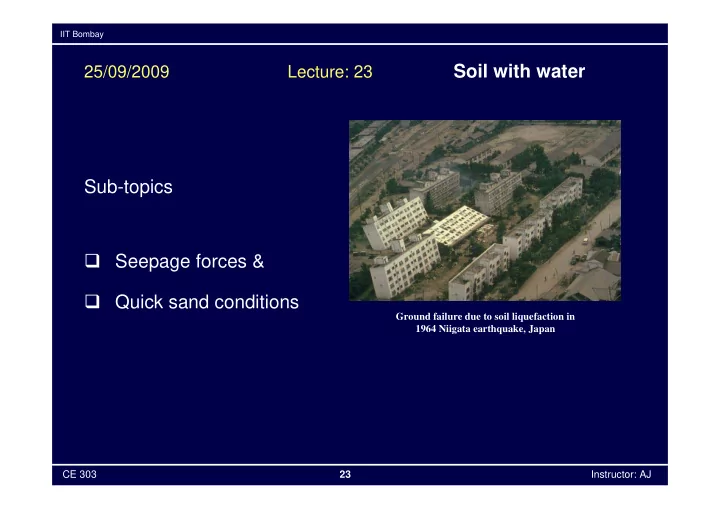
Ground failure due to soil liquefaction in 1964 Niigata earthquake, Japan

slide-2
SLIDE 2

IIT Bombay

CE 303 23 Instructor: AJ

Seepage forces

Water flow exerts drag force called “seepage force” on soil grains Force act in direction of flow cause change in PWP and σ’ Flow conditions :

inflow

  • utflow

(2)

No flow condition [hydrostatic case] Downward flow Upward flow

  • verflow
  • verflow

inflow (3) (1) valve closed

Constant water level maintained in the tank

slide-3
SLIDE 3

IIT Bombay

CE 303 23 Instructor: AJ

No flow condition

Water level at top, bottom and at any intermediate position of soil layer is the same (why?) no VERTICAL flow takes place when water level in the standpipe is the same at all depths

Variation of σ, u, and σ’ for “no flow” condition

valve closed

σ u σ’

H1γw H1γw + zγsat H1γw + Hγsat

H1 z H

(H1+z)γw (H1+H)γw z(γsat - γw) H(γsat - γw)

slide-4
SLIDE 4

IIT Bombay

CE 303 23 Instructor: AJ

Flow occurs under hydraulic gradient H h flow

  • f

length loss head i = = ∴ h = (Total head at A – Total head at B)

  • r h = (H + H1) – Total head at B
  • r Total head at B = (H + H1) – h

Elevation head at B = 0 (B is taken as datum); ∴ pressure head at B = (H + H1) – h

Total head difference between A and B = h

Downward flow

inflow

  • utflow

H1 H A B h

slide-5
SLIDE 5

IIT Bombay

CE 303 23 Instructor: AJ

  • utflow

inflow

H1 H A B h

Stress distribution for downward flow condition

σ u σ’

w 1 A

H γ = σ Pore water pressure

w 1 A

H u γ =

Recall PWP = Pressure head x unit weight of water

sat w 1 B

H H γ + γ = σ

( )

[ ] w

1 B

h H H u γ − + = Total stress At A: Effective stress At B:

( ) ( )

[ ] w

1 sat w 1 ' B

h H H H H γ − + − γ + γ = σ

w ' ' B

h H γ + γ = σ ⇒

( )

uA

A '

= − σ = σ z ?

[ ] w

z

iz z H1 u γ − + =

slide-6
SLIDE 6

IIT Bombay

CE 303 23 Instructor: AJ

A B

inflow

  • utflow

H1 H h

Compare σ’B for no flow and downward flow conditions

' ' B

Hγ = σ No flow

valve closed

B A Downward flow

w ' ' B

h H γ + γ = σ

seepage pressure act in direction of flow

Increase in σ’ at any point at depth z below surface is

w

izγ (= seepage pressure in general)

slide-7
SLIDE 7

IIT Bombay

CE 303 23 Instructor: AJ

w w w

iH H H h

  • r

h γ = γ γ Effective stress is increased by

w w

iH

  • r

h γ γ is referred to as seepage pressure

slide-8
SLIDE 8

IIT Bombay

CE 303 23 Instructor: AJ

Upward flow

H h flow

  • f

length loss head i = = Flow occurs under hydraulic gradient

  • verflow
  • verflow

inflow

A B h H1 H ∴ h = (Total head at B – Total head at A)

  • r h = Total head at B - (H + H1)
  • r Total head at B = (H + H1) + h

Elevation head at B = 0 (B is taken as datum); ∴ pressure head at B = (H + H1) + h

Total head difference between A and B = h

slide-9
SLIDE 9

IIT Bombay

CE 303 23 Instructor: AJ

Stress distribution for upward flow condition

  • verflow
  • verflow

inflow

A B h H1 H

σ u σ’

z ?

[ ] w

z

iz z H1 u γ

+

+ =

w 1 A

H γ = σ

sat w 1 B

H H γ + γ = σ At A: At B: Total stress

w 1 A

H u γ =

( )

[ ] w

1 B

h H H u γ + + = Pore water pressure Effective stress

( ) ( )

[ ] w

1 sat w 1 ' B

h H H H H γ + + − γ + γ = σ

w ' ' B

h H γ − γ = σ ⇒

w ' ' B

iH H γ − γ = σ ⇒

( )

u A

A '

= − σ = σA

slide-10
SLIDE 10

IIT Bombay

CE 303 23 Instructor: AJ

Stress distribution for upward flow condition

Effective stress is decreased by

w

iHγ

slide-11
SLIDE 11

IIT Bombay

CE 303 23 Instructor: AJ

Quick sand condition

http://picasaweb.google.com/melaniejbonk

w ' ' B

iH H γ − γ = σ

  • verflow
  • verflow

inflow

A B h H1 H During upward flow, seepage pressure can sometimes be very high can result in effective stress = 0 σ’B = 0 if

w '

iH H γ = γ

  • r when

w '

i γ γ = This hydraulic gradient is called critical hydraulic gradient icr

slide-12
SLIDE 12

IIT Bombay

CE 303 23 Instructor: AJ

Soil (mainly sand) loses all shear strength and cannot support load Soil becomes “quick” or “alive” and boiling occurs Popular name for this phenomenon is quicksand Quicksand is not a type of sand but only a hydraulic condition As long as i < icr, only part of head loss is used in friction Contrary to popular belief, it is not possible to drown in quicksand !!

Quick sand condition

slide-13
SLIDE 13

IIT Bombay

CE 303 23 Instructor: AJ

( )

e 1 1 G

w s '

+ γ − = γ ∴ Critical hydraulic gradient

( )

e 1 1 G i

s cr

+ − = Recall : buoyant unit weight More on critical hydraulic gradient….. Typical values of icr (e.g. assume Gs = 2.65)

0.84 Loose 1.0 0.96 Medium 0.75 1.12 Dense 0.5 icr Approximate relative density Void ratio

icr ~ 1 is a relatively easy number to remember

slide-14
SLIDE 14

IIT Bombay

CE 303 23 Instructor: AJ

Quick conditions for clays? YES – In very sensitive clays quick conditions can occur Other e.g:

  • 1. Excavations below water table excavate first and then pump out

water (NOT GOOD) or first pump out water and then excavation (BETTER)

  • 1. Confined aquifer in an artesian pressure condition

γsat

y z clay sand

slide-15
SLIDE 15

IIT Bombay

CE 303 23 Instructor: AJ

Soil liquefaction

slide-16
SLIDE 16

IIT Bombay

CE 303 23 Instructor: AJ

Loose saturated sand subjected to large loads within short duration (e.g. earthquakes, pile driving, and blasting) Loose sand densifies; this tends to squeeze water out of the pores Under static loading, sand has sufficient permeability so water can escape and induced PWP dissipates For loads induced in short duration, water does not have time to escape and PWP increase σ’ tend to zero and the soil loses all strength

Soil liquefaction

slide-17
SLIDE 17

IIT Bombay

CE 303 23 Instructor: AJ

Soil liquefaction

slide-18
SLIDE 18

IIT Bombay

CE 303 23 Instructor: AJ

Image courtesy NASA/GSFC/LaRC/JPL