Software are reviewed: Optimization Visualization Testing - - PDF document

software
SMART_READER_LITE
LIVE PREVIEW

Software are reviewed: Optimization Visualization Testing - - PDF document

Visualizations for Software Engineering Visualizations for the following engineering tasks Software are reviewed: Optimization Visualization Testing Monitoring deployed software Common themes Wesley Coelho Overview +


slide-1
SLIDE 1

1

Software Visualization

Wesley Coelho

CPSC 533C March 29, 2004

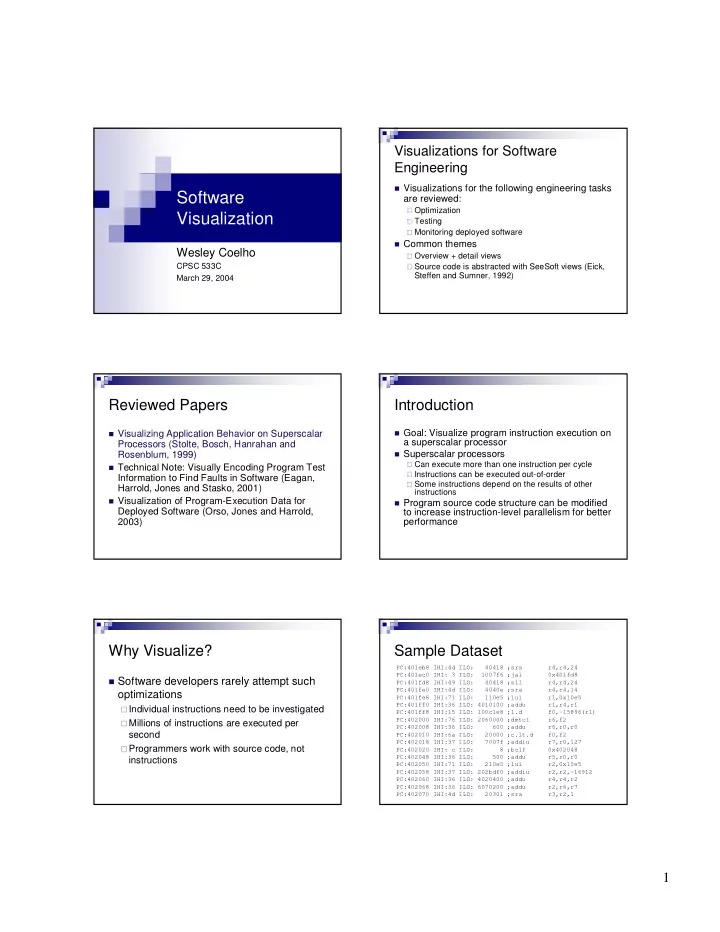
Visualizations for Software Engineering

Visualizations for the following engineering tasks

are reviewed:

Optimization Testing Monitoring deployed software

Common themes

Overview + detail views Source code is abstracted with SeeSoft views (Eick,

Steffen and Sumner, 1992)

Reviewed Papers

Visualizing Application Behavior on Superscalar

Processors (Stolte, Bosch, Hanrahan and Rosenblum, 1999)

Technical Note: Visually Encoding Program Test

Information to Find Faults in Software (Eagan, Harrold, Jones and Stasko, 2001)

Visualization of Program-Execution Data for

Deployed Software (Orso, Jones and Harrold, 2003)

Introduction

Goal: Visualize program instruction execution on

a superscalar processor

Superscalar processors

Can execute more than one instruction per cycle Instructions can be executed out-of-order Some instructions depend on the results of other

instructions

Program source code structure can be modified

to increase instruction-level parallelism for better performance

Why Visualize?

Software developers rarely attempt such

  • ptimizations

Individual instructions need to be investigated Millions of instructions are executed per

second

Programmers work with source code, not

instructions

Sample Dataset

PC:401eb8 IHI:4d ILO: 40418 ;sra r4,r4,24 PC:401ec0 IHI: 3 ILO: 1007f6 ;jal 0x401fd8 PC:401fd8 IHI:49 ILO: 40418 ;sll r4,r4,24 PC:401fe0 IHI:4d ILO: 4040e ;sra r4,r4,14 PC:401fe8 IHI:71 ILO: 110e5 ;lui r1,0x10e5 PC:401ff0 IHI:36 ILO: 4010100 ;addu r1,r4,r1 PC:401ff8 IHI:15 ILO: 100c1e8 ;l.d f0,-15896(r1) PC:402000 IHI:76 ILO: 2060000 ;dmtc1 r6,f2 PC:402008 IHI:36 ILO: 600 ;addu r6,r0,r0 PC:402010 IHI:6a ILO: 20000 ;c.lt.d f0,f2 PC:402018 IHI:37 ILO: 7007f ;addiu r7,r0,127 PC:402020 IHI: c ILO: 8 ;bc1f 0x402048 PC:402048 IHI:36 ILO: 500 ;addu r5,r0,r0 PC:402050 IHI:71 ILO: 210e5 ;lui r2,0x10e5 PC:402058 IHI:37 ILO: 202bdf0 ;addiu r2,r2,-16912 PC:402060 IHI:36 ILO: 4020400 ;addu r4,r4,r2 PC:402068 IHI:36 ILO: 6070200 ;addu r2,r6,r7 PC:402070 IHI:4d ILO: 20301 ;sra r3,r2,1

slide-2
SLIDE 2

2

Visualization Approach

Overview + Detail display based on three views

Timeline View

Overview of application’s execution Used to find problems

Pipeline View

Detailed view of instructions in the pipeline at a particular cycle Used to identify a problem

Source Code View

Relates overview and detail views to lines of source code

Timeline View Pipeline View Source Code View Paper Critique

  • Strengths

These techniques are general enough for use in other applications:

Compiler and hardware design, assembly lines, graphics pipelines

Animation could be very useful for understanding pipeline behaviour Intuitive use of visual cues in timeline view Self contained – accessible background information about superscalar

processors is included

  • Weaknesses

Scalability -- Only one second of instructions can be visualized Description of animation is deferred to another paper Somewhat complicated colouring scheme for instructions in pipeline

view, no legend for instruction border colours

Fixed timeline intervals, no explanation for chosen values No explanation of how mapping from instructions to source lines is

performed, or what input data is required

slide-3
SLIDE 3

3

Reviewed Papers

Visualizing Application Behavior on Superscalar

Processors (Stolte, Bosch, Hanrahan and Rosenblum, 1999)

Technical Note: Visually Encoding Program Test

Information to Find Faults in Software (Eagan, Harrold, Jones and Stasko, 2001)

Visualization of Program-Execution Data for

Deployed Software (Orso, Jones and Harrold, 2003)

Tarantula

A visualization for automated software test

suite results

Large systems sometimes have thousands

  • f test cases

Tarantula provides a high-level overview

  • f how the software functions under

testing

Input Dataset

Test case results Test number Pass or Fail Lines of code covered during test execution

Visualization Approach

Overview of test results is shown with an array

  • f rectangles representing test cases executed

Green rectangles indicate passed tests Red rectangles indicate failed tests Lines representing source-code lines

are coloured to indicate the number of passed or failed tests that executed that line

Source-line colouring scheme

Hue is displayed on a spectrum from red to

yellow to green

More red indicates the statement was executed in a

higher proportion of failed tests

Brightness indicates the number of tests that

executed the statement

High brightness indicates a high number of tests that

executed the statement passed or failed

Intuition: Lines that are most likely to be faulty

should be closer to bright red

slide-4
SLIDE 4

4

Paper Critique

  • Strengths

This is a useful solution to a real problem Paper explains why several simpler colouring schemes were not used Flexible interface, i.e. “Discrete Mode” available for a simpler

perspective of the faults

  • Weaknesses

Source code window is too small. May be difficult to scroll if code

changes when you mouse over the main view to get to the scrollbar

The name of a file containing a selected source code line is not shown Colour Legend could include axis labels indicating what bright red or

dark yellow means

Confusing description of the actual meaning of the Hue and Brightness

colouring scheme

Is there a system available for producing the input to this tool? Scalability – System can only show results for a few files at a time

Reviewed Papers

Visualizing Application Behavior on Superscalar

Processors (Stolte, Bosch, Hanrahan and Rosenblum, 1999)

Technical Note: Visually Encoding Program Test

Information to Find Faults in Software (Eagan, Harrold, Jones and Stasko, 2001)

Visualization of Program-Execution Data for

Deployed Software (Orso, Jones and Harrold, 2003)

Motivation and Dataset

Many software problems arise only when

deployed

The Gamma tool is capable of collecting

program-execution data

Coverage data Exception-related information Profiling information Memory and CPU usage

This can produce a vast amount of data when

there are many deployed instances

Gammatella

Implements a novel approach for visualizing

program-execution data

Supports continuous monitoring and exploration Program-execution data is shown by applying

colour to different levels of program representation

Statement Level File Level System Level

Example Application: Profiling

Profiling finds code that is executed often This is useful for

Finding code to optimize Determining feature usage Reducing software bloat

Colour assignment

Red = statement executed very often Yellow = statement executed often Green = statement executed rarely

Statement Level

Provides detail by showing actual source

code

Higher levels of are abstraction required

slide-5
SLIDE 5

5

File Level

SeeSoft-style miniature view of source

code

Relative colours of source code lines still

visible

Still not suitable for viewing large programs

System Level Treemap

The system is represented using a treemap of its

package and file structure

The size of a leaf node is proportional to the

number of lines in the file it represents

Example:

System Level Treemap

Colour distribution of statements must be

represented in the corresponding treemap node

Nodes are coloured in proportion to the

colours of lines in the corresponding file

System Level Treemap

File-node colouring algorithm

Miniature source- code view Statement colours plotted on the hue- brightness space Space is divided into discrete ‘buckets’ Make the width of each ‘bucket’ proportional to the number

  • f statements

in the row Make the height of each row proportional to the number

  • f statements

in the node

Execution Bar

An “execution” represents a run of a program

and the corresponding data collected

Executions are represented as vertical bands on

an execution bar

Depending on the data being represented, hue

  • r hue and brightness are used to determine the

colour

Scrollbars allow an unlimited number of

executions to be displayed

slide-6
SLIDE 6

6

Filters and Summarizers

Collected data is recorded as property-

value pairs e.g. java.version = 1.4.1_01

The executions visualized can be filtered

using statements such as:

(java.version = ‘1.3.0’) and (os.name = ‘Linux’)

A ‘summarizer’ is a statement that

instructs the system to aggregate executions with the specified properties

Feasibility Study

Applied Gamma and Gammatella to JABA (Java

Architecture for Bytecode Analysis)

550 Classes, 60KLOC Instrumentation caused a 28% reduction in

performance

Found many classes that were never used Found that JABA failed systematically when

using the Sun JVM v. 1.4.0 on Solaris 2.8

Paper Critique

  • Strengths

Scales to visualize larger systems than SeeSoft views alone Solution can be generalized to many forms of analysis Feasibility study suggests that valuable information can be gained from

the system

  • Weaknesses

Feasibility study suggests that instrumentation might be infeasible for

many applications due to performance reduction

May be difficult to explore package structure – need to hover over

package to get tool-tip with package name

Many file name labels are unreadable Suggested colouring schemes for the execution bar were not explained Colour mappings used in the feasibility study were not stated Paper organization: Potential colour mappings not stated until the end

Questions?