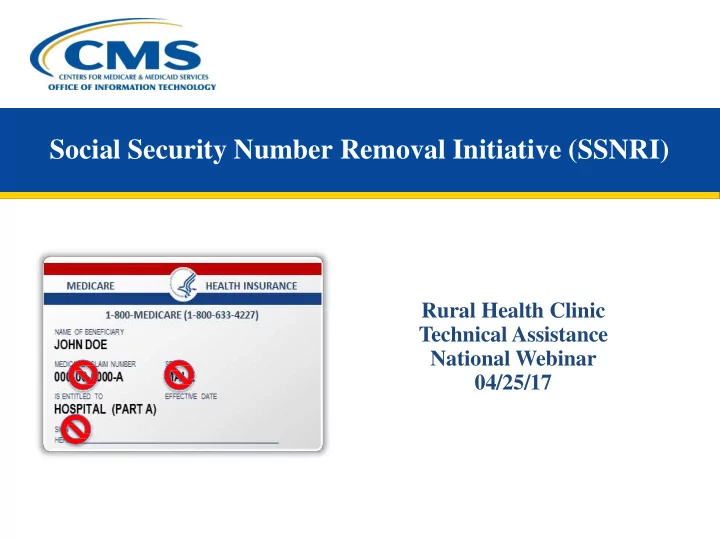
Social Security Number Removal Initiative (SSNRI) Rural Health - - PowerPoint PPT Presentation
Social Security Number Removal Initiative (SSNRI) Rural Health Clinic Technical Assistance National Webinar 04/25/17 Background The Health Insurance Claim Number (HICN) is a Medicare beneficiarys identification number, used for paying
- The Health Insurance Claim Number (HICN) is a Medicare beneficiary’s
identification number, used for paying claims and for determining eligibility for services across multiple entities (e.g. Social Security Administration (SSA), Railroad Retirement Board (RRB), States, Medicare providers and health plans, etc.)
- The Medicare Access and CHIP Reauthorization Act (MACRA) of 2015
mandates the removal of the Social Security Number (SSN)-based HICN from Medicare cards to address current risk of beneficiary medicalidentity theft
- The legislation requires that CMS mail out new Medicare cards with a new
Medicare Beneficiary Identifier (MBI) by April2019
2
Background
- Primary goal: To decrease Medicare Beneficiary vulnerability to identity
theft by removing the SSN-based HICN from their Medicare identification cards and replacing the HICN with a new Medicare Beneficiary Identifier (MBI)
- In achieving this goal CMS seeks to:
− Minimize burdens for beneficiaries − Minimize burdens for providers − Minimize disruption to Medicare operations − Provide a solution to our business partners that allows usage ofHICN and/or MBI for business critical data exchanges − Manage the cost, scope, and schedule for the project
3
SSNRI Program Goals
- Along with our partners, CMS will address complex systems changesfor
- ver 75 systems, conduct extensive outreach & education activities and
analyze the many changes that will be needed to systems and business processes
- Affected stakeholders include:
− Federal partners, States, Beneficiaries, Providers, and Plans − Other key stakeholders, such as billing agencies, advocacy groups, data warehouses, etc.
- CMS has been working closely with partners and stakeholdersto
implement the SSN Removal Initiative
4
Complex IT Systems affecting Providers, Partners, and Beneficiaries
Implementation of SSNRI
5
The solution for SSNRI must provide the following capabilities: 1. Generate MBIs for all beneficiaries: Includes existing (currently active, deceased or archived) and new beneficiaries 2. Issue new, redesigned Medicare cards: New cards containing the MBI to existing and new beneficiaries 3. Modify systems and business processes: Required updatesto accommodate receipt, transmission, display, and processing of the MBI CMS will use a MBI generatorto:
- Assign 150 million MBIs in the initial enumeration (60 million active and 90
million deceased/archived) and generate a unique MBI for each new Medicare beneficiary
- Generate a new unique MBI for a Medicare beneficiary whose identityhas
been compromised
6
Solution Concept: Medicare Beneficiary Identifier (MBI)
HICN and MBI Number
Health Insurance Claim Number(HICN)
- Primary Beneficiary Account Holder
Social Security Number (SSN) plus Beneficiary Identification Code (BIC)
- 9-byte SSN plus 1 or 2-byte BIC
- Key positions 1-9 are numeric
Medicare Beneficiary Identifier(MBI)
- New Non-Intelligent Unique Identifier
- 11 bytes
- Key positions 2, 5, 8, and 9 will always be
alphabetic
Note: Identifiers are fictitious and dashes for display purposes only; they are not stored in the database nor used in file formats 7
The Medicare Beneficiary Identifier will have the following characteristics:
- The same number of characters as the current HICN (11), but will be visibly
distinguishable from the HICN
- Contain uppercase alphabetic and numeric characters throughout the 11 digit
identifier
- Occupy the same field as the HICN on transactions
- Be unique to each beneficiary (e.g. husband and wife will have their own
MBI)
- Be easy to read and limit the possibility of letters being interpreted as
numbers (e.g. Alphabetic characters are upper case only and will exclude S, L, O, I, B, Z)
- Not contain any embedded intelligence or special characters
- Not contain inappropriate combinations of numbers or strings that may be
- ffensive
CMS anticipates that the MBI will not be changed for an individual unless the MBI is compromised or other limited circumstances still undergoing review
8
MBI Characteristics
MBI Generation and Transition Period
9
- The transition period will run from April 2018 through December 31, 2019
- CMS will complete its system and process updates to be ready to accept
and return the MBI on April 1,2018
- All stakeholders who submit or receive transactions containing the HICN
must modify their processes and systems to be ready to submit or exchange the MBI by April 1, 2018. Stakeholders may submit either the MBI or HICN during the transition period
- CMS will accept, use for processing and return to stakeholders eitherthe
MBI or HICN, whichever is submitted, during the transition period
- In addition, beginning October 2018 through the end of the transition period,
when a valid and active HICN is submitted on Medicare fee-for-service claims both the HICN and the MBI will be returned on the remittance advice
10
SSNRI Transition Periods
Once the transition period is over, you’ll still be able to use the HICN in these situations: 1. Appeals
- Appeal requests and related forms will be accepted with either a HICN or MBI
2. Reports
- Incoming Reports to CMS* (i.e., Quality reporting, Disproportionate Hospital data requests)
- Outgoing Reports from CMS (i.e., Provider Statistical & Reimbursement Report, Accountable
Care Organization Reports) 3. Retroactive enrollments 4. Span-date claims
- 11X-Inpatient Hospital, 32X-Home Health and 41X-Religious Non-Medical Health Care
Institution claims with a “From Date” prior to the end of the transition period (12/31/19) 5. Adjustments
- Use the HICN for adjustments where you originally submitted a HICN on the claim (i.e. PDE,
Risk Adjustment and Encounter data) 6. Incoming information requests (i.e. inquiries, Medicare Secondary Payer information requests, Requests for Medical Documentation, etc.) 7. Incoming premium payments (i.e. (Part A premiums, Part B premiums, Part D income related monthly adjustment amounts, etc.) *note: we will use the HICN on these reports until further notice
11
SSNRI Exceptions After the Transition Period
SSNRI Card Issuance
12
- CMS will begin issuing new Medicare cards for existing beneficiariesafter
the initial enumeration of MBIs; roughly 60 million beneficiaries
- The gender and signature line will be removed from the new Medicarecards
- The Railroad Retirement Board who will issue their new cards toRRB
beneficiaries
- We will work with states that currently include the HICN on Medicaid cards
to remove the Medicare ID or replace it with aMBI
- CMS will conduct intensive education and outreach to allMedicare
beneficiaries and their agents to help prepare for this change
Outreach and Education
13
- CMS will provide outreach and education to:
− Approximately 60 million beneficiaries, their agents, advocacy groups and caregivers − Health Plans − The provider community (1.5M providers) − States and Territories − Key stakeholders, vendors & other partners
- CMS will ensure that we involve all stakeholders in our outreach and
education efforts through their existing vehicles for communication(e.g. Open Door Forums, HPMS notices, etc.)
Final Thoughts
14
- Thank you for participating in this discussion today, to learn more about
SSNRI you can:
- Participate in our Open Door Forums
- Check our SSNRI website for other information:
- http://go.cms.gov/ssnri
- Please submit any additional comments or questions to the SSNRI team