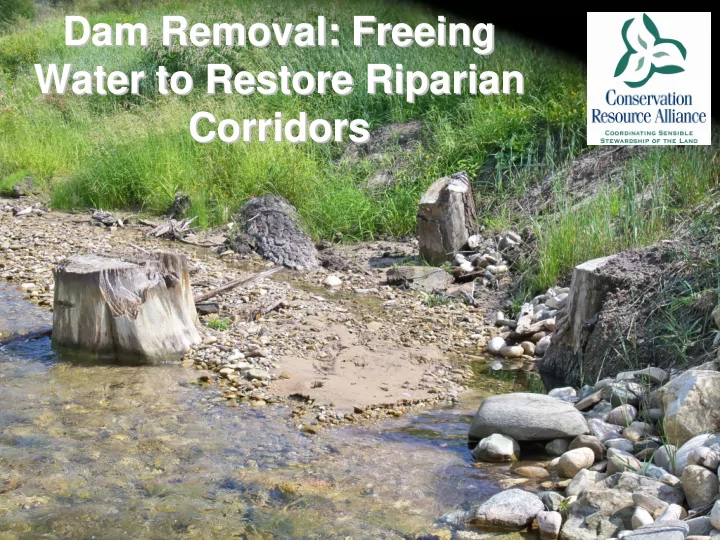
SLIDE 1
Dam Removal: Freeing Dam Removal: Freeing Water to Restore Riparian Water to Restore Riparian Corridors Corridors
SLIDE 2 5,000 miles of streams & tributaries 15 watersheds 13 counties 4 million acres Key CRA Funders
Conservation Service
- Michigan Coastal Management
Program
- US Fish & Wildlife Service
- National Fish and Wildlife
Foundation
- Sustain Our Great Lakes Program
- Private Donations
SLIDE 3
Watershed Approach Watershed Approach
SLIDE 4
Focus on Riparian Corridors Focus on Riparian Corridors
Hub, Corridor, Matrix All wetland soil types with a 300ft. buffer. Prime areas for water quality, biodiversity, and habitat connectivity Maple River Watershed Emmet County
SLIDE 5 Corridors based on a Black Bear Corridors based on a Black Bear “ “Umbrella Umbrella” ”
Map courtesy of the Michigan Dept. of Natural Resources Wildlife Division
Implies that corridors are still functioning. If developed and/or improperly managed what will happen? If bear habitat is secure a broad range of other species should also be secure.
SLIDE 6 On On-
the-
Ground Projects: Projects: Private and Public Private and Public Land Land CRA has managed the removal of 5 dams since 2007. 16 dams are in the process of removal.
SLIDE 7
What is a dam? 6 ft tall with impoundment of 5 acres
SLIDE 8 Why have dams?
- Hydropower
- Irrigation
- Recreation
- Store water for
consumption
- Industry
- Flood control
- Wildlife Habitat
- Navigation
- Invasive species
control
SLIDE 9
SLIDE 10 Where are the dams in our area?
Oakland – 144 Alcona – 75 Marquette – 64 Washtenaw – 64 Huron – 5 Bay – 5 Keewenaw – 9 Source: Jim Pawloski MDNR Dam Safety Program
SLIDE 11
x
SLIDE 12 Source: Jim Pawloski and Byron Lane. MDNR Dam Safety Program
Average Design Life Expectancy of a Dam is ~50 Years
SLIDE 13 Source: American Society of Civil Engineers. Michigan Section Website.
Ohio: C Wisconsin: D Indiana: D- Illinois: C
SLIDE 14
SLIDE 15
SLIDE 16
American Express Commercial featuring Yvon Chouinard from Patagonia
National attention for removing aging dams
SLIDE 17 Ecological Considerations of Dam Removal
- Unnaturally warm/cool discharged water
- Accumulate sediment and organic material, alter normal flow
and water chemistry
- Are contaminated sediments present?
- Change open water habitat, river habitat, and wetlands
- Change flooding cycles and channel location
- Stop aquatic organism passage (fish, mussels, inverts, etc.)
- May stop invasive species spread (sea lampreys, asian
carp?)
- Threat of catastrophic failure
- What’s in the seedbank?
- Effects on threatened/endangered species (sturgeon vs.
loons?)
- Immediate impacts of drawdown on fish, herps, and mussels
- Others?
SLIDE 18
Wheeler Creek example
SLIDE 19
SLIDE 20
SLIDE 21 Song of the Morning Yoga Retreat and the Pigeon River
- Summer 1984, operational error and gate malfunction
kills fish on large stretch of the Pigeon River.
- Summer 2008, dam gates opened again releasing warm
water and silt, then closed nearly shutting off flow.
- Sediment flush, increased temps, decreased oxygen,
then shut off of flow killed fish (and other aquatic life) for an estimated 21 river miles.
- Fish kill alone estimated at 475,000 individuals.
SLIDE 22
SLIDE 23 Social/Economic Considerations of Dam Removal
- Loss of dam function (lake, electricity, irrigation, etc.)
- Expense of maintenance, permitting, operations, repairs, dredging, and
liability
- Land ownership of re-exposed lands
- Loss of property values
- Historic value of the structure (rare)
- Alters aesthetics of the area
- Impact (+ or -) on specific types of recreation and tourism
- Landowner “issues”
(In MI, roughly 61% of dams are privately owned)
- Neighbor issues.
- Threat of catastrophic failure
- Dam no longer serves original purpose
- Loss/change of flood control at some sites
- Permitting
- Fundraising
- Prioritization of dams to be removed/repaired
- Public safety
- Others?
SLIDE 24
SLIDE 25 Between 1985 and 1994 there were 400 dam failures in the United States.
- Graham. 1999. U.S. Dept. of Interior. Bureau of Reclamation Report.
SLIDE 26
SLIDE 27
SLIDE 28
Every dam (and dam project) is unique
SLIDE 29 Project Overview The dams slated for removal with heads ranging from 31’-41’ All dams are “top draw” which elevate water temps The Boardman River supports 2,000,000 recreational user days per day Removal of three upper dams will reconnect 160 miles of river (and tributary) channel and habitats Project Partners
Grand Traverse Band of Ottawa and Chippewa Indians US Fish and Wildlife Service City of Traverse City Traverse City Light and Power Department Grand Traverse County Michigan DNRE Grand Traverse Conservation District Conservation Resource Alliance Michigan Hydro Relicensing Coalition Rotary Camps and Services Watershed Center Grand Traverse Conservation Resource Alliance
SLIDE 30
Tank Creek Project Overview 7 project partners $30,000 budget Reconnected 1.75 miles of riparian corridor
SLIDE 31 The 103 hydroelectric facilities in Michigan impact 49 river systems, including almost every major river system in the state. These facilities, at a minimum, prevent anadromous fish movement into 2,063 mainstem river miles, dewater 57 river miles, directly impound 623 river miles, and impact 733 river miles through their
- peration. The total reservoir area impacted by these
facilities is approximately 123,000 acres. These facilities produce, in net, only 1.5% of the electricity in the State
and Kakela 1983).
Quote taken from the MDNR Dam Safety Website
Hydropower is Green Power?
SLIDE 32 State of Michigan Electricity Sources Thousand Megawatt Hours Total Net Electricity Generation 9,434 Petroleum-Fired 17 Natural Gas-Fired 714 Coal-Fired 5,524 Nuclear 2,837 Hydroelectric 82 Other Renewables 216
Data compiled September 2010. Source: U.S. Energy Information Administration website, www.eia.gov
Hydroelectric accounts for .87% of Net Electricity Generation in Michigan
SLIDE 33 Isn’t Dam Removal Expensive?
- Yes. But maintaining, repairing, operating, insuring, and
permitting existing structures can be more expensive. AND There is considerably more money to help with dam removal/river restoration than dam repair.
Wheeler Creek Dam 20 ft tall, 4 acres impounded Removed 2010 Removal cost - $299,000. Green River Dam 8 ft tall, 1 acre impounded Removed 2007 Removal cost - $190,000 Tank Creek Dam 12 ft. tall, 2 acres impounded Removed 2010 Removal cost - $30,000
Boardman River Example * Present value of gross revenue over the next 30 years: $9,690,000 * Present value of cost to relicense, operation, maintenance, and repairs over the next 30 years: $16,768,000 * Difference: $7,078,000
SLIDE 34
SLIDE 35
#1. Who owns this land?
SLIDE 36
- Legal opinion of landowner and government attorneys: The City
- f Traverse City and Grand Traverse County own the
bottomlands of the respective impoundments created by dams that they own.
- However, the legal opinion indicated that some adjacent
property owners may have riparian rights (access to river) but such a claim would not limit the dam owners as to what they could do with the dams or how the level of the impoundments are maintained.
- Every dam, and dam project, is unique.
SLIDE 37
#2. Hello bottomlands, now what?
SLIDE 38 Our experience in Northern
- Michigan. Do your bank work,
wait to see what comes up, map invasives if present, control invasives, then reseed with natives as needed.
SLIDE 39
April 2009
SLIDE 40
June 2009
“Stinking mud flats”
→
SLIDE 41
June 2010
SLIDE 42
- 1. “Stimulus project my ass, this sounds like a bunch of left wing tree hugger crap to
me.”
- 2. “Wetlands, that are so precious to all of these folks, will dry up and become wild grass
areas.”
- 3. “These people will not stop untill
every dicent spot in Michigan is arranged to their liking.”
- 4. “These people do not care a lick what the people want they only care about what they
can do and get away with.”
You spent over $300,00 to take that dam out and all I get is $20,000 to build my pond!”
(On a sign along the river)
#3. Which statement was not made during a dam removal project?
SLIDE 43
#4. How long ago was this “impoundment's” dam removed? Thompsonville dam failed 20 years ago
SLIDE 44
Thank You for Attending! A copy of this Thank You for Attending! A copy of this presentation will be posted at presentation will be posted at www.rivercare.org www.rivercare.org
Eric Ellis, Biologist Conservation Resource Alliance eric@rivercare.org, (231) 946-6817