Social Pr Social Protection otection: : Conc Concepts and Lif - - PowerPoint PPT Presentation

social pr social protection otection
SMART_READER_LITE
LIVE PREVIEW

Social Pr Social Protection otection: : Conc Concepts and Lif - - PowerPoint PPT Presentation

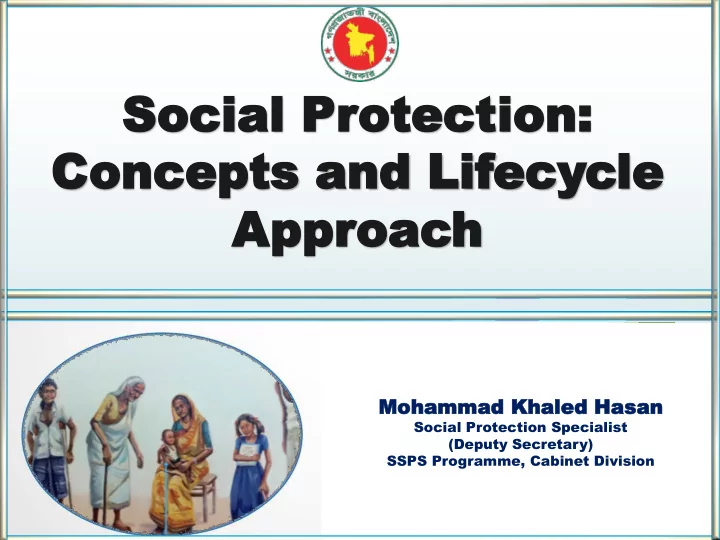
Social Pr Social Protection otection: : Conc Concepts and Lif epts and Lifec ecycle le Appr pproac oach Moha Mohammad mmad Khaled Khaled Hasa Hasan Social Protection Specialist (Deputy Secretary) SSPS Programme, Cabinet Division


slide-1
SLIDE 1

Social Pr Social Protection

  • tection:

: Conc Concepts and Lif epts and Lifec ecycle le Appr pproac

  • ach

Moha Mohammad mmad Khaled Khaled Hasa Hasan

Social Protection Specialist (Deputy Secretary) SSPS Programme, Cabinet Division

slide-2
SLIDE 2

Earliest Social Protection

– MAHASTHAN BRAHMI INSCRIPTION (3RD CENTURY BC) – TELA (OIL), DUMA (TREE), DHANYA (PADDY) AND TWO VARIETIES OF SMALL COINS TO BE DEPOSITED IN STOREHOUSE. – AS PROVISIONS AGAINST ANY EMERGENCY CAUSED BY FLOOD, FIRE AND DEVASTATION OF PADDY BY PARROTS.

slide-3
SLIDE 3

WHAT IS SOCIAL PROTECTION

Policies and programmes designed to reduce poverty and vulnerability by promoting efficient labour markets, diminishing people's exposure to risks, and enhancing their capacity to manage economic and social risks, such as unemployment, exclusion, sickness, disability and old age (UN).

slide-4
SLIDE 4

WHAT IS SOCIAL PROTECTION

A specific set of actions to address the vulnerability of people’s life through social insurance…, social assistance… and inclusion efforts…(NSSS)

slide-5
SLIDE 5

Pover erty ty

Poverty is the total absence

  • f
  • pportunities,

accompanied by high levels

  • f

undernourishment, hunger, illiteracy, lack

  • f

education etc. Poverty is usually measured in two ways:

  • A set of constant

standard

  • 1.90 $ a day

Absolute poverty

  • Percentage of average

income

  • 50-60% of median

income

Relative Poverty

slide-6
SLIDE 6

Vulner ulnerability bility

Vulnerability is a combination of exposure to shocks and stresses, susceptibility or sensitivity to such adverse events. While poverty describes the state

  • f affairs in the present day,

vulnerability is concerned with what the situation could be in future with respect to poverty.

slide-7
SLIDE 7

Types of ypes of Social Pr Social Protection

  • tection

Social Assistance

  • Cash transfer
  • Social Pensions
  • In-kind transfers

Social Insurance

  • Medical insurance
  • Old age Pensions
  • Unemployment benefit
  • Survivors’ assistance

Labour Market Intervention

  • Job centres
  • Training
  • Compensation

Informal Social Protection

  • Community based SP
  • Charity

Other types

  • Subsidies
  • Price support
slide-8
SLIDE 8

Social P Social Prote

  • tection

ction & & Social S Social Ser ervices vices

Social Services Education Health

Social protection Social assistance Social insurance Social justice

  • Cash transfers
  • Access to social

services

  • Unemployment

insurance

  • Social Security
  • Social rights
  • Non-

discrimination

slide-9
SLIDE 9

Social Social Insur Insurance ance

Social insurance is a programme where risks are transferred to and pooled mostly by government

  • rganizations. Insurance programme has the

following characteristics:  The benefits, eligibility requirements, and

  • ther aspects of the programme are defined

by statute;  Explicit provision is made to account for income and expenses (often through a trust fund);  It is usually contributory.  Many programmes are funded by the government.  Participation is often compulsory for particular groups.

slide-10
SLIDE 10

So Social cial Assistanc Assistance

Social assistance is a type of social protection in which non-contributory, tax-financed, regular and predictable cash or in-kind resources are transferred to poor and vulnerable individuals or households. Cash and in-kind allowances, school feeding and public works programmes are usually included in this type of programmes. Social Assistance is need based, not based on contribution. It is provided to people who may not be covered by social insurance.

slide-11
SLIDE 11

Social Pr Social Protec

  • tection

tion Functions Functions

  • enhancing

incomes and capabilities (e.g. inputs)

  • social equity and

inclusion, empowerment and rights (e.g. labour laws)

  • averting

deprivation (e.g. savings clubs, social insurance)

  • providing relief

from deprivation (e.g. income benefits, state pensions) Protective Preventive Promotive Transformative

slide-12
SLIDE 12

Impact Impacts of s of Social Pr Social Protec

  • tection

tion

Pover erty ty reduction eduction Human Human ca capital pital

Liv Livelihoo elihoods ds

Ris Risk k ma mana nagem gement ent

Econo Economic mic resili esilience ence Social Social coh cohesion esion Econo Economic mic ref efor

  • rm
slide-13
SLIDE 13

Univ Univer ersal sal Dec Declar laration of tion of Human Human Rights Rights

Everyone, as a member of society, … has the right to social security through national effort and international co-operation and in accordance with the organization and resources of each State, of the economic, social and cultural rights indispensable for his dignity and the free development of his personality (Article 22)

slide-14
SLIDE 14

Con Constit stitution ution of

  • f Ban

Banglades ladesh

….the right to social security, that is to say to public assistance in cases of undeserved want arising from unemployment, illness or disablement, or suffered by widows or orphans or in old age, or in other such cases. Art 15d

slide-15
SLIDE 15

Voluntary Insurance Mandatory Social Insurance/Social Security Benefits of Guaranteed Levels for Contributors The FLOOR: Four Essential Guarantees Access to essential Health Care for all Income Security Children Assistance Unemployed and Poor Income Security Elderly and Disabled

The Social Protection Floors

slide-16
SLIDE 16

Social Pr Social Protection in SDG

  • tection in SDG

Implement nationally appropriate social protection systems and measures for all, including floors, and by 2030 achieve substantial coverage of the poor and the vulnerable (Goal 1.3).

slide-17
SLIDE 17

1970s

  • Poor

Relief 1980s

  • Relief +

developme nt 1998

  • Social

Safety Net 2000

  • Safety

Ladder

2015

  • Lifecycle

Based Social Protecti

  • n

Ev Evolution of

  • lution of Social Pr

Social Protection in BD

  • tection in BD

Incremental Strategic

slide-18
SLIDE 18

Two Br

  • Broad A
  • ad Appr

pproac

  • aches

hes

Lifecycle Approach

  • Initiated in UK in 1945
  • Used across

developed countries; also, in a range of developing countries;

  • Long term planning -

programs directed at particular stages of the life cycle;

  • Focus resources on

particular lifecycle risks

Poor Relief Approach

  • Used in 19th century

Europe;

  • Adopted in some

developing countries – Mexico, Colombia;

  • Short term planning-

tries to resolve poverty immediately;

  • No focus – usually fails

because of large targeting errors and small budgets.

slide-19
SLIDE 19

Pregnancy & Childhood

School Age

Youth Working Age

Old Age

  • Unsafe birth
  • Less natal care
  • Wasting
  • Stunting
  • Less mental

development

  • Child labour
  • Violence
  • Drop out
  • Abuse
  • Orphan
  • No training
  • Unemployment
  • Alienation
  • Unemployment
  • Illness
  • Disability
  • Debt
  • No insurance
  • Gender

discrimination

  • Frailty; illness
  • Medical costs
  • No income
  • Discrimination;
  • Neglect

Covariate Risks

  • Disasters
  • Climate change
  • Food Price Shocks

Lif Lifec ecycle F le Framew amewor

  • rk
slide-20
SLIDE 20

‘ ’

1 2 3 6 5 4 High Low Years Emotional con Sym Peer social skil Relative quant

Sen Sensitivity sitivity in in Ear Early y De Develop elopmen ment t of

  • f Childr

Children en

Binocular vision Central auditory sys Habitual responding Language Emotional control Symbol Peer social skills Relative quantity

slide-21
SLIDE 21

Limita Limitation of tion of Pr Present Pr esent Practice actice

Unspecific goals

Short-term planning Weak M&E

Proliferation of programmes Coordination gap Overlapping Leakage Targeting errors Ghost beneficiary Double dipping

Inefficient delivery system

Deprivation Rent seeking

slide-22
SLIDE 22

Non poor Near poor 46% Poor 23% Ultra poor 12.9% Food poor 4%

Social Protection Tk 66,000 Crore 5 Crore People

Social Pr Social Protection C

  • tection Cover

erage ge

slide-23
SLIDE 23
  • Categorical targeting
  • Self-targeting
  • Community-based targeting
  • Household Assessments
  • Means Test

In this method the income and expenditure and the wealth of a household

  • r individual is taken into consideration.
  • Proxy Means Test (PMT)

In this method the economic conditions are assessed based on statistical estimate of the probability of a household being poor. In this process a score card is prepared and the scores indicate the poverty condition of the households.

Tar argeting of geting of Beneficiar Beneficiary

slide-24
SLIDE 24

24

Sing Single R le Registr gistry y MIS MIS

Integrated MIS

Single Registry Programme MISs Fiscal MIS Government to Person (G2P) Cash Transfer Grievance Redress System (GRS) Result Based M&E

slide-25
SLIDE 25

Gr Group W

  • up Wor
  • rk

The participants will be divided into 8 groups for group work and presentation. Group discussion and preparation of PPT: 30 Mins Group Presentation: 5 Mins Q/A for each group: 3 Mins Observation of reviewers: 2 Mins

slide-26
SLIDE 26

Topics f

  • pics for Gr
  • r Group
  • up -1

Evaluate the functions of a major social protection programme in Bangladesh by using the 3P+T framework Suggested outline of presentation:  Does Does it pr it provide pr vide protection

  • tection to the

to the ben benef eficiaries? iciaries?  Ho How w does it does it pr prevent po ent pover erty ty?  Does Does it it pr promote or

  • mote or bring t

bring the benef he beneficiari iciaries es out of

  • ut of po

pover erty ty sus sustaina tainabl bly? y?  Ho How does it w does it emp empower and er and enh enhanc ance r e respec espect of t of benef beneficiari iciaries? es?  Gener General al comments comments

slide-27
SLIDE 27

Topics

  • pics for Gr
  • r Group
  • up - 2

Evaluate the significance of charity based informal social protection in Bangladesh. Suggested outline of presentation:  Protection, prevention, promotion and empowerment  Economic return for the country  Recommendation for efficiency

slide-28
SLIDE 28

Topics

  • pics for Gr
  • r Group
  • up - 3

Evaluate the impacts of primary school stipend programme in Bangladesh? Suggested outline of presentation:  Contribution in reducing drop out and child labour  Role in human capital development  Impact on economy  Any suggestion for improving the programme

slide-29
SLIDE 29

Topics

  • pics for Gr
  • r Group
  • up - 4

Medical costs push 6 million Bangladeshis into poverty every

  • year. What type of social protection intervention would you

suggest for preventing people from falling into poverty because of medical expenditure. Suggested outline of presentation: Do you recommend for contributory social insurance? Will you combine it with certain level of free medical facilities for the poor?

slide-30
SLIDE 30

Topic

  • pic for Gr
  • r Group
  • up - 5

Innovation in social protection for reducing scopes of leakages. Suggested outline of presentation:  Developing online MIS  Modalities of delivery of benefits  Grievance redress system

slide-31
SLIDE 31

Topic

  • pic for Gr
  • r Group
  • up - 6

What programmes would you recommend for ensuring child nutrition in Bangladesh? Suggested outline of presentation:  Child benefit programme  Target age group  How does it improves nutrition  Supply of micro nutrients (vitamins etc)

slide-32
SLIDE 32

Topic

  • pic for Gr
  • r Group
  • up - 7

Importance of lifecycle based social protection in Bangladesh Suggested outline of presentation:  What is lifecycle based social protection  Efficiency and effectiveness  Economic returns

slide-33
SLIDE 33

Topic

  • pic for Gr
  • r Group
  • up - 8

What measures would you suggest for accurate targeting of social protection beneficiaries? Suggested outline of presentation:  Importance of statistical tools like proxy means test (PMT)  Challenges  Recommendations for remedies

slide-34
SLIDE 34

Thank y hank you

  • u