SLIDE 1 1
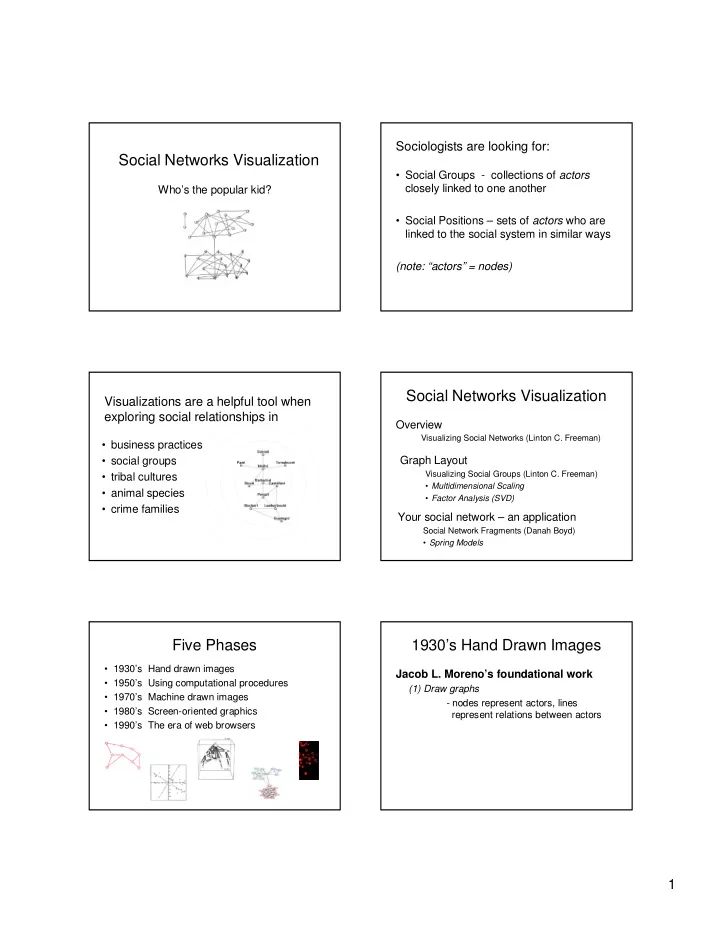
Social Networks Visualization
Who’s the popular kid?
Sociologists are looking for:
- Social Groups - collections of actors
closely linked to one another
- Social Positions – sets of actors who are
linked to the social system in similar ways (note: “actors” = nodes)
Visualizations are a helpful tool when exploring social relationships in
- business practices
- social groups
- tribal cultures
- animal species
- crime families
Social Networks Visualization
Overview
Visualizing Social Networks (Linton C. Freeman)
Graph Layout
Visualizing Social Groups (Linton C. Freeman)
- Multidimensional Scaling
- Factor Analysis (SVD)
Your social network – an application
Social Network Fragments (Danah Boyd)
Five Phases
- 1930’s Hand drawn images
- 1950’s Using computational procedures
- 1970’s Machine drawn images
- 1980’s Screen-oriented graphics
- 1990’s The era of web browsers
1930’s Hand Drawn Images
Jacob L. Moreno’s foundational work
(1) Draw graphs
- nodes represent actors, lines
represent relations between actors
SLIDE 2 2
1930’s Hand Drawn Images
Jacob L. Moreno’s foundational work
(1) Draw graphs (2) Draw directed graphs
Moreno (1932)
1930’s Hand Drawn Images
Jacob L. Moreno’s foundational work
(1) Draw graphs (2) Draw directed graphs (3) Use colours to draw “multigraphs”
Moreno (1932)
1930’s Hand Drawn Images
Jacob L. Moreno’s foundational work
(1) Draw graphs (2) Draw directed graphs (3) Use colours (4) Vary shapes of nodes
Moreno (1932)
1930’s Hand Drawn Images
Jacob L. Moreno’s foundational work
(1) Draw graphs (2) Draw directed graphs (3) Use colours (4) Vary shapes of nodes (5) Use location of nodes to stress different features of the data
1950’s Computational Methods
The burning question: How do we lay out the points? Solutions: Factor analysis Multidimensional scaling
1950’s Computational Methods
Factor analysis Reduce the number of points by mapping similar points into “factors”. Each successive factor represents less and less
- f the variability of the data.
SLIDE 3 3
1950’s Computational Methods
Bock & Husain (1952) Clusters of 9th grade school children
1950’s Computational Methods
Bock & Husain (1952) Clusters of 9th grade school children
1950’s Computational Methods
Multidimensional Scaling (MDS) Arrange points in 2D or 3D in such a way that distances between pairs of points on the display correspond to distances between individuals in the data
1980’s Screen oriented graphics
Krackplot image of Social Support Network of a Homeless Woman
1980’s Screen oriented graphics
Two-mode data on Women’s Attendance at Social Events
1990’s The era of web browsers
SLIDE 4 4
1990’s The era of web browsers
- Java Programs
- Virtual Reality Modeling Language (VRML)
Visualizing Social Networks by Linton C. Freeman
Strong Points:
- A comprehensive
- verview
- Many examples of
visualizations with real data Weak Points:
each system
Visualizing Social Networks by Linton C. Freeman
Strong Points:
- A comprehensive
- verview
- Many examples of
visualizations with real data Weak Points:
each system
- Figures!!!
- Examples arranged
chronologically, not by contribution
Social Networks Visualization
Overview
Visualizing Social Networks (Linton C. Freeman)
Graph Layout
Visualizing Social Groups (Linton C. Freeman)
- Multidimensional Scaling
- Factor Analysis (SVD)
Your social network – an application
Social Network Fragments (Danah Boyd)
Visualizing Social Groups
We want to (1) uncover social groups (2) investigate roles/positions in the groups Social connections are either (1) Binary – individuals are either linked or not linked (2) Qualitative – individuals are relatively more or relatively less strongly linked
Binary Connections
SLIDE 5 5
Laying out the Nodes
Two methods
- Multidimensional Scaling (MDS)
- Factor Analysis (SVD)
Multidimensional Scaling (MDS)
Need proximity data; relative distance between two points. Arrange points in 2D or 3D so that distances between pairs of points on the display correspond to distances between individuals in the data Spring Model to lay them out so that the ideal distance between nodes is their proximity. Nodes are laid out in random then “let go”.
Multidimensional Scaling (MDS) Multidimensional Scaling (MDS) Multidimensional Scaling (MDS) Principal Components Analysis
Another way to assign a location to the points Maps each node in the matrix of associations to a new vector (factor). Some nodes will have been collapsed to a single point Each new vector contains less and less of the variance of the original data.
SLIDE 6 6
Principal Components Analysis Evaluation
How do we decide which method is better? Two criteria: (1) Groups as specified in ethnographic reports (2) Groups based on formal specification of group properties
Ethnographic report
Observer reports:
- Workers are divided into two groups
(W1, W2, W3, W4, S1, I1) (W6, W7, W8, W9, S4)
- W5 was an outsider to both groups
MDS SVD Ethnographic report
Observer reports:
- Workers are divided into two groups (W1, W2,
W3, W4, S1, I1) (W6, W7, W8, W9, S4)
- W5 was an outsider to both groups
- Groups had core and peripheral members
W3 “leader”, W2 “marginal” W6 “not entirely accepted”, S4 “socially inferior”
SLIDE 7
7
MDS MDS MDS MDS MDS SVD
SLIDE 8 8
SVD SVD SVD Evaluation
(1) Groups as specified in ethnographic reports
- Both do well, MDS captures more subtle
detail
(2) Groups based on formal specification of group properties
Evaluation Qualitative Connections
SLIDE 9
9
MDS SVD Evaluation
A is a member of a group A,B,C,… if A interacts more often with B,C,… than with others, and B interacts more with A,C,… than with others, and … A simple genetic algorithm on the dolphin data shows that there are 3 groups: {a,b,c,d,e,f,g,h}, {i,j}, {k,l,m} The first can be divided into {a,b}, {c,d,e}, {f,g,h} which overlap a bit
MDS MDS MDS
SLIDE 10 10
SVD SVD SVD
Visualizing Social Networks by Linton C. Freeman
Strong Points:
using real data sets
evaluation of each Weak Points:
- No guidelines given
- Gloss over the
details of MDS and
computations performed?
Social Networks Visualization
Overview
Visualizing Social Networks (Linton C. Freeman)
Graph Layout
Visualizing Social Groups (Linton C. Freeman)
- Multidimensional Scaling
- Factor Analysis (SVD)
Your social network – an application
Social Network Fragments (Danah Boyd)
Your Social Network
Context We all have a social network of connections which we use to obtain emotional, economical and functional support. The connections vary in strength. The same concepts can be applied in the digital world. People manage and control their social networks using digital tools.
SLIDE 11 11
Your Social Network
Goal Create a system that reveals the structure of an individual’s social network so that they can consider the impact of the network on their identity.
Visual Who (Judith Donath) Visual Who (Judith Donath) Visual Who (Judith Donath) Your Social Network
Proposed solution Spring system
- nodes start off in random positions
- all nodes repel one another
- there is an attraction force between nodes
with a tie, relative to the strength of the tie Use people as nodes and email messages to determine the ties between people
Determining Ties
Example From: Drew To: Mike, Taylor BCC: Morgan, Kerry Ties Drew knows Mike Mike is aware of Drew Mike is loosely aware of Taylor Drew knows & trusts Morgan Coloring Mike: College Morgan: Family All others: Work (because Drew is writing from work address)
SLIDE 12 12
Evaluation
Are the clusters meaningful? Ask Drew
Weaknesses?
Evaluation
Weak points
- Unrelated individuals can appear close
- Longer names stand out more
- The colouring scheme must be carefully
chosen
- Ties are only as good as the rules used to
make them IS THIS REALLY USEFUL TO SOMEONE?
Evaluation
Strong points
- Used real data
- Implementation fully described
- Evaluation attempted (although criteria for
success not clearly explained)
Take-away messages
(1) Social groups and positions in groups can be visualized by considering the strength
- f connections between individuals
(proximity data) (2) Multidimensional scaling and Factor Analysis (aka. component analysis, SVD) are two ways displaying proximity data (3) Spring systems layout nodes using repulsion and attraction forces which depend on proximity data
References
Visualizing Social Groups, Linton C. Freeman, American Statistical Association, 1999 Proceedings of the Section
- n Statistical Graphics, 2000, 47-54.
Visualizing Social Networks, Linton C. Freeman, Journal of Social Structure, 1, 2000, (1). Social Network Fragments, Dana Boyd, MIT Master’s Thesis: Faceted Id/entity: Managing Representation in a Digital World, Chapter 7. Visual Who, Judith Donath, Proceedings of ACM Multimedia ’95, Nov 5-9, San Francisco, CA.