Social Infrastructure Social Infrastructure Protocols Fulfilment - - PDF document

social infrastructure
SMART_READER_LITE
LIVE PREVIEW

Social Infrastructure Social Infrastructure Protocols Fulfilment - - PDF document

Specification and verification of agent interaction using SOCS-SI Federico Chesani Universit di Bologna Marco Gavanelli Universit di Ferrara Social Infrastructure Social Infrastructure Protocols Fulfilment Expectations YES


slide-1
SLIDE 1

Specification and verification of agent interaction using SOCS-SI

Federico Chesani – Università di Bologna Marco Gavanelli – Università di Ferrara

CLIMA VI London, June 27-29, 2005

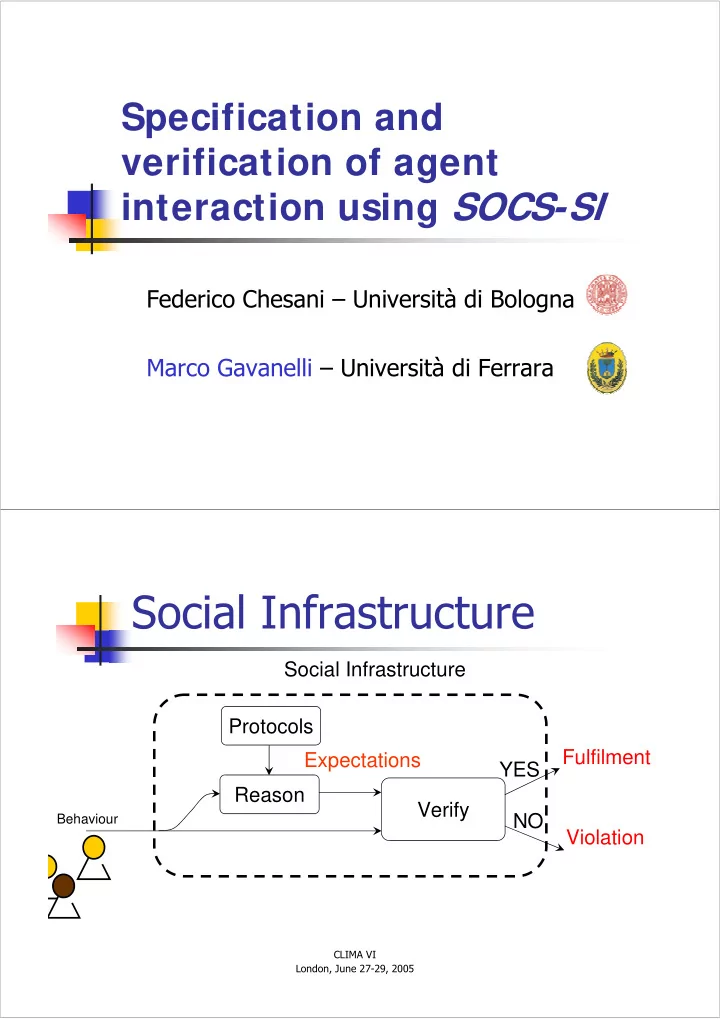
Social Infrastructure

Behaviour

Social Infrastructure Fulfilment Violation Verify YES NO Expectations Protocols Reason

slide-2
SLIDE 2

CLIMA VI London, June 27-29, 2005

Use of expectations

Behaviour Social Infrastructure Fulfilment Violation Reasoning Satisfaction? YES NO Expectations

(1) check of compliance to protocols (1) check of compliance to protocols

CLIMA VI London, June 27-29, 2005

Use of expectations

Behaviour Social Infrastructure Reasoning Expectations

(2) feedback loop that influences behaviour (2) feedback loop that influences behaviour

Different Behaviour

slide-3
SLIDE 3

CLIMA VI London, June 27-29, 2005

Part I: Synopsis

Types of society The SCIFF language

syntax and semantics

Verification

Types of verification

CLIMA VI London, June 27-29, 2005

Multi-Agent Systems (MAS)

Agent: a software system

Autonomous: the agent is able to work

autonomously

Reactive: it is able to react to external

stimuli, changes in the environment

Proactive: it can have objectives, goal-

directed behaviour

Social: can interact with other agents to

reach its goals

slide-4
SLIDE 4

CLIMA VI London, June 27-29, 2005

Design

Design a MAS means designing

Type of the society Interaction Roles …

Open

CLIMA VI London, June 27-29, 2005

Society types [Davidsson 01]

Closed: Agents cannot enter

(fixed number of agents)

Semiclosed: Agents cannot

enter, but can spawn a representative in the society

Semiopen: agents can enter

by registering to a gatekeeper

Open: agents can enter

without restrictions

slide-5
SLIDE 5

CLIMA VI London, June 27-29, 2005

Open society

“it supports openness and flexibility very well, but it is very difficult to make such a society stable and trustful.” [Davidsson 01]

But, we design the MAS in order to obtain

some goals …

Give semantics to communication Agents comply to rules The MAS reaches its goals The MAS has some required properties

CLIMA VI London, June 27-29, 2005

Protocols

Definition: language Impose that agents behave according

to protocols?

Not in an open society! Verification / raising violations

Protocol properties

slide-6
SLIDE 6

CLIMA VI London, June 27-29, 2005

Example: Auction

We want to design a MAS for managing

auctions

We have to

Design the communication acts, and their

semantics

Design the protocol Use the protocol for

Guiding the agents behaviour Prove society properties CLIMA VI London, June 27-29, 2005

Syntax: events

happened events (ground) Desc (term) Time (integer) Eg

Bob tells Alice that he bids 1$ for the pen in the auction auc1 at time 3

Events compose a history

H(Desc, Time)

HAP

H(tell(bob, alice, bid(pen, 1 $), auc1), 3)

slide-7
SLIDE 7

CLIMA VI London, June 27-29, 2005

Syntax: Expectations

Events that should / should not happen Eg

Alice should answer to Bob’s bid, after time 3

Eg

No agent should place a bid to Alice for the pen in auction 1 for less than 1$, after time 3

Expectations compose the set ∆

E(Desc, Time) EN(Desc, Time)

E(tell(alice, bob, answ(A, pen, 1$), auc1), TAns), TAns > 3 EN(tell(B, alice, bid(pen, P), auc1), TBid), Tbid > 3, P < 1$

CLIMA VI London, June 27-29, 2005

Declarative semantics

SCIFF: abductive semantics Coherence of set ∆ Compliance to protocol

KB ∪ ∆ | = G KB ∪ ∆ | = IC

∀p, E(p), EN(p) 6∈ ∆

∀p, ¬E(p), E(p) 6∈ ∆

∀p, EN(p), ¬EN(p) 6∈ ∆ ∀p, E(p) → H(p)

∀p, EN(p) → notH(p)

slide-8
SLIDE 8

CLIMA VI London, June 27-29, 2005

Syntax

Social Organization Knowledge Base (SOKB)

clauses Atom Cond Cond: conjunction of literals, constraints,

expectations

Social Integrity Constraints (ICs)

Body Head Body: conjunction of literals defined in SOKB, H,

E, EN and CLP constraints

Head: a disjunction of conjunction of E, EN literals

and CLP constraints

CLIMA VI London, June 27-29, 2005

Auction: communicative acts

Openauction: opens an auction for an

item

Bid: propose to buy an item for a given

price

Answer (win/lose): communicate if a

bid wins or loses

Deliver: provide the item Pay: pay for the item

slide-9
SLIDE 9

CLIMA VI London, June 27-29, 2005

Auction: semantics of communicative acts

If I open an auction, I am willing to give the item for

some amount of money

If I place a bid, I am willing to pay such amount of

money for the item

H(tell(B, A, bid(Item, Q), D), TBid), H(tell(A, B, answ(win, Item, Q), D), TWin), H(tell(A, B, deliver(Item), D), TDel) → E(tell(B, A, pay(Item, Q), D), TP ay), TP ay < TDel + TPay Deadline H(tell(A, Bidders,opauc(Item, τ, Tnotify, Type), D), Topen), H(tell(B, A, bid(Item, Q), D), TBid), H(tell(A, B, answ(win, Item, Q), D),TWin), → E(tell(A, B, deliver(Item), D),TDel), TDel < TWin + TDeliver Deadline

CLIMA VI London, June 27-29, 2005

Protocols

Protocols are often seen as finite state

automata

Define allowed moves,

the rest is forbidden

Could be a limit in open

societies

SCIFF: define explicitly

allowed/ necessary/ forbidden moves

a b b c c c

slide-10
SLIDE 10

CLIMA VI London, June 27-29, 2005

Auctions

Before placing bids, there must have

been an openauction

The auctioneer should reply to bids

H(tell(S, R, bid(Item, P), D), Tbid) → E(tell(R, , openauction(Item, Tend, ), D), Topen) ∧Topen < Tbid ∧ Tbid ≤ Tend. H(tell(B, A, bid(Item, P), Anumber), Tbid) ∧H(tell(A, , openauction(Item, Tend, Tdeadline), D), Topen) → E(tell(A, B, answer(Answer, B, Item), D), Tanswer) ∧Tanswer ≥ Tend ∧ Tanswer ≤ Tdeadline ∧ Answer :: [win, lose].

CLIMA VI London, June 27-29, 2005

Auctions

no contradicting answers

H(tell(A, B, answer(A1, B, Itemlist), D), T1) → EN(tell(A, B, answer(A2, B, Itemlist), D), T2) A1 6= A2

slide-11
SLIDE 11

CLIMA VI London, June 27-29, 2005

Auctions

Payment

H(tell(A, Bw, answer(win, Bw, Item), D), Tw) ∧ H(tell(Bw, A, bid(Item, P), D), Tbid) → E(tell(Bw, A, pay(P), D), Tp).

CLIMA VI London, June 27-29, 2005

English auction: protocol

You cannot place bids lower than the previous Either one places a higher within τ units after my bid,

  • r I win

H(tell(Bidder1, Auc, bid(Item, Q1)), T1) → EN(tell(Bidder2, Auc, bid(Item, Q2)), T2), T2 > T1, Q2 ≤ Q1 H(tell(Auc, Bidders, opauc(Item, τ, Tnotify, english), D), Topen), H(tell(Bidder1, Auc, bid(Item, Q1), D), T1) → E(tell(Bidder2, Auc, bid(Item, Q2), D), T2), Q2 > Q1, T2 < T1 + τ ∨ E(tell(Auc, Bidder1, answ(win, Item, Q1), D), Twin), Twin < T1 + Tnotify

slide-12
SLIDE 12

CLIMA VI London, June 27-29, 2005

First price sealed bid auction

Predefined deadline. Either there is a higher

bid, or I must be declared winner

H(tell(Auc, Bidders, opauc(Item, Tdead, Tnotify, fpsb), D), Topen), H(tell(Bidder1, Auc, bid(Item, Q1), D), T1), T1 < Tdead → E(tell(Bidder2, Auc, bid(Item, Q2), D), T2), Q2 > Q1, T2 < Tdead ∨ E(tell(Auc, Bidder1, answ(win, Item, Q1), D), Twin), Twin < Tdead + Tnotify

CLIMA VI London, June 27-29, 2005

Vickrey auction

You should pay at least the amount of

the other bidders

H(tell(A, Bw, answer(win, Bw, Item), D), Tw) ∧ H(tell(A, Bl, answer(lose, Bl, Item), D), Tl) ∧ H(tell(Bl, A, bid(Item, Pl), D), Tbid) → E(tell(Bw, A, pay(P), D), Tp) ∧ P ≥ Pl.

slide-13
SLIDE 13

CLIMA VI London, June 27-29, 2005

Verification

Types of verification [Guerin, Pitt 02]

Type 1: An agent will always comply to

protocol (required: agent specification, not available

in open societies)

Type 2: verification through observation (on

the fly)

Type 3: verification of protocol properties (if

agents behave according to protocols, does the MAS respect specifications?)

CLIMA VI London, June 27-29, 2005

Type 1 Verification

Agents behaviour Semantics Protocols Properties

Compliance Violation

slide-14
SLIDE 14

CLIMA VI London, June 27-29, 2005

Type 2 verification

Agents behaviour Semantics Protocols Properties

Compliance Violation

CLIMA VI London, June 27-29, 2005

Operational Semantics

Generation of expectations Abduction of literals with universally quantified

variables

Dynamically happening events CLP constraints on variables (both existentially and

universally quantified)

SCIFF: Extension of the IFF

abductive proof-procedure [Fung-Kowalski]

slide-15
SLIDE 15

CLIMA VI London, June 27-29, 2005

Operational Semantics

Data structure

T = <R,CS,PSIC,EXP,HAP,FULF,VIOL> Where

R: Conjunction of literals CS: Constraint Store PSIC: Implications EXP: (Pending) Expectations FULF: Fulfilled expectations VIOL: Violated Expectations

CLIMA VI London, June 27-29, 2005

Transitions

IFF-Like (extended) Fulfilment, violation Dynamically growing history Consistency CLP

slide-16
SLIDE 16

CLIMA VI London, June 27-29, 2005

IFF-like transitions

unfolding:

p(X), A p(Y) ← B → → X=Y, B, A

propagation:p(X), B → C

p(Y) → → X=Y, B → C

splitting: distributes conjunctions and disjunctions case analysis:

c(X,Y) → A

either

c(X,Y), A

  • r

¬c(X,Y)

factoring tries to reuse previously made hypotheses; rewrite rules: use the inferences in the Clark Equality Theory; logical simplifications A,false ↔

↔ false, A ← true ↔ ↔ A, etc.

CLIMA VI London, June 27-29, 2005

Fulfilment / Violation

Rely on the constraint solver

EXPk = {EN(E1), …} HAPk = {H(E2), …} EXPk = {EN(E1), …} HAPk = {H(E2), …} CSk+1 = CSk ∪ {E1 = E2} VIOLk+1 = VIOLk ∪ {EN(E1)} EXPk+1 = {…} CSk+1 = CSk ∪ {E1 = E2} VIOLk+1 = VIOLk ∪ {EN(E1)} EXPk+1 = {…} CSk+1 = CSk ∪ {E1 ≠ E2} CSk+1 = CSk ∪ {E1 ≠ E2}

Violation EN: Violation EN:

slide-17
SLIDE 17

CLIMA VI London, June 27-29, 2005

Fulfilment / Violation

EXPk = {E(E1), …} HAPk = {H(E2), …} EXPk = {E(E1), …} HAPk = {H(E2), …} CSk+1 = CSk ∪ {E1 = E2} FULFk+1 = FULFk ∪ {E(E1)} EXPk+1 = {…} CSk+1 = CSk ∪ {E1 = E2} FULFk+1 = FULFk ∪ {E(E1)} EXPk+1 = {…} CSk+1 = CSk ∪ {E1 ≠ E2} CSk+1 = CSk ∪ {E1 ≠ E2}

Fulfilment E: Fulfilment E:

CLIMA VI London, June 27-29, 2005

Dynamically Growing History

External set of incoming events A transition Happening takes an event from the external set and

puts it into the HAP set

Tn = <Rn,CSn,PSICn,EXPn,HAPn,FULFn,VIOLn> Tn = <Rn,CSn,PSICn,EXPn,HAPn,FULFn,VIOLn> H1 H1 H2 H2 H3 H3 … … Tn+1 = <Rn,CSn,PSICn,EXPn, HAPn ∪ {H1}, FULFn,VIOLn> Tn+1 = <Rn,CSn,PSICn,EXPn, HAPn ∪ {H1}, FULFn,VIOLn> Happening Happening Other transitions reason about non-happening, closure of the history Other transitions reason about non-happening, closure of the history

slide-18
SLIDE 18

CLIMA VI London, June 27-29, 2005

CLP

Constraint solving

constrain case-analysis

Equalities & disequalities are constraints The solver also considers the

quantification of variables

∃Y ∀X > Y EN(p(X)) ∃ZE(p(Z)) Y Z ≤ Y X Z

CLIMA VI London, June 27-29, 2005

Type 3 verification

g-SCIFF proof-

procedure

Agents Behaviour Semantics Protocols Properties

Compliance Violation

slide-19
SLIDE 19

CLIMA VI London, June 27-29, 2005

SCIFF abductive framework

1 SCIFF abductive framework: 1.a representation of agents’ behaviour 1.b language for defining protocols 1.c Abductive semantics

Agents behaviour Semantics Protocols properties

Compliance Violation

2 Proof-procedure SCIFF 3 Properties of protocols: 3.a representation 3.b Verification: g-SCIFF proof-proc

1a 1b 1c 2 3a 3b

Specification and verification of agent interaction using SOCS-SI

Federico Chesani – Università di Bologna Marco Gavanelli – Università di Ferrara

Part 2

slide-20
SLIDE 20

CLIMA VI London, June 27-29, 2005

Part 2

Outline

Overview of SOCS-SI How to define a protocol (e.g. First-price,

Sealed-bid, private values Auctions) and the related social knowledge base

Simulating the defined protocol Property check of the defined protocol (work

in progress)

CLIMA VI London, June 27-29, 2005

The software SOCS-SI

Which use? SOCS-SI is a tool for verifying agent interactions w.r.t. a defined protocol

It provides a way for formally specifying protocols It shows the state of the society as events occur

(history, expectations,…)

Given a protocol definition and an agent interaction,

it verifies if the interaction “follows” the protocol

Such a verification has been called “Type 2”

slide-21
SLIDE 21

CLIMA VI London, June 27-29, 2005

The software SOCS-SI

General overview

We assume that SOCS-SI can

access all relevant messages exchanged during an interaction

interaction

SOCS-SI

SCIFF

CLIMA VI London, June 27-29, 2005

The software SOCS-SI

General overview

Medium Layer File System Prompt >

User Defined Protocols

Society I nfrastructure

Society Module

Society GUI Module

User

slide-22
SLIDE 22

CLIMA VI London, June 27-29, 2005

The software SOCS-SI

General Overview

ICs ICs SOKB SOKB Events yes fullfillment no violation Protocol Definition Social Knowledge Base Source of Events SOCS-SI

SCIFF

CLIMA VI London, June 27-29, 2005

The software SOCS-SI

Inputs

Inputs:

A file containing the protocol description (ICs

formalism)

A file containing the social knowledge base A source of events

The SOCS agent communication platform Jade platform TuCSoN E-Mail system A log file …

slide-23
SLIDE 23

CLIMA VI London, June 27-29, 2005

The software SOCS-SI

Outputs (1) Outputs:

An answer (yes/no) about the compliance

  • f the happened (or happening) events

w.r.t. the given protocol S CIFF

It is possible at any time to inspect the

state of the system in case no more events will ever occur (“closure” of the history)

CLIMA VI London, June 27-29, 2005

The software SOCS-SI

Outputs (2)

The tree explored by the SCIFF proof

procedure

“Browsing” of the tree:

Each node represents a quiescence state of the

proof

Each intermediate node can be accessed In each node the state of the proof can be

inspected

slide-24
SLIDE 24

CLIMA VI London, June 27-29, 2005

The software SOCS-SI

Running SOCS-SI

In order to execute the tool, the inputs must be

  • provided. Several ways:

run

Loads and executes using default configuration file, “society.config”

run --config config_file

Loads and executes using the settings stored in the file config_file

run --graphic

Open a gui for selecting by hand the inputs

run --manual …

Specifies the input parameters directly on the command line

CLIMA VI London, June 27-29, 2005

Defining a protocol

Using ICs to define a protocol

SOCS-SI can be used as a platform to try different

methodologies for designing protocols

Ongoing work: definition of such a general

methodology

A possibility is below: Definition of the protocol Tests on posi- tive examples Tests on nega- tive examples Proof of properties Use in real cases

slide-25
SLIDE 25

CLIMA VI London, June 27-29, 2005

Defining a protocol

The auction example

We will consider a “first-price sealed-

bid” auction with private values

Each bidder submits one bid, without

knowing the others’ bid.

The highest bid wins the item and pays

the amount of his bid

CLIMA VI London, June 27-29, 2005

Defining a protocol

The auction example

It is possible to identify the following “steps” in the protocol:

1. The auctioneer opens the auction (by sending the message “openauction” to the invited bidders) 2. Each bidder places its bid 3. The auctioneer communicates the closing of the auction 4. The auctioneer communicates to each bid if it has won or it has lost.

init send “openAuction” receives a bid send “closeAuction” send answers

slide-26
SLIDE 26

CLIMA VI London, June 27-29, 2005

Defining a protocol

The auction example Step 1:

  • No “preconditions” about the
  • pening auction step.
  • Only one future event required:

the auctioneer will close the auction at a certain time.

init send “openAuction” receives a bid send “closeAuction” send answers

H( tell( A, B, openauction(Item,TEnd,TDeadline), D), TOpen)

  • -->

E( tell( A, B, closeauction, D), Tend) /\ Tend > Topen.

CLIMA VI London, June 27-29, 2005

Defining a protocol

The auction example Step 2:

Before placing a bid, an

“openauction” message must have been sent.

If a bidder places a bid, it must be

notified of winning or losing.

init send “openAuction” receive a bid send “closeAuction” send answers

H( tell( B, A, bid(Item,Price), D), TBid)

  • -->

E( tell( A, B, openauction(Item,TEnd,TDeadline), D), TOpen) /\ TOpen < TBid /\ TBid < TEnd /\ TEnd < TDeadline. H( tell( A, B, openauction(Item,TEnd,TDeadline), D), TOpen) /\ H( tell( B, A, bid(Item,Price), D), TBid) /\ TOpen < TBid /\ TOpen < TEnd /\ TEnd < TDeadline

  • -->

E( tell( A, B, answer(win,Item,Price), D), TWin) /\ TWin <= TDeadline /\ TEnd < TWin \/ E( tell( A, B, answer(lose,Item,Price), D), TLose) /\ TLose <= TDeadline /\ TEnd < TLose.

slide-27
SLIDE 27

CLIMA VI London, June 27-29, 2005

Defining a protocol

The auction example

Step 3:

In order to communicate the

“closeAuction” message, the auctioneer should have opened the auction with a previous message

init send “openAuction” receives a bid send “closeAuction” send answers

H( tell( A, B, closeauction, D), Tend)

  • -->

E( tell( A, B, openauction(Item,TEnd,TDeadline), D), TOpen) /\ Tend > Topen.

CLIMA VI London, June 27-29, 2005

Defining a protocol

The auction example Step 4:

The auctioneer should send answers

  • nly to bidders that submitted a bid

No future consequence if you conclude

the protocol here…

init send “openAuction” receives a bid send “closeAuction” send answers

H( tell( A, B, answer(_,Item,Price), D), TAnswer)

  • -->

E( tell( B, A, bid(Item,Price), D), TBid) /\ E( tell( A, _, openauction(Item,TEnd,TDeadline), D), TOpen) /\ TOpen < TBid /\ TBid < TEnd /\ TEnd < TDeadline /\ TAnswer <= TDeadline.

slide-28
SLIDE 28

CLIMA VI London, June 27-29, 2005

Checking the defined protocol

Checking compliant histories

Once the protocol has been defined, a first test can

be conducted by simulating correct agent interactions and observing the answer given by SOCS-SI

SOCS-SI can read interactions saved on files (a sort

  • f log of the interactions)

The interactions are represented in the form of

exchanged messages

A first “feedback” on the “quality” of the protocol

defined consists in being assured that all the desired interactions are considered compliant w.r.t. the protocol definition

CLIMA VI London, June 27-29, 2005

Checking the defined protocol

Checking compliant histories

tell([s0], auction1, federico, bidder1, openauction, [laptop,10,20],5). tell([s0], auction1, federico, bidder2, openauction, [laptop,10,20],5). tell([s0], auction1, federico, bidder3, openauction, [laptop,10,20],5). tell([s0], auction1, bidder1, federico, bid,[laptop,100],6). tell([s0], auction1, bidder3, federico, bid,[laptop,80],8). tell([s0], auction1, bidder2, federico, bid,[laptop,120],9). tell([s0], auction1, federico, bidder1, closeauction, [],10). tell([s0], auction1, federico, bidder2, closeauction, [],10). tell([s0], auction1, federico, bidder3, closeauction, [],10). tell([s0], auction1, federico, bidder2, answer, [win,laptop,120], 12). tell([s0], auction1, federico, bidder1, answer, [lose,laptop,100],13). tell([s0], auction1, federico, bidder3, answer, [lose,laptop,80], 15).
slide-29
SLIDE 29

CLIMA VI London, June 27-29, 2005

Checking the defined protocol

Checking non-compliant histories

A second “feedback” on the “quality” of the

formalization of the protocol consists to verify that “wrong” interactions are detected as “violating” the protocol.

Easy to do only for naive violations Useful anyway for verifying conjectures

about the formalization of the protocol

CLIMA VI London, June 27-29, 2005

Checking the defined protocol

Checking non-compliant histories

tell([s0], auction1, federico, bidder1, openauction, [laptop,10,20],5). tell([s0], auction1, federico, bidder2, openauction, [laptop,10,20],5). tell([s0], auction1, federico, bidder3, openauction, [laptop,10,20],5). tell([s0], auction1, bidder1, federico, bid,[laptop,100],6). tell([s0], auction1, bidder3, federico, bid,[laptop,80],8). tell([s0], auction1, bidder2, federico, bid,[laptop,120],9). tell([s0], auction1, federico, bidder1, closeauction, [],10). tell([s0], auction1, federico, bidder2, closeauction, [],10). tell([s0], auction1, federico, bidder3, closeauction, [],10). tell([s0], auction1, federico, bidder2, answer, [lose,laptop,120], 12). tell([s0], auction1, federico, bidder1, answer, [lose,laptop,100],13). tell([s0], auction1, federico, bidder3, answer, [lose,laptop,80], 15).

slide-30
SLIDE 30

CLIMA VI London, June 27-29, 2005

Checking the defined protocol

Fixing the protocol?

H( tell( A, B, openauction(Item,TEnd,TDeadline), D), TOpen) /\ H( tell( B, A, bid(Item,Price), D), TBid) /\ TOpen < TBid /\ TOpen < TEnd /\ TEnd < TDeadline

  • -->

E( tell( A, _, answer(win,_,_), D), TWin) /\ TWin <= TDeadline /\ TEnd < TWin.

If at least one bid has been placed by an allowed

bidder, then there must be at least one winning message

CLIMA VI London, June 27-29, 2005

Proving properties

The generative SCIFF

We are developing a version of the SCIFF

proof procedure that is able to disprove a property w.r.t a given protocol specification.

It is still a work in progress; some results

have been presented in a previous talk

Given a property P and a protocol Q, if we

are able to generate a history that is compliant with ( Q ∪ ¬P), hence P does not hold.

slide-31
SLIDE 31

CLIMA VI London, June 27-29, 2005

Conclusions

Abductive Framework SCIFF:

Interaction Representation Protocol Definition Language (ICs)

SOCS-SI

Verify if an interaction is compliant with a given

protocol definition

Can be used for simulating the defined protocol

Protocol properties

CLIMA VI London, June 27-29, 2005

Links

SOCS Project:

http://lia.deis.unibo.it/SOCS/

SCIFF proof procedure

http://lia.deis.unibo.it/Research/sciff/

Acknowledgments:

This work is partially funded by the Information Society Technologies programme of the European Commission under the IST-2001-32530 project in the context of the Global Computing initiative of the FET (Future Emerging Technology) initiative

slide-32
SLIDE 32

CLIMA VI London, June 27-29, 2005

Bibliography

  • General Framework
  • Marco Alberti, Marco Gavanelli, Evelina Lamma, Paola Mello, and Paolo Torroni. Specification and verification of agent interactions

using social integrity constraints. Electronic Notes in Theoretical Computer Science, 85(2), April 2004.

  • Marco Alberti, Anna Ciampolini, Marco Gavanelli, Evelina Lamma, Paola Mello, and Paolo Torroni. A social ACL semantics by deontic
  • constraints. In Vladimir Marik, Jorg Muller, and Michal Pechoucek, editors, Multi-Agent Systems and Applications III. 3rd International

Central and Eastern European Conference on Multi-Agent Systems CEEMAS 2003, volume 2691 of LNAI

  • Marco Alberti, Federico Chesani, Marco Gavanelli, Evelina Lamma, Paola Mello, and Paolo Torroni. The SOCS computational logic

approach to the specification and verification of agent societies. In Corrado Priami and Paola Quaglia, editors, Global Computing: IST/FET International Workshop, GC 2004 Rovereto, Italy, March 9-12, 2004 Revised Selected Papers, volume 3267 of LNCS

  • Marco Alberti, Federico Chesani, Marco Gavanelli, Evelina Lamma, Paola Mello, and Paolo Torroni. A logic based approach to interaction

design in open multi-agent systems. In Martin Fredriksson, Rune Gustavsson, Alessandro Ricci, and Andrea Omicini, editors, 13th IEEE International Workshops on Enabling Technologies: Infrastructure for Collaborative Enterprises (WET ICE 2004), pages 387-392, Washington, DC, USA, September 2004. IEEE Computer Society.

  • Operational Semantics
  • Marco Alberti, Marco Gavanelli, Evelina Lamma, Paola Mello, and Paolo Torroni. Abduction with hypotheses confirmation. In Rossi and

Panegai ed., CILC 2004

  • Marco Alberti, Marco Gavanelli, Evelina Lamma, Paola Mello, and Paolo Torroni. The SCIFF abductive proof-procedure. In Fabio

Zanzotto, editor, IX Congresso nazionale Associazione Italiana per l'Intelligenza Artificiale, Lecture Notes in Artificial Intelligence, Berlin,

  • 2005. Università degli studi di Milano Bicocca, Springer Verlag. to appear.
  • Implementation
  • Marco Alberti, Federico Chesani, Marco Gavanelli, Evelina Lamma, Paola Mello, and Paolo Torroni. Compliance verification of agent

interaction: a logic-based tool. In Robert Trappl, editor, Proceedings of the 17th European Meeting on Cybernetics and Systems Research, Vol. II, Symposium ``From Agent Theory to Agent Implementation'' (AT2AI-4), pages 570-575, Vienna, Austria, April 13-16

  • 2004. Austrian Society for Cybernetic Studies.
  • Applications
  • Marco Alberti, Marco Gavanelli, Evelina Lamma, Paola Mello, and Paolo Torroni. Modeling interactions using social integrity constraints:

a resource sharing case study. In Joao Alexandre Leite, Andrea Omicini, Leon Sterling, and Paolo Torroni, editors, Declarative Agent Languages and Technologies, First International Workshop, DALT 2003, Melbourne, Australia, July 15, 2003, Revised Selected and Invited Papers, volume 2990 of Lecture Notes in Computer Science, pages 243-262, Melbourne, Australia, 2004. Springer Verlag.

  • Marco Alberti, Federico Chesani, Marco Gavanelli, Alessio Guerri, Evelina Lamma, Paola Mello, and Paolo Torroni. Expressing interaction

in combinatorial auction through social integrity constraints. Intelligenza Artificiale, II(1):22-29, 2005.