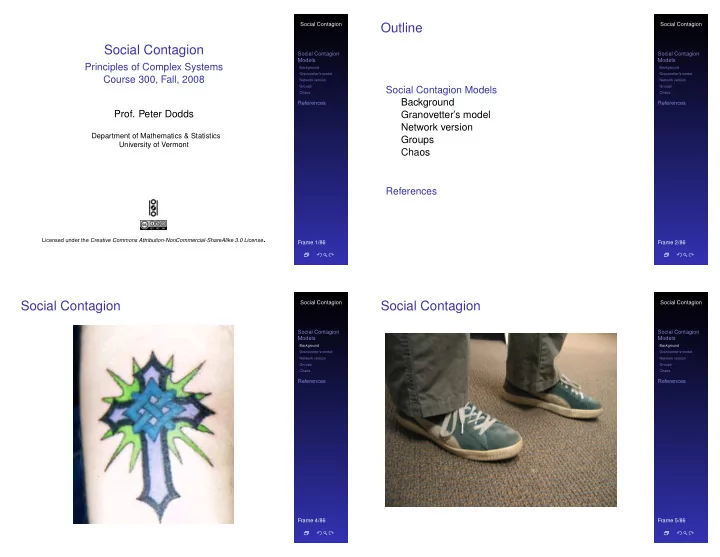
Outline Social Contagion Social Contagion Social Contagion Social - - PowerPoint PPT Presentation

outline
SMART_READER_LITE
LIVE PREVIEW

Outline Social Contagion Social Contagion Social Contagion Social - - PowerPoint PPT Presentation

Social Contagion Outline Social Contagion Social Contagion Social Contagion Social Contagion Models Models Principles of Complex Systems Background Background Granovetters model Granovetters model Course 300, Fall, 2008 Network


slide-1
SLIDE 1

Social Contagion Social Contagion Models

Background Granovetter’s model Network version Groups Chaos

References Frame 1/86

Social Contagion

Principles of Complex Systems Course 300, Fall, 2008

  • Prof. Peter Dodds

Department of Mathematics & Statistics University of Vermont

Licensed under the Creative Commons Attribution-NonCommercial-ShareAlike 3.0 License. Social Contagion Social Contagion Models

Background Granovetter’s model Network version Groups Chaos

References Frame 2/86

Outline

Social Contagion Models Background Granovetter’s model Network version Groups Chaos References

Social Contagion Social Contagion Models

Background Granovetter’s model Network version Groups Chaos

References Frame 4/86

Social Contagion

Social Contagion Social Contagion Models

Background Granovetter’s model Network version Groups Chaos

References Frame 5/86

Social Contagion

slide-2
SLIDE 2

Social Contagion Social Contagion Models

Background Granovetter’s model Network version Groups Chaos

References Frame 6/86

Social Contagion

Examples abound

◮ fashion ◮ striking ◮ smoking (⊞) [6] ◮ residential

segregation [15]

◮ ipods ◮ obesity (⊞) [5] ◮ Harry Potter ◮ voting ◮ gossip ◮ Rubik’s cube ◮ religious beliefs ◮ leaving lectures

SIR and SIRS contagion possible

◮ Classes of behavior versus specific behavior: dieting

Social Contagion Social Contagion Models

Background Granovetter’s model Network version Groups Chaos

References Frame 7/86

Framingham heart study:

Evolving network stories:

◮ The spread of quitting smoking (⊞) [6] ◮ The spread of spreading (⊞) [5]

Social Contagion Social Contagion Models

Background Granovetter’s model Network version Groups Chaos

References Frame 8/86

Social Contagion

Two focuses for us

◮ Widespread media influence ◮ Word-of-mouth influence

Social Contagion Social Contagion Models

Background Granovetter’s model Network version Groups Chaos

References Frame 9/86

Social Contagion

We need to understand influence

◮ Who influences whom? Very hard to measure... ◮ What kinds of influence response functions are

there?

◮ Are some individuals super influencers?

Highly popularized by Gladwell [8] as ‘connectors’

◮ The infectious idea of opinion leaders (Katz and

Lazarsfeld) [12]

slide-3
SLIDE 3

Social Contagion Social Contagion Models

Background Granovetter’s model Network version Groups Chaos

References Frame 10/86

The hypodermic model of influence

Social Contagion Social Contagion Models

Background Granovetter’s model Network version Groups Chaos

References Frame 11/86

The two step model of influence [12]

Social Contagion Social Contagion Models

Background Granovetter’s model Network version Groups Chaos

References Frame 12/86

The general model of influence

Social Contagion Social Contagion Models

Background Granovetter’s model Network version Groups Chaos

References Frame 13/86

Social Contagion

Why do things spread?

◮ Because of system level properties? ◮ Or properties of special individuals? ◮ Is the match that lights the fire important? ◮ Yes. But only because we are narrative-making

machines...

◮ We like to think things happened for reasons... ◮ System/group properties harder to understand ◮ Always good to examine what is said before and

after the fact...

slide-4
SLIDE 4

Social Contagion Social Contagion Models

Background Granovetter’s model Network version Groups Chaos

References Frame 14/86

The Mona Lisa

◮ “Becoming Mona Lisa: The Making of a Global

Icon”—David Sassoon

◮ Not the world’s greatest painting from the start... ◮ Escalation through theft, vandalism, parody, ...

Social Contagion Social Contagion Models

Background Granovetter’s model Network version Groups Chaos

References Frame 15/86

The completely unpredicted fall of Eastern Europe

Timur Kuran: [13, 14] “Now Out of Never: The Element of Surprise in the East European Revolution of 1989”

Social Contagion Social Contagion Models

Background Granovetter’s model Network version Groups Chaos

References Frame 16/86

The dismal predictive powers of editors...

Social Contagion Social Contagion Models

Background Granovetter’s model Network version Groups Chaos

References Frame 17/86

Social Contagion

Messing with social connections

◮ Ads based on message content

(e.g., Google and email)

◮ Buzz media ◮ Facebook’s advertising: Beacon (⊞)

slide-5
SLIDE 5

Social Contagion Social Contagion Models

Background Granovetter’s model Network version Groups Chaos

References Frame 18/86

Getting others to do things for you

A very good book: ‘Influence’ by Robert Cialdini [7]

Six modes of influence

  • 1. Reciprocation: The Old Give and Take... and Take
  • 2. Commitment and Consistency: Hobgoblins of the

Mind

  • 3. Social Proof: Truths Are Us
  • 4. Liking: The Friendly Thief
  • 5. Authority: Directed Deference
  • 6. Scarcity: The Rule of the Few

Social Contagion Social Contagion Models

Background Granovetter’s model Network version Groups Chaos

References Frame 19/86

Examples

◮ Reciprocation: Free samples, Hare Krishnas ◮ Commitment and Consistency: Hazing ◮ Social Proof: Catherine Genovese, Jonestown ◮ Liking: Separation into groups is enough to cause

problems.

◮ Authority: Milgram’s obedience to authority

experiment.

◮ Scarcity: Prohibition.

Social Contagion Social Contagion Models

Background Granovetter’s model Network version Groups Chaos

References Frame 20/86

Getting others to do things for you

◮ Cialdini’s modes are heuristics that help up us get

through life.

◮ Useful but can be leveraged...

Social Contagion Social Contagion Models

Background Granovetter’s model Network version Groups Chaos

References Frame 21/86

Social Contagion

Other acts of influence

◮ Conspicuous Consumption (Veblen, 1912) ◮ Conspicuous Destruction (Potlatch)

slide-6
SLIDE 6

Social Contagion Social Contagion Models

Background Granovetter’s model Network version Groups Chaos

References Frame 22/86

Social Contagion

Some important models

◮ Tipping models—Schelling (1971) [15, 16, 17]

◮ Simulation on checker boards ◮ Idea of thresholds ◮ Fun with Netlogo and Schelling’s model [20]...

◮ Threshold models—Granovetter (1978) [9] ◮ Herding models—Bikhchandani, Hirschleifer, Welch

(1992) [1, 2]

◮ Social learning theory, Informational cascades,... Social Contagion Social Contagion Models

Background Granovetter’s model Network version Groups Chaos

References Frame 23/86

Social contagion models

Thresholds

◮ Basic idea: individuals adopt a behavior when a

certain fraction of others have adopted

◮ ‘Others’ may be everyone in a population, an

individual’s close friends, any reference group.

◮ Response can be probabilistic or deterministic. ◮ Individual thresholds can vary ◮ Assumption: order of others’ adoption does not

matter... (unrealistic).

◮ Assumption: level of influence per person is uniform

(unrealistic).

Social Contagion Social Contagion Models

Background Granovetter’s model Network version Groups Chaos

References Frame 24/86

Social Contagion

Some possible origins of thresholds:

◮ Desire to coordinate, to conform. ◮ Lack of information: impute the worth of a good or

behavior based on degree of adoption (social proof)

◮ Economics: Network effects or network externalities ◮ Externalities = Effects on others not directly involved

in a transaction

◮ Examples: telephones, fax machine, Facebook,

  • perating systems

◮ An individual’s utility increases with the adoption

level among peers and the population in general

Social Contagion Social Contagion Models

Background Granovetter’s model Network version Groups Chaos

References Frame 26/86

Social Contagion

Granovetter’s Threshold model—definitions

◮ φ∗ = threshold of an individual. ◮ f(φ∗) = distribution of thresholds in a population. ◮ F(φ∗) = cumulative distribution =

φ∗

φ′

∗=0 f(φ′

∗)dφ′ ∗ ◮ φt = fraction of people ‘rioting’ at time step t.

slide-7
SLIDE 7

Social Contagion Social Contagion Models

Background Granovetter’s model Network version Groups Chaos

References Frame 27/86

Threshold models

0.2 0.4 0.6 0.8 1 0.2 0.4 0.6 0.8 1

φ p

0.2 0.4 0.6 0.8 1 0.2 0.4 0.6 0.8 1

φ p

◮ Example threshold influence response functions:

deterministic and stochastic

◮ φ = fraction of contacts ‘on’ (e.g., rioting) ◮ Two states: S and I.

Social Contagion Social Contagion Models

Background Granovetter’s model Network version Groups Chaos

References Frame 28/86

Threshold models

◮ At time t + 1, fraction rioting = fraction with φ∗ ≤ φt. ◮

φt+1 = φt f(φ∗)dφ∗ = F(φ∗)|φt

0 = F(φt) ◮ ⇒ Iterative maps of the unit interval [0, 1].

Social Contagion Social Contagion Models

Background Granovetter’s model Network version Groups Chaos

References Frame 29/86

Threshold models

Action based on perceived behavior of others.

1 0.2 0.4 0.6 0.8 1 φi

A

φi,t Pr(ai,t+1=1)

0.5 1 0.5 1 1.5 2 2.5 B

φ∗ f (φ∗)

0.5 1 0.2 0.4 0.6 0.8 1

φt φt+1 = F (φt)

C

◮ Two states: S and I. ◮ φ = fraction of contacts ‘on’ (e.g., rioting) ◮ Discrete time update (strong assumption!) ◮ This is a Critical mass model

Social Contagion Social Contagion Models

Background Granovetter’s model Network version Groups Chaos

References Frame 30/86

Threshold models

0.2 0.4 0.6 0.8 1 0.5 1 1.5 2

γ f(γ)

0.2 0.4 0.6 0.8 1 0.2 0.4 0.6 0.8 1

φt φt+1

◮ Another example of critical mass model...

slide-8
SLIDE 8

Social Contagion Social Contagion Models

Background Granovetter’s model Network version Groups Chaos

References Frame 31/86

Threshold models

0.2 0.4 0.6 0.8 1 0.5 1 1.5 2 2.5 3

γ f(γ)

0.2 0.4 0.6 0.8 1 0.2 0.4 0.6 0.8 1

φt φt+1

◮ Example of single stable state model

Social Contagion Social Contagion Models

Background Granovetter’s model Network version Groups Chaos

References Frame 32/86

Threshold models

Implications for collective action theory:

  • 1. Collective uniformity ⇒ individual uniformity
  • 2. Small individual changes ⇒ large global changes

Social Contagion Social Contagion Models

Background Granovetter’s model Network version Groups Chaos

References Frame 33/86

Threshold models

Chaotic behavior possible [11, 10]

0.2 0.4 0.6 0.8 1 0.2 0.4 0.6 0.8 1

xn F ( xn+1 )

0.2 0.4 0.6 0.8 1 0.2 0.4 0.6 0.8 1

xn F ( xn+1 )

◮ Period doubling arises as map amplitude r is

increased.

◮ Synchronous update assumption is crucial

Social Contagion Social Contagion Models

Background Granovetter’s model Network version Groups Chaos

References Frame 35/86

Threshold model on a network

Many years after Granovetter and Soong’s work: “A simple model of global cascades on random networks”

  • D. J. Watts. Proc. Natl. Acad. Sci., 2002 [19]

◮ Mean field model → network model ◮ Individuals now have a limited view of the world

slide-9
SLIDE 9

Social Contagion Social Contagion Models

Background Granovetter’s model Network version Groups Chaos

References Frame 36/86

Threshold model on a network

◮ Interactions between individuals now represented by

a network

◮ Network is sparse ◮ Individual i has ki contacts ◮ Influence on each link is reciprocal and of unit weight ◮ Each individual i has a fixed threshold φi ◮ Individuals repeatedly poll contacts on network ◮ Synchronous, discrete time updating ◮ Individual i becomes active when

fraction of active contacts ai ≥ φiki

◮ Individuals remain active when switched (no

recovery = SI model)

Social Contagion Social Contagion Models

Background Granovetter’s model Network version Groups Chaos

References Frame 37/86

Threshold model on a network

t=1

b c e a d

t=1

c a b e d

◮ All nodes have threshold φ = 0.2.

Social Contagion Social Contagion Models

Background Granovetter’s model Network version Groups Chaos

References Frame 38/86

Snowballing

The Cascade Condition: If one individual is initially activated, what is the probability that an activation will spread over a network? What features of a network determine whether a cascade will occur or not?

Social Contagion Social Contagion Models

Background Granovetter’s model Network version Groups Chaos

References Frame 39/86

Snowballing

First study random networks:

◮ Start with N nodes with a degree distribution pk ◮ Nodes are randomly connected (carefully so) ◮ Aim: Figure out when activation will propagate ◮ Determine a cascade condition

slide-10
SLIDE 10

Social Contagion Social Contagion Models

Background Granovetter’s model Network version Groups Chaos

References Frame 40/86

Snowballing

Follow active links

◮ An active link is a link connected to an activated

node.

◮ If an infected link leads to at least 1 more infected

link, then activation spreads.

◮ We need to understand which nodes can be

activated when only one of their neigbors becomes active.

Social Contagion Social Contagion Models

Background Granovetter’s model Network version Groups Chaos

References Frame 41/86

The most gullible

Vulnerables:

◮ We call individuals who can be activated by just one

contact being active vulnerables

◮ The vulnerability condition for node i:

1/ki ≥ φi

◮ Which means # contacts ki ≤ ⌊1/φi⌋ ◮ For global cascades on random networks, must have

a global cluster of vulnerables [19]

◮ Cluster of vulnerables = critical mass ◮ Network story: 1 node → critical mass → everyone.

Social Contagion Social Contagion Models

Background Granovetter’s model Network version Groups Chaos

References Frame 42/86

Cascade condition

Back to following a link:

◮ Link from leads to a node with probability ∝ kPk. ◮ Follows from links being random + having k chances

to connect to a node with degree k.

◮ Normalization: ∞

  • k=0

kPk = k = z

◮ So

P(linked node has degree k) = kPk k

Social Contagion Social Contagion Models

Background Granovetter’s model Network version Groups Chaos

References Frame 43/86

Cascade condition

Next: Vulnerability of linked node

◮ Linked node is vulnerable with probability

βk = 1/k

φ′

∗=0

f(φ′

∗)dφ′ ∗ ◮ If linked node is vulnerable, it produces k − 1 new

  • utgoing active links

◮ If linked node is not vulnerable, it produces no active

links.

slide-11
SLIDE 11

Social Contagion Social Contagion Models

Background Granovetter’s model Network version Groups Chaos

References Frame 44/86

Cascade condition

Putting things together:

◮ Expected number of active edges produced by an

active edge =

◮ ∞

  • k=1

(k − 1)βk kPk z

  • success

+ 0(1 − βk)kPk z

  • failure

=

  • k=1

(k − 1)kβkPk/z

Social Contagion Social Contagion Models

Background Granovetter’s model Network version Groups Chaos

References Frame 45/86

Cascade condition

So... for random networks with fixed degree distributions, cacades take off when:

  • k=1

k(k − 1)βkPk/z ≥ 1.

◮ βk = probability a degree k node is vulnerable. ◮ Pk = probability a node has degree k.

Social Contagion Social Contagion Models

Background Granovetter’s model Network version Groups Chaos

References Frame 46/86

Cascade condition

Two special cases:

◮ (1) Simple disease-like spreading succeeds: βk = β ◮

β

  • k=1

k(k − 1)Pk/z ≥ 1.

◮ (2) Giant component exists: β = 1 ◮ ∞

  • k=1

k(k − 1)Pk/z ≥ 1.

Social Contagion Social Contagion Models

Background Granovetter’s model Network version Groups Chaos

References Frame 47/86

Cascades on random networks

1 2 3 4 5 6 7 0.2 0.4 0.6 0.8 1

z 〈 S 〉

Example networks Possible No Cascades Low influence

Fraction of Vulnerables cascade size Final

Cascades No Cascades Cascades No High influence

◮ Cascades occur

  • nly if size of max

vulnerable cluster > 0.

◮ System may be

‘robust-yet-fragile’.

◮ ‘Ignorance’

facilitates spreading.

slide-12
SLIDE 12

Social Contagion Social Contagion Models

Background Granovetter’s model Network version Groups Chaos

References Frame 48/86

Cascade window for random networks

1 2 3 4 5 6 7 0.2 0.4 0.6 0.8 1

z 〈 S 〉

0.05 0.1 0.15 0.2 0.25 5 10 15 20 25 30

φ z

cascades no cascades

influence = uniform individual threshold

◮ ‘Cascade window’ widens as threshold φ decreases. ◮ Lower thresholds enable spreading.

Social Contagion Social Contagion Models

Background Granovetter’s model Network version Groups Chaos

References Frame 49/86

Cascade window for random networks

Social Contagion Social Contagion Models

Background Granovetter’s model Network version Groups Chaos

References Frame 50/86

Cascade window—summary

For our simple model of a uniform threshold:

  • 1. Low k: No cascades in poorly connected networks.

No global clusters of any kind.

  • 2. High k: Giant component exists but not enough

vulnerables.

  • 3. Intermediate k: Global cluster of vulnerables exists.

Cascades are possible in “Cascade window.”

Social Contagion Social Contagion Models

Background Granovetter’s model Network version Groups Chaos

References Frame 51/86

All-to-all versus random networks

0.2 0.4 0.6 0.8 1

a0

at F (at+1) all−to−all networks A

0.2 0.4 0.6 0.8 1

〈 k 〉 〈 S 〉 random networks B

0.2 0.4 0.6 0.8 1 0.2 0.4 0.6 0.8 1

a0 a’0

at F (at+1) C

5 10 15 20 0.2 0.4 0.6 0.8 1

〈 k 〉 〈 S 〉 D

0.5 1 5 10 φ∗ f (φ∗) 0.5 1 2 4 φ∗ f (φ∗)

slide-13
SLIDE 13

Social Contagion Social Contagion Models

Background Granovetter’s model Network version Groups Chaos

References Frame 52/86

Early adopters—degree distributions

t = 0 t = 1 t = 2 t = 3

5 10 15 20 0.05 0.1 0.15 0.2

t = 0

5 10 15 20 0.2 0.4 0.6 0.8

t = 1

5 10 15 20 0.2 0.4 0.6 0.8

t = 2

5 10 15 20 0.2 0.4 0.6 0.8

t = 3

t = 4 t = 6 t = 8 t = 10

5 10 15 20 0.1 0.2 0.3 0.4 0.5

t = 4

5 10 15 20 0.1 0.2 0.3 0.4 0.5

t = 6

5 10 15 20 0.1 0.2 0.3 0.4

t = 8

5 10 15 20 0.1 0.2 0.3 0.4

t = 10

t = 12 t = 14 t = 16 t = 18

5 10 15 20 0.05 0.1 0.15 0.2

t = 12

5 10 15 20 0.05 0.1 0.15 0.2

t = 14

5 10 15 20 0.05 0.1 0.15 0.2

t = 16

5 10 15 20 0.05 0.1 0.15 0.2

t = 18

Pk,t versus k

Social Contagion Social Contagion Models

Background Granovetter’s model Network version Groups Chaos

References Frame 53/86

The multiplier effect:

1 2 3 4 5 6 0.2 0.4 0.6 0.8 1

navg Savg A

1 2 3 4 5 6 1 2 3 4

navg B

Gain Influence Influence Average individuals Top 10% individuals Cascade size Cascade size ratio Degree ratio ◮ Fairly uniform levels of individual influence. ◮ Multiplier effect is mostly below 1.

Social Contagion Social Contagion Models

Background Granovetter’s model Network version Groups Chaos

References Frame 54/86

The multiplier effect:

1 2 3 4 5 6 0.2 0.4 0.6 0.8 1

navg Savg A

1 2 3 4 5 6 3 6 9 12

navg B

Cascade size Influence Average Individuals Top 10% individuals Cascade size ratio Degree ratio Gain ◮ Skewed influence distribution example.

Social Contagion Social Contagion Models

Background Granovetter’s model Network version Groups Chaos

References Frame 55/86

Special subnetworks can act as triggers

i0 A B

◮ φ = 1/3 for all nodes

slide-14
SLIDE 14

Social Contagion Social Contagion Models

Background Granovetter’s model Network version Groups Chaos

References Frame 57/86

The power of groups...

despair.com

“A few harmless flakes working together can unleash an avalanche

  • f destruction.”

Social Contagion Social Contagion Models

Background Granovetter’s model Network version Groups Chaos

References Frame 58/86

Extensions

◮ Assumption of sparse interactions is good ◮ Degree distribution is (generally) key to a network’s

function

◮ Still, random networks don’t represent all networks ◮ Major element missing: group structure

Social Contagion Social Contagion Models

Background Granovetter’s model Network version Groups Chaos

References Frame 59/86

Group structure—Ramified random networks

p = intergroup connection probability q = intragroup connection probability.

Social Contagion Social Contagion Models

Background Granovetter’s model Network version Groups Chaos

References Frame 60/86

Bipartite networks

c d e a b 2 3 4 1 a b c d e contexts individuals unipartite network

slide-15
SLIDE 15

Social Contagion Social Contagion Models

Background Granovetter’s model Network version Groups Chaos

References Frame 61/86

Context distance

e c a high school teacher

  • ccupation

health care education nurse doctor teacher kindergarten d b

Social Contagion Social Contagion Models

Background Granovetter’s model Network version Groups Chaos

References Frame 62/86

Generalized affiliation model

100

e c a b d geography

  • ccupation

age

(Blau & Schwartz, Simmel, Breiger)

Social Contagion Social Contagion Models

Background Granovetter’s model Network version Groups Chaos

References Frame 63/86

Generalized affiliation model networks with triadic closure

◮ Connect nodes with probability ∝ exp−αd

where α = homophily parameter and d = distance between nodes (height of lowest common ancestor)

◮ τ1 = intergroup probability of friend-of-friend

connection

◮ τ2 = intragroup probability of friend-of-friend

connection

Social Contagion Social Contagion Models

Background Granovetter’s model Network version Groups Chaos

References Frame 64/86

Cascade windows for group-based networks

Generalized Affiliation A Group networks Single seed Coherent group seed Model networks Random set seed Random F C D E B

slide-16
SLIDE 16

Social Contagion Social Contagion Models

Background Granovetter’s model Network version Groups Chaos

References Frame 65/86

Multiplier effect for group-based networks:

4 8 12 16 20 0.2 0.4 0.6 0.8 1

navg Savg A

4 8 12 16 20 1 2 3

navg B

4 8 12 16 0.2 0.4 0.6 0.8 1

navg Savg C

4 8 12 16 1 2 3

navg D

Degree ratio Gain Cascade size ratio Cascade size ratio < 1!

◮ Multiplier almost always below 1.

Social Contagion Social Contagion Models

Background Granovetter’s model Network version Groups Chaos

References Frame 66/86

Assortativity in group-based networks

5 10 15 20 0.2 0.4 0.6 0.8

k

4 8 12 0.5 1 k

Average Cascade size Local influence Degree distribution for initially infected node

◮ The most connected nodes aren’t always the most

‘influential.’

◮ Degree assortativity is the reason.

Social Contagion Social Contagion Models

Background Granovetter’s model Network version Groups Chaos

References Frame 67/86

Social contagion

Summary

◮ ‘Influential vulnerables’ are key to spread. ◮ Early adopters are mostly vulnerables. ◮ Vulnerable nodes important but not necessary. ◮ Groups may greatly facilitate spread. ◮ Seems that cascade condition is a global one. ◮ Most extreme/unexpected cascades occur in highly

connected networks

◮ ‘Influentials’ are posterior constructs. ◮ Many potential influentials exist.

Social Contagion Social Contagion Models

Background Granovetter’s model Network version Groups Chaos

References Frame 68/86

Social contagion

Implications

◮ Focus on the influential vulnerables. ◮ Create entities that can be transmitted successfully

through many individuals rather than broadcast from

  • ne ‘influential.’

◮ Only simple ideas can spread by word-of-mouth.

(Idea of opinion leaders spreads well...)

◮ Want enough individuals who will adopt and display. ◮ Displaying can be passive = free (yo-yo’s, fashion),

  • r active = harder to achieve (political messages).

◮ Entities can be novel or designed to combine with

  • thers, e.g. block another one.
slide-17
SLIDE 17

Social Contagion Social Contagion Models

Background Granovetter’s model Network version Groups Chaos

References Frame 70/86

Chaotic contagion:

◮ What if individual response functions are not

monotonic?

◮ Consider a simple deterministic version:

◮ Node i has an ‘activation threshold’ φi,1

. . . and a ‘de-activation threshold’ φi,2

◮ Nodes like to imitate but only up to a

limit—they don’t want to be like everyone else.

1 0.2 0.4 0.6 0.8 1 i,1

  • i,2
  • A

i,t Pr(ai,t+1=1)

  • Social Contagion

Social Contagion Models

Background Granovetter’s model Network version Groups Chaos

References Frame 71/86

Two population examples:

1 0.2 0.4 0.6 0.8 1 φi,1

φi,2

A

φi,t Pr(ai,t+1=1)

0.5 1 0.2 0.4 0.6 0.8 1 B

φ1

φ2

∗ 0.5 1 0.2 0.4 0.6 0.8 1

φ1

φ2

∗ C

0.5 1 0.5 1 0.5 1 0.5 1

◮ Randomly select (φi,1, φi,2) from gray regions shown

in plots B and C.

◮ Insets show composite response function averaged

  • ver population.

◮ We’ll consider plot C’s example: the tent map.

Social Contagion Social Contagion Models

Background Granovetter’s model Network version Groups Chaos

References Frame 72/86

Chaotic contagion

Definition of the tent map:

F(x) = rx for 0 ≤ x ≤ 1

2,

r(1 − x) for 1

2 ≤ x ≤ 1. ◮ The usual business: look at how F iteratively maps

the unit interval [0, 1].

Social Contagion Social Contagion Models

Background Granovetter’s model Network version Groups Chaos

References Frame 73/86

The tent map

Effect of increasing r from 1 to 2.

0.2 0.4 0.6 0.8 1 0.2 0.4 0.6 0.8 1

xn F ( xn+1 )

0.2 0.4 0.6 0.8 1 0.2 0.4 0.6 0.8 1

xn F ( xn+1 )

0.2 0.4 0.6 0.8 1 0.2 0.4 0.6 0.8 1

xn F ( xn+1 )

Orbit diagram:

Chaotic behavior increases as map slope r is increased.

slide-18
SLIDE 18

Social Contagion Social Contagion Models

Background Granovetter’s model Network version Groups Chaos

References Frame 74/86

Chaotic behavior

Take r = 2 case:

0.2 0.4 0.6 0.8 1 0.2 0.4 0.6 0.8 1

xn F ( xn+1 )

◮ What happens if nodes have limited information? ◮ As before, allow interactions to take place on a

sparse random network.

◮ Vary average degree z = k, a measure of

information

Social Contagion Social Contagion Models

Background Granovetter’s model Network version Groups Chaos

References Frame 75/86

Invariant densities—stochastic response functions

500 1000 1500 2000 0.2 0.4 0.6 0.8 1

t s

z = 5

0.5 1 20 40 60

s P(s)

z = 5

activation time series activation density

Social Contagion Social Contagion Models

Background Granovetter’s model Network version Groups Chaos

References Frame 76/86

Invariant densities—stochastic response functions

500 1000 1500 2000 0.2 0.4 0.6 0.8 1

t s

z = 5

0.5 1 20 40 60

s P(s)

z = 5 500 1000 1500 2000 0.2 0.4 0.6 0.8 1

t s

z = 10

0.5 1 10 20 30

s P(s)

z = 10 500 1000 1500 2000 0.2 0.4 0.6 0.8 1

t s

z = 18

0.5 1 5 10 15 20

s P(s)

z = 18 500 1000 1500 2000 0.2 0.4 0.6 0.8 1

t s

z = 22

0.5 1 2 4 6 8 10

s P(s)

z = 22 500 1000 1500 2000 0.2 0.4 0.6 0.8 1

t s

z = 24

0.5 1 2 4 6 8

s P(s)

z = 24 500 1000 1500 2000 0.2 0.4 0.6 0.8 1

t s

z = 30

0.5 1 2 4 6

s P(s)

z = 30

Social Contagion Social Contagion Models

Background Granovetter’s model Network version Groups Chaos

References Frame 77/86

Invariant densities—deterministic response functions for one specific network with k = 18

500 1000 1500 2000 0.2 0.4 0.6 0.8 1

t s

z = 18

0.5 1 10 20 30

s P(s)

z = 18 500 1000 1500 2000 0.2 0.4 0.6 0.8 1

t s

z = 18

0.5 1 5 10 15 20 25

s P(s)

z = 18 500 1000 1500 2000 0.2 0.4 0.6 0.8 1

t s

z = 18

0.5 1 10 20 30 40 50

s P(s)

z = 18 500 1000 1500 2000 0.2 0.4 0.6 0.8 1

t s

z = 18

0.5 1 10 20 30 40 50

s P(s)

z = 18 500 1000 1500 2000 0.2 0.4 0.6 0.8 1

t s

z = 18

0.5 1 2 4 6 8

s P(s)

z = 18 500 1000 1500 2000 0.2 0.4 0.6 0.8 1

t s

z = 18

0.5 1 10 20 30

s P(s)

z = 18

slide-19
SLIDE 19

Social Contagion Social Contagion Models

Background Granovetter’s model Network version Groups Chaos

References Frame 78/86

Invariant densities—stochastic response functions

500 1000 1500 2000 0.2 0.4 0.6 0.8 1

t s

z = 100

0.5 1 1 2 3 4

s P(s)

z = 100 500 1000 1500 2000 0.2 0.4 0.6 0.8 1

t s

z = 1000

0.5 1 0.5 1 1.5 2 2.5

s P(s)

z = 1000

Trying out higher values of k. . .

Social Contagion Social Contagion Models

Background Granovetter’s model Network version Groups Chaos

References Frame 79/86

Invariant densities—deterministic response functions

500 1000 1500 2000 0.2 0.4 0.6 0.8 1

t s

z = 100

0.5 1 1 2 3 4

s P(s)

z = 100 500 1000 1500 2000 0.2 0.4 0.6 0.8 1

t s

z = 1000

0.5 1 0.5 1 1.5 2 2.5

s P(s)

z = 1000

5000 10000 0.2 0.4 0.6 0.8 1

t s

z = 100

0.5 1 10 20 30

s P(s)

z = 100

Trying out higher values of k. . .

Social Contagion Social Contagion Models

Background Granovetter’s model Network version Groups Chaos

References Frame 80/86

Connectivity leads to chaos:

Stochastic response functions:

Social Contagion Social Contagion Models

Background Granovetter’s model Network version Groups Chaos

References Frame 81/86

Chaotic behavior in coupled systems

Coupled maps are well explored (Kaneko/Kuramoto):

xi,n+1 = f(xi,n) +

  • j∈Ni

δi,jf(xj,n)

◮ Ni = neighborhood of node i

  • 1. Node states are continuous
  • 2. Increase δ and neighborhood size |N|

⇒ synchronization

But for contagion model:

  • 1. Node states are binary
  • 2. Asynchrony remains as connectivity increases
slide-20
SLIDE 20

Social Contagion Social Contagion Models

Background Granovetter’s model Network version Groups Chaos

References Frame 82/86

Bifurcation diagram: Asynchronous updating

0.2 0.4 0.6 0.8 1 0.2 0.4 0.6 0.8 1

α

P(s | r)/max P(s | r)

Social Contagion Social Contagion Models

Background Granovetter’s model Network version Groups Chaos

References Frame 83/86

References I

  • S. Bikhchandani, D. Hirshleifer, and I. Welch.

A theory of fads, fashion, custom, and cultural change as informational cascades.

  • J. Polit. Econ., 100:992–1026, 1992.
  • S. Bikhchandani, D. Hirshleifer, and I. Welch.

Learning from the behavior of others: Conformity, fads, and informational cascades.

  • J. Econ. Perspect., 12(3):151–170, 1998. pdf (⊞)
  • J. Carlson and J. Doyle.

Highly optimized tolerance: A mechanism for power laws in design systems.

  • Phys. Rev. Lett., 60(2):1412–1427, 1999. pdf (⊞)

Social Contagion Social Contagion Models

Background Granovetter’s model Network version Groups Chaos

References Frame 84/86

References II

  • J. Carlson and J. Doyle.

Highly optimized tolerance: Robustness and design in complex systems.

  • Phys. Rev. Lett., 84(11):2529–2532, 2000. pdf (⊞)
  • N. A. Christakis and J. H. Fowler.

The spread of obesity in a large social network over 32 years. New England Journal of Medicine, 357:370–379,

  • 2007. pdf (⊞)
  • N. A. Christakis and J. H. Fowler.

The collective dynamics of smoking in a large social network. New England Journal of Medicine, 358:2249–2258,

  • 2008. pdf (⊞)

Social Contagion Social Contagion Models

Background Granovetter’s model Network version Groups Chaos

References Frame 85/86

References III

  • R. B. Cialdini.

Influence: Science and Practice. Allyn and Bacon, Boston, MA, 4th edition, 2000.

  • M. Gladwell.

The Tipping Point. Little, Brown and Company, New York, 2000.

  • M. Granovetter.

Threshold models of collective behavior.

  • Am. J. Sociol., 83(6):1420–1443, 1978. pdf (⊞)
  • M. Granovetter and R. Soong.

Threshold models of diversity: Chinese restaurants, residential segregation, and the spiral of silence. Sociological Methodology, 18:69–104, 1988. pdf (⊞)

slide-21
SLIDE 21

Social Contagion Social Contagion Models

Background Granovetter’s model Network version Groups Chaos

References Frame 86/86

References IV

  • M. S. Granovetter and R. Soong.

Threshold models of interpersonal effects in consumer demand. Journal of Economic Behavior & Organization, 7:83–99, 1986. Formulates threshold as function of price, and introduces exogenous supply curve. pdf (⊞)

  • E. Katz and P

. F . Lazarsfeld. Personal Influence. The Free Press, New York, 1955.

  • T. Kuran.

Now out of never: The element of surprise in the east european revolution of 1989. World Politics, 44:7–48, 1991.

Social Contagion Social Contagion Models

Background Granovetter’s model Network version Groups Chaos

References Frame 87/86

References V

  • T. Kuran.

Private Truths, Public Lies: The Social Consequences of Preference Falsification. Harvard University Press, Cambridge, MA, Reprint edition, 1997.

  • T. Schelling.

Dynamic models of segregation.

  • J. Math. Sociol., 1:143–186, 1971.
  • T. C. Schelling.

Hockey helmets, concealed weapons, and daylight saving: A study of binary choices with externalities.

  • J. Conflict Resolut., 17:381–428, 1973.
  • T. C. Schelling.

Micromotives and Macrobehavior. Norton, New York, 1978.

Social Contagion Social Contagion Models

Background Granovetter’s model Network version Groups Chaos

References Frame 88/86

References VI

  • D. Sornette.

Critical Phenomena in Natural Sciences. Springer-Verlag, Berlin, 2nd edition, 2003.

  • D. J. Watts.

A simple model of global cascades on random networks.

  • Proc. Natl. Acad. Sci., 99(9):5766–5771, 2002.

pdf (⊞)

  • U. Wilensky.

Netlogo segregation model. http://ccl.northwestern.edu/netlogo/ models/Segregation. Center for Connected Learning and Computer-Based Modeling, Northwestern University, Evanston, IL., 1998.