What can Infrastructure do for you today? Daniel Humbedooh Gruno - - PowerPoint PPT Presentation

what can infrastructure do for you today
SMART_READER_LITE
LIVE PREVIEW

What can Infrastructure do for you today? Daniel Humbedooh Gruno - - PowerPoint PPT Presentation

What can Infrastructure do for you today? Daniel Humbedooh Gruno Infrastructure Architect, The Apache Software Foundation What is infrastructure? What is infrastructure? The Apache Infrastructure Committee (henceforth


slide-1
SLIDE 1

What can Infrastructure do for you today?

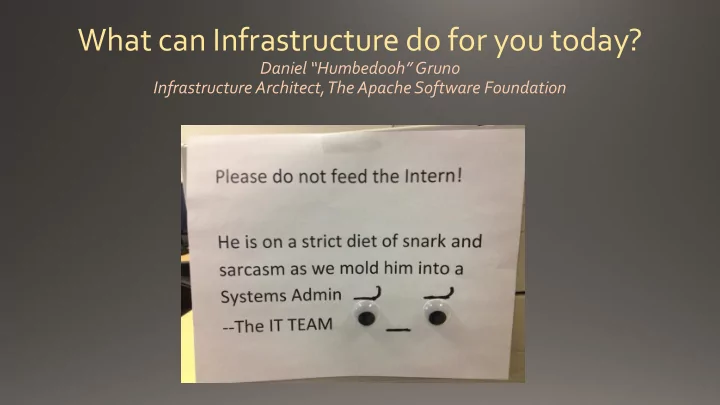
Daniel “Humbedooh” Gruno Infrastructure Architect, The Apache Software Foundation
slide-2
SLIDE 2

What is infrastructure?

slide-3
SLIDE 3

What is infrastructure?

  • The Apache Infrastructure Committee (henceforth ‘Infrastructure’)

is the steward of code and development provenance.

  • Infrastructure manages all the machines and services that tie

together the ASF.

  • Infrastructure grants and oversees the resources project teams

need to be able to collaborate on the software that makes the ASF interesting.

  • Infrastructure facilitates the common community resources that

allows people to communicate and make the ASF awesome.

slide-4
SLIDE 4

Who is infrastructure?

slide-5
SLIDE 5

Infrastructure is a vast group of people and hardware

  • 90 members of the Infrastructure LDAP group
  • 42 people in the supporting infrastructure-interest LDAP group
  • 16 people in the presidents committee (root@)
  • 6 paid staffers (4 full-time, 2 part-time)
  • 35 bare-metal machines
  • 100+ VMs and jails
slide-6
SLIDE 6

A historical look at infrastructure

  • The Infrastructure team was informally founded in 1999
  • In 2002, a resolution was made to form the Infrastructure

Committee as a board committee. IT WAS DECLINED!!!11one

  • Somehow, (without anyone apparently knowing when), the

Infrastructure Committee was formed as a President’s Committee somewhere between October, 2002 and February, 2003.

  • First actual Vice President was in 2008 (Paul Querna)
  • Originally tasked with handling email, website and subversion repo
  • Started out as an all-volunteer group of committers
slide-7
SLIDE 7

Infrastructure service timeline

A list of some of the main services as they appeared in the ASF:

  • CVS Server
  • Mailing lists
  • Web sites

1999

  • BugZilla

2001

  • Infra-PMC founded
  • Subversion

2003

  • JIRA

2004

  • Moin Moin Wiki

2005

  • First VP, Infra
  • Buildbot
  • Hudson (Jenkins)

2008

  • Git
  • Roller weblog
  • Confluence

2010

  • GitHub integration

starts

2012

  • Completed GitHub

Integration

  • Puppetized

systems

2014

slide-8
SLIDE 8

Committers Infrastructure ASF Members Root

How was infrastructure comprised back in the day?

  • All volunteer based
  • Infrastructure members were picked from committers
  • Root was by merit and ASF Members only
slide-9
SLIDE 9

Non-committers Committers Infrastructure Root Staff

How is Infrastructure comprised today?

  • All-volunteer model did not scale
  • Staff was hired to deal with the growth of the ASF
  • Root picked from infrastructure members or hired staff
  • Root does not require ASF membership
slide-10
SLIDE 10

Chain of Command

Infrastructure is a President’s Committee. It is comprised of 16 members, including a Vice President of Infrastructure (Currently David Nalley since April 2014). Infrastructure reports to the president of the ASF (or the EVP in his/her absence). Unlike Top Level Projects, that reports to the board every quarter, Infrastructure is required to report to the president every month, who in turn reports to the board at the monthly board meeting.

slide-11
SLIDE 11

Chain of Command

Board of Directors Ross Gardler, President of the ASF Rich Bowen, Executive Vice President The Pony Mafia David Nalley, Vice President, Infrastructure Infrastructure Committee (root@) Infrastructure Infrastructure Interest

slide-12
SLIDE 12

What does Infrastructure report on?

  • Infrastructure reports on the general activity and future of the

infrastructure at the ASF:

  • General activity
  • Significant events the past month (CVEs, faulty h/w, maintenance,

upgrades)

  • Overall uptime statistics (see next slide)
  • Ongoing changes to the infrastructure
  • Future development plans
  • Post mortem on failures and incidents
slide-13
SLIDE 13

Service level agreements and reality

  • The Infrastructure team is bound by an SLA for a select group of

services:

  • Critical services (mail, web sites, svn, git) must have 99.50% uptime
  • Core services (BugZilla, JIRA, CI, Whimsy, SSL Frontends) must have

99.00% uptime

  • Standard services (Weblogs, Wikis, Pootle, ReviewBoard etc) must have

95.00% uptime.

  • Overall, services must have an average 98.00% uptime.
slide-14
SLIDE 14

Service level agreements and reality

  • Current uptime statistics for the past 6 months:
  • Critical services: 99.96% (0.46% above target)
  • Core services: 99.75% (0.75% above target)
  • Standard services: 97.98% (2.98% above target)
  • Overall uptime: 99.31% (1.31% above target)
  • Source: http://s.apache.org/uptime

June-July July-August August-September September-October October-November November-December 96.00% 96.50% 97.00% 97.50% 98.00% 98.50% 99.00% 99.50% 100.00%

Reporting cycle Uptime in percent

Uptime over time

Availability: Target:

slide-15
SLIDE 15

Service level agreements and reality

Failures and service restoration relative to (my) time of day, past month Each week, we have between 5 and 10 service failures

slide-16
SLIDE 16

What does infrastructure do?

slide-17
SLIDE 17

What does infrastructure do today?

  • Infrastructure manages the 40+ unique services used by today’s

developers and users.

  • These services include:
  • Mailing lists
  • Mail archives
  • Committer email

accounts

Email

  • Subversion

repositories

  • Git repositories
  • Nexus repository

Code repositories

  • Main apache.org

site

  • Project web sites
  • Paste, comment,

pad etc

Web sites

  • JIRA
  • Bugzilla
  • ReviewBoard
  • Allura

Issue and bug tracking

  • Moin Moin Wiki
  • Confluence Wiki

Wiki services

  • Dist repository
  • Release archive
  • RSYNC

Release distribution

  • Logging
  • Heartbeats
  • Health checks

Monitoring

  • Buildbot
  • Jenkins

Continuous Integration

slide-18
SLIDE 18

Heck, let’s list all services!*

Blogs

Foundation blog Project blogs

Web sites

Main web site Project web sites Comments system

Wikis

Moin Moin Wiki Confluence Wiki

Email

Mailing lists Mail archives Committer email aliases Front-end mail exchangers SMTP relay server

Issue and bugs

JIRA Bugzilla

Continuous Integration

Jenkins Buildbot

Code review

ReviewBoard SonarQube Analysis

Code distribution

Dist repository Release archives Maven Nexus Archiva repository

Source repositories

Subversion repos Writable git repos Git mirrors

IRC

ASFBot #apache-* namespace

Monitoring

Unified logging Heartbeat monitors Health checks

Supplementary services

Whimsy Self-serve Ac/ml/tlp-req Etherpad Paste bucket

Translation services

Pootle

Code integration services

Github integration
  • Pull requests
  • Email integration
  • Git-wip sync
Svngit2jira

Virtual machines and jails

Project playgrounds Project-managed services

*These are the ones I could think of

slide-19
SLIDE 19

How does infra work on a daily basis?

  • Most direct day-to-day communication happen on HipChat
  • http://s.apache.org/infrachat
  • Important decisions/discussions happen via the mailing lists
  • Weekly operational team meetings take place on Google Hangout
  • And everyone is invited, see our HipChat room topic.
  • Weekly and monthly reports are shared with the ASF operational

group

slide-20
SLIDE 20

Who does what on a normal day?

  • The bulk of infra handles open tickets and ongoing projects
  • On-call staff handles immediate queries/alerts and account

creations on a rotating week-by-week basis

  • Escalation plans are in place that delegate tasks to staff based on

response times and severity of incidents

slide-21
SLIDE 21

Typical questions we get

  • 1. This doesn’t work! (no details provided)
  • Please always provide enough information to replicate the error/bug
  • 2. I can’t commit anything to the repo!
  • Make sure you use https instead of http! Make sure you’re not banned!
  • 3. I can’t log onto JIRA/BugZilla/whatever using my LDAP creds!
  • We don’t use LDAP for everything (yet!), some services require local accts.
  • 4. Your $project software is ruining my life, fix it!
  • Yeah, I’m gonna need you to come in on Sunday and work late…
  • 5. Unsubscribe me!!!
  • Read the footer in the ML emails you get, it has a link to unsubscribe you
slide-22
SLIDE 22

Contacting Infrastructure

  • Canonical contact list: www.apache.org/dev/infra-contact.html
  • We are no longer on IRC – use HipChat: http://s.apache.org/infrachat
  • Via email: infrastructure@apache.org
  • Or, you can break something and we’ll notice immediately.
slide-23
SLIDE 23

That’s all, folks!

For inquiries, comments, snark:

  • humbedooh@apache.org
  • Twitter: @humbedooh