
SLIDE 1
SMART SNACKS IN SCHOOL
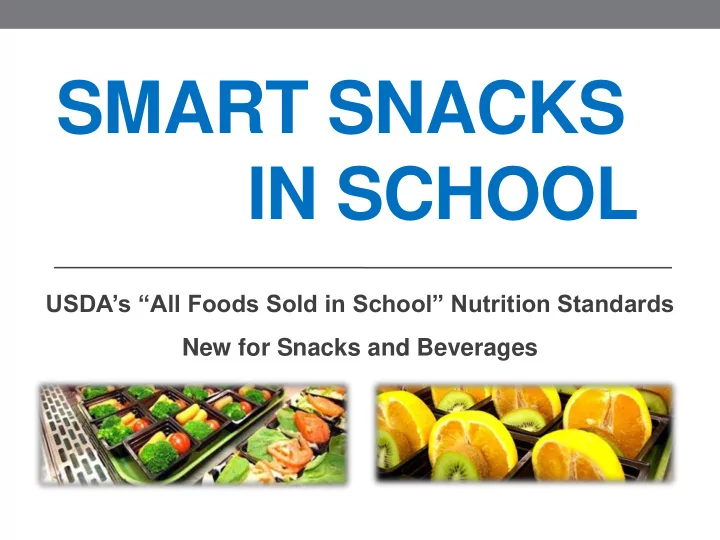
USDA’s “All Foods Sold in School” Nutrition Standards New for Snacks and Beverages
SMART SNACKS IN SCHOOL USDAs All Foods Sold in School Nutrition - - PowerPoint PPT Presentation
SMART SNACKS IN SCHOOL USDAs All Foods Sold in School Nutrition Standards New for Snacks and Beverages Presentation Outline Overview of USDAs Smart Snacks in School Nutrition Standards What is the purpose When and where do
USDA’s “All Foods Sold in School” Nutrition Standards New for Snacks and Beverages
As a part of the Healthy Hunger-Free Kids Act of 2010, the new Smart Snacks in School rules affect “competitive foods” sold in schools, which include vending machines, a la carte lunch lines, and in student stores. These snacks and beverages are purchased outside of the regular meals provided by the school, and “compete” with the nutritionally regulated and reimbursable national school lunch and breakfast programs.
Administration staff
School campus: All areas of the property under the jurisdiction of the school that are accessible to students during the school day.
to make necessary adjustments to the school food environment.
new standards.
such as diabetes and heart disease due to being overweight or obese.
shorter lives than their parents.
service professionals, health professionals, industry, etc.
by other entities, and expert recommendations from the Institute of Medicine and the Dietary Guidelines for Americans.
flexible solutions to promote healthier eating at school, which were published in the Federal Register on February 8, 2013.
www.fns.usda.gov/cnd/Governance/Legislation/allfoods.hmt
February 1, 2013
Proposed rule initially released by USDA
March 25, 2013
SNA submitted comments
A competitive foods task force was assembled by SNA, which prepared and submitted comments in response to the call for comments by USDA.
June 28, 2013
Interim final rule released by USDA
September 24, 2013
SNA submitted second round of comments
The SNA competitive foods task force prepared and submitted additional comments on the interim final rule released by USDA.
understands that the state and local policies can and do have stricter recommendations.”
fit their district.”
within school buildings and property.”
Resource: http://www.schoolnutrition.org/meetings.aspx
SNA believes that the rule, when implemented, should:
Meal Pattern Guidelines, limiting the additional burden as required by Healthy Hunger-Free Kids Act.”
without any further restrictions.”
for students.”
Any food sold in schools must:
vegetable, diary product, or protein food; or
vegetable; or
concern (calcium, potassium, vitamin D or dietary fiber)
Calorie Limits
Sodium Limits
Fat Limits
Sugar Limit
*On July 1, 2016, foods may not qualify using 10% DV criteria ** On July 1, 2016, snack items must contain ≤200 mg sodium per item
however, state agencies may determine frequency they take place.
For for All Grade Levels
Water
Milk
Juice
8 oz., or ≤ 20 calories per 20 oz.
Elementary and Middle Schools
amounts of naturally-occurring caffeine substances. High School
“Good-bye doughnuts, candy bars, high-fat chips, full-calorie soft drinks and chocolate sandwich cookies. Those kinds of foods and beverages will no longer be allowed to be sold in school… Hello granola bars, peanuts, fruit cups, light popcorn, low-fat chips and no-calorie flavored water. Those types of foods will be offered.” – “ ‘Smart Snacks’ Replacing Junk Food in Schools”, USA Today
schools through a review of local educational agency records as part of the State agency administrative review.
required.
educational agencies prior to and during the implementation process.
Smart Snacks in School: USDA Website http://www.fns.usda.gov/cnd/governance/legislation/allfoods.htm USDA’s The School Day Just Got Healthier Toolkit http://www.fns.usda.gov/healthierschoolday Smart Snacks in School: Questions and Answers http://www.fns.usda.gov/cnd/Governance/Legislation/allfoods_QandA.pdf
To read more about the new Smart Snacks in School nutrition standards, reference the websites listed below.
requirement is met
introduction of the programs in 1946
the Dietary Guidelines for Americans
IOM recommendations
Hunger Free Kids Act, was in 1995