
SLIDE 1
“Top-up” Operation at the Swiss Light Source
SPring-8 12/03/02
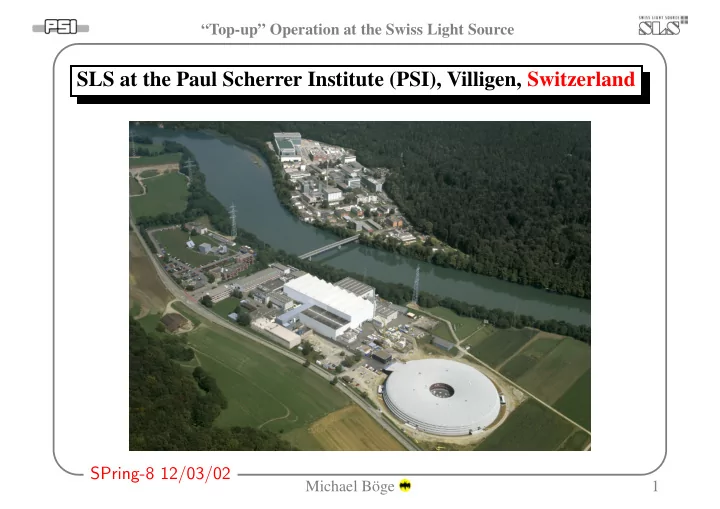
SLS at the Paul Scherrer Institute (PSI), Villigen, Switzerland
Michael B¨
- ge
SLS at the Paul Scherrer Institute (PSI), Villigen, Switzerland - - PowerPoint PPT Presentation
Top-up Operation at the Swiss Light Source SLS at the Paul Scherrer Institute (PSI), Villigen, Switzerland SPring-8 12/03/02 Michael B oge 1 Top-up Operation at the Swiss Light Source SLS Team at PSI SPring-8 12/03/02 Michael
SLS 100 MeV Pre− Injector Layout
Optics Gun, bunching section and first accelerating structure
Goal:
− Fast injection into the SLS storage ring (up to 200 mA/min).
Constraints:
− Narrow apertures of the innovative SLS booster synchrotron. − Radiation protection limitations.
Modes of operation:
− A single bunch mode (max. 1.5nC, 1ns). − A variable multi bunch mode (max. 1.5 nC). − In addition an optional low current mode is planned to
perform a top up injection, keeping the mean current in the storage ring nearly constant. Low energy region (up to 10 MeV):
− 31 solenoids.
Drift section at 50MeV:
− Quadrupole triplet to matches the beam through the
second accelerating structure. Two 35MW pulsed klystrons, TH2100 from Thomson, are used to power the travelling wave bunchers and the accelerating structures. The power distribution between bunchers and section 1 is performed by means of two variable power splitters. The RF power needs for a 100 MeV
RF distribution
500 MHz prebuncher 500 W 4 cell buncher 2.7 MW 16 cell buncher 3.7 MW Accelerating section 1 11.5 MW Accelerating section 2 18 MW Diagnostic description
Except the Integrating Current Transformers (standard ICT monitors from Bergoz) all the diagnostics have been developed at PSI and optimised to cover the large dynamic range of the SLS pre− injector. FCUP− 1 (Coaxial Faraday Cup)
− transient beam meas. behind the gun at 90 KeV. − bandwidth: >6 GHz − can be moved into a beam with pneumatic actuators
WCM− 1 and WCM− 2 (Wall Current Monitors)
− transient beam meas. behind the gun and in the transfer line at 100 MeV − cut− off: <100 kHz − bandwidth: ~4 GHz
ICT− 1 and ICT− 2 (Integrating Current Transformers)
− beam transmission efficiency trough Linac − resolution: <5%
BPM (strip line Beam Position Monitors)
− mismatch design for high sensitivity and max. aperture for low current Top− up mode
SMs − OPTICAL diagnostics
− six optical Screen Monitors (SM) have been used during the commissioning. All SM have been
intensively used for fine beam alignment and focus optimisation.
− SM− 5 and SM− E have been used for emittance and energy spread measurements. − two different monitors are installed in each SM station for high resolution measurements of the
transverse beam parameters:
a high sensitivity YAG:Ce detector for low current operation (charge < 1nC). an Al− foil producing Optical Transition Radiation (OTR).
− all SM monitors can be moved into the beam with 3 stage pneumatic actuators. Max single bunch width 1ns Bunch train length 0.2 − 0.9µs Max Charge 1.5nC (both modes) Energy >100 MeV Pulse −pulse energy stability <0.25% Relative energy spread <0.5% (rms.) Normalized emittance (1σ) <50 π πmm mrad Single bunch purity <0.01 Repetition rate 3.125 Hz, 10 Hz (max.) RF Frequency 2.997912 GHz Faults <1 fault/hour
Beam specifications
Linac main components
The electron source:
− A 90 kV triode gun with Pierce geometry. In the single
bunch mode the cathode is pulsed with respect to the grid. In the multi− bunch mode the grid is modulated at 500 MHz with respect to the cathode. The bunching section:
− SPB: 500 MHz sub− harmonic pre− buncher. − TWB1: 4 cells travelling wave buncher (b=0.6, 2p/3). − TWB2: 16 cells trav. wave buncher (b =0.95, 8p/9).
Two travelling wave accelerating structures:
− Structures based on SBTF design (b=1, 2p/3, 5.2 m
long).
The transfer lines:
− To the beam dump. − To the booster.
single bunch multi− bunch
Single bunch width
1 ns
Multi bunch width
0.5 µs
Charge in a
bunch/ bunch train 2 nC 2.1 − 2.3 nC Energy 102 MeV 103 MeV
Pulse to pulse energy stability
<0.1% <0.1%
Energy spread (rms) 0.2% 0.3% Normalized emittance (1σ) 50 mm mrad 40 mm mrad Single bunch purity
<0.01
Repetition rate
3.125 Hz 3.125 Hz
RF reflected power interlock
trips
1 trip/4hours 2 trips/4hours
Acceptance test summary
During the acceptance tests, the long term stability of the system has been demonstrated within the specified beam parameters
Emittance @ 100 MeV Energy spread @ 100 MeV
Horizontal Beta: 9.871 m Alfa: − 1.758 rad Emittance: 14.7 mc mm mrad [9%]
Vertical Beta: 10.425 m Alfa: − 1.995 rad Emittance: 15.8 mc mm mrad [6%] Beam energy = 99.99 MeV/c
Rms energy spread = 0.089 % Dispersion = 0.831 m
energy 0.089% emittance x/y: spread:
> 15 mm rad >0.089 %
0 5 10 15 20 25m
O T R
Maximum Energy GeV 2.7 Circumference m 270 Lattice FODO with 3 straights of 8.68 m Harmonic number (15x30=) 450 RF frequency MHz 500 Peak R F voltage MV 0.5 Maximum current mA 12 Maximum rep. Rate Hz 3 Tunes 12.39 / 8.35 Chromaticities −1 / −1 Momentum compaction 0.005 pread, rms t 2.4 GeV Equilibrium v Emittance 9 Radiation l oss keV/ turn 233 Energy s 0.075 % Partition numbers (x,y, (1.7, 1, 1.3) Damping times (x,y, ms (11, 19, 14) alues a nm rad ε) ε)
0.4 0.8 1.2 1.6 2 2.4 2.8 40 80 120 160 200 240 280 320 energy [GeV] time [ms] booster ramp 2.4 GeV 100 MeV
0.04 0.08 0.12 0.16 0.2 50 100 150 200 250 300 350 400 450 500 current [mA] time [ms] MPCT