
SLIDE 1
RCNP研究会「ミューオン科学と加速器研究」, 23-24.Feb.2010, 大阪大学RCNP
PSIでのミューオン実験
西口 創, KEK素核研
Muon Experiment at the PSI
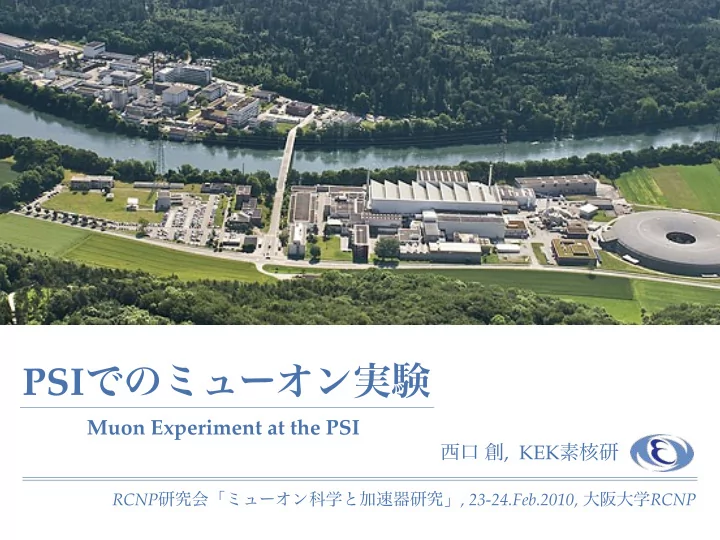
PSI Muon Experiment at the PSI , KEK RCNP - - PowerPoint PPT Presentation
PSI Muon Experiment at the PSI , KEK RCNP , 23-24.Feb.2010, RCNP 2 Contents PSI ? Muon Beam Line in PSI Muon
RCNP研究会「ミューオン科学と加速器研究」, 23-24.Feb.2010, 大阪大学RCNP
西口 創, KEK素核研
Muon Experiment at the PSI
✤ PSI ? ✤ Muon Beam Line in PSI ✤ Muon Experiment in PSI ✤ past / present (MEG) ✤ Future Prospects in PSI
2
Hajime NISHIGUCHI (KEK) “Muon Experiment at PSI” 「RCNP研究会: ミューオン科学と加速器研究」, 23-24.Feb.2010, RCNP
✤ Largest Swiss Federal Institute for a lot of Scientific research activities. ✤ Mainly based on “proton cyclotron” and “nuclear reactor” because this
institute was merged by two institutes in 1988:
✤ SIN : Swiss Institute for Nuclear Research ✤ EIR : Federal Institute for Reactor Research ✤ something similar with combination of KEK and JAEA in Japan ✤ PSI is a member of ETH domain (ETHZ, EPFL); for not only Particle-
Nuclear but also Structure of Matter, Energy & Environment, and Health.
✤ However, according to its prestigious history of powerful cyclotron, PSI
is still referred as “Mecca of Meson Factory” like TRIUMF, LAMPF, RAL.
4
Hajime NISHIGUCHI (KEK) “Muon Experiment at PSI” 「RCNP研究会: ミューオン科学と加速器研究」, 23-24.Feb.2010, RCNP
5
Hajime NISHIGUCHI (KEK) “Muon Experiment at PSI” 「RCNP研究会: ミューオン科学と加速器研究」, 23-24.Feb.2010, RCNP
✤ The cyclotron facility contains a
cascade of three accelerators that deliver a proton beam of 590 MeV energy at a current up to 2 mA (1.2 MW).
✤ Pre-accelerated in a C-W column to
an energy of 870 keV, secondary- accelerated in the 4-sector Injector 2 cyclotron up to 72 MeV.
✤ Final acceleration of the main beam
to 590 MeV occurs in the large 8- sector Ring Cyclotron, from which the beam is transported through the experimental hall in a shielded tunnel.
6
Hajime NISHIGUCHI (KEK) “Muon Experiment at PSI” 「RCNP研究会: ミューオン科学と加速器研究」, 23-24.Feb.2010, RCNP
✤ The main beam passes through
two pion production targets whereby the proton energy is reduced to 570 MeV.
✤ Target-M (5mm C) ✤ Target-E (40mm C) ✤ After passing through the targets
the beam can either be dumped in a beam stopper or can be recaptured and bent downwards through a sloping drift tube for
facility.
7
proton therapy isotope prod.
πM1 πM3 πE5 πE1 πE3
Hajime NISHIGUCHI (KEK) “Muon Experiment at PSI” 「RCNP研究会: ミューオン科学と加速器研究」, 23-24.Feb.2010, RCNP
✤ PSI provides beam time for particle physics and other experiments. Its
unique specialty is very high intensity pion and muon beams of momenta up to a few hundred MeV/c.
✤ Each beam line is designed for “surface”, “subsurface”, “cloud”, and
“low-E μSR” muons, except for πM1.
✤ The world most intense DC muon beam (~108 muon/sec) is available. ✤ Two target station, M (thin, 5 mm C) and E (thick, 40/60 mm C), are
equipped; Two beam lines are attached with Target-M and Five beam lines are attached with Target-E.
✤ One beam line is used for test beam purpose, Three beam lines are
exclusively used for μSR, and Three beam lines are used for Particle/ Nuclear Physics experiments.
9
Hajime NISHIGUCHI (KEK) “Muon Experiment at PSI” 「RCNP研究会: ミューオン科学と加速器研究」, 23-24.Feb.2010, RCNP
✤ πM1 beam line ✤ High resolution pion beam line
with a momentum range between 100 and 500 MeV/c.
✤ The beam line contains an
electrostatic separator built at CERN, which can reduce the proton contamination in a π+ beam from 400% to about 5% at 300 MeV/c momentum.
✤ No "surface" muons available. ✤ Mainly used for the test-beam
purposes.
✤ πM3 beam line ✤ Currently the only beam line
dedicated exclusively to μSR experiments with "surface" muons
✤ A 3 m long crossed-field
separator can be used either as an electron/muon separator or as a muon spin rotator.
✤ After the separator the beam
can be steered into one of two experimental areas; Low temperature facility LTF and a general purpose system GPS for μSR studies is installed.
10
Hajime NISHIGUCHI (KEK) “Muon Experiment at PSI” 「RCNP研究会: ミューオン科学と加速器研究」, 23-24.Feb.2010, RCNP
11
High intensity pi/mu with momentum ranging 10-500 MeV/c. Surface muon is available.
Was used by PiBeta. Is being used by PEN.
High intensity pi/mu with momentum ranging 10-250 MeV/c. Surface and Cloud muons.
Was used by Many muon programs. Is being used by MuSun, and being modified for high-B muSR.
High intensity low momenta pi/mu ranging 10-120 MeV/c. The most intense surface muon.
Was used by SINDRUM. Is being used by MEG/LambShift
For an intense medium energy polarized muon beam, very low pion/electron contamination.
Dedicated for μSR
Large acceptance beam line for low momenta muon (<40MeV/c), specially designed for Low-E μSR
Dedicated for μSR
Hajime NISHIGUCHI (KEK) “Muon Experiment at PSI” 「RCNP研究会: ミューオン科学と加速器研究」, 23-24.Feb.2010, RCNP
✤ PSI has born the burden of fundamental physics for many decades; in
particular precise measurement of pion and muon properties.
✤ Recently completed programs: ✤ Muonium-AntiMuonium conversion (MM) ✤ Search for Heavy Neutral Particle (KARMEN) ✤ Muon-Electron Conversion (SINDRUM-II) ✤ Improved Measurement of Charged Pion Mass ✤ T-violation in Muon decay ✤ Pion Beta-decay (PiBeta) ✤ Pionic Hydrogen ✤ (developments) Large Acceptance Detector System (LADS) ✤ (developments) F/B muon spectrometer at L3 ✤ (developments) Central Silicon Tracker at H1
13
Hajime NISHIGUCHI (KEK) “Muon Experiment at PSI” 「RCNP研究会: ミューオン科学と加速器研究」, 23-24.Feb.2010, RCNP
✤ MEG and nEDM : Flagship Projects in Particle Physics Division ✤ MuCap : Singlet Muon Capture on the Proton ✤ nTRV : Decay of Free Polarized Neutron ✤ LambShift in Muonic Hydrogen : to eliminate the contribution of the
proton charge radius
✤ MuLan : τμ measurement (Improving the precision of GF) ✤ FAST : τμ measurement (Improving the precision of GF) ✤ PEN : Improving the accuracy of the π→eν branching ratio. ✤ MuSun : Muon Capture on the Deuterium ✤ Detector Developments : Pixel barrel and ECAL for CMS
14
Hajime NISHIGUCHI (KEK) “Muon Experiment at PSI” 「RCNP研究会: ミューオン科学と加速器研究」, 23-24.Feb.2010, RCNP
✤ Search Experiment for “μ→eγ” ✤ μ→eνν ~ 100% (normal muon decay in SM) ✤ μ→eγ violates Lepton Flavour Conservation ✤ Even assuming “SM” + “Neutrino-Oscillation”
B(μ→eγ) is assumed < 10-50
✤ Many models of beyond SM, however, predicts
large B(μ→eγ) ~ 10-15~-11
15
✤ New experiment with a Sensitivity of B ~ 10-13 was proposed at PSI ✤ Two orders of magnitude better than current best limit (1.2×10⁻¹¹) ✤ Cover the most of theoretically predicted region ✤ Physics data-taking started 2008 and is currently running.
Hajime NISHIGUCHI (KEK) “Muon Experiment at PSI” 「RCNP研究会: ミューオン科学と加速器研究」, 23-24.Feb.2010, RCNP
✤ Signal and Backgrounds ✤ Clear 2-body kinematics (Ee=Eγ=52.8MeV, θeγ=180°, Time Coincidence) ✤ Sensitivity is Limited by “Accidental Overlap” ✤ DC muon is the Best Solution ✤ Good Resolution (Energy, Spacial and Timing) under Very High Rate
16
Signal Prompt BG. Accidental BG. How about in MUSIC ???
Hajime NISHIGUCHI (KEK) “Muon Experiment at PSI” 「RCNP研究会: ミューオン科学と加速器研究」, 23-24.Feb.2010, RCNP
✤ The world most intense DC muon beam ✤ ~ 108 muon/sec at πE5 ✤ Liquid-Xenon photon detector ✤ Excellent Resolutions (E: 2%, T: ~70ps, X: ~5mm) ✤ Fast Response (Good for pile-ups) ✤ Uniform, Segment is not necessary ✤ Specially Degraded Magnetic Spectrometer ✤ Possible in 108 /sec intensity ✤ Very Light Tracker (0.002X0 in total) ✤ Very Fast Hodoscope array (~120ps)
17
σ σ σ
1m
γ-ray from muon decay
Hajime NISHIGUCHI (KEK) “Muon Experiment at PSI” 「RCNP研究会: ミューオン科学と加速器研究」, 23-24.Feb.2010, RCNP
✤ Proposal was approved 1999, Construction was completed 2007. ✤ The 1st Physics Run 12/Sep. to 23/Dec. 2008. ✤ Right after the detector maintenance period, physics data taking started
18
✤ Several Sever Problems; ✤ Inefficient and Unstable operation of
Spectrometer due to DC-HV discharge.
✤ Lower Light yield of Calorimeter due to
Impurity in Liquid Xenon.
✤ Lower Trigger Rate due to lack of
triggering counter (fibre counter).
✤ i.e. Lower Statistics than expected.
Integrated Stopped Muon on Target
Hajime NISHIGUCHI (KEK) “Muon Experiment at PSI” 「RCNP研究会: ミューオン科学と加速器研究」, 23-24.Feb.2010, RCNP
✤ “Eγ-ΔTeγ“ plane was
used to determine Pre- selection, Analysis Box, and Blind Box.
✤ 16% of triggered events
are pre-selected and 0.2% of events are blinded.
✤ Performances are
estimated by Side-band.
✤ Reprocess was repeated
several times with improved calibrations and algorithms.
19
✤ Final blinding box: ±1ns around Time-Zero
Hajime NISHIGUCHI (KEK) “Muon Experiment at PSI” 「RCNP研究会: ミューオン科学と加速器研究」, 23-24.Feb.2010, RCNP
20
✤ 1189 events in Analysis Box ✤ Best Fit : 0 < Nsignal < 14.7
Hajime NISHIGUCHI (KEK) “Muon Experiment at PSI” 「RCNP研究会: ミューオン科学と加速器研究」, 23-24.Feb.2010, RCNP
✤ Single Event Sensitivity :
5×10-12
✤ Expected NBG : 0.5 ✤ Evaluated by Sideband ✤ Average Sensitivity : 1.3×10⁻¹¹ ✤ ToyMC with obtained PDF ✤ Best Fit : UL(Nsignal)=14.7 ✤ Obtained by Likelihood ✤ Upper Limit (90% C.L.) :
B(μ+→e+γ)<2.8×10⁻¹¹
21
✤ Preliminary Result of Run2008 was
Published in hep-ex/0908.2594 , and the final result of Run2008 will come soon in NPB.
Hajime NISHIGUCHI (KEK) “Muon Experiment at PSI” 「RCNP研究会: ミューオン科学と加速器研究」, 23-24.Feb.2010, RCNP
✤ 2009, the 2nd Physics Run was performed successfully ✤ Spectrometer Problem was solved !! Full Efficiency and Better Resolution. ✤ nb. All Digitizer replaced, Blighter Xenon, Still missing fibre counters ✤ Even Shorter Run period than 2008, the data amount is 2.2 times more than
that we took 2008 because of recovered detector efficiency !
✤ Analysis & Detector Maintenance is Ongoing. ✤ The 2nd result will be published this summer. ✤ Aiming to finish Maintenance works by the end of April. ✤ Run-2010 will start ~May (after several commissioning and calibration
runs), and will continue by Christmas shutdown. (First Long-term Run)
✤ MEG will continue to collect further more data (at least) 3 years in order to
achieve 10-13 sensitivity.
22
Hajime NISHIGUCHI (KEK) “Muon Experiment at PSI” 「RCNP研究会: ミューオン科学と加速器研究」, 23-24.Feb.2010, RCNP
✤ Active muon experiments (only for particle physics!) are “MEG”,
“MuLAN/FAST”, “LambShift” and “MuCap/Sun”
✤ Flagship project, MEG, will continue by 2012 at least. ✤ Recently the discussion has been arising for the future flagship project. ✤ Next flagship project should be discussed by following points: ✤ Should contribute for “New Physics”, not for just an “Improvement” ✤ Should be utilized for using the world most intense DC muon beam
✤ PSI cyclotron is still upgrading (2.2mA @ 2010, aiming 2.5-3mA)
✤ Currently there are three major discussions: ✤ “New Muon EDM”, “MEG upgrades” and “μ→eee”
24
Hajime NISHIGUCHI (KEK) “Muon Experiment at PSI” 「RCNP研究会: ミューオン科学と加速器研究」, 23-24.Feb.2010, RCNP
✤ Compact Storage Ring (<1m dia.) with adapting the frozen spin method ✤ Aiming dμ ~ 5×10-23 e cm, and confirm the tech. to achieve 10-25 in future ✤ cf. hep-ex/0606034 (experiment idea), PRL93.p052001 (frozen spin meth.)
25
Hajime NISHIGUCHI (KEK) “Muon Experiment at PSI” 「RCNP研究会: ミューオン科学と加速器研究」, 23-24.Feb.2010, RCNP
✤ It is possible to improve the current MEG sensitivity ✤ Xenon; High QE, Finer Granularity by using Smaller PMT (MPPC?) ✤ Spectrometer; Reduce Material more, Double Acceptance ✤ Expected Improvements; 10 times better sensitivity is possible ✤ Using Polarized Muon is very attractive ✤ Plastic target is currently used, thus ~100% depolarized ✤ Using Metal target can provide full polarization because πE5 is surface-
muon beam line.
✤ Measuring angular asymmetry of e+ emission wrt. muon polarization
will tell us the useful information to understand the New Physics.
✤ Asymmetry is distinguishable with 68% C.L. assuming B(μ→eγ)>10-12.5
✤
Measurements at Low Energy, 18-19.Jan.2007 at PSI
26
Hajime NISHIGUCHI (KEK) “Muon Experiment at PSI” 「RCNP研究会: ミューオン科学と加速器研究」, 23-24.Feb.2010, RCNP
✤ “μ→3e“ has many more diagrams than “μ→eγ“ ✤ Present Upper limit; B(μ→3e) < 1.2×10⁻¹² (SINDRUM-I, 22 years old!) ✤ Signature ✤ total energy, total momentum ✤ phase space distribution gives additional information if observed. ✤ in a constant B field the acceptance is defined by the pt threshold. ✤ Background ✤ accidental background involves low invariant mass e+e- pairs produced
by photons or by Bhabha scattering
27
µ → 3e2ν accidentals
SINDRUM I
Dominated by Accidental DC muon is BEST How about in MUSIC ???
Hajime NISHIGUCHI (KEK) “Muon Experiment at PSI” 「RCNP研究会: ミューオン科学と加速器研究」, 23-24.Feb.2010, RCNP
✤ Physics of fundamental Symmetries
& Interactions
✤ Oct. 11-14, 2010 at PSI ✤ Continuation of the past Workshop;
Precision Measurements at Low Energy,
✤ as a contribution to an evaluation
Research at PSI
✤ Future Particle Physics Research at
PSI will be discussed in detail !!
28
Hajime NISHIGUCHI (KEK) “Muon Experiment at PSI” 「RCNP研究会: ミューオン科学と加速器研究」, 23-24.Feb.2010, RCNP
✤ PSI has a powerful proton cyclotron and has been contributing to the
fundamental particle physics as a “Meson Factory”
✤ The world most intense DC muon beam is available. ✤ Presently, 2.2mA (1.2MW) proton current and 108 muon/sec is provided. ✤ MEG experiment started 2008 and currently running in order to discover
the first event of “charged lepton flavour violation”.
✤ In addition, several muon-experiment programs are running. ✤ Recently, the next particle physics program is being discussed. ✤ New muon EDM ?, MEG upgrades (improved sensitivity and using
polarized muon) ?, μ→3e search experiment with a sensitivity of 10-16
29
Hajime NISHIGUCHI (KEK) “Muon Experiment at PSI” 「RCNP研究会: ミューオン科学と加速器研究」, 23-24.Feb.2010, RCNP