Slide 3 (Answer) / 38 1 Which of the following is NOT an example of - - PDF document

slide 3 answer 38
SMART_READER_LITE
LIVE PREVIEW

Slide 3 (Answer) / 38 1 Which of the following is NOT an example of - - PDF document

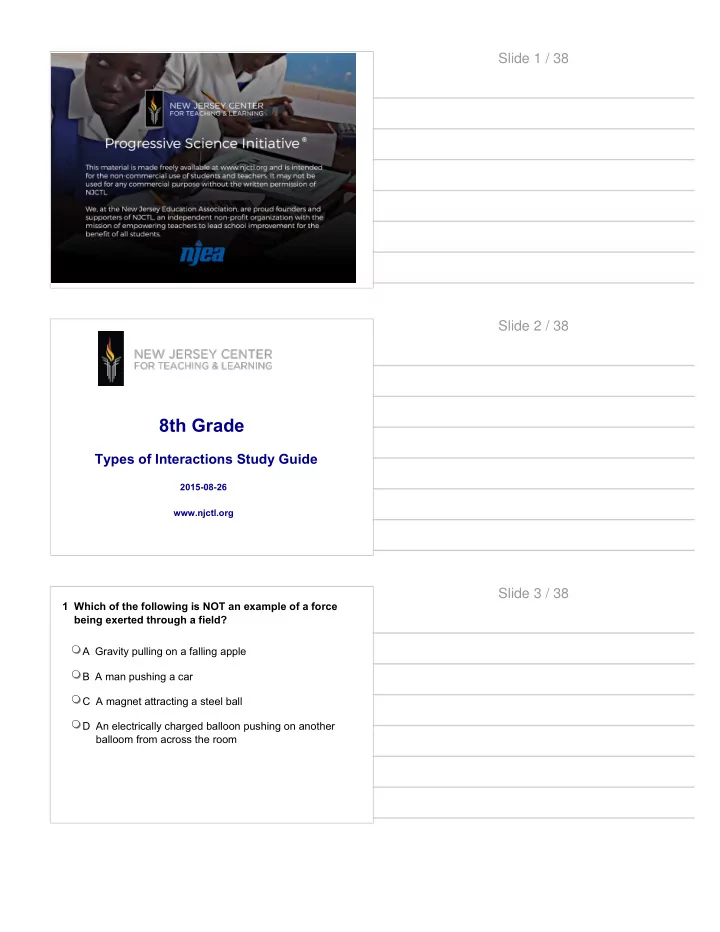
Slide 1 / 38 Slide 2 / 38 8th Grade Types of Interactions Study Guide 2015-08-26 www.njctl.org Slide 3 / 38 1 Which of the following is NOT an example of a force being exerted through a field? A Gravity pulling on a falling apple B A man


slide-1
SLIDE 1

Slide 1 / 38

8th Grade

Types of Interactions Study Guide

2015-08-26 www.njctl.org

Slide 2 / 38

1 Which of the following is NOT an example of a force being exerted through a field? A Gravity pulling on a falling apple B A man pushing a car C A magnet attracting a steel ball D An electrically charged balloon pushing on another balloom from across the room

Slide 3 / 38

slide-2
SLIDE 2

1 Which of the following is NOT an example of a force being exerted through a field? A Gravity pulling on a falling apple B A man pushing a car C A magnet attracting a steel ball D An electrically charged balloon pushing on another balloom from across the room

[This object is a pull tab]

Answer

B

Slide 3 (Answer) / 38

2 Unbalanced forces acting on an object will cause it to accelerate (chance velocity). True False

Slide 4 / 38

2 Unbalanced forces acting on an object will cause it to accelerate (chance velocity). True False

[This object is a pull tab]

Answer

True

Slide 4 (Answer) / 38

slide-3
SLIDE 3

3 The force of gravity ___ as the object's mass decreases. A increases B remains constant C decreases

Slide 5 / 38

3 The force of gravity ___ as the object's mass decreases. A increases B remains constant C decreases

[This object is a pull tab]

Answer

C

Slide 5 (Answer) / 38

4 The force of gravity _________ as the distance between two objects decreases.

A

Increases

B

Remains Constant

C

Decreases

Slide 6 / 38

slide-4
SLIDE 4

4 The force of gravity _________ as the distance between two objects decreases.

A

Increases

B

Remains Constant

C

Decreases

[This object is a pull tab]

Answer

A

Slide 6 (Answer) / 38

5 The force of gravity decreases at a constant rate as we move away from a planet like Jupiter. True False

Slide 7 / 38

5 The force of gravity decreases at a constant rate as we move away from a planet like Jupiter. True False

[This object is a pull tab]

Answer

False

Slide 7 (Answer) / 38

slide-5
SLIDE 5

6 As we move away from the Sun, the force of gravity gets weaker by an inverse of:

A

distance cubed

B

distance

C

distance squared

Slide 8 / 38

6 As we move away from the Sun, the force of gravity gets weaker by an inverse of:

A

distance cubed

B

distance

C

distance squared

[This object is a pull tab]

Answer

C

Slide 8 (Answer) / 38

7 What makes a balloon exhibit an overall positive charge? A Equal protons and electrons in the object B More electrons than protons in the object C More protons than electrons in the object D Less electrons in the object

Slide 9 / 38

slide-6
SLIDE 6

7 What makes a balloon exhibit an overall positive charge? A Equal protons and electrons in the object B More electrons than protons in the object C More protons than electrons in the object D Less electrons in the object

[This object is a pull tab]

Answer

C

Slide 9 (Answer) / 38

8 What makes an object exhibit a overall negative charge?

A

equal protons and electrons in the object

B

more electrons than protons in the object

C

more protons than electrons in the object

D

less electrons in the object

Slide 10 / 38

8 What makes an object exhibit a overall negative charge?

A

equal protons and electrons in the object

B

more electrons than protons in the object

C

more protons than electrons in the object

D

less electrons in the object

[This object is a pull tab]

Answer

B

Slide 10 (Answer) / 38

slide-7
SLIDE 7

9 What makes an object exhibit an overall neutral charge?

A

equal protons and electrons in the object

B

more electrons than protons in the object

C

more protons than electrons in the object

D

less electrons in the object

Slide 11 / 38

9 What makes an object exhibit an overall neutral charge?

A

equal protons and electrons in the object

B

more electrons than protons in the object

C

more protons than electrons in the object

D

less electrons in the object

[This object is a pull tab]

Answer

A

Slide 11 (Answer) / 38

10 Opposite charges repel. True False

Slide 12 / 38

slide-8
SLIDE 8

10 Opposite charges repel. True False

[This object is a pull tab]

Answer

False

Slide 12 (Answer) / 38

11 Like charges attract. True False

Slide 13 / 38

11 Like charges attract. True False

[This object is a pull tab]

Answer

False

Slide 13 (Answer) / 38

slide-9
SLIDE 9

12 As the amount of charge decreases, the electric force between the charges ___. A decreases B remains constant C increases

Slide 14 / 38

12 As the amount of charge decreases, the electric force between the charges ___. A decreases B remains constant C increases

[This object is a pull tab]

Answer

A

Slide 14 (Answer) / 38

13 As the amount of distance between charges decreases, the force between the charges ___. A decreases B remains constant C increases

Slide 15 / 38

slide-10
SLIDE 10

13 As the amount of distance between charges decreases, the force between the charges ___. A decreases B remains constant C increases

[This object is a pull tab]

Answer

C

Slide 15 (Answer) / 38

14 Electric field lines exit positive charges and enter negative charges. True False

Slide 16 / 38

14 Electric field lines exit positive charges and enter negative charges. True False

[This object is a pull tab]

Answer

True

Slide 16 (Answer) / 38

slide-11
SLIDE 11

15 The electric field strength between two parallel

  • ppositely charged plates:

A increases as you move towards the positive plate. B decreases as you move towards the negative plate. C remains constant at all points between the plates.

Slide 17 / 38

15 The electric field strength between two parallel

  • ppositely charged plates:

A increases as you move towards the positive plate. B decreases as you move towards the negative plate. C remains constant at all points between the plates.

[This object is a pull tab]

Answer

C

Slide 17 (Answer) / 38

16 William Gilbert was the scientist who discovered that the Earth was a giant magnet. True False

Slide 18 / 38

slide-12
SLIDE 12

16 William Gilbert was the scientist who discovered that the Earth was a giant magnet. True False

[This object is a pull tab]

Answer

True

Slide 18 (Answer) / 38

17 Microscopic regions inside iron are called ___. A magnetic crystals B magnetic domains C magnetic atoms

Slide 19 / 38

17 Microscopic regions inside iron are called ___. A magnetic crystals B magnetic domains C magnetic atoms

[This object is a pull tab]

Answer

B

Slide 19 (Answer) / 38

slide-13
SLIDE 13

18 Ferromagnetic substances include: (select all that are ferromagnetic) A iron B aluminum C nickel D cobalt

Slide 20 / 38

18 Ferromagnetic substances include: (select all that are ferromagnetic) A iron B aluminum C nickel D cobalt

[This object is a pull tab]

Answer

A, C, D

Slide 20 (Answer) / 38

19 An electromagnet produces a magnetic field when current flows through it. True False

Slide 21 / 38

slide-14
SLIDE 14

19 An electromagnet produces a magnetic field when current flows through it. True False

[This object is a pull tab]

Answer

True

Slide 21 (Answer) / 38

20 Soft iron is an example of a(an) ___. A electromagnet B temporary magnet C permanent magnet D superconductor

Slide 22 / 38

20 Soft iron is an example of a(an) ___. A electromagnet B temporary magnet C permanent magnet D superconductor

[This object is a pull tab]

Answer

B

Slide 22 (Answer) / 38

slide-15
SLIDE 15

21 Like magnetic poles ___. A attract B repel C don't interact

Slide 23 / 38

21 Like magnetic poles ___. A attract B repel C don't interact

[This object is a pull tab]

Answer

B

Slide 23 (Answer) / 38

22 What does this type of field drawing represent? A Attraction B Repulsion C Suspension

Slide 24 / 38

slide-16
SLIDE 16

22 What does this type of field drawing represent? A Attraction B Repulsion C Suspension

[This object is a pull tab]

Answer

A

Slide 24 (Answer) / 38

23 A test compass at A will be oriented like:

A B C D

A Slide 25 / 38

23 A test compass at A will be oriented like:

A B C D

A

[This object is a pull tab]

Answer

A

Slide 25 (Answer) / 38

slide-17
SLIDE 17

24 A test compass at B will orient itself like:

A B C D

B Slide 26 / 38

24 A test compass at B will orient itself like:

A B C D

B

[This object is a pull tab]

Answer

A

Slide 26 (Answer) / 38

25 Magnetic field lines exit from the south pole of a magnet. True False

Slide 27 / 38

slide-18
SLIDE 18

25 Magnetic field lines exit from the south pole of a magnet. True False

[This object is a pull tab]

Answer

False

Slide 27 (Answer) / 38

26 As the distance from a magnetic field is increased, the magnetic field intensity will ___. A increase B decrease C stay the same

Slide 28 / 38

26 As the distance from a magnetic field is increased, the magnetic field intensity will ___. A increase B decrease C stay the same

[This object is a pull tab]

Answer

B

Slide 28 (Answer) / 38

slide-19
SLIDE 19

27 Moving electric charges (electric current) causes a magnetic field to form. True False

Slide 29 / 38

27 Moving electric charges (electric current) causes a magnetic field to form. True False

[This object is a pull tab]

Answer

True

Slide 29 (Answer) / 38

28 The __________ rule is the rule that relates the direction of a magnetic field surrounding a wire carrying current.

A

left thumb

B

right hand

C

right arm

D

left hand

Slide 30 / 38

slide-20
SLIDE 20

28 The __________ rule is the rule that relates the direction of a magnetic field surrounding a wire carrying current.

A

left thumb

B

right hand

C

right arm

D

left hand

[This object is a pull tab]

Answer

B

Slide 30 (Answer) / 38

29 The father of modern electromagnetic theory is:

A

Albert Einstein

B

Sir Isaac Newton

C

Michael Faraday

D

Michael Bolton

Slide 31 / 38

29 The father of modern electromagnetic theory is:

A

Albert Einstein

B

Sir Isaac Newton

C

Michael Faraday

D

Michael Bolton

[This object is a pull tab]

Answer

C

Slide 31 (Answer) / 38

slide-21
SLIDE 21

30 The ___ rule is used to determine the direction of the magnetic field around a current carrying coil

  • f wire.

A

right hand

B

left hand

C

right thumb

D

left thumb

Slide 32 / 38

30 The ___ rule is used to determine the direction of the magnetic field around a current carrying coil

  • f wire.

A

right hand

B

left hand

C

right thumb

D

left thumb

[This object is a pull tab]

Answer

B

Slide 32 (Answer) / 38

31 List the three types of fields discussed in this

  • chapter. What factors affect the strength of each type
  • f field?

Slide 33 / 38

slide-22
SLIDE 22

32 How can a) a mass, b) a positive charge, and c) a compass be used as field detectors?

Slide 34 / 38

33 Explain the process of induction.

Slide 35 / 38

34 How do electric field diagrams and magnetic field diagrams compare to each other for attraction/ repulsion? Explain your answer in a short paragraph.

Slide 36 / 38

slide-23
SLIDE 23

35 How is Coulomb's Law (forces between charges) similar/different to Newton's Law of Gravitation (forces between masses)? Similarities Differences

Answer

Slide 37 / 38

36 Drag and drop the terms below to into the Newton's Law of Gravitation or Coulomb's Law. If they are used for both Laws place the term on the line. Newton's Law of Gravitation Coulomb's Law Mass Charge As distance increases force drops Attraction Repulsion Field

Slide 38 / 38