Slide 1 / 84 1 Objects can possess energy as: (a) endothermic - - PDF document

slide 1 84
SMART_READER_LITE
LIVE PREVIEW

Slide 1 / 84 1 Objects can possess energy as: (a) endothermic - - PDF document

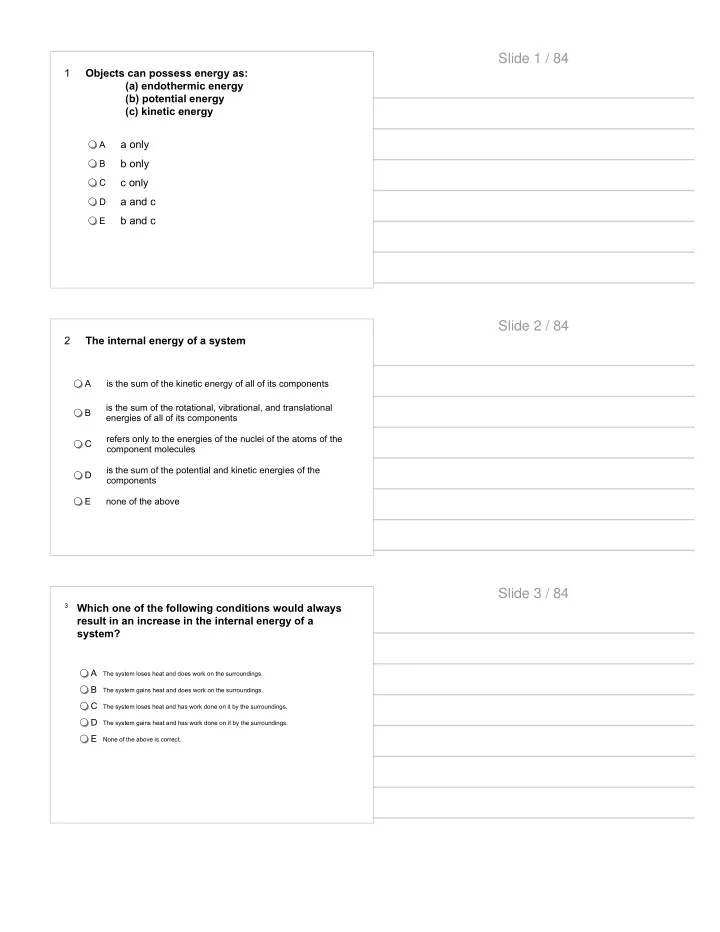
Slide 1 / 84 1 Objects can possess energy as: (a) endothermic energy (b) potential energy (c) kinetic energy a only A b only B C c only a and c D b and c E Slide 2 / 84 2 The internal energy of a system A is the sum of the


slide-1
SLIDE 1

1 Objects can possess energy as: (a) endothermic energy (b) potential energy (c) kinetic energy

A

a only

B

b only

C

c only

D

a and c

E

b and c

Slide 1 / 84

2 The internal energy of a system

A is the sum of the kinetic energy of all of its components B is the sum of the rotational, vibrational, and translational energies of all of its components C refers only to the energies of the nuclei of the atoms of the component molecules D is the sum of the potential and kinetic energies of the components E none of the above

Slide 2 / 84

3

Which one of the following conditions would always result in an increase in the internal energy of a system?

A

The system loses heat and does work on the surroundings.

B

The system gains heat and does work on the surroundings.

C

The system loses heat and has work done on it by the surroundings.

D

The system gains heat and has work done on it by the surroundings.

E

None of the above is correct.

Slide 3 / 84

slide-2
SLIDE 2

4

The value of ΔE for a system that performs 111 kJ of work on its surroundings and gains 89 kJ of heat is __________ kJ.

A

  • 111

B

  • 200

C

200

D

  • 22

E

22

Slide 4 / 84

5

The value of ΔE for a system that performs 13 kJ of work on its surroundings and loses 9 kJ of heat is __________ kJ.

A

22

B

  • 22

C

4

D

  • 4

E

  • 13

Slide 5 / 84

6

Calculate the value of ΔE in joules for a system that loses 50 J of heat and has 150 J of work performed

  • n it by the surroundings.

A

50

B

100

C

  • 100

D

  • 200

E

200

Slide 6 / 84

slide-3
SLIDE 3

7

The change in the internal energy of a system that absorbs 2,500 J of heat and that does 7,655 J of work

  • n the surroundings is __________ J.

A

10,155

B

5,155

C

  • 5,155

D

  • 10,155

E

1.91 x10⁷

Slide 7 / 84

8

The change in the internal energy of a system that releases 2,500 J of heat and that does 7,655 J of work on the surroundings is __________ J.

A

  • 10,155

B

  • 5,155

C

  • 1.91x10⁷

D

10,155

E

5,155

Slide 8 / 84

9

When a system __________, ΔE is always negative.

A

absorbs heat and does work

B

gives off heat and does work

C

absorbs heat and has work done on it

D

gives off heat and has work done on it

E

none of the above is always negative.

Slide 9 / 84

slide-4
SLIDE 4

10 Of the following, which one is a state

function?

A

H

B

q

C

w

D

heat

E

none of the above

Slide 10 / 84

11 Which one of the following is an

endothermic process?

A

ice melting

B

water freezing

C

boiling soup

D

Hydrochloric acid and barium hydroxide are mixed at 25 °C: the temperature increases.

E

Both A and C

Slide 11 / 84

12 Which one of the following is an

exothermic process?

A

ice melting

B

water evaporating

C

boiling soup

D

condensation of water vapor

E

Ammonium thiocyanate and barium hydroxide are mixed at 25 °C: the temperature drops.

Slide 12 / 84

slide-5
SLIDE 5

13 A __________ ΔH corresponds to an

__________ process.

A

negative, endothermic

B

negative, exothermic

C

positive, exothermic

D

zero, exothermic

E

zero, endothermic

Slide 13 / 84

14 A __________ ΔH corresponds to an

__________ process.

A

negative, endothermic

B

positive, exothermic

C

positive, endothermic

D

zero, exothermic

E

zero, endothermic zero, endothermic

Slide 14 / 84

15 For an endothermic process is _____ while ΔH for an

exothermic process is _______.

A

zero, positive

B

zero, negative

C

positive, zero

D

negative, positive

E

positive, negative

Slide 15 / 84

slide-6
SLIDE 6

16 A chemical reaction that absorbs heat from the

surroundings is said to be __________ and has a __________ ΔH.

A

endothermic, positive

B

endothermic, negative

C

exothermic, negative

D

exothermic, positive

E

exothermic, neutral

Slide 16 / 84

17 The reaction 4Al(s) + 3O2 (g) → 2Al2O3 (s)

ΔH° = -3351 kJ is __________, and therefore heat is __________ by the reaction.

A

endothermic, released

B

endothermic, absorbed

C

exothermic, released

D

exothermic, absorbed

E

thermoneutral, neither released nor absorbed

Slide 17 / 84

18 The molar heat capacity of a compound with the

formula C2H6SO is 88.0 J/mol-K. The specific heat of this substance is __________ J/g-K.

A

88.0

B

1.13

C

4.89

D

6.88x10

3

E

  • 88.0

Slide 18 / 84

slide-7
SLIDE 7

19 A sample of aluminum metal absorbs 9.86 J of heat,

and the temperature of the sample increases from 23.2 °C to 30.5 °C. Since the specific heat capacity

  • f aluminum is 0.90 J/g-K, the mass of the sample is

__________ g.

A

75

B

1.5

C

65

D

8.1

E

6.6

Slide 19 / 84

20 The specific heat capacity of lead is 0.13 J/g-K. How

much heat (in J) is required to raise the temperature

  • f 15g of lead from 22 °C to 37 °C?

A

2.0

B

  • 0.13

C

5.8 x10⁻⁴

D

29

E

0.13

Slide 20 / 84

21 The temperature of a 15-g sample of lead metal

increases from 22 °C to 37 °C upon the addition of 29.0 J of heat. The specific heat capacity of the lead is __________ J/g-K.

A

7.8

B

1.9

C

29

D

0.13

E

  • 29

Slide 21 / 84

slide-8
SLIDE 8

22 The ΔH for the solution process when solid sodium

hydroxide dissolves in water is 44.4 kJ/mol. When a 13.9-g sample of NaOH dissolves in 250.0 g of water in a coffee-cup calorimeter, the temperature increases from 23.0 °C to __________ °C. Assume that the solution has the same specific heat as liquid water, i.e., 4.18 J/g-K.

A

35.2 °C

B

24.0 °C

C

37.8 °C

D

37.0 °C

E

40.2 °C

Slide 22 / 84

23 An 8.29 g sample of calcium carbonate [CaCO3(s)]

absorbs 50.3 J of heat, upon which the temperature

  • f the sample increases from 21.1 °C to 28.5 °C. What

is the specific heat of calcium carbonate?

A

0.63

B

0.82

C

1.1

D

2.2

E

4.2

Slide 23 / 84

24 A sample of iron absorbs 67.5 J of heat, upon which

the temperature of the sample increases from 21.5 ° C to 28.5 °C. If the specific heat of iron is 0.450 J/g-K, what is the mass (in grams) of the sample?

A

4.3

B

11

C

21

D

1100

E

1200

Slide 24 / 84

slide-9
SLIDE 9

25 A 22.44 g sample of iron absorbs 180.8 J of heat,

upon which the temperature of the sample increases from 21.1 °C to 39.0 °C. What is the specific heat of iron?

A

0.140

B

0.450

C

0.820

D

0.840

E

0.900

Slide 25 / 84

26 When 45 g of an alloy at 1000C is dropped into 100.0

g of water at 25°C, the final temperature is 37°C. What is the specific heat of the alloy (J/goC)?

A

9.88

B

48.8

C

0.423

D

1.77

Slide 26 / 84

27 A 50.0-g sample of liquid water at 25.0 C is mixed

with 29.0 g of water at 45.0 °C. The final temperature

  • f the water is __________.

A

102

B

27.6

C

35.0

D

142

E

32.3

Slide 27 / 84

slide-10
SLIDE 10

28 A 6.50-g sample of copper metal at 25.0 °C is heated

by the addition of 84.0 J of energy. The final temperature of the copper is _____ °C. The specific heat of copper is 0.38 J/g-K.

A

29.9

B

25.0

C

9.0

D

59.0

E

34.0

Slide 28 / 84

29 How much heat is required to melt 1.5 moles of NaCl at

its melting point (DHfus = 30 kJ/mol)

A

1.5 kJ

B

15 kJ

C

20 kJ

D

30 kJ

E

45 kJ

Slide 29 / 84

30 A substance releases 500 kJ of heat as 25 mol of it

condenses from a gas to a liquid . What is the heat

  • f vaporization (DHvap) of this substance?

A

20 kJ/mol

B

25 kJ/mol

C

475 kJ/mol

D

525 kJ/mol

Slide 30 / 84

slide-11
SLIDE 11

31 If you supply 36 kJ of heat, how many moles of ice a

0oC can be melted, heated to its boiling point and completely boiled away? DHvap = 40.5 kJ/mol; DHfus = 6.0 kJ/mol; specific heat for water, C = 0.0753 kJ/mol-oC

Slide 31 / 84

32 Given the equation: H2O (l) → H2O(g) DHrxn = 40.7

kJ at 100 °C Calculate the mass of liquid water (in grams) at 100 °C that can converted to vapor by absorbing 2.40 kJ of heat.

Slide 32 / 84

33 Given the equation: H2O (l) → H2O(g) DHrxn = 40.7

kJ at 100 °C Calculate the heat required to convert 3.00 grams of liquid water at 100 °C to vapor.

Slide 33 / 84

slide-12
SLIDE 12

34 Based on the following information, which compound

has the strongest intermolecular forces? Substance ΔHvap (kJ/mol) Argon (Ar) 6.3 Benzene (C6H6) 31.0 Ethanol (C2H5OH) 39.3 Water (H2O) 40.8 Methane (CH4) 9.2

A

Argon

B

Benzene

C

Ethanol

D

Water

E

Methane

Slide 34 / 84

35 What amount of heat (in kJ) is required to melt 35.0

g of ice at 0oC?

A

3.09 kJ

B

11.7 kJ

C

20.9 kJ

D

79.1 kJ

Specific heat of ice 2.09 J/g-oC Specific heat of water 4.18 J/g-oC Specific heat of steam 1.84 J/g-oC Heat of fusion of water (Hfus) 6.01 kJ/mol Heat of vaporization of water (Hvap) 40.7 kJ/mol

Slide 35 / 84

36 What amount of heat (in kJ) is required to completely

convert 190.0 g of liquid water at 18oC to steam at 100.0oC?

A

6.51 kJ

B

6.94 kJ

C

430 kJ

D

559 kJ

Specific heat of ice 2.09 J/g-oC Specific heat of water 4.18 J/g-oC Specific heat of steam 1.84 J/g-oC Heat of fusion of water (Hfus) 6.01 kJ/mol Heat of vaporization of water (Hvap) 40.7 kJ/mol

Slide 36 / 84

slide-13
SLIDE 13

37 The enthalpy change for converting 1.00 mol of ice at -

50.0 °C to water at 70.0 °C is ________kJ.

A

12.28

B

6.41

C

13.16

D

7154

E

9.40

Specific heat of ice 2.09 J/g-oC Specific heat of water 4.18 J/g-oC Specific heat of steam 1.84 J/g-oC Heat of fusion of water (Hfus) 6.01 kJ/mol Heat of vaporization of water (Hvap) 40.7 kJ/mol

Slide 37 / 84

38 The enthalpy change for converting 10.0 g of ice at -

25.0 °C to water at 80.0 °C is __________ kJ.

A

12.28

B

6.16

C

3870

D

7.21

E

9.88

Specific heat of ice 2.09 J/g-oC Specific heat of water 4.18 J/g-oC Specific heat of steam 1.84 J/g-oC Heat of fusion of water (Hfus) 6.01 kJ/mol Heat of vaporization of water (Hvap) 40.7 kJ/mol

Slide 38 / 84

39 The heat of fusion of water is 6.01 kJ/mol. The heat

capacity of liquid water is 75.3 J/mol-K The conversion of of ice at 0.00 °C to liquid water at 22.0 °C requires __________ kJ of heat.

A

3.8 x10²

B

21.3

C

17.2

D

0.469

E

Insufficient data given

Slide 39 / 84

slide-14
SLIDE 14

40 Which of the following

statements is false?

A

Internal energy is a state function.

B

Enthalpy is an intensive property.

C

The enthalpy change for a reaction is equal in magnitude, but opposite in sign, to the enthalpy change for the reverse reaction.

D

The enthalpy change for a reaction depends on the state of the reactants and products.

E

The enthalpy of a reaction is equal to the heat of the reaction.

Slide 40 / 84

41 The value of DH0 for the reaction below is -72 kJ.

__________ kJ of heat are released when 1.0 mol of HBr is formed in this reaction: H2(g) + Br2 (g) → 2HBr (g)

A

144

B

72

C

0.44

D

36

E

  • 72

Slide 41 / 84

42 The value of DH0 for the reaction below is -126 kJ.

__________ kJ are released when 2.00 mol of NaOH is formed in the reaction? 2Na2O2(s) + 2H2O(l) → 4NaOH (s) + O2(g)

A

252

B

63

C

3.9

D

7.8

E

  • 126

Slide 42 / 84

slide-15
SLIDE 15

43 The value of DH0 for the reaction below is -790 kJ.

The enthalpy change accompanying the reaction of 0.95 g of S is __________ kJ. 2S(s) + 3O2 (g) → 2SO3 (g)

A

23

B

  • 23

C

  • 12

D

12

E

  • 790

Slide 43 / 84

44 The value of DH0 for the reaction below is -6535 kJ.

__________ kJ of heat are released in the combustion

  • f 16.0 g of C6H6(l)? 2C6H6(l) + 15O2 (g) → 12CO2 (g) +

6H2O(l)

A

1.34 x 10³

B

5.23 x 10

4

C

669

D

2.68 x10

3

E

  • 6535

Slide 44 / 84

45 The value of DH0 for the reaction below is -482 kJ.

Calculate the heat (kJ) released to the surroundings when 12.0 g of CO (g) reacts completely. 2CO(g) + O2(g) → 2CO2(g)

A

2.89x10

3

B

207

C

103

D

65.7

E

  • 482

Slide 45 / 84

slide-16
SLIDE 16

46 The value of DH0 for the reaction below is -336 kJ.

Calculate the heat (kJ) released to the surroundings when 23.0 g of HCl is formed. CH4(g) +3Cl2 (g) → CHCl3(l) + 3HCl(g)

A

177

B

2.57x10³

C

70.7

D

211

E

  • 336

Slide 46 / 84

47 The value of DH0 for the reaction below is -186 kJ.

Calculate the heat (kJ) released from the reaction of 25 g of Cl2. H2 (g) + Cl2 (g) → 2HCl (g)

A

66

B

5.3 x 10

2

C

33

D

47

E

  • 186

Slide 47 / 84

48 The enthalpy change for the following reaction is -

483.6 kJ: 2H2 (g) + O2 (g) → 2H2O(g) Therefore, the enthalpy change for the following reaction is __________ kJ: 4H2 (g) + 2O2 (g) → 4H2O(g)

A

  • 483.6

B

  • 967.2

C

2.34x10⁵

D

483.6

E

967.2

Slide 48 / 84

slide-17
SLIDE 17

49 The value of DH° for the reaction below is +128.1 kJ:

CH3OH (l) ’ CO(g) + 2H2(g) How many kJ of heat are consumed when 15.5 g of CH3OH(l) decomposes as shown in the equation?

A

0.48

B

62.0

C

1.3x10

2

D

32

E

8.3

Slide 49 / 84

50 The value of DH0 for the reaction below is +128.1 kJ: CH3OH (l) ↔ CO(g) + 2H2(g) How many kJ of heat are consumed when 5.10 g of H2 (g) is formed as shown in the equation?

A

162

B

62.0

C

128

D

653

E

326

Slide 50 / 84

51 The value of DH0 for the reaction below is +128.1 kJ: CH3OH (l) ↔CO(g) + 2H2(g) How many kJ of heat are consumed when 5.10 g of CO (g) are formed?

A

0.182

B

162

C

8.31

D

23.3

E

62.0

Slide 51 / 84

slide-18
SLIDE 18

52 The value of DH0 for the reaction below is +128.1 kJ: CH3OH (l) ↔CO(g) + 2H2(g) How many kJ of heat are consumed when 5.75 g of CO(g) is formed?

A

23.3

B

62.0

C

26.3

D

162

E

8.3

Slide 52 / 84

53 The value of DH0 for the reaction below is -1107 kJ: 2Ba(s) + O2 (g) ↔ 2BaO (s) How many kJ of heat are released when 5.75 g of Ba(s) reacts completely with oxygen to form BaO (s)?

A

96.3

B

26.3

C

46.4

D

23.2

E

193

Slide 53 / 84

54 The value of DH0 for this reaction is -1107 kJ: 2Ba(s) + O2 (g) ↔ 2BaO (s) How many kJ of heat are released when 5.75 g of BaO (s) is produced?

A

56.9

B

23.2

C

20.8

D

193

E

96.3

Slide 54 / 84

slide-19
SLIDE 19

55 The value of DH0 for the reaction below is -1107 kJ: 2Ba(s) + O2 (g) ↔ 2BaO (s) How many kJ of heat are released when 15.75 g of Ba(s) reacts completely with oxygen to form BaO(s)?

A

20.8

B

63.5

C

114

D

70.3

E

35.1

Slide 55 / 84

56 Which of the following is a statement of Hess's law?

A

If a reaction is carried out in a series of steps, the ΔH for the reaction will equal the sum of the enthalpy changes for the individual steps.

B

If a reaction is carried out in a series of steps, the ΔH for the reaction will equal the product of the enthalpy changes for the individual steps.

C

The ΔH for a process in the forward direction is equal in magnitude and opposite in sign to the ΔH for the process in the reverse direction.

D

The ΔH for a process in the forward direction is equal to the ΔH for the process in the reverse direction.

Slide 56 / 84

57 ΔH for the reaction IF5 (g) à IF3 (g) + F2 (g) is __________ kJ, give the data below. IF (g) + F2(g) à IF3 (g) ) ΔH = -390 kJ IF (g) + 2F2(g) à IF5 (g) ΔH = -745 kJ

A

+355

B

  • 1135

C

+1135

D

+35

E

  • 35

Slide 57 / 84

slide-20
SLIDE 20

58 Given the following reactions the enthalpy of the reaction of the nitrogen to produce nitric oxide N2 (g) + O2(g)à 2NO (g) is __________ kJ. N2 (g) + 2O2(g) à 2NO2 (g) ΔH = 66.4 kJ 2NO (g) + O2(g) à 2NO2 (g) ΔH = -114.2 kJ

A

180.6

B

  • 47.8

C

47.8

D

90.3

E

  • 180.6

Slide 58 / 84

59 Given the following reactions the enthalpy of the reaction of nitrogen with oxygen to produce nitrogen dioxide N2 (g) + 2O2(g) à 2NO2 (g) is __________ kJ. (1) 2NO à N2 + O2 ΔH = -180 kJ (2) 2NO + O2 à 2NO2 ΔH = -112 kJ

A

68

B

  • 68

C

  • 292

D

292

E

  • 146

Slide 59 / 84

60 Given the following reactions the enthalpy of the reaction CaCO3 (s) à CaO(s) + C (s) + O2 (g) is __________ kJ. CaCO3 (s) à CaO(s) + CO2(g) ΔH = 178.1 kJ C(s) + O2 (g) à CO2(g) ΔH = -393.5 kJ

A

215.4

B

571.6

C

  • 215.4

D

  • 571.6

E

7.01 x 10⁴

Slide 60 / 84

slide-21
SLIDE 21

61 Given the following reactions the enthalpy for the decomposition of liquid water into gaseous hydrogen and oxygen 2H2O (l) à 2H2 (g) + O2(g) is __________ kJ. H2O (l) à H2O (g) ΔH = 44.01 kJ 2H2 (g) O2(g) à 2H2O (g) ΔH = -483.64 kJ

A

  • 395.62

B

  • 527.65

C

439.63

D

571.66

E

527.65

Slide 61 / 84

62 Given the following reactions the enthalpy for the decomposition of nitrogen dioxide into molecular nitrogen and oxygen 2NO2 (g) à N2(g) + 2O2 (g) is __________ kJ. N2 (g) + O2(g) à 2NO(g) ΔH = +180.7 kJ 2NO (g) + O2 (g) à 2NO2 (g) ΔH = -113.1 kJ

A

67.6

B

  • 67.6

C

293.8

D

  • 293.8

E

45.5

Slide 62 / 84

63 Given the following reactions the enthalpy of reaction for 4NO(g) à 2NO2 (g) + N2 (g) is ____ kJ. N2 (g) + O2(g) à 2NO (g) ΔH = +180.7 kJ 2NO(g) +O2 (g) à 2NO2 (g) ΔH = -113.1 kJ

A

67.6

B

45.5

C

  • 293.8

D

  • 45.5

E

293.8

Slide 63 / 84

slide-22
SLIDE 22

64 Given the following reactions the enthalpy of reaction for 2N2O(g) à 2NO(g) +N2(g) is __________ kJ. N2 (g) + O2(g) à 2NO(g) ΔH = +180.7 kJ 2N2O(g) à O2 (g) + 2N2(g) ΔH = -163.2 kJ

A

145.7

B

343.9

C

  • 343.9

D

17.5

E

  • 145.7

Slide 64 / 84

65 Of the following, ΔHf

0 is not zero for __________.

A

O2(g)

B

C (graphite)

C

N2(g)

D

F2 (s)

E

Cl2(g)

Slide 65 / 84

66 In the reaction below, ΔHf

0 is zero for __________.

Ni(s) + 2CO (g) +2PF3 (g) à Ni(CO)2 (PF3)2(l)

A Ni(s) B CO(g) C PF3(g) D Ni(CO)2 (PF3)2(l) E Both CO and PF3

Slide 66 / 84

slide-23
SLIDE 23

67 For the species in the reaction below, ΔHf

0 is zero for

__________. 2Co(s) + H2(g) + 8PF3 (g) à 2HCo(PF3)4 (I)

A

Co(s)

B

H2(g)

C

PF3(g)

D

HCo(PF3)4

E

Both Co(s) and H2(g)

Slide 67 / 84

68 For which one of the following equations is ΔH0 rxn equal to ΔHf

0 for the product?

A

Xe (g) + 2F2 (g) à XeF4 (g)

B

CH4 (g) +2Cl2(g) à CH2Cl2 (l) + 2HCl(g)

C

N2(g) + O3 (g) à N2O3 (g)

D

2CO(g) +O2(g) à 2CO2

E

C(diamond) + O2(g) à CO2 (g)

Slide 68 / 84

69 For which of the following reactions is the value of ΔH0

rxn equal to ΔHf

0 for the product?

A 2Ca(s) + O2 (g) à 2CaO(s) B C2H2(g) + H2(g) à C2H4 (g) C 2C(graphite) +O2(g) à 2CO (g) D 3Mg(s) + N2(g) à Mg3N2(s) E C(diamond) + O2(g) à CO2 (g)

Slide 69 / 84

slide-24
SLIDE 24

70 For which of the following reactions is the value of

ΔH0 rxn equal to ΔHf

0 for the product?

A 2C(graphite) + 2H2(g) à C2H4(g) B N2(g) +O2(g) à 2NO(g) C 2H2(g) +O2(g) à 2H2O(l) D 2H2(g) + O2(g) à 2H2O(g) E H2O(l) +1/2 O2(g) à 2H2O(l)

Slide 70 / 84

71 For which of the following reactions is the value of ΔHo rxn equal to ΔHf

  • for the product?

A

H2O(l) +1/2 O2(g) → H2O2(l)

B

N2(g) +O2(g) → 2NO(g)

C

2H2(g) + O2(g) → 2H2O(l)

D

2H2(g) + O2(g) → 2H2O(g

E

none of the above

Slide 71 / 84

72 For which of the following reactions is the value of ΔHo rxn equal to ΔHf

  • for the product?

A

H2(g) + 1/2O2(g) → H2O(l)

B

H2(g) + O2(g) → H2O2 (l)

C

2C(graphite) + 2H2(g) → C2H4(g)

D

1/2N2(g) + O2(g) → NO2(g)

E

All of the above

Slide 72 / 84

slide-25
SLIDE 25

73 The value of for the reaction below is -186 kJ. H2(g) + Cl2(g) → 2HCl(g) The value of ΔHf

  • for HCl (g) is __________ kJ/mol

A

  • 3.72x10²

B

  • 1.27x10²

C

  • 93.0

D

  • 186

E +186

Slide 73 / 84

74 The value of for the following reaction is -3351 kJ:

2Al(s) +3O2(g) → Al2O3 The value of ΔHf

  • for Al2O3 is __________ kJ.

A

  • 3351

B

  • 1676

C

  • 32.86

D

  • 16.43

E

+3351

Slide 74 / 84

75 Given the data in the table below, ΔHo

rxn for this

reaction is __________ kJ. Ca(OH)2 + 2H3AsO4 → Ca(H2AsO4)2 + 2H2O

A

  • 744.9

B

  • 4519

C

  • 4219

D

  • 130.9

E

  • 76.4

Substance ΔHf

0 (kJ/mol)

Ca(OH)2 -986.6 H3AsO4 -900.4 Ca(H2AsO4)2 -2346.0 H2O -285.9

Slide 75 / 84

slide-26
SLIDE 26

76 Given the data in the table below, ΔHo

rxn for this

reaction is __________ kJ. 4NH3 (g) + 5O2(g) → 4NO(g) + 6H2O(l)

A

  • 1172

B

  • 150

C

  • 1540

D

  • 1892

E

The ΔHf

  • of O2(g) is needed

Substance ΔHf

0 (kJ/mol)

H2O(l) -286

NO (g) 90

NO2 (g) 34 NO3 (aq) -207 NH3 (g) -46

Slide 76 / 84

77 Given the data in the table below, Ho

rxn for this

reaction is ________ kJ. C2H5OH(l) + O2(g) → CH3CO2(l) + H2O(l)

A

  • 79.0

B

  • 1048.0

C

  • 476.4

D

  • 492.6

E

The value of Hf

  • of O2(g) is required

Substance ΔHf

0 (kJ /mol)

C2H4(g) 523 C2H5OH(l) -277.7 CH3CO2H(l) -484.5 H2O(l) -285.8

Slide 77 / 84

78 Given the data in the table below, ΔHo

rxn for this

reaction is __________ kJ. 3NO2 +H2O (l) → 2HNO3 (aq) + NO(g)

A

64

B

140

C

  • 140

D

  • 508

E

  • 64

Substance ΔHf

0 (kJ/mol)

H2O(l) -286 NO (g) 90 NO2 (g) 34 HNO3 (aq) -207 NH3 (g) -46

Slide 78 / 84

slide-27
SLIDE 27

79 Given the data in the table below, ΔHo

rxn for this

reaction is __________ kJ. IF5(g) + F2(g) → IF7(g)

A

1801

B

  • 1801

C

121

D

  • 121

E

  • 101

Substance ΔHf

0 (kJ /mol)

IF(g) -95 IF5(g) -840 IF7(g) -941

Slide 79 / 84

80 Given the data in the table below, ΔHo for the reaction is __________ kJ. 2CO (g) + O2 → 2CO2(g)

A

  • 566.4

B

  • 283.2

C

283.2

D

  • 677.0

E

The ΔHf

  • of is needed

Substance ΔHf

0 (kJ /mol)

CO(g) -110.5 CO2(g) -393.7 CaCO3(s) -1207.0

Slide 80 / 84

81 The value of ΔH° for the following reaction is 177.8

  • kJ. The value of ΔHf
  • for CaO(s) is __________

kJ/mol. CaCO3(s) → CaO(s) + CO2(g)

A

  • 1600

B

  • 813.4

C

  • 635.5

D

813.4

E

177.8

Substance ΔHf

0 (kJ /mol)

CO(g) -110.5 CO2(g) -393.7 CaCO3(s) -1207.0

Slide 81 / 84

slide-28
SLIDE 28

82 Given the data in the table below, ΔHo

rxn for the

reaction is __________ kJ. 2Ag2S(s) +O2(g) → 2Ag2O(s) +2S(s)

A

  • 1.6

B

+1.6

C

  • 3.2

D

+3.2

E

The ΔHf

  • of S(s) and of O2(g) are needed.

Substance ΔHf

0 (kJ /mol)

Ag2O(s) -31.0 Ag2S(s) -326 H2S(g) -20.6 H2O(l) -286

Slide 82 / 84

83 Given the data in the table below, ΔHo

rxn for the

reaction is __________ kJ. PCl3(g) +3HCl(g) → 3Cl2(g) +PH3(g)

A

  • 570.37

B

  • 385.77

C

570.37

D

385.77

E

The ΔHf

  • of Cl2(g) is needed for the calculation.

Substance ΔHf

0 (kJ /mol)

PCl3(g) -288.07 HCl(g) -92.30 PH3(g) 5.40

Slide 83 / 84

84 Given the data in the table below and ΔHo

rxn for the

reaction, ΔHf

  • of HCl(g) is __________ kJ/mol.

SO2Cl2(g) +2H2O(l) → H2SO4(l) + 2HCl(g) ΔHf

  • = -62 kJ

A

  • 184

B

60

C

  • 92

D

30

E

Insufficient data are given.

Substance ΔHf

0 (kJ /mol)

SO2(g) -297 SO3(g) -396 SO2Cl2(g) -364 H2SO4(l) -814 H2O(l) -286

Slide 84 / 84