SLIDE 1 1
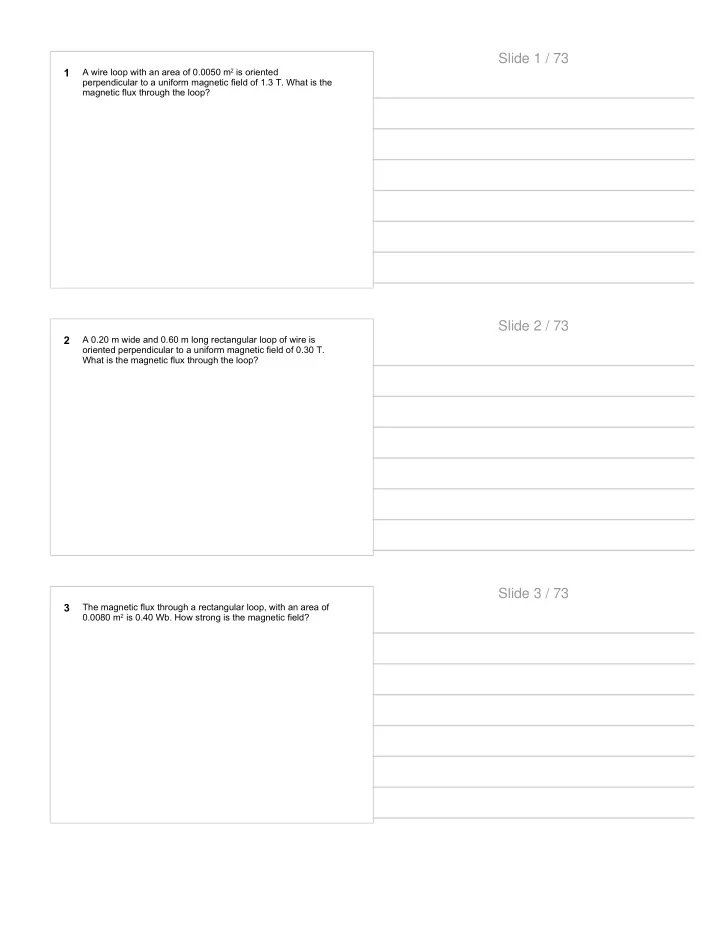
A wire loop with an area of 0.0050 m2 is oriented perpendicular to a uniform magnetic field of 1.3 T. What is the magnetic flux through the loop?
Slide 1 / 73
2
A 0.20 m wide and 0.60 m long rectangular loop of wire is
- riented perpendicular to a uniform magnetic field of 0.30 T.
What is the magnetic flux through the loop?
Slide 2 / 73
3
The magnetic flux through a rectangular loop, with an area of 0.0080 m2 is 0.40 Wb. How strong is the magnetic field?
Slide 3 / 73
SLIDE 2 4
A loop of wire, 4.2 cm in diameter, is oriented perpendicular to a uniform magnetic field of 0.60 T. What is the magnetic flux in the loop?
Slide 4 / 73
5
A 0.40 m wide and 0.80 m long rectangular loop of wire is
- riented perpendicular to a uniform magnetic field of 0.50 T.
What is the magnetic flux through the loop?
Slide 5 / 73
6
The magnetic flux through a loop of wire, 15 cm in diameter, is 3.0 Wb. What is the strength of the magnetic field?
Slide 6 / 73
SLIDE 3
7
The magnetic flux through a loop of wire changes from zero to 12 Wb in 0.30 s. What is the induced emf in the loop?
Slide 7 / 73
8
What is the rate of change of magnetic flux through a coil of wire with 100 turns if the induced emf is 12 V?
Slide 8 / 73
9
The magnetic flux through a coil of wire changes uniformly from 2.0 Wb to 4.8 Wb in 0.20 s and induces an emf of 14 V. How many loops are in the coil?
Slide 9 / 73
SLIDE 4 10
A wire loop with a radius of 9.0 cm is initially parallel to a uniform magnetic field 2.6 T. The loop’s orientation is then changed so that it is perpendicular to the field in 0.12 s. What is the induced emf in the loop?
Slide 10 / 73
11
A circular loop is made of a flexible wire. The loop is perpendicular to a uniform magnetic field with a magnitude of 3.5 T. The area of the loop is changed from 0.0050 m
2 to
0.0080 m2 in 0.15 s. What is the induced emf in the loop?
Slide 11 / 73
12
The magnetic flux through a coil of wire with 100 turns changes from 5.0 Wb to 45 Wb in 0.25 s? What is the induced emf in the coil?
Slide 12 / 73
SLIDE 5
13
A coil with 200 turns is oriented perpendicular to a changing magnetic field. An induced emf of 30.0 V is caused by the change in magnetic field. What is the rate of change of magnetic flux through the coil?
Slide 13 / 73
14
The magnetic flux through a coil of wire changes uniformly from 5.2x10⁻² Wb to zero in 0.13 s and induces an emf of 4.0 V. How many loops are in the coil?
Slide 14 / 73
15
A rectangular loop of wire with an area of 0.048 m2 is perpendicular to a magnetic field. The magnitude of the field changes uniformly from 0.24 T to 1.67 T in 0.25 s. What is the induced emf in the loop?
Slide 15 / 73
SLIDE 6 16
A rectangular loop is made of a flexible wire. The loop is perpendicular to a uniform magnetic field with a magnitude of 4.5 T. The area of the loop is changed from 0.010 m
2 to
0.0080 m2 in 0.15 s. What is the induced emf in the loop?
Slide 16 / 73
17
A loop is placed in a uniform magnetic field. Determine the direction of the induced current in the loop, when a) the
- riginal field, B, increases, b) the original field, B, decreases.
Slide 17 / 73
18
Two loops of wire are moving in the vicinity of a very long wire carrying a steady current. Find the direction of the induced current in each loop.
Slide 18 / 73
SLIDE 7 19
A circular loop lies on a horizontal table. A student holds a bar magnet with the north pole pointing down. Find the direction
- f the induced current when a) the bar magnet is stationary;
b) the bar magnet is dropped into the loop.
Slide 19 / 73
20
A rectangular loop of wire, whose axis is oriented horizontally, is rotating a quarter turn in clockwise direction, as shown
- above. What is the induced current in the loop as it rotates
from a vertical to horizontal orientation?
Slide 20 / 73
21
A permanent magnet is pushed into a stationary ring that is suspended from a vertical string. What happens to the ring? How can we use Lenz’s Law to explain this experiment?
Slide 21 / 73
SLIDE 8
22
A bar magnet is pushed into a coil. Is VB – VA positive, negative or zero?
Slide 22 / 73
23
A rectangular loop is pushed into a uniform magnetic field. Find the direction of the induced current.
Slide 23 / 73
24
A circular loop is removed from a uniform magnetic field. Find the direction of the induced current in the loop.
Slide 24 / 73
SLIDE 9
25 A loop of wire is placed stationary near a straight wire with an
increasing current. What is the direction of the induced current in the loop?
Slide 25 / 73
26
A straight wire is moving to the right between two magnets facing each other. What is the direction of the induced current in the wire?
Slide 26 / 73
27 Two coaxial rings are connected to a circuit shown above. Ring
B is connected in series to a battery, switch and rheostat. After the switch is closed a steady current flows through the circuit. Find the direction of the induced current in ring A when a) the rheostat rider is moved to the right (R increases, so I decreases); b) the rheostat rider is moved to the left (I increases).
Slide 27 / 73
SLIDE 10
28 A constant force is applied to a metal rod that is placed on two
parallel conducting rails. The rod then slides to the right at a constant speed, perpendicular to a constant magnetic field. Find the direction of the induced current in the resistor.
Slide 28 / 73
29
A 15 cm wire moves at a constant speed of 16 m/s perpendicular to a uniform magnetic field of 0.80 T. What is the induced emf in the wire?
Slide 29 / 73
30
When a 36 cm wire moves at constant speed in a 3.4 T magnetic field the induced emf is 16 V. What is the speed of the wire?
Slide 30 / 73
SLIDE 11 31
How strong must a magnetic field be in order to induce a 6.0 V emf in a 0.32 m wire that is moving at a constant speed
- f 17 m/s, perpendicular to the field?
Slide 31 / 73
32
A 48 cm wire moves at a constant speed of 25 m/s perpendicular to a uniform magnetic field of 2.2 T. What is the induced emf in the wire?
Slide 32 / 73
33
A 1.4 m straight wire moves at constant speed in a 4.9 T magnetic field. What is the speed of the wire if the induced emf is 24 V?
Slide 33 / 73
SLIDE 12 34
How strong must a magnetic field be in order to induce a 5.0 V emf in a 0.12 m wire moving at a constant speed of 15 m/s, perpendicular to the field?
Slide 34 / 73
General Problems
Slide 35 / 73
- 1. A 0.14 m wide and 0.28 m long wire coil containing
10 loops lies on a horizontal table top (see the figure above). An upward magnetic field crosses the table top and the field magnitude increases from zero to the maximum value of 2.6 T in 0.30 s.
- a. What is the maximum magnetic flux through the coil?
- b. What is the induced emf in the coil?
- c. If the net resistance of the coil is 0.60 Ω what is the
magnitude of the induced current in the coil?
- d. What is the direction of the induced current in the coil?
- e. What is the rate of thermal energy produced by the coil?
Slide 36 / 73
SLIDE 13
- 1. A 0.14 m wide and 0.28 m long wire coil containing
10 loops lies on a horizontal table top (see the figure above). An upward magnetic field crosses the table top and the field magnitude increases from zero to the maximum value of 2.6 T in 0.30 s.
- a. What is the maximum magnetic flux through the coil?
Slide 37 / 73
- 1. A 0.14 m wide and 0.28 m long wire coil containing
10 loops lies on a horizontal table top (see the figure above). An upward magnetic field crosses the table top and the field magnitude increases from zero to the maximum value of 2.6 T in 0.30 s.
- b. What is the induced emf in the coil?
Slide 38 / 73
- 1. A 0.14 m wide and 0.28 m long wire coil containing
10 loops lies on a horizontal table top (see the figure above). An upward magnetic field crosses the table top and the field magnitude increases from zero to the maximum value of 2.6 T in 0.30 s.
- c. If the net resistance of the coil is 0.60 Ω what is the
magnitude of the induced current in the coil?
Slide 39 / 73
SLIDE 14
- 1. A 0.14 m wide and 0.28 m long wire coil containing
10 loops lies on a horizontal table top (see the figure above). An upward magnetic field crosses the table top and the field magnitude increases from zero to the maximum value of 2.6 T in 0.30 s.
- d. What is the direction of the induced current in the coil?
Slide 40 / 73
- 1. A 0.14 m wide and 0.28 m long wire coil containing
10 loops lies on a horizontal table top (see the figure above). An upward magnetic field crosses the table top and the field magnitude increases from zero to the maximum value of 2.6 T in 0.30 s.
- e. What is the rate of thermal energy produced by the coil?
Slide 41 / 73
- 2. A circular coil with a radius of 25 cm has 20 turns. The coil is oriented
perpendicularly to a magnetic field whose initial magnitude is 3.2 T. Suddenly, the magnetic field vanishes in 0.40 s.
- a. What is the initial magnetic flux in the coil?
- b. What is the induced emf in the coil?
- c. If the net resistance of the coil is 6.8 Ω, what is the magnitude
- f the induced current in the coil?
- d. What is the direction of the induced current in the coil?
- e. What is the rate of thermal energy generated by the coil?
Slide 42 / 73
SLIDE 15
- 2. A circular coil with a radius of 25 cm has 20 turns. The coil is oriented
perpendicularly to a magnetic field whose initial magnitude is 3.2 T. Suddenly, the magnetic field vanishes in 0.40 s.
- a. What is the initial magnetic flux in the coil?
Slide 43 / 73
- 2. A circular coil with a radius of 25 cm has 20 turns. The coil is oriented
perpendicularly to a magnetic field whose initial magnitude is 3.2 T. Suddenly, the magnetic field vanishes in 0.40 s.
- b. What is the induced emf in the coil?
Slide 44 / 73
- 2. A circular coil with a radius of 25 cm has 20 turns. The coil is oriented
perpendicularly to a magnetic field whose initial magnitude is 3.2 T. Suddenly, the magnetic field vanishes in 0.40 s.
- c. If the net resistance of the coil is 6.8 Ω, what is the magnitude
- f the induced current in the coil?
Slide 45 / 73
SLIDE 16
- 2. A circular coil with a radius of 25 cm has 20 turns. The coil is oriented
perpendicularly to a magnetic field whose initial magnitude is 3.2 T. Suddenly, the magnetic field vanishes in 0.40 s.
- d. What is the direction of the induced current in the coil?
Slide 46 / 73
- 2. A circular coil with a radius of 25 cm has 20 turns. The coil is oriented
perpendicularly to a magnetic field whose initial magnitude is 3.2 T. Suddenly, the magnetic field vanishes in 0.40 s.
- e. What is the rate of thermal energy generated by the coil?
Slide 47 / 73
- 3. A square loop of wire, 0.20 m on each side has a resistance of
0.35 Ω. The loop is moved at constant speed in 0.40 s from position I where a magnetic field is zero to position II where a magnetic field is 0.90 T.
- a. What is the induced emf in the loop during this period of time?
- b. What is the direction of the induced current in the loop?
- c. What is the magnitude of the induced current in the loop?
- d. What is the power dissipated in the loop?
- e. How much force is required to move the coil from position I to
position II?
Slide 48 / 73
SLIDE 17
- 3. A square loop of wire, 0.20 m on each side has a resistance of
0.35 Ω. The loop is moved at constant speed in 0.40 s from position I where a magnetic field is zero to position II where a magnetic field is 0.90 T.
- a. What is the induced emf in the loop during this period of time?
Slide 49 / 73
- 3. A square loop of wire, 0.20 m on each side has a resistance of
0.35 Ω. The loop is moved at constant speed in 0.40 s from position I where a magnetic field is zero to position II where a magnetic field is 0.90 T.
- b. What is the direction of the induced current in the loop?
Slide 50 / 73
- 3. A square loop of wire, 0.20 m on each side has a resistance of
0.35 Ω. The loop is moved at constant speed in 0.40 s from position I where a magnetic field is zero to position II where a magnetic field is 0.90 T.
- c. What is the magnitude of the induced current in the loop?
Slide 51 / 73
SLIDE 18
- 3. A square loop of wire, 0.20 m on each side has a resistance of
0.35 Ω. The loop is moved at constant speed in 0.40 s from position I where a magnetic field is zero to position II where a magnetic field is 0.90 T.
- d. What is the power dissipated in the loop?
Slide 52 / 73
- 3. A square loop of wire, 0.20 m on each side has a resistance of
0.35 Ω. The loop is moved at constant speed in 0.40 s from position I where a magnetic field is zero to position II where a magnetic field is 0.90 T.
- e. How much force is required to move the coil from position I to
position II?
Slide 53 / 73
- 4. A square loop of wire, 0.40 m on each side has a resistance of
0.14 Ω. The loop is moved at constant speed in 0.20 s from position I where a magnetic field is 1.3 T to position II where the magnitude of the magnetic field is zero.
- a. What is the induced emf in the loop during this period of time?
- b. What is the direction of the induced current in the loop?
- c. What is the magnitude of the induced current in the loop?
- d. What is the power dissipated in the loop?
- e. How much force is required to move the coil from position I to
position II?
Slide 54 / 73
SLIDE 19
- 4. A square loop of wire, 0.40 m on each side has a resistance of
0.14 Ω. The loop is moved at constant speed in 0.20 s from position I where a magnetic field is 1.3 T to position II where the magnitude of the magnetic field is zero.
- a. What is the induced emf in the loop during this period of time?
Slide 55 / 73
- 4. A square loop of wire, 0.40 m on each side has a resistance of
0.14 Ω. The loop is moved at constant speed in 0.20 s from position I where a magnetic field is 1.3 T to position II where the magnitude of the magnetic field is zero.
- b. What is the direction of the induced current in the loop?
Slide 56 / 73
- 4. A square loop of wire, 0.40 m on each side has a resistance of
0.14 Ω. The loop is moved at constant speed in 0.20 s from position I where a magnetic field is 1.3 T to position II where the magnitude of the magnetic field is zero.
- c. What is the magnitude of the induced current in the loop?
Slide 57 / 73
SLIDE 20
- 4. A square loop of wire, 0.40 m on each side has a resistance of
0.14 Ω. The loop is moved at constant speed in 0.20 s from position I where a magnetic field is 1.3 T to position II where the magnitude of the magnetic field is zero.
- d. What is the power dissipated in the loop?
Slide 58 / 73
- 4. A square loop of wire, 0.40 m on each side has a resistance of
0.14 Ω. The loop is moved at constant speed in 0.20 s from position I where a magnetic field is 1.3 T to position II where the magnitude of the magnetic field is zero.
- e. How much force is required to move the coil from position I to
position II?
Slide 59 / 73
- 5. A conducting rod with a length of 0.45 m makes a contact with two
conducting and parallel rails. The rails are connected to a 2.5 Ω resistor; ignore the resistance of the rod and rails. A constant force F moves the rod at a constant speed 4.2 m/s to the right with no friction between the rod and rails. The apparatus is placed in a uniform magnetic field 1.8 T that is perpendicular to the rails and the rod.
- a. What is the induced emf in the loop during this period of time?
- b. What is the direction of the induced current in the loop?
- c. What is the magnitude of the induced current in the loop?
- d. What is the power dissipated in the loop?
- e. How much force is required to move the coil from position I to
position II?
Slide 60 / 73
SLIDE 21
- 5. A conducting rod with a length of 0.45 m makes a contact with two
conducting and parallel rails. The rails are connected to a 2.5 Ω resistor; ignore the resistance of the rod and rails. A constant force F moves the rod at a constant speed 4.2 m/s to the right with no friction between the rod and rails. The apparatus is placed in a uniform magnetic field 1.8 T that is perpendicular to the rails and the rod.
- a. What is the induced emf in the loop during this period of time?
Slide 61 / 73
- 5. A conducting rod with a length of 0.45 m makes a contact with two
conducting and parallel rails. The rails are connected to a 2.5 Ω resistor; ignore the resistance of the rod and rails. A constant force F moves the rod at a constant speed 4.2 m/s to the right with no friction between the rod and rails. The apparatus is placed in a uniform magnetic field 1.8 T that is perpendicular to the rails and the rod.
- b. What is the direction of the induced current in the loop?
Slide 62 / 73
- 5. A conducting rod with a length of 0.45 m makes a contact with two
conducting and parallel rails. The rails are connected to a 2.5 Ω resistor; ignore the resistance of the rod and rails. A constant force F moves the rod at a constant speed 4.2 m/s to the right with no friction between the rod and rails. The apparatus is placed in a uniform magnetic field 1.8 T that is perpendicular to the rails and the rod.
- c. What is the magnitude of the induced current in the loop?
Slide 63 / 73
SLIDE 22
- 5. A conducting rod with a length of 0.45 m makes a contact with two
conducting and parallel rails. The rails are connected to a 2.5 Ω resistor; ignore the resistance of the rod and rails. A constant force F moves the rod at a constant speed 4.2 m/s to the right with no friction between the rod and rails. The apparatus is placed in a uniform magnetic field 1.8 T that is perpendicular to the rails and the rod.
- d. What is the power dissipated in the loop?
Slide 64 / 73
- 5. A conducting rod with a length of 0.45 m makes a contact with two
conducting and parallel rails. The rails are connected to a 2.5 Ω resistor; ignore the resistance of the rod and rails. A constant force F moves the rod at a constant speed 4.2 m/s to the right with no friction between the rod and rails. The apparatus is placed in a uniform magnetic field 1.8 T that is perpendicular to the rails and the rod.
- e. How much force is required to move the coil from position I to
position II?
Slide 65 / 73
- 6. A 2.0 m conducting rod is connected to a 6.0 V battery by two very
light wires. The rod is moved at a constant speed of 2.8 m/s in a perpendicular magnetic field with a magnitude of 1.1 T. The total resistance of the circuit is 2.5 Ω. Answer the following questions:
- a. What is the induced emf in the rod while it is moving in the
magnetic field?
- b. What is the magnitude of the induced current in the rod?
- c. What is the direction of the induced current in the rod with
respect to the coordinate system shown on the diagram?
- d. What is the magnitude of the current in the rod produced by
the battery?
- e. What is the magnitude of the net current in the rod?
- f. What is the direction of the net current in the rod?
Slide 66 / 73
SLIDE 23
- 6. A 2.0 m conducting rod is connected to a 6.0 V battery by two very
light wires. The rod is moved at a constant speed of 2.8 m/s in a perpendicular magnetic field with a magnitude of 1.1 T. The total resistance of the circuit is 2.5 Ω. Answer the following questions:
- a. What is the induced emf in the rod while it is moving in the
magnetic field?
Slide 67 / 73
- 6. A 2.0 m conducting rod is connected to a 6.0 V battery by two very
light wires. The rod is moved at a constant speed of 2.8 m/s in a perpendicular magnetic field with a magnitude of 1.1 T. The total resistance of the circuit is 2.5 Ω. Answer the following questions:
- b. What is the magnitude of the induced current in the rod?
Slide 68 / 73
- 6. A 2.0 m conducting rod is connected to a 6.0 V battery by two very
light wires. The rod is moved at a constant speed of 2.8 m/s in a perpendicular magnetic field with a magnitude of 1.1 T. The total resistance of the circuit is 2.5 Ω. Answer the following questions:
- c. What is the direction of the induced current in the rod with
respect to the coordinate system shown on the diagram?
Slide 69 / 73
SLIDE 24
- 6. A 2.0 m conducting rod is connected to a 6.0 V battery by two very
light wires. The rod is moved at a constant speed of 2.8 m/s in a perpendicular magnetic field with a magnitude of 1.1 T. The total resistance of the circuit is 2.5 Ω. Answer the following questions:
- d. What is the magnitude of the current in the rod produced by
the battery?
Slide 70 / 73
- 6. A 2.0 m conducting rod is connected to a 6.0 V battery by two very
light wires. The rod is moved at a constant speed of 2.8 m/s in a perpendicular magnetic field with a magnitude of 1.1 T. The total resistance of the circuit is 2.5 Ω. Answer the following questions:
- e. What is the magnitude of the net current in the rod?
Slide 71 / 73
- 6. A 2.0 m conducting rod is connected to a 6.0 V battery by two very
light wires. The rod is moved at a constant speed of 2.8 m/s in a perpendicular magnetic field with a magnitude of 1.1 T. The total resistance of the circuit is 2.5 Ω. Answer the following questions:
- f. What is the direction of the net current in the rod?
Slide 72 / 73
SLIDE 25
Slide 73 / 73