SLIDE 1 Slide 1 / 103
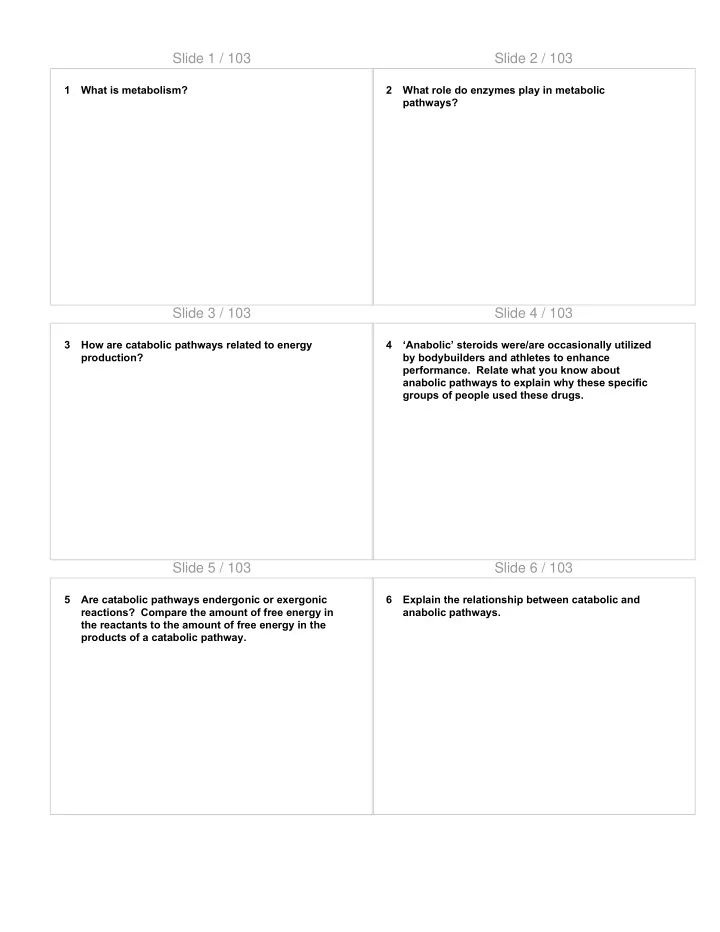
1 What is metabolism?
Slide 2 / 103
2 What role do enzymes play in metabolic pathways?
Slide 3 / 103
3 How are catabolic pathways related to energy production?
Slide 4 / 103
4 ‘Anabolic’ steroids were/are occasionally utilized by bodybuilders and athletes to enhance
- performance. Relate what you know about
anabolic pathways to explain why these specific groups of people used these drugs.
Slide 5 / 103
5 Are catabolic pathways endergonic or exergonic reactions? Compare the amount of free energy in the reactants to the amount of free energy in the products of a catabolic pathway.
Slide 6 / 103
6 Explain the relationship between catabolic and anabolic pathways.
SLIDE 2
Slide 7 / 103
7 Which type of pathway may occur spontaneously? Explain this in terms of free energy availability.
Slide 8 / 103
8 What energy-storing molecule, created through catabolic pathways, can be utilized later as a source of energy currency?
Slide 9 / 103
9 Which bond, in an ATP molecule, contains the most energy? Why is this true?
Slide 10 / 103
10 What has happened to a molecule that has been ‘phosphorylated?’ How do you know energy has been released in this process?
Slide 11 / 103
11 Why is ATP considered a recyclable molecule?
Slide 12 / 103
12 What type of cellular process may be powered by the input of ATP molecules? Homework
SLIDE 3 Slide 13 / 103
13 Suppose you were able to remove enzymes from their involvement in metabolic pathways. What changes, if any, would you be able to observe in the metabolic processes?
Slide 14 / 103
14 What are the differences between catabolic and anabolic pathways?
Slide 15 / 103
15 Would a bodybuilder elect to use a catabolic steroid or an anabolic steroid? Explain your answer.
Slide 16 / 103
16 Explain why it makes sense, in terms of energy content, that a catabolic pathway is utilized in
- btaining energy from food.
Slide 17 / 103
17 Which type of a pathway (catabolic or anabolic) needs to occur first, in order to supply energy for the other one?
Slide 18 / 103
18 When coupled, do metabolic pathways result in a net endergonic or exergonic reaction? Explain your answer.
SLIDE 4 Slide 19 / 103
19 Which molecule contains more energy, adenosine diphosphate or adenosine triphosphate? Explain your answer.
Slide 20 / 103
20 Which bond, in a molecule of ATP, is broken to
- btain energy from the molecule? Why is this the
case?
Slide 21 / 103
21 Why does adding phosphate groups to the tail of adenosine monophosphate store energy within the molecule?
Slide 22 / 103
22 After providing a reaction with energy through phosphorylation, why does an ADP molecule get recycled back to ATP, instead of supporting an additional reaction? Cellular Respiration Classwork
Slide 23 / 103
23 If cellular respiration is a process that yields ATP molecules, do you think this is a catabolic or anabolic pathway? Support your answer.
Slide 24 / 103
24 What role do the molecules NAD+ and FAD play in the process of cellular respiration?
SLIDE 5 Slide 25 / 103
25 Why are electron acceptors necessary in order for NADH+H+ and FADH2 to release stored energy?
Slide 26 / 103
26 Is oxygen a good agent for reduction or oxidation processes? Why?
Slide 27 / 103
27 Suppose you are a scientist studying a newly discovered organism. You are asked to determine the type of cellular respiration utilized by this
- rganism and determine whether it is an a)
- bligate anaerobe, b) obligate aerobe, or c)
facultative anaerobe. Design an experiment to test this, and explain what results you would expect for each type of organism.
Slide 28 / 103
28 What is the net yield of ATP through glycolysis?
Slide 29 / 103
29 Why does the citric acid cycle need to convert pyruvate to a different carbon compound in order complete the cycle? What is the scientific name for this process?
Slide 30 / 103
30 What relationship exists between the CO2 molecules produced through the citric acid cycle and the pyruvates that begin the cycle?
SLIDE 6 Slide 31 / 103
31 Why does the citric acid cycle need to complete two rounds in order to completely process a molecule of glucose?
Slide 32 / 103
32 Why is the reduction of FAD to FADH2 a significant result of the citric acid cycle?
Slide 33 / 103
33 When analyzing the process of cellular respiration, it may help to compare the process to volleyball, with the first three stages being the ‘set,’ and the final stage the ‘spike.’ Explain why this analogy makes sense.
Slide 34 / 103
34 Considering anaerobic respiration, explain why primordial Earth had a higher concentration of CH4, H2, and N2S than our current atmosphere.
Slide 35 / 103
35 Why is the creation of a proton gradient, through the electron transport chain, essential for the ultimate goal of energy production through
- xidative phosphorylation?
Slide 36 / 103
36 In what way is ATP synthase like a turnstile? What object would represent people in this analogy?
SLIDE 7
Slide 37 / 103
37 How are electron carriers NADH and FADH2 utilized in the electron transport chain process?
Slide 38 / 103
38 How do you think the oxidative phosphorylation process would be affected by the lack of an electron acceptor at the end of the ETC? For example, what would happen if all of the oxygen were consumed during the process of phosphorylation, but reduced electron carriers were still available?
Slide 39 / 103
39 Explain why the versatility of catabolism through cellular respiration allows organisms to survive in many different conditions.
Slide 40 / 103
40 Summarize the process of cellular respiration to describe how organisms produce ATP through catabolic pathways. Homework
Slide 41 / 103
41 Life on Earth is sometimes described as a cycle by biologists. Explain why this ‘cycle’ can never reach a point of equilibrium.
Slide 42 / 103
42 Which molecule contains more energy: FAD or FADH2? Explain your response.
SLIDE 8 Slide 43 / 103
43 Is the conversion of FADH2 to FAD an example of
- xidation or reduction? Why?
Slide 44 / 103
44 Suppose you are experimenting in a lab with an
- rganism that dies in the presence of oxygen.
Considering metabolic pathways, how would you categorize this organism?
Slide 45 / 103
45 Glycolysis is considered an anaerobic process. What information can you determine from this description?
Slide 46 / 103
46 What carbon compound is created as a result of glycolysis?
Slide 47 / 103
47 What three energy storing compounds are created through the citric acid cycle?
Slide 48 / 103
48 What is the net gain of ATPs from the breakdown
- f one glucose molecule at the end of the citric
acid cycle?
SLIDE 9 Slide 49 / 103
49 When oxygen is present, oxidative phosphorylation can yield 3 ATPs per NADH and 2 ATPs per FADH2. After the first three steps of cellular respiration, we have 10 NADH molecules and 2 FADH2 molecules. How many ATP molecules can these electron carriers yield?
Slide 50 / 103
50 Why does the valence number of an atom of
- xygen allow it to be a strong electron acceptor,
enabling more copious energy production?
Slide 51 / 103
51 Why is the creation of a concentration gradient essential for the process of oxidative phosphorylation?
Slide 52 / 103
52 How would a condition that caused the inability of the previous steps of cellular respiration to create NADH and FADH2 affect production of ATP through oxidative phosphorylation?
Slide 53 / 103
53 Compare the process of oxidative phosphorylation to the synthesis or hydroelectric power through using a dam.
Slide 54 / 103
54 Which carbon compound yields more energy through respiration, fats or carbohydrates? Fermentation Classwork
SLIDE 10 Slide 55 / 103
55 Why must organisms resort to the process of fermentation when electron acceptors are unavailable?
Slide 56 / 103
56 Do obligate aerobes engage in the process of fermentation? Why or why not?
Slide 57 / 103
57 Would fermentation occur in an organism that had an ample supply of electron acceptors? Why or why not?
Slide 58 / 103
58 It may be said that in an absence of electron acceptors, fermentation allows glycolysis to
Slide 59 / 103
59 Swiss cheese is produced partially by the process
- f fermentation. Hypothesize why Swiss cheese
has holes in it when completed.
Slide 60 / 103
60 Imagine you are working as a sports medicine
- physician. You are asked to devise a way that
athletes could perform strenuous activity without the associated muscle burn. Provide a possible solution for this problem.
SLIDE 11
Slide 61 / 103
61 Does the process of fermentation itself produce any ATP? Explain. Homework
Slide 62 / 103
62 In what way is glycolysis related to fermentation?
Slide 63 / 103
63 What is the difference between lactic acid fermentation and ethanol fermentation?
Slide 64 / 103
64 What role does anaerobic respiration play in the creation of alcoholic beverages, such as beer or wine?
Slide 65 / 103
65 Why do your muscles burn during a strenuous physical activity?
Slide 66 / 103
66 Suppose you are sitting in the lunch room when a neighboring student makes the claim that ‘eating bacteria would be so gross.’ You notice the student has just eaten a yogurt. How do you reply to this statement? Photosynthesis Classwork
SLIDE 12 Slide 67 / 103
67 Based on the chemical equation, what relationship exists between photosynthesis and cellular respiration?
Slide 68 / 103
68 Even though humans do not conduct photosynthesis, our existence relies in this process in two ways. Identify these two ways.
Slide 69 / 103
69 In what way might photosynthesis and cellular respiration be described as a cycle?
Slide 70 / 103
70 Why might the addition of oxygen to Earth’s atmosphere 2.5 BYA have been problematic for the obligate anaerobes in existence at that time?
Slide 71 / 103
71 Identify the primary electron carrier utilized in the process of photosynthesis.
Slide 72 / 103
72 Suppose you placed a plant in a container that allowed only green, blue and indigo wavelengths
- f light through. Would this plant be able to
conduct photosynthesis at a normal rate? Why or why not?
SLIDE 13 Slide 73 / 103
73 What role does chlorophyll play in the initiation of the photosynthesis process?
Slide 74 / 103
74 In what way does a concentration gradient play a role in the light reaction process?
Slide 75 / 103
75 What happens to an electron that has been through photosystems II and I?
Slide 76 / 103
76 What is the source of the oxygen produced in non-cyclic energy transport?
Slide 77 / 103
77 At what point in non-cyclic energy transport is
Slide 78 / 103
78 In what way are the light-independent reactions reliant upon the light-dependent reactions?
SLIDE 14 Slide 79 / 103
79 What role did the Calvin Cycle play in the
- rigination of oxygen in our Earth’s atmosphere?
Slide 80 / 103
80 When looking at a tree, you might realize the solid form of the bark, tissue, roots and branches were
- nce another form of carbon. Explain this
thought process.
Slide 81 / 103
81 Can the Calvin Cycle occur at nighttime? Explain your response.
Slide 82 / 103
82 How does burning fossil fuels add more carbon to the carbon cycle?
Slide 83 / 103
83 How is the carbon cycle related to the greenhouse effect?
Slide 84 / 103
84 Why is it important to consider long term, holistic studies when analyzing climate change, as
- pposed to isolated years and events?
SLIDE 15
Slide 85 / 103
85 In what way does the existence of large, forested areas such as the Amazon rainforest, help to moderate Earth’s climate?
Slide 86 / 103
86 Explain the relationship between the burning of fossil fuels and climate change. Homework
Slide 87 / 103
87 Write the balanced chemical equations for photosynthesis and cellular respiration.
Slide 88 / 103
88 How are the products of cellular respiration related to the reactants of photosynthesis?
Slide 89 / 103
89 In photosynthesis, the reduction of NADP+ yields what molecule?
Slide 90 / 103
90 What is the name of the pigment that allows plant cells to absorb sunlight and power photosynthesis?
SLIDE 16 Slide 91 / 103
91 Explain the ‘cyclic’ nature of cyclic energy transport in photosynthesis?
Slide 92 / 103
92 Sketch a thylakoid and label the following: stroma, membrane, lumen.
Slide 93 / 103
93 How is the production of ATP in the process of cellular respiration similar to the production of ATP in photosystems II and I?
Slide 94 / 103
94 Would it be true to say that oxygen is a byproduct
- f photosynthesis? Why or why not?
Slide 95 / 103
95 What is the role of NADP+ in photosystem I?
Slide 96 / 103
96 What role does CO2 play in the light-independent reactions?
SLIDE 17 Slide 97 / 103
97 Explain the term ‘carbon fixation.’
Slide 98 / 103
98 Explain how the light-independent reactions are responsible for the existence of carbohydrates on Earth.
Slide 99 / 103
99 Why are greenhouse gases necessary for the maintenance of temperatures adequate to support life on Earth?
Slide 100 / 103
This material is made freely available at www.njctl.org and is intended for the non-commercial use of students and teachers. These materials may not be used for any commercial purpose without the written permission of the owners. NJCTL maintains its website for the convenience of teachers who wish to make their work available to other teachers, participate in a virtual professional learning community, and/or provide access to course materials to parents, students and others.
Click to go to website: www.njctl.org New Jersey Center for Teaching and Learning Progressive Science Initiative
Slide 101 / 103
100 How did the death and preservation of prehistoric plants and animals affect global temperature trends?
Slide 102 / 103
www.njctl.org
Energy Processing Multiple Choice Review
SLIDE 18
Slide 103 / 103
101 Explain the concept of ‘anthropogenic climate change.’