Nucleic Acids Basic Concepts Basic Concepts Nucleic Acids David - - PowerPoint PPT Presentation

nucleic acids basic concepts basic concepts nucleic acids
SMART_READER_LITE
LIVE PREVIEW

Nucleic Acids Basic Concepts Basic Concepts Nucleic Acids David - - PowerPoint PPT Presentation

Nucleic Acids Basic Concepts Basic Concepts Nucleic Acids David Murray PhD UCD|Mater Clinical Research Centre UCD School of Medicine and Medical Sciences Mater Misericordiae University Hospital Dublin DNA and RNA are Nucleic Acids


slide-1
SLIDE 1

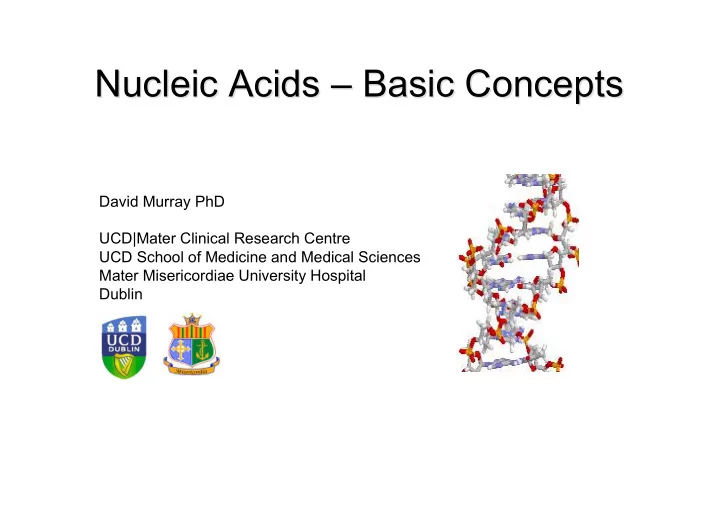
Nucleic Acids Nucleic Acids – – Basic Concepts Basic Concepts

David Murray PhD UCD|Mater Clinical Research Centre UCD School of Medicine and Medical Sciences Mater Misericordiae University Hospital Dublin
slide-2
SLIDE 2
slide-3
SLIDE 3

DNA and RNA are Nucleic Acids

slide-4
SLIDE 4

Outline

  • What are DNA and RNA ?
  • The Structure and Function of DNA and

RNA

  • What is a Gene ?
  • What is a Genome ?
slide-5
SLIDE 5

DNA and RNA What's the Big Deal ?

  • Hereditary Genetics
  • Importance of Genetics in Disease
  • Predisposition
  • Mutations
  • Loss of Genetic Control
slide-6
SLIDE 6

What is DNA ?

  • Contained in the nucleus
  • Arranged in 22 chromosomes, plus two sex

chromosomes

  • Two copies of each (46)
  • 99.9% identical to other humans, 98% to chimp!
  • Each cell; 6 feet of DNA

– >billion miles of DNA in the body!

  • Therefore, very tightly packed
slide-7
SLIDE 7

The Structure of DNA and RNA

  • DNA (deoxyribonucleic acid)
  • RNA (ribonucleic acid)

– What’s the Difference ?

  • Both composed of two different

classes of nitrogen containing bases:

– the purines and pyrimidines.

slide-8
SLIDE 8

The Purines

  • The most commonly
  • ccurring purines in

DNA are adenine (A) and guanine (G)

A G

slide-9
SLIDE 9

The Pyrimidines

  • The most commonly
  • ccurring pyrimidines

in DNA are cytosine (C) and thymine (T)

C T

slide-10
SLIDE 10
  • Contains the same bases as DNA with the

exception of thymine.

  • Instead, RNA contains the pyrimidine uracil (U)
  • DNA : AGCT

RNA : AGCU

RNA

T U

slide-11
SLIDE 11
  • Purines and pyrimidines form chemical linkages

with pentose (5-carbon) sugars.

  • The carbon atoms on these sugars are

designated 1', 2', 3', 4' and 5'.

The building blocks…

T A

slide-12
SLIDE 12
  • It is the 1' carbon of the sugar that becomes bonded to

the nitrogen atom at position N1 of a pyrimidine or N9 of a purine.

  • DNA precursors contain the pentose deoxyribose.
  • RNA precursors contain the pentose ribose (which

contains an additional OH group at the 2' position)

T A

slide-13
SLIDE 13

Base (Purine/Pyrimidine) + Pentose (Deoxyribose/Ribose) = Nucleoside

slide-14
SLIDE 14

The resulting molecules are called nucleosides and can serve as elementary precursors for DNA and RNA synthesis, in vivo.

Nucleosides

Acid

slide-15
SLIDE 15

Nucleotides

  • Before a nucleoside can become part of a DNA or RNA

molecule it must become complexed with a phosphate group to form a nucleotide (then termed either a deoxyribonucleotide or ribonucleotide).

  • Nucleotides can posess 1, 2 or 3 phosphate groups,

e.g. the nucleotides adenosine monophosphate (AMP), adenoside diphosphate (ADP) and adenosine triphosphate (ATP).

  • The phosphate groups are attached to the 5' carbon of

the ribose sugar. Beginning with the phosphate group attached to the 5' ribose carbon, they are labeled α, β and γ phosphate.

  • It is the tri-phosphate nucleotide which is incorporated

into DNA or RNA

slide-16
SLIDE 16

Nucleotide (dNTP)

dTTP

T Where N = A / G /C / T / U

slide-17
SLIDE 17

Polynucleotides

  • DNA and RNA are simply

long polymers of nucleotides called polynucleotides.

  • Only the α phosphate is

included in the polymer. It becomes chemically bonded to the 3' carbon

  • f the sugar moiety of

another nucleotide.

  • Phosphate ‘backbone’ is

negatively charged.

Where ‘Base’ = A,C,G or T

slide-18
SLIDE 18

Polynucleotides

  • The polynucleotide is

connected by a series of 5' to 3' phosphate linkages.

  • Polynucleotide

sequences are referenced in the 5' to 3' direction.

  • Typically, polynucleotides

will contain a 5' phosphate and 3' hydroxyl terminal groups.

slide-19
SLIDE 19

Summary of Terms

  • DNA (deoxyribonucleic acid) and RNA (ribonucleic acid) composed
  • f nitrogen containing bases

– Purines: adenine (A) and guanine (G) – Pyrimidines: cytosine (C) and thymine (T) (uracil (U) in RNA)

  • Link with pentose sugars (DNA: deoxyribose, RNA: ribose) to form

nucleosides

– Nucleosides complex with three phosphate groups (Nucleotides) – Polymers are incorporated into DNA/RNA (polynucleotides)

slide-20
SLIDE 20

Summary of Terms

U dUTP Uridine Uracil T dTTP Thymidine Thymine C dCTP Cytidine Cytosine G dGTP Guanosine Guanine A dATP Adenosine Adenine Code RNA/DNA (Triphosphate) Nucleoside Base

slide-21
SLIDE 21

What is the structure of DNA? How is the structure related to function?

slide-22
SLIDE 22

History

  • 1950

– Primary chemical structure of polynucleotides was known (i.e. the 5'-3' phosphate linkage).

  • 1951

– Erwin Chargaff:

  • Experiment: To analyse DNA from a variety of species and determine

the relative concentrations of individual pyrimidines and purines (A, T, C and G bases).

  • Result: Although different species had uniquely different ratios of

pyrimidines or purines, the relative concentrations of adenine always equaled that of thymine, and guanine equaled cytosine.

  • Chargaff's Law: A=T, G=C
slide-23
SLIDE 23

History

  • 1953

– J.D. Watson and F.H.C. Crick:

  • Identified a hydrogen bonding

arrangement between models of thymine and adenine bases, and between cytosine and guanine bases which fulfilled Chargaff's rule.

  • “Double Helix”

G=C A=T _

slide-24
SLIDE 24

Consequences

  • If G always paired with C, and T always paired with A, then

either strand could be regenerated from the complementary information in the other strand.

  • The basis of the complementarity was hydrogen bonding, i.e.

non-covalent interactions which could be easily broken and re-formed.

  • The information which DNA carried was within the unique

base sequence of the DNA.

  • From the general interior location of the bases, it would

appear that the double helix would have to dissociate in

  • rder to access the information.
slide-25
SLIDE 25

DNA Structure

  • Thousands of

nucleotides are strung together by a phosphate-sugar backbone

slide-26
SLIDE 26

DNA Structure

  • Two strands of DNA

twist around one another to form a double helix

  • ‘Twisted Ladder’
  • Complementary base

pairs form the rungs

slide-27
SLIDE 27

DNA Structure

  • Two nucleotide

sequences running in

  • pposite directions pair

with one another.

  • Each adenine (A)

pairing with a thymine (T)

  • And each guanine (G)

pairing with a cytosine (C)

5' C-G-A-T-T-G-C-A-A-C-G-A-T-G-C 3' | | | | | | | | | | | | | | | 3' G-C-T-A-A-C-G-T-T-G-C-T-A-C-G 5' Base Pairs (BP)

slide-28
SLIDE 28

A Word on DNA function

  • Carries the blueprint for life
  • Duplication for new cells
  • Make proteins for biological functions:
slide-29
SLIDE 29

DNA

  • Prior to cell division, DNA is replicated

before being it is passed on to daughter cells

  • The DNA within our cells contains the

information for everything which occurs within each cell,

– every action – every substance made – every event – every response – everything!

slide-30
SLIDE 30

The Genome

slide-31
SLIDE 31

The Genome

  • The complete set of information in an organism's

DNA is called its genome

  • Carries the information for all the proteins the
  • rganism will ever synthesize.
  • Typical human cell

– 6 feet of DNA – Written in the four-letter nucleotide alphabet that spells out the linear sequence of amino acids in a protein. – Carries instructions for ~ 30,000 different proteins

slide-32
SLIDE 32

Gene Expression

slide-33
SLIDE 33

What are Genes ?

  • Approx 26,000 human genes
  • Made up of DNA
  • Coding regions of DNA

Genes Chromosomes The Cell Sentences Books Library

slide-34
SLIDE 34

Gene Structure

  • Like a sentence – beginning (Start) and end

(Stop)

  • Ordered structure – not random bunch of

nucleotides linked in some random order

slide-35
SLIDE 35

Transcription

  • The first step in gene

expression

  • DNA (gene) is used

as a template to synthesise RNA copy

  • Transcriptional

Profiling

slide-36
SLIDE 36
  • A specific gene specifies a polypeptide (protein)

– The DNA is transcribed into message RNA (mRNA), which is translated into the polypeptide

DNA RNA Protein TRANSCRIPTION TRANSLATION

slide-37
SLIDE 37

Translation

  • mRNA used as template to make proteins
  • Occurs in ribosomes
  • One codon corresponds to one amino acid
slide-38
SLIDE 38

DNA molecule Gene 1 Gene 2 Gene 3 DNA strand TRANSCRIPTION RNA Protein TRANSLATION Codon Amino acid

  • A specific gene specifies a polypeptide
slide-39
SLIDE 39

The Genetic Code

slide-40
SLIDE 40
  • Specific DNA sequences code for specific amino

acids

Start codon RNA Transcribed strand Stop codon Translation Transcription DNA Polypeptide

Mutations ? Faulty Protein

slide-41
SLIDE 41

Summary

slide-42
SLIDE 42

An Example

Nucleotide sequence for Human Beta- Globulin gene.

  • Haemoglobin subunit
slide-43
SLIDE 43
  • Caries information for amino acid

sequence of one globulin subunit molecule.

  • Alpha globulin – another gene
  • Only one of two complementary strands
  • f DNA shown
  • Written and read from left to right (from 5’

to 3’) like text.

  • DNA highlighted in yellow: regions that

specify amino sequence for protein.

slide-44
SLIDE 44

Review

  • DNA and RNA

– What they are – Structure and Function

  • Genes and Genomes
  • Transcription and Translation
  • Any Questions ?
slide-45
SLIDE 45

Nucleic Acids Nucleic Acids – – Analytical Techniques

David Murray PhD UCD Clinical Research Centre UCD School of Medicine and Medical Sciences

slide-46
SLIDE 46

Overview…

  • Analytical Techniques
  • RNA Techniques

– Extraction – Analysis

  • Reverse Transcription

– RNA → DNA

  • RTPCR

– Reverse Transcription Polymerase Chain Reaction

  • Quantitative Real Time PCR
  • RNA interference (siRNA)
  • Introduction to Microarrays
slide-47
SLIDE 47

RNA Analysis

Extraction Quantitation Quality Assessment

slide-48
SLIDE 48

Why Analyse RNA ?

  • Transcriptional Profiling
  • Levels of mRNA expression
  • mRNA: early step in gene expression
  • Controlled step
  • Variation between different cases

– Normal Vs Disease – Responders Vs Non-Responders

slide-49
SLIDE 49

ANALYSIS OF GENE EXPRESSION

PROMOTER exon 1 exon 2 intron

5’ 3’

transcription RNA processing

protein

3’ 5’

RNA (1o Transcript)

m7GpppN AAAAAA

5’ 3’

mRNA

RNA analysis

DNA (gene): Note: Non coding Introns are not included in mRNA molecule

translation

Polyadenylated

slide-50
SLIDE 50
slide-51
SLIDE 51

RNA Analysis

RNA RT-PCR Quantitative PCR Microarray Analysis

  • Comparison of mRNA expression profiles between two states;
  • Disease Vs Normal
  • Treated Vs Untreated
  • Primary Vs Mets
slide-52
SLIDE 52

RNA is more susceptible to degradation than DNA

The 2´ hydroxyl groups adjacent to the phosphodiester linkages in RNA are able to act as intramolecular nucleophiles in both base- and enzyme-catalysed hydrolysis. DNases require metal ions for activity and so can be inactivated with chelating agents e.g. EDTA RNases bypass the need for metal ions by taking advantage of the 2´ hydroxyl group as a reactive species.

Working with RNA

slide-53
SLIDE 53

Problems with RNases

  • RNases

– single-strand specific endoribonucleases – resistant to metal chelating agents – can survive prolonged boiling or autoclaving

  • But…

– relies on active site histidine residues for activity – Therefore, it can be inactivated by the histidine- specific alkylating agent diethyl pyrocarbonate (DEPC).

slide-54
SLIDE 54

Avoiding ribonucleases Exogenous Introduced during working procedures Eliminate through good working practices Endogenous Released by cells or tissue during extraction Eliminate through use of inhibitors of RNase activity

slide-55
SLIDE 55

Always wear gloves - Skin is an abundant source of ribonucleases. Prepare solutions for RNA work using autoclaved glassware, then autoclave the solutions after they are prepared. Better still use disposable plastic ware if possible. If possible use pre-sterilized water. Use separate solutions for RNA work and only use them for RNA. DEPC treatment of water isn’t always necessary. Autoclaving water and solutions can sometimes be more effective in removing RNases than chemical treatment.

Working with RNA – Dos and Don’ts

slide-56
SLIDE 56

If you do need to treat your solutions with DEPC: 1.make your solution 0.1% DEPC (500 µl in 500 ml H2O) 2.shake it well 3.keep it overnight at RT 4.autoclave Take care! DEPC is highly carcinogenic. Use a fumehood! Working with RNA – Dos and Don’ts

slide-57
SLIDE 57

Maintain a separate area for RNA work that has its own set

  • f pipettes.

This is especially important if your work requires the use of RNase A (e.g. plasmid preps). Sterile, disposable plasticware can safely be considered RNase-free and should be used when possible Use RNase away or RNase zap!! Working with RNA – Dos and Don’ts

slide-58
SLIDE 58

RNA Extraction …an example

slide-59
SLIDE 59

TRI ReagentTM

  • Sigma (Cat# T9424)
  • RNA, DNA and Protein extraction
  • Cell/Tissue lysis
  • Liquid separation
  • Quick and Effective
slide-60
SLIDE 60

Extraction from Cells in Culture

  • 80 – 100% Confluent T75

(~1 x 10⁷ cells)

  • Remove all media, wash

twice with PBS (saline)

  • Add 1ml TRI REAGENT

(cover all cells)

– Scale Down/Up for other culture vessels

  • 10 min at Room Temp (RT)
  • Remove to sterile microfuge

tube

slide-61
SLIDE 61

Extraction from Tissue

  • Remove tissue from

RNAlater into sterile microfuge tube.

  • Add 1 mL TRI REAGENT
  • Homogenise at 15,000 rpm

for 1-2 min.

  • Wash Tip between samples

in 100% Ethanol, then 0.1 % DEPC.

slide-62
SLIDE 62

Chloroform Separation

  • Add 200 µL (0.2 ml)

Chloroform (fumehood!)

  • Mix well (vortex), and stand

at RT for 15 min

  • Centrifuge at 12,000 x g

(MAX!) for 15 min at 4oC

  • 3 layers:

– Upper (aqueous): RNA – Middle (interphase): Protein – Lower (organic): DNA

  • Remove upper phase to

fresh microfuge tube.

slide-63
SLIDE 63

Propanol Precipitation

  • Add 500 µL Ice-Cold Isopropanol

and mix

  • Stand on Ice for 10 min
  • Centrifuge at 12,000 x g for 10 min

at 4oC

  • Pellet ?
  • Remove Isopropanol
  • Add 1 ml 75% Ethanol and vortex
  • Centrifuge at 7,500 x g for 5 min
  • Remove Ethanol and allow to air dry

(10 min)

  • Resuspend in 10 – 50 µL 0.1%

DEPC (60oC 10 min)

slide-64
SLIDE 64

RNA Quantitation

slide-65
SLIDE 65

RNA Quantitation

  • UV Spectroscopy
  • 1/100 dilution of RNA

– 5 µL RNA in 495 µL 0.1 % DEPC

  • Absorbance at 260nm and

280nm

– Quartz cuvette – Blank with 0.1% DEPC

slide-66
SLIDE 66

RNA Quantitation Calculation

  • A260 = 1.0 (40 µg/mL)
  • Concentration (µg/µL) =

A260 x 40 x 100 (diln. factor) 1000 (mL → µL)

  • Or Simply: A260 x 4 = Concentration (µg/µL)
  • A260/A280 Ratio: RNA Quality/Purity (≈ 1.8)

– Higher: Organic Contaminants – Lower: Protein Contaminants

slide-67
SLIDE 67

RNA Quantitation Calculation

  • Eg

– 1/100 dilution of RNA – Absorbance Values:

  • 260nm 0.456
  • 280nm 0.250

– Concentration:

  • (0.456 x 40 x 100)/1000
  • 0.456 x 4 = 1.824 µg/µl

– Purity

  • 0.456/0.250 = 1.8 (perfect!)

Newer technologies : BioAnalyzer NanoDrop

slide-68
SLIDE 68

Next?

Assessment of RNA Quality

slide-69
SLIDE 69

Agarose Gel Electrophoresis

  • To assess Quality of

RNA

– Extent of degradation

  • Also used to as

standard method for analysing, identifying and purifying fragments of DNA (later).

slide-70
SLIDE 70

“Electrophoresis”

  • A

technique used to separate and sometimes purify macromolecules

  • especially proteins and nucleic acids –

based on their difference in size, charge or conformation.

  • When charged molecules are placed in

an electric field, they migrate toward either the positive (anode) or negative (cathode) pole according to their charge.

  • In contrast to proteins, which can have

either a net positive or net negative charge, nucleic acids have a consistent negative charge imparted by their phosphate backbone, and migrate toward the anode.

I V

slide-71
SLIDE 71

“Electrophoresis”

  • Nucleic acids are electrophoresed within a matrix
  • r "gel".
  • The gel is cast in the shape of a thin slab, with wells for

loading the sample.

  • Agarose is typically used at concentrations of 0.5 to

2%.

  • The higher the agarose concentration the "stiffer" the

gel.

  • Agarose gels are extremely easy to prepare: simply

mix agarose powder with buffer solution (TAE/TBE), melt it by heating, and pour the gel. It is also non-toxic.

  • The gel is immersed within an electrophoresis buffer

(same as above) that provides ions to carry a current and it also maintains the pH at a relatively constant value.

slide-72
SLIDE 72

RNA Electrophoresis

  • 1. The agarose gel with three slots (S).
  • 2. Injection of RNA sample into the first slot.
  • 3. Injection of samples into the second and third slot.
  • 4. A current is applied. The RNA moves toward the positive anode

due to the negative charges on its phosphate backbone.

slide-73
SLIDE 73
  • +
slide-74
SLIDE 74

Gel System

slide-75
SLIDE 75

Procedure

  • Clean Gel System with RNase Inhibitor

Spray

  • Mix 50ml 10X TAE (Tris Acetate EDTA)

buffer with 450ml DIW (De-ionised Water) = 1X TAE

  • 0.5g Agarose in 50ml 1X TAE Buffer

– 1% (w/v) solution/gel – Microwave until dissolved (1-2min @ 650W)

  • Pour into casting tray (with combs) and

allow to cool/solidify

slide-76
SLIDE 76

Procedure

  • Analyse 2µg RNA by electrophoresis

– 2/concentration (µg/µl) – Eg:

  • 1.824 µg/µl
  • 2 µg in ~ 1 µl
  • Mix with 1 µl DEPC and 0.5 µl RNA

loading buffer

  • Heat 65oC 10 min then chill on ice
  • Submerge gel in 1X TAE (running buffer)
  • Load RNA (2.5 µl) on gel and run at 100V
slide-77
SLIDE 77

Procedure

  • Remove gel after ~ 40min (blue of buffer almost

at end of gel)

  • Visualise under UV light
  • Visible ribosomal subunits indicate intact RNA

– 1 Degraded – 2,3 Good Quality

slide-78
SLIDE 78

RT-PCR

Reverse Transcriptase Polymerase Chain Reaction

slide-79
SLIDE 79

The basics…

  • Interested in gene expression (mRNA)
  • Levels of mRNA (transcripts)
  • Comparison between 2 states (normal and

disease)

  • mRNA (1-5% of total RNA)
  • We use PCR (DNA Technique)

– More on that later

  • Must Convert RNA to DNA

– How ?

slide-80
SLIDE 80

Reverse Transcription

  • mRNA molecule is copied into a double

stranded DNA compliment (cDNA)

  • Reverse transcriptase – enzyme that

performs this.

  • Used naturally by retroviruses to insert

themselves into an infected organism's DNA genome

  • cDNA contain coding regions only (exons)
slide-81
SLIDE 81

Reverse Transcription (RT)

  • mRNA Template
  • ‘Priming’

– polyA mRNA isolated from total RNA using oligo dT primer

  • Polynucleotide of T’s

– Initiates synthesis

  • First strand of cDNA

synthesised using Reverse Transcriptase (RT) enzyme

– Adds complimentary nucleotide bases to mRNA to make cDNA

slide-82
SLIDE 82

cDNA is then used as a template in PCR

slide-83
SLIDE 83

PCR

  • Polymerase Chain Reaction

– Technique for Targeted DNA Amplification – Starting material ('target sequence’);

  • A gene or segment of DNA (cDNA in our case)

– Target sequence can be amplified a billion fold in a matter

  • f hours
  • PCR allows one to take a specimen of genetic

material, even from just one cell, copy its genetic sequence over and over, and generate a test sample sufficient to detect the presence or absence

  • f a specific virus, bacterium or any particular

sequence of genetic material

slide-84
SLIDE 84

PCR Applications

  • Widely used in molecular biology
  • Specific Amplification
  • Assuming sequence of target is known;

– Viral Detection

  • HIV can be quantitated

– Screening genes for mutations – Detecting gene expression – Detection of food pathogens – Forensic identification

slide-85
SLIDE 85

The PCR Reaction

  • Template

– Target DNA that Primers will bind

  • Primers

– Bind target sequence, making the reaction specific

  • Taq

– enzyme which carries out the amplification reaction – extends the primers from their binding-sites on the target along the template

  • Buffer

– Contains a salt (KCl) and MgCl (cofactor for Taq)

  • Nucleotides

– A,T,G and C – Deoxyribonucleotide triphosphates (dNTPs) – DNA building blocks

  • Water

– High ‘PCR’ grade

slide-86
SLIDE 86

PCR: Practicalities

  • Always wear gloves
  • All reagents must be thawed and mixed

completely before use

  • Typical Reaction Mix (50µl);

– 37.5µl sterile water – 5µl 10X Buffer – 1µl 10mM dNTP mix – 0.5µl Taq (5U/µl stock) – 1µl Primer 1 & 1µl Primer 2 (10 pmol/ul) – 5µl Template (cDNA)

slide-87
SLIDE 87

The PCR Procedure

  • Entire genomic double stranded DNA is heated

(denatured)

  • Primers (DNA oligonucleotides)

– flank the nucleotide sequence of the gene – synthesised chemically – Prime DNA synthesis on single stranded DNA

  • In vitro DNA Synthesis catalysed by DNA

polymerase

  • Primers remain at 5’ end of new DNA fragments
slide-88
SLIDE 88

The PCR Cycle

  • Initial Cycle: 1min @ 95oC
  • Followed by 40 cycles of following;

– Denature: 1min @ 95oC – Anneal: 1min @ 50-60oC (depends on primer) – Elongate: 1min @ 72oC

  • Final extension: 10min @ 72oC
slide-89
SLIDE 89

PCR Links

  • Calculate Annealing Temperature

– http://www.bioinformatics.vg/bioinformatics_to

  • ls/oligo2002.shtml
  • Primer Design

– http://frodo.wi.mit.edu/cgi- bin/primer3/primer3_www.cgi – http://www.basic.nwu.edu/biotools/oligocalc.ht ml

slide-90
SLIDE 90

The Thermocycle

slide-91
SLIDE 91

The PCR Procedure

slide-92
SLIDE 92

PCR: DNA Amplification

slide-93
SLIDE 93

Agarose Gel Electrophoresis

  • Analysis of PCR product
  • Mix 50ml 10X TAE (Tris Acetate EDTA) buffer with 450ml

DIW (De-ionised Water) = 1X TAE

  • 0.5g Agarose in 50ml 1X TAE Buffer

– 1% (w/v) solution/gel – Microwave until dissolved (1-2min @ 650W)

  • Add 1µl 10mg/ml Ethidium Bromide and mix

– Interacts with Nucleic Acids – Fluorescent Complex – Visible under UV

  • Potent Mutagen

– Fumehood, Lab Coat, Safety Glasses, Gloves – Spills: Absorbed and Decontaminated with soap and water

  • Pour into casting tray (with combs) and allow to cool/solidify
slide-94
SLIDE 94

Running the Gel

  • Submerge gel in 1X TAE (running buffer)
  • Mix 3µl PCR reaction with 3µl loading

buffer and load onto gel

  • Mix 3µl 100bp DNA ladder with 3µl loading

buffer and load onto gel

  • Run at 100V
  • Remove gel after ~ 40min (blue of buffer

almost at end of gel)

  • Visualise under UV light
  • Dispose Gel in Yellow Biohazard Bin
slide-95
SLIDE 95

DNA Electrophoresis

1. The agarose gel with three slots (S). 2. Pipette DNA ladder into the first slot. 3. DNA ladder loaded. loading of samples into the second and third slot. 4. A current is applied. The DNA moves toward the positive anode due to the negative charges on its phosphate backbone. 5. Small DNA strands move fast, large DNA strands move slowly through the

  • gel. DNA is not normally visible during

this process, so the marker dye is added to the DNA to avoid the DNA being run entirely off the gel. The marker dye has a low molecular weight, and migrates faster than the DNA, so as long as the marker has not run past the end of the gel, the DNA will still be in the gel. 6. The DNA is spread over the whole gel. The electrophoresis process is finished.

slide-96
SLIDE 96
slide-97
SLIDE 97

Real Time PCR

slide-98
SLIDE 98

Traditional PCR – Limitations

  • Qualitative not Quantitative
  • Gel Required
  • End point detection
  • 4/5 hrs until result
  • Non numerical
  • Non Automated
slide-99
SLIDE 99

Real Time PCR

  • Monitor Amplification in Real Time
  • Measure the kinetics of the reaction in the

early phases of PCR

  • Quantitative and Qualitative
  • 30/40 min until result
  • Numerical output
  • Automated
slide-100
SLIDE 100

PCR Phases

Doubling of product at every cycle. Reaction components being consumed. Reaction is slowing. Reaction has stopped. No more products are being made. Area for Real Time Detection

slide-101
SLIDE 101

Real Time PCR Instruments

slide-102
SLIDE 102

SYBR Green Chemistry

  • A dye that binds the Minor Groove of double

stranded DNA.

  • Increasing the intensity of the fluorescent

emissions.

  • As more double stranded amplicons are

produced, SYBR Green dye signal will increase.

  • Increase in fluorescence directly proportional to

increase in amplicons (amplified product) produced, which is proportional to the amount of target template present initially.

slide-103
SLIDE 103

SYBR Green Chemistry

slide-104
SLIDE 104

Amplification Curve

slide-105
SLIDE 105

Real Time PCR

  • Pro

– Sensitive – No gel

  • Con

– Expense – Hardware

slide-106
SLIDE 106

Real Time PCR Links

  • Good Article

– http://dorakmt.tripod.com/genetics/realtime.html

  • Troubleshooting

– http://www.eurogentec.com/module/FileLib/GRT- TSGCUST-0304-V4.pdf

slide-107
SLIDE 107

Microarrays

slide-108
SLIDE 108

Microarray Analysis

Monitor the activity of thousands of genes simultaneously Compare activity of one gene in many samples. Compare activity of many genes in one sample. Take a photo of genes in action!

slide-109
SLIDE 109
  • Thousands of genes and their products, in

a living organism function in a complicated and orchestrated way.

  • Traditional methods in molecular biology

generally work on a "one gene in one experiment“.

– Limited throughput. – “Whole picture" of gene function is hard to

  • btain.
  • Microarrays

– Monitor the whole genome on a single chip – Better picture of the interactions among thousands of genes

slide-110
SLIDE 110

Base-pairing or hybridization (A-T and G-C for DNA) (A-U and G-C for RNA) Underlining principle of DNA microarrays

slide-111
SLIDE 111

What is an Array ? What is an Array ?

aka aka Genechips Genechips aka aka BioArrays BioArrays aka aka Biochips Biochips aka aka Genomechips Genomechips

  • Microarrays involve the immobilization of

defined nucleic acids sequences (probes) on a solid support…

  • Subsequent binding of target sequences

complementary to these nucleic acids to measure gene expression levels.

  • The DNA sequences at each probe represent

important genes (or parts of genes)

  • 1.28 x 1.28 cm glass/silicon wafer
  • 24 x 24 µm probe site (≈ 500,000 probes)
  • Lengths of DNA up to 25 nucleotides long

GeneChip

slide-112
SLIDE 112

Applications of DNA Applications of DNA Microarrays Microarrays

  • DNA Microarrays are used to study gene activity (expression)
  • What proteins are being actively produced by a group of cells?
  • “Which genes are being expressed?”
  • Compare expression levels
  • How?
  • When a cell is making a protein, it translates the genes (made of DNA)

which code for the protein into RNA used in its production

  • The RNA present in a cell can be extracted
  • If a gene has been expressed in a cell
  • RNA will bind to “a copy of itself” on the array
  • RNA with no complementary site will wash off the array
  • The RNA can be “tagged” with a fluorescent dye to determine its presence
  • DNA microarrays provide a high throughput technique for quantifying

the presence of specific RNA sequences

slide-113
SLIDE 113

Control Disease cRNA Cells/ Tissues mRNA Hybridisation Expression Comparison

slide-114
SLIDE 114

The Process The Process

Cells Poly-A RNA AAAA cDNA L L L L IVT 10% Biotin-labeled Uracil Antisense cRNA L Fragment (heat, Mg2+) Labeled fragments Hybridize Wash/stain Scan L (In-vitro Transcription)

slide-115
SLIDE 115

Affymetrix GeneChip Techonology

slide-116
SLIDE 116

Hybridization and Staining Hybridization and Staining

L L GeneChip Biotin Labeled cRNA

+

L L L L L L L L L L

+

SAPE Streptavidin- phycoerythrin Hybridized Array

slide-117
SLIDE 117

The Result The Result

  • A light source scans the

array, causing the dyes to fluoresce

  • The glow is picked up by

a sensor and is used to determine the relative abundance of the RNA

  • This information must be

processed to determine the level of activity for each expressed gene

slide-118
SLIDE 118

Data Clustering Data Clustering

slide-119
SLIDE 119

Array Applications Array Applications

  • Basic Understanding
  • Arrays can take a snap shot of which subset of genes in a cell is

actively making proteins

  • Medical diagnosis
  • Used to determine if a person’s genetic profile would make him or

her more or less susceptible to drug side effects

  • Used to distinguish between similar diseases or to define previously

unknown subsets within a disease.

  • Drug design
  • Translate the human genome results into new products
  • Must figure out what the genes do, how they interact, and how

they relate to diseases.

slide-120
SLIDE 120

Microarray Links

  • Affymetrix

–http://www.affymetrix.com

slide-121
SLIDE 121

RNA interference (siRNA)

slide-122
SLIDE 122

Outline

1. RNA interference (RNAi) – what is it? 2. Mechanism of RNAi – an overview 3. Meet the players 4. Experimental Applications 5. Therapeutic Applications

slide-123
SLIDE 123

what is RNA interference?

  • RNAi is a way to silence gene expression
  • to perform RNAi, dsRNA homologous

to the targeted gene is made and then introduced into cells

  • mRNA with high sequence homology

to the dsRNA may be silenced

slide-124
SLIDE 124

RNA Interference

  • Post-transcriptional gene silencing
  • First discovered in c. elegans and plants

– Protective role: parasitic and viral resistance

  • Mammals

– RNAi occurs – role???

slide-125
SLIDE 125

How does RNAi work?

RNAi works postranscriptionally……..

slide-126
SLIDE 126

siRNAs have a defined structure

19 nt duplex 2 nt 3’ overhangs

slide-127
SLIDE 127
  • siRNA binding

siRNA binding

  • siRNA unwinding

siRNA unwinding

  • RISC activation

RISC activation

  • (

(RNAi silencing

complex)

)

slide-128
SLIDE 128

practical aspects of RNAi

  • biological research

– defining gene function (gene knockout) – defining biochemical pathways

  • microarray screening of RNAi

knockouts

  • therapeutic treatment

– cancer – Infection

slide-129
SLIDE 129

INDUCIBLE KNOCK-OUT HIGH-THROUGHPUT tissue or time specific analysis of gene function KNOCK-OUT/ -DOWN gene function analysis cell engineering in vitro drug target validation forward genetic screens ES cell gene function analysis in vivo drug target validation gene interaction therapeutic testing cell type

  • f interest

GENE THERAPY tissue type

  • f interest

Short hairpin vector TISSUE CULTURE future? future future? producer virus

McManus and Conklin RNAi, 2003

Although silencing by siRNAs is transient, vectors can be made to express siRNAs in cells

slide-130
SLIDE 130

siRNA Delivery

  • in vitro

– Chemical transfection (Lipofectamine, Oligofectamine, TransIT-TKO, Siport Amine, Siport

  • in vivo

– Intramuscular injection – Hydrodynamic transfection into mammals

slide-131
SLIDE 131

siRNA Therapeutics

slide-132
SLIDE 132

Therapeutic siRNAs

Cancer

p53 mutant K-Ras BCR-ABL MDR1 C-RAF Bcl-2 VEGF PKC-α Β-Catenin

Disease siRNA target gene

(Sioud, 2004)

slide-133
SLIDE 133

Therapeutic siRNAs

Viral Infection

HIV-Tat HIV-Rev HIV-Vif, -Hef HPV-E6 and –E7 HBV-S1, -S2, -S, -X CCR5, CXCR4 CD4

Disease siRNA target gene

(Sioud, 2004)

slide-134
SLIDE 134

Therapeutic siRNAs

Sepsis

TNF-α

Acute Liver Failure

Fas receptor Caspase-8

Disease siRNA target gene

(Sioud, 2004)

slide-135
SLIDE 135

References

Hannon, G.J. (2002). RNA interference. Nature. 418; 244-251. (review) Agrawal, N. et al. (2003). RNA interference: biology, mechanism and applications. Microbiol. Mol. Biol. Rev. 67; 657-685. (review) Elbashir et al. (2001). Duplexes of 21-nucleotide RNAs mediate RNA interference in cultured mammalian cells. Nature. 411; 494- 498. Fire, A. et al. (1998). Potent and specific genetic interference by double-stranded RNA in Caenorhabditis elegans. Nature. 391; 806- 811. Agrawal, N. et al. (2003). RNA interference: biology, mechanism and applications. Microbiol. Mol. Biol. Rev. 67; 657-685. Tuschl, T. (2002). Expanding small RNA interference. Nature Biotech. 20; 446-448 Donze, O and Picard, D. (2002). RNA interference in mammalian cells using siRNAs synthesized with T7 RNA polymerase. Nucleic Acids Research. 30; e46 Hannon, G.J. (2002). RNA interference. Nature. 418; 244-251. McCaffrey, A.P. et al. (2002). RNA interference in adult mice. Nature. 418; 38-39. Shuey, D.J. et al. (2002). RNAi: gene-silencing in therapeutic intervention. DDT. 7; 1040-1046. Sioud, M. (2003). Therapeutic siRNAs. TIPS. 25; 22-28. Wall, N.R. and Shi, Y. (2003). Small RNA: can RNA interference be exploited for therapy? The Lancet. 362; 1401-1403

slide-136
SLIDE 136

Extra Links

  • NCBI Human Genome:

– http://www.ncbi.nlm.nih.gov/genome/guide/human/ release_notes.html

  • Human Genome Project:

– http://www.genome.gov/

  • General Protocols

– http://micro.nwfsc.noaa.gov/protocols/protocols.ht ml