Acids and Bases Acids corrode active metals. Acids turn blue litmus - - PDF document

acids and bases
SMART_READER_LITE
LIVE PREVIEW

Acids and Bases Acids corrode active metals. Acids turn blue litmus - - PDF document

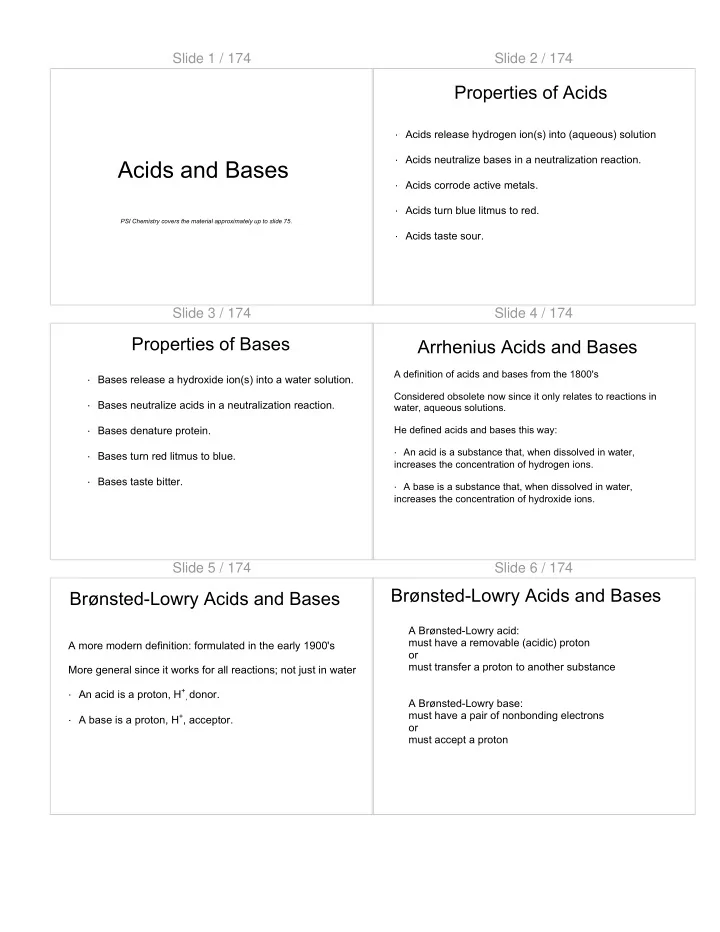
Slide 1 / 174 Slide 2 / 174 Properties of Acids Acids release hydrogen ion(s) into (aqueous) solution Acids neutralize bases in a neutralization reaction. Acids and Bases Acids corrode active metals. Acids turn blue litmus to red.


slide-1
SLIDE 1

Slide 1 / 174

Acids and Bases

PSI Chemistry covers the material approximately up to slide 75.

Slide 2 / 174

· Acids release hydrogen ion(s) into (aqueous) solution · Acids neutralize bases in a neutralization reaction. · Acids corrode active metals. · Acids turn blue litmus to red. · Acids taste sour.

Properties of Acids

Slide 3 / 174

Properties of Bases

· Bases release a hydroxide ion(s) into a water solution. · Bases neutralize acids in a neutralization reaction. · Bases denature protein. · Bases turn red litmus to blue. · Bases taste bitter.

Slide 4 / 174

Arrhenius Acids and Bases

A definition of acids and bases from the 1800's Considered obsolete now since it only relates to reactions in water, aqueous solutions. He defined acids and bases this way: · An acid is a substance that, when dissolved in water, increases the concentration of hydrogen ions. · A base is a substance that, when dissolved in water, increases the concentration of hydroxide ions.

Slide 5 / 174

Brønsted-Lowry Acids and Bases

A more modern definition: formulated in the early 1900's More general since it works for all reactions; not just in water · An acid is a proton, H+

, donor.

· A base is a proton, H+, acceptor.

Slide 6 / 174

A Brønsted-Lowry acid: must have a removable (acidic) proton

  • r

must transfer a proton to another substance A Brønsted-Lowry base: must have a pair of nonbonding electrons

  • r

must accept a proton

Brønsted-Lowry Acids and Bases

slide-2
SLIDE 2

Slide 7 / 174

1 A Bronsted-Lowry base is defined as a substance that __________.

A

increases [H+] when placed in H2O

B

decreases [H+] when placed in H2O C increases [OH-] when placed in H2O D acts as a proton acceptor

E

acts as a proton donor

Slide 8 / 174

2 A Bronsted-Lowry acid is defined as a substance that __________.

A

increases Ka when placed in H2O

B

decreases [H+] when placed in H2O C increases [OH-] when placed in H2O D acts as a proton acceptor

E

acts as a proton donor

Slide 9 / 174

HCl donates the proton and acts as a Brønsted-Lowry acid H2O accepts the proton and acts as a Brønsted-Lowry base H3O+ is called a hydrated proton or a hydronium ion. It is also written as H+

Brønsted-Lowry Acids and Bases

HCl + H2O # Cl- + H3O+

_

+

+

Slide 10 / 174

Lewis Acids

· Brønsted-Lowry acids replaced Arrhenius acids because the former were more general: Arrhenius acids could only be defined in aqueous (water) solutions. Brønsted-Lowry acids don't have that limitation. · Similarly, Brønsted-Lowry acids are limited to substances that gain or lose hydrogen. But there are acids and bases that don't. · The most general approach is that of Lewis acids; which don't require an aqueous environment or an exchange of hydrogen.

Slide 11 / 174

Lewis Acids

· Lewis acids are defined as electron-pair acceptors. · Atoms with an empty valence orbital can be Lewis acids.

Slide 12 / 174

Lewis Bases

· Lewis bases are defined as electron-pair donors. · Anything that could be a Brønsted-Lowry base is a Lewis base. · Lewis bases can interact with things other than protons,

  • however. Therefore, this definition is the broadest of the three.
slide-3
SLIDE 3

Slide 13 / 174

3 Which of the following compounds could never act as an acid?

A

SO4

2-

B

HSO4

  • C

H2SO4

D

NH3

E

CH3COOH

Slide 14 / 174

4 According to the following reaction model, which reactant is acting like an acid?

A

H2SO4

B

H2O

C

H3O+

D

HSO4

  • E

None of the above H2O + H2SO4 → H3O+ + HSO4

  • Slide 15 / 174

5 According to the following reaction, which reactant is acting as a base? H3O+ + HSO4

  • → H2O + H2SO4

A

H2SO4

B

H2O

C

H3O+

D

HSO4

  • E

None of the above

Slide 16 / 174

6 For the following reaction, identify whether the compound in bold is behaving as an acid or a base. H3PO4 + H2O → H2PO4

  • + H3O+

A

Acid

B

Base

C

Neither

D

Both

E

None of the above

Slide 17 / 174

7 For the following reaction, identify whether the compound in bold is behaving as an acid or a base. H3PO4 + H2O → H2PO4

  • + H3O+

A

Acid

B

Base

C

Both

D

Neither

E

None of the above

Slide 18 / 174

8 For the following reaction, identify whether the compound in bold is behaving as an acid or a base. H3PO4 + H2O → H2PO4

  • + H3O+

A

Acid

B

Base

C

Both

D

Neither

E

None of the above

slide-4
SLIDE 4

Slide 19 / 174

What Happens When an Acid Dissolves in Water? · Water acts as a Brønsted-Lowry base and takes a proton (H+) from the acid. · As a result, the conjugate base

  • f the acid and a hydronium ion

are formed.

Acids in Water

Which is the acid? Which is the base?

_

+

+

Slide 20 / 174

Conjugate Acids and Bases

· The term conjugate comes from the Latin word “conjugare,” meaning “to join together.” · Reactions between acids and bases always yield their conjugate bases and acids.

HNO2(aq) + H2O(l) NO2 - (aq) + H3O-(aq) remove H+ add H+ Acid Base Conjugate base conjugate acid

Slide 21 / 174

Conjugate Acids and Bases

After the acid donates a proton, the result is called its conjugate base. After the base accepts a proton, the result is called its conjugate acid.

HNO2(aq) + H2O(l) NO2 - (aq) + H3O-(aq) remove H+ add H+ Acid Base Conjugate base conjugate acid

Slide 22 / 174

If a substance can act both as an acid and base, it is known as amphoteric. For example, water can act as a base or acid depending on the situation. HCl + H2O Cl- + H3O+ Above, water accepts a proton, thus acting as a base. NH3 +H2O NH4 + + OH- Above, water donates a proton, thus acting as an acid.

Amphoteric Substances

↔ ↔

Slide 23 / 174

9 A substance that is capable of acting as both an acid

and as a base is __________. A autosomal B conjugated C amphoteric D saturated E miscible

Slide 24 / 174

Another term for amphoteric is amphiprotic. For each of the following substances, write two equations, one showing it as a Bronsted-Lowry acid and another showing it as a Bronsted-Lowry base. HCO3

  • HSO4
  • H2O

Amphoteric Substances

slide-5
SLIDE 5

Slide 25 / 174

What is the conjugate acid of NH3?

NH3 NH2

+

NH3

+

NH4

+

NH4OH

10

A B C D E

Slide 26 / 174

What are the conjugate bases of HClO4, H2S, PH4

+ ,

HCO3

  • ?

ClO4

+, HS-, PH3

  • , CO3
  • ClO4
  • , HS-, PH3, CO3

2-

ClO4

2-, HS2-, PH3 3-, CO3 2-

11

A B C

Slide 27 / 174

Acid and Base Strength

· Strong acids are completely dissociated in water. · Their conjugate bases are quite weak.

S t r

  • n

g Weak Negligible Strong W e a k Negligible

Acid Base HCl Cl

  • H2SO4 HSO4
  • HNO3 NO3
  • H3O+ H2O

HSO4

  • SO4

2-

H3PO4 H2PO4

  • HF F-

HC2H3O2 C2H3O2

  • H2CO3 HCO3
  • H2S HS
  • H2PO4
  • HPO4

2-

NH4

+ NH3

HCO3

  • CO3

2-

HPO4

2- PO4 3-

H2O OH- OH

  • O

2-

H2 H

  • CH4 CH3
  • 100%

protonated in H2O

Base strength increases Acid strength increases 100% ionized in H2O

Slide 28 / 174

Acid and Base Strength

· Weak acids only dissociate partially in water. · Their conjugate bases are weak bases.

S t r

  • n

g Weak Negligible Strong W e a k Negligible

Acid Base HCl Cl- H2SO4 HSO4

  • HNO3 NO3
  • H3O

+ H2O

HSO4

  • SO4

2-

H3PO4 H2PO4

  • HF F-

HC2H3O2 C2H3O2

  • H2CO3 HCO3
  • H2S HS
  • H2PO4
  • HPO4

2-

NH4

+ NH3

HCO3

  • CO3

2-

HPO4

2- PO4 3-

H2O OH

  • OH- O2-

H2 H- CH4 CH3

  • 100%

protonated in H2O

Base strength increases Acid strength increases 100% ionized in H2O

Slide 29 / 174

· Substances with negligible acidity do not dissociate in

  • water. They will not readily

give up protons. · Their conjugate bases are exceedingly strong.

Acid and Base Strength

S t r

  • n

g Weak Negligible Strong W e a k

Acid Base HCl Cl

  • H2SO4 HSO4
  • HNO3 NO3
  • H3O

+ H2O

HSO4

  • SO4

2-

H3PO4 H2PO4

  • HF F-

HC2H3O2 C2H3O2

  • H2CO3 HCO3
  • H2S HS
  • H2PO4
  • HPO4

2-

NH4

+ NH3

HCO3

  • CO3

2-

HPO4

2- PO4 3-

H2O OH

  • OH
  • O

2-

H2 H

  • CH4 CH3
  • 100%

protonated in H2O

Base strength increases Acid strength increases 100% ionized in H2O

Slide 30 / 174

Strong Acids

The seven strong acids are: · HCl hydrochloric acid · HBr hydrobromic acid · HI hydroiodic acid · HNO3 nitric acid · H2SO4 sulfuric acid · HClO3 chloric acid · HClO4 perchloric acid

Memorize this list.

slide-6
SLIDE 6

Slide 31 / 174

Strong Acids

· The seven strong acids are strong electrolytes because they are 100% ionized. In other words, these compounds exist totally as ions in aqueous solution. · For the monoprotic strong acids (acids that donates only

  • ne proton per molecule of the acid), the hydronium ion

concentration equals the acid concentration. [acid] = [H3O+] So, if you have a solution of 0.5 M HCl, then [H3O+] = 0.5 M

Slide 32 / 174

· All alkali metals in Group I form hydroxides that are strong bases: LiOH, NaOH, KOH, etc. · Only the heavier alkaline earth metals in Group II form strong bases: Ca(OH)2, Sr(OH)2, and Ba(OH)2. · Again, these substances dissociate completely in aqueous solution. In other words, NaOH exists entirely as Na+ ions and OH- ions in water.

Strong Bases

All strong bases are group of compounds called "metal hydroxides."

Slide 33 / 174

12 What is the hydroxide ion concentration of a 0.22 M calcium hydroxide solution?

A

0.11

B

0.22

C

0.44

D

0.88

E

Not enough information.

Slide 34 / 174

13 What is the concentration of a 25ml solution of 0.05M HCl when diluted to final volume of 100ml?

Slide 35 / 174

14 What is the concentration of a 50 ml solution of 0.025M H2SO4 diluted with 150 ml of water?

Slide 36 / 174

15 What is the [H + ] ion concentration of a 50 ml solution of 0.025M H2SO4, when diluted with 150 ml of water?

slide-7
SLIDE 7

Slide 37 / 174

16 A solution of 25 ml of 0.1M HCl and 50 ml of 0.5M HNO3 are mixed together. What is the [H+] ion concentration of the resulting solution?

Slide 38 / 174

17 A solution of 25 ml of 0.1M HCl and 50 ml of 0.5M HNO3 are mixed together. What is the molarity of the resulting solution?

Slide 39 / 174

· In any acid-base reaction, equilibrium will favor the reaction in which the proton moves toward the stronger base. · In other words, a stronger base will "hold onto" its proton whereas a strong acid easily releases its proton(s).

Acid and Base Strength

An alternative way to consider equilibrium is that it will favor the reaction AWAY from the stronger acid.

W e a k N e g l i g i b l e Strong Weak Negligible

Acid Base HCl Cl- H2SO4 HSO4

  • HNO3 NO3
  • H3O+ H2O

HSO4

  • SO4

2-

H3PO4 H2PO4

  • HF F-

HC2H3O2 C2H3O2

  • H2CO3 HCO3
  • H2S HS-

H2PO4

  • HPO4

2-

NH4

+ NH3

HCO3

  • CO3

2-

HPO4

2- PO4 3-

H2O OH- OH

  • O

2-

H2 H- CH4 CH3

  • 100%

protonated in H2O Base strength increases

Acid strength increases 100% ionized in H2O

HCl (aq) + H2O (l) → H3O+ (aq) + Cl- (aq) acid base

  • conj. acid conj. base

Slide 40 / 174

Acid and Base Strength

S t r

  • n

g Weak N e g l i g i b l e Strong Weak Negligible

Acid Base HCl Cl- H2SO4 HSO4

  • HNO3 NO3
  • H3O+ H2O

HSO4

  • SO4
2-

H3PO4 H2PO4

  • HF F-

HC2H3O2 C2H3O2

  • H2CO3 HCO3
  • H2S HS-

H2PO4

  • HPO4
2-

NH4

+ NH3

HCO3

  • CO3
2-

HPO4

2- PO4 3-

H2O OH- OH- O2- H2 H- CH4 CH3

  • 100%

protonated in H2O Base strength increases

Acid strength increases 100% ionized in H2O

HCl (aq) + H2O (l) → H3O+ (aq) + Cl- (aq) acid base

  • conj. acid conj. base

· In this example, H2O is a much stronger base than Cl-, so the proton moves from HCl to H2O · Conversely, HCl is a much stronger acid than the hydronium ion, so equilibrium lies very far to the right · K >>1

Slide 41 / 174

Acid and Base Strength

Consider this equilibrium between acetic acid and acetate ion:

If you look for the stronger acid: If you look for the stronger base: Equilib lies away from the stronger acid. Equilib favors this base accepting a proton.

CH3COOH (aq) + H2O (l) ↔ H3O+ (aq) + CH3COO- (aq)

Does equilibrium lie to the left (K<1) or to the right (K>1)?

Slide 42 / 174

Acid and Base Strength

CH3COOH (aq) + H2O (l) ↔ H3O+ (aq) + CH3COO- (aq)

Since the hydronium ion is a stronger acid than acetic acid, equilibrium lies to the left (K<1).

S t r

  • n

g W e a k Negligible S t r

  • n

g Weak Negligible

Acid Base HCl Cl- H2SO4 HSO4

  • HNO3 NO3
  • H3O+ H2O

HSO4

  • SO4

2-

H3PO4 H2PO4

  • HF F-

HC2H3O2 C2H3O2

  • H2CO3 HCO3
  • H2S HS-

H2PO4

  • HPO4

2-

NH4

+ NH3

HCO3

  • CO3

2-

HPO4

2- PO4 3-

H2O OH- OH- O2- H2 H- CH4 CH3

  • 100%

protonated in H2O

Base strength increases Acid strength increases 100% ionized in H2O

slide-8
SLIDE 8

Slide 43 / 174

Acetic acid is a weak acid. This means that only a small percent of the acid will dissociate. The double headed arrow is used only in weak acid or weak base dissociation equations.

Acid and Base Strength

A single arrow is used for strong acid or strong bases which dissociate completely. CH3CO2H (aq) + H2O(l) ↔ H3O+ (aq) + CH3CO2

  • (aq)

NaOH → Na+ (aq) + OH- (aq)

Slide 44 / 174

18 Strong acids have ___________ conjugate bases.

A

strong

B

weak

C

neutral

D

negative

Slide 45 / 174

19 HBr, hydrobromic acid is a strong acid. This means that _______________.

A

aqueous solutions of HBr contain equal concentrations of H+ and OH-

B

does not dissociate at all when it is dissolved in water

C

cannot be neutralized by a base

D

dissociates completely to H+ and Br- when it dissolves in water

Slide 46 / 174

Autoionization of Water

· As we have seen, water is amphoteric, meaning that it can act as either an acid or a base. · In pure water, a few molecules act as bases and a few act as acids, in a process referred to as autoionization. · The double headed arrow indicates that both the forward and reverse reactions occur simultaneously.

H O H O H H H O H - H O H + +

H2O (l) + H2O (l) ↔ H3O+ (aq) + OH- (aq)

Slide 47 / 174

· When there is an equilibrium state, the ratio of products to reactants yields a constant. · This value is known as the equilibrium constant, K and will be discussed in more depth later in this unit. · All concentrations are in M, molarity, as designated by brackets, [ ]. [H3O+] x [OH-] [H2O] x [H2O]

K =

Autoionization of Water

H2O (l) + H2O (l) ↔ H3O+ (aq) + OH- (aq)

Slide 48 / 174

Ion-Product Constant

· In most dilute acid and base solutions, the concentration

  • f undissociated water, remains more or less a constant.

We can thus disregard the denominator in the equilibrium expression.

· So, becomes Kw = [H3O+] x [OH-] [H2O] x [H2O]

K =

[H3O+] x [OH-]

slide-9
SLIDE 9

Slide 49 / 174

Ion-Product Constant

Kw = [H3O+] x [OH-] · This special equilibrium constant, Kw is referred to as the ion-product constant for water. · At 25°C, Kw = 1.0 x 10⁻¹⁴. Since this is such a small number, we conclude that pure water contains relatively very few ions.

Slide 50 / 174

20 The magnitude of Kw indicates that _________

A

water ionizes to a very small extent

B the autoionization of water is exothermic C

water ionizes very quickly D water ionizes very slowly

Slide 51 / 174

21 The ion-product constant for water, Kw is represented by A

[H2O]2

B

[H3O+] x [OH-]

C

[H3O+] + [OH-]

D

[H3O+] - [OH-]

Slide 52 / 174

pH

· It is a measure of hydrogen ion concentration, [H+] in a solution, where the concentration is measured in moles H+ per liter, or molarity. · The pH scale ranges from 0-14. · pH is defined as the negative base-10 logarithm of the concentration of hydronium ion. pH = -log [H3O+]

Slide 53 / 174

· pH is defined as the negative base-10 logarithm of the concentration of hydronium ion.

pH = -log [H3O+]

pH

Hydrogen ion concentration, [H+] in moles/Liter

pH

1.0 x 10⁻¹

1

1.0 x 10⁻²

2

1.0 x 10⁻¹⁰

10

Is the relationship between [H+] and pH a direct or an inverse one?

Slide 54 / 174

pH

Because of the base-10 logarithm, each 1.0-point value

  • n the pH scale differs by a value of ten.

A solution with pH = 9 has a hydrogen ion concentration, [H+], that is ten times more than a pH = 10 solution. A solution with pH = 8 has a hydrogen ion concentration, [H+], that is 102 or 100 times more than a pH = 10 solution. A solution with pH = 7 has a hydrogen ion concentration, [H+], that is 103 or 1000 times more than a pH = 10 solution.

slide-10
SLIDE 10

Slide 55 / 174

pH

· Recall that in pure water, the ion-product is Kw = 1.0 ´ 10-14 · In pure water, the hydronium ion concentration and hydroxide ion concentrations are equal: [H3O+] = [OH-] · Therefore, in pure water, [H3O+] = 1.0 ´ 10-14 = 1.0 x 10⁻⁷ M and [OH-] = 1.0 ´ 10-14 = 1.0 x 10⁻⁷ M

Slide 56 / 174

22 The molar concentration of hydronium ion, [H3O+], in pure water at 25 °C is ___________.

A B

1

C

7

D

10-7

E

10-14

Slide 57 / 174

23 A solution with pH = 3 has a hydrogen ion concentration that is __________than a solution with pH = 5.

A

2x more

B

2x less

C

100x more

D

100x less

Slide 58 / 174

24 A solution with pH = 14 has a hydrogen ion concentration that is __________than a solution with pH = 11. A

3x more

B

3x less

C

1000x more

D

1000x less

Slide 59 / 174

· Therefore, in pure water, pH = -log [H3O+] = 7.00 pH = -log (1.0 ´ 10-7) = 7.00 · An acid has a higher [H3O+] than pure water, so its pH is <7. · A base has a lower [H3O+] than pure water, so its pH is >7.

pH

Solution type [H +](M) [OH-] (M) pH value Acidic > 1.0x10⁻⁷ <1.0x10⁻⁷ <7.00 Neutral =1.0x10-7 =1.0x10-7 =7.00 Basic <1.0x10⁻⁷ > 1.0x10⁻⁷ >7.00

Slide 60 / 174

pH

ACID BASE [H+] > [OH-] There are excess hydrogen ions in solution. [H+] < [OH-] There are excess hydroxide ions in solution.

Solution type [H +](M) [OH-] (M) pH value Acidic > 1.0x10⁻⁷ <1.0x10⁻⁷ <7.00 Neutral =1.0x10-7 =1.0x10-7 =7.00 Basic <1.0x10⁻⁷ > 1.0x10⁻⁷ >7.00

slide-11
SLIDE 11

Slide 61 / 174

25 For a basic solution, the hydrogen ion concentration is ______________ than the hydroxide ion concentration. A greater than B

less than

C

equal to

D

Not enough information.

Slide 62 / 174

26 For an acidic solution, the hydroxide ion concentration is ______________ than the hydrogen ion concentration. A greater than B

less than

C

equal to

D

Not enough information.

Slide 63 / 174

27 Which solution below has the highest concentration

  • f hydroxide ions?

A

pH = 3.21

B

pH = 7.00

C

pH = 8.93

D

pH = 12.6

Slide 64 / 174

28 Which solution below has the lowest concentration of hydrogen ions? A

pH = 11.4

B

pH = 8.53

C

pH = 5.91

D

pH =1.98

Slide 65 / 174

pH

These are the pH values for several common substances.

More acidic More basic

Battery acid lemon juice pure rain or water distilled water sea water baking soda household ammonia household bleach household lye gastric fluid carbonated beverages vinegar

  • range juice

beer coffee egg yolks milk blood milk of magnesia

Slide 66 / 174

29 For a 1.0-M solution of a weak base, a reasonable pH would be_____.

A

2

B

6

C

7

D

9

E

13

slide-12
SLIDE 12

Slide 67 / 174

30 For a 1.0-M solution of a strong acid, a reasonable pH would be_____.

A

2

B

6

C

7

D

9

E

13

Slide 68 / 174

31 A solution with the pH of 5.0

A

is basic

B

has a hydrogen ion concentration of 5.0M

C

is neutral

D

has a hydroxide-ion concentration of 1x10⁻⁹

Slide 69 / 174

32 The pH of a solution with a concentration of 0.01M hydrochloric acid is

A

10-2

B

12

C

2

D

10-12

Slide 70 / 174

How Do We Measure pH?

For less accurate measurements, one can use Litmus paper · “Red” litmus paper turns blue above ~pH = 8 · “Blue” litmus paper turns red below ~pH = 5 Or an indicator (usually an organic dye) such as one of the following:

2 4 6 8 10 12 14

pH range for color change

Methyl violet Thymol blue Methyl orange Bromothymol blue Phenolphthalein Alizarin yellow R Methyl red

Slide 71 / 174

For more accurate measurements, one uses a pH meter, which measures the voltage in the solution.

How Do We Measure pH?

Slide 72 / 174

How Do We Calculate pH?

Recall that pH is defined as the negative base-10 logarithm of the concentration of hydronium ion (or hydrogen ion). pH = -log [H3O+]

  • r

pH = -log [H+]

slide-13
SLIDE 13

Slide 73 / 174

How Do We Calculate pH?

What is the pH of the solution with hydrogen ion concentration of 5.67 x 10⁻⁸ M (molar)? pH = -log [H+] First, take the log of 5.67 x 10-8= -7.246 Now, change the sign from - to + Answer: pH = 7.246 If you take the log of -5.67 x 10⁻⁸, you will end up with an incorrect answer. The order of operations: 1. Take the log

  • 2. Switch the sign

Slide 74 / 174

33 What is the pH of a solution with a hydrogen ion concentration of 1 x 10⁻⁵ M?

A

1 x 10⁻⁵

B

  • 5

C

5

D

9

Slide 75 / 174

34 What is the pH of a solution with a hydrogen ion concentration of 1 x 10-12 M?

A

1 x 10-12

B

12

C

2

D

  • 12

Slide 76 / 174

What is the pH of an aqueous solution at 25.0 °C in which [H+] is 0.0025 M? 3.4 2.6

  • 2.6
  • 3.4

2.25 35 A B C D E

Slide 77 / 174

What is the pH of an aqueous solution at 25.0 °C in which [H+] is 0.025 M? +1.60

  • 1.60

+12.4

  • 12.4
  • 1.25

36 A B C D E

Slide 78 / 174

Additional pH calculations

If you are given the pH and asked to find the [H+] (or [H3O+]) in a solution, use the inverse log. Since pH = -log [H+], then [H+] = 10-pH What is the hydrogen ion concentration (M) in a solution of Milk of Magnesia whose pH = 9.8? [H+] = 10-9.8 [H+] = 1.58 x 10⁻¹⁰ M or mol/Liter

slide-14
SLIDE 14

Slide 79 / 174

37 What is the pH of a solution whose hydronium ion concentration is 7.14 x 10⁻³ M?

Slide 80 / 174

38 What is the pH of a solution whose hydronium ion concentration is 1.92 x 10⁻⁹ M?

Slide 81 / 174

39 What is the hydronium ion concentration in a solution whose pH = 4.29?

Slide 82 / 174

40 What is the hydroxide ion concentration in a solution whose pH = 4.29?

Slide 83 / 174

41 The pH of an aqueous solution is 11.58. What is the molarity of the hydrogen ion, H+?

2.63 x 10⁻¹² M

Answer

Slide 84 / 174

Other “p” Scales

· The “p” in pH tells us to take the negative base-10 logarithm of the quantity (in this case, hydronium ions). Some similar examples are · pOH = -log [OH-] · pKw = -log Kw · pKa = -log Ka

slide-15
SLIDE 15

Slide 85 / 174

Relationship between pH and pOH

Because [H3O+] [OH-] = Kw = 1.0 x 10⁻¹⁴, we know that

  • log [H3O+] + -log [OH-] = -log Kw = 14.00
  • r, in other words,

pH + pOH = pKw = 14.00

Slide 86 / 174

42 An aqueous solution of an acid has a hydrogen ion concentration of 2.5x10⁻⁴. What is the OH- ion concentration of this solution? A 4.0x10⁻¹¹

B

5.0x10⁻¹¹ C 4.5x10⁻⁸ D 7.5x10⁻¹¹

E

4.0x10⁻⁷

Slide 87 / 174

43 An aqueous solution has a hydrogen ion concentration of 1.5x10⁻¹². What is the pH of this solution? Report your answer to 3 significant figures.

Slide 88 / 174

Acid Dissociation Constants

· For a generalized acid dissociation, the equilibrium expression would be · This equilibrium constant is called the acid-dissociation constant, Ka.

HA (aq) + H2O (l) ↔ A- (aq) + H3O+ (aq) Kc, AKA Ka = [H3O+][A-] [HA] Ka = [H3O+] [HA] [A-]

Slide 89 / 174

Acid Dissociation Constants

The greater the value of Ka, the stronger is the acid.

Slide 90 / 174

44 The acid dissociation constant (Ka) of HF is 6.7 x 10⁻⁴. Which of the following is true of a 0.1M solution of HF?

A

[HF] is greater than [H+][F-]

B

[HF] is less than [H+][F-]

C

[HF] is equal to [H+][F-]

D

[HF] is equal to [H-][F+] Ka = [H3O+] [HA] [A-]

slide-16
SLIDE 16

Slide 91 / 174

Calculating Ka from the pH

The pH of a 0.10 M solution of formic acid, HCOOH, at 25°C is 2.38. Calculate Ka for formic acid at this temperature. The dissociation equation for formic acid may be written as a reaction with water HCOOH + H2O ↔ HCOO- + H3O+

  • r, without water

HCOOH ↔ HCOO- + H+

Slide 92 / 174

Calculating Ka from the pH

HCOOH + H2O ↔ HCOO- + H3O+ From this dissociation equation, we can obtain the Ka expression: Ka = [H3O+][HCOO-] [HCOOH]

Slide 93 / 174

Weak Acids: Calculating Ka from the pH

The pH of a 0.10 M solution of formic acid, HCOOH, at 25°C is 2.38. Calculate Ka for formic acid at this temperature. To calculate Ka, we need the equilibrium concentrations of all three things. We can find [H3O+], which is the same as [HCOO-], from the pH.

Slide 94 / 174

pH = -log [H3O+] 2.38 = -log [H3O+]

  • 2.38 = log [H3O+]

10-2.38 = 10log [H3O+] = [H3O+] 4.2 x 10⁻³ M = [H3O+] = [HCOO-]

Note that this is a monoprotic acid, so [acid] = [conjugate base]

Weak Acids: Calculating Ka from the pH

Slide 95 / 174 [4.2 ´ 10-3] [4.2 ´ 10-3] [0.10] Ka = Ka = 1.8 ´ 10-4

Weak Acids: Calculating Ka from the pH

Ka = [H3O+][HCOO-] [HCOOH]

Now, we substitute values into the Ka expression and solve:

Slide 96 / 174

Calculating Percent Ionization

Percent Ionization = ´ 100

[H3O+]eq [HA]initial One way to compare the strength of two acids is by the extent to which each one ionizes. This is done by calculating percent ionization, or the ratio of [H+] ions that are produced, compared to the original acid concentration.

slide-17
SLIDE 17

Slide 97 / 174

Calculating Percent Ionization

In this example [H3O+]eq = 4.2 ´ 10-3 M [HCOOH]initial = 0.10 M Percent Ionization = ´ 100

[H3O+]eq [HA]initial

Percent Ionization = ´ 100

4.2 x 10⁻³ 0.10 = 4.2 %

Slide 98 / 174

Calculating Percent Ionization

What would be the analogous formula to calculate percent ionization for a base?

Percent Ionization = ´ 100

[OH-]eq [Base]initial

Slide 99 / 174

Calculating pH from Ka

Calculate the pH of a 0.30 M solution of acetic acid, HC2H3O2, at 25°C. Ka for acetic acid at 25°C is 1.8 x 10⁻⁵. First, we write the dissociation equation for acetic acid HC2H3O2 (aq) + H2O (l) ↔ H3O+ (aq) + C2H3O2

  • (aq)

Slide 100 / 174

Calculating pH from Ka

From the dissociation equation, we obtain the equilibrium constant expression:

Ka = [H3O+][C2H3O2

  • ]

[HC2H3O2]

Calculate the pH of a 0.30 M solution of acetic acid, HC2H3O2, at 25°C. Ka for acetic acid at 25°C is 1.8 x 10⁻⁵.

Slide 101 / 174

Calculating pH from Ka

[HC2H3O2], M [H3O+], M [C2H3O2-], M

We next set up an ICE chart... We are assuming that x will be very small compared to 0.30 and can, therefore, be ignored.

Calculate the pH of a 0.30 M solution of acetic acid, HC2H3O2, at 25°C. Ka for acetic acid at 25°C is 1.8 x 10⁻⁵. Initial

0.30 M

Change

  • x

+ x + x

Equilibrium about 0.30 M

x x

Slide 102 / 174

Calculating pH from Ka

Now, substituting values from the ICE chart into the Ka expression yields 1.8 ´ 10-5 = (x)2 (0.30) (1.8 ´ 10-5) (0.30) = x2 5.4 x 10-6 = x2 2.3 x 10-3 = x

Calculate the pH of a 0.30 M solution of acetic acid, HC2H3O2, at 25°C. Ka for acetic acid at 25°C is 1.8 x 10⁻⁵. Remember what your "x" is ! In this case, it's [H3O+], but other times it's [OH-].

slide-18
SLIDE 18

Slide 103 / 174

Calculating pH from Ka

pH = -log [H3O+] pH = -log (2.3 x 10⁻³) pH = 2.64

Significant figure rules for pH on the AP exam: · The calculated pH value should have as many DECIMAL places as the [H+] has sig figs. · So if the [H+] has 2 sig figs, report the pH to the 0.01 place value. · If the [H+] has 3 sig figs, report the pH to the 0.001 place value. Calculate the pH of a 0.30 M solution of acetic acid, HC2H3O2, at 25°C. Ka for acetic acid at 25°C is 1.8 x 10⁻⁵.

Slide 104 / 174

45 What is the hydrogen ion concentration if the acid dissociation constant is 1 x 10⁻⁶ and the acid concentration is 0.01M?

A

10-6

B

10-5

C

10-4

D

10-3 Ka = [H3O+] [HA] [A-]

Slide 105 / 174

46 What is the concentration of the acid if the pH is 4 and the Ka is 1 x 10⁻⁷?

A

10-7

B

10-5

C

10-3

D

10-1 Ka = [H3O+] [HA] [A-]

Slide 106 / 174

Polyprotic Acids…

Polyprotic acids are characterized by having more than one acidic proton. Here are some examples:

Sulfuric acid H2SO4 Phosphoric acid H3PO4 Carbonic acid H2CO3 Oxalic acid H2C2O4

Slide 107 / 174

Polyprotic Acids

Polyprotic acids have a Ka value for each proton that can be removed. For example, consider carbonic acid, H2CO3. The first ionization equation for carbonic acid is

H2CO3 + H2O <-- --> HCO3

  • + H3O+

Write the Ka expression for this equation. This is referred to as Ka1.

Slide 108 / 174

Polyprotic Acids

The second ionization equation for carbonic acid is

HCO3

  • + H2O <-- --> CO3

2- + H3O+

Write the Ka expression for this equation. This is referred to as Ka2.

slide-19
SLIDE 19

Slide 109 / 174

Ka2 = [HCO3

  • ]

Ka1 = [HCO3

  • ][H3O+]

[H2CO3]

Polyprotic Acids

H2CO3 + H2O <-- --> HCO3

  • + H3O+

HCO3

  • + H2O <-- --> CO3

2- + H3O+

[CO3

2-][H3O+]

Now, we examine both dissociation constants.

Slide 110 / 174

Ka1 x Ka2 = [HCO3

  • ][H3O+]

[H2CO3] [CO3

2-][H3O+]

[HCO3

  • ]

Ka1 x Ka2 = [HCO3

  • ][H3O+]

[H2CO3] [CO3

2-][H3O+]

[HCO3

  • ]

Polyprotic Acids

Notice that the bicarbonate ion, HCO3

  • , appears in

each expression; in the numerator for Ka1 and in the denominator for Ka2.

Slide 111 / 174

Ka1 x Ka2 = overall K

So, the product of Ka1 x Ka2 for a diprotic acid yields the

  • verall K for complete dissociation.

Polyprotic Acids

Ka1 x Ka2 = [HCO3

  • ][H3O+]

[H2CO3] [CO3

2-][H3O+]

[HCO3

  • ]

The equation for the complete ionization of carbonic acid is H2CO3 + H2O <-- --> CO3

2- + 2 H3O+

and the Ka expression for this reaction is

K = [CO3

2-][H3O+]2

[H2CO3]

Slide 112 / 174

Polyprotic Acids

Generally, the pH of polyprotic acids depends

  • nly on the removal of the first proton.

This holds true when the difference between the Ka1 and Ka2 values is at least 103.

Slide 113 / 174

47 The Ka of carbonic acid is 4.3 x 10⁻⁷ H2CO3 <--> H+ + HCO3

  • This means that H2CO3 is a ____.

A

good hydrogen-ion acceptor

B

good hydrogen-ion donor

C

poor hydrogen-ion acceptor

D

poor hydrogen-ion donor

Slide 114 / 174

48 A diprotic acid, H2X, has the following dissdiprotic ociation constants: Ka1 = 2.0 x 10⁻⁴ Ka2 = 3.0 x 10⁻⁶ What is the overall K value for this acid?

A

5.0 X 10⁻¹⁰

B

6.0 X 10⁻¹⁰

C

5.0 X 10⁻²⁴

D

6.0 x 10⁻²⁴

E

6.0 x 1024

slide-20
SLIDE 20

Slide 115 / 174

Weak Bases

Bases react with water to produce hydroxide ion.

Even though NH3 does not have the hydroxide ion, OH-, in its formula, note that it is a base according to both the Arrenhius and Bronsted-Lowry definitions.

Slide 116 / 174

Weak Bases

The equilibrium constant expression for this reaction is B- + H2O ↔ HB + OH-

Kb = [HB][OH-] [B-]

where Kb is the base-dissociation constant. Just as for Ka, the stronger a base is, it will have a higher Kb

  • value. In fact, since the strong bases dissociate 100%, their

Kb values are referred to as "very large".

Slide 117 / 174

Weak Bases

Kb can be used to find [OH-] and, ultimately, pH.

Slide 118 / 174

49 Which base has the smallest base dissociation constant, Kb?

A

potassium hydroxide

B

sodium hydroxide

C

calcium hydroxide

D

ammonia

Slide 119 / 174

50 A base has a dissociation constant, Kb = 2.5 x 10⁻¹¹. Which of the following statements is true?

A

This is a concentrated base.

B

This base ionizes slightly in aqueous solution.

C

This is a strong base.

D

An aqueous solution of this would be acidic.

Slide 120 / 174

51 A substance with a Ka of 1x10⁻⁵ would be classified as a ________________.

A

strong acid

B

weak acid

C

strong base

D

weak base

slide-21
SLIDE 21

Slide 121 / 174

Weak Bases

Most problems involving weak bases require you to calculate either · pH

  • r

· the base-dissociation constant, Kb.

Slide 122 / 174

pH of Basic Solutions

What is the pH of a 0.15 M solution of NH3?

NH3 (aq) + H2O (l) ↔ NH4

+ (aq) + OH- (aq)

As with weak acids, first write the equilibrium expression for the dissociation equation. Obtain the Kb value from an earlier page. Kb = [NH4

+][OH-]

[NH3] =1.8 x 10⁻⁵

Slide 123 / 174

pH of Basic Solutions

Tabulate the data [NH3], M [NH4

+], M

[OH-], M Initially 0.15 Change

  • x

+x +x At Equilibrium 015 - x ≈ 0.15 x x What is the pH of a 0.15 M solution of NH3?

NH3 (aq) + H2O (l) ↔ NH4

+ (aq) + OH- (aq)

Slide 124 / 174

pH of Basic Solutions

(1.8 ´ 10-5) (0.15) = x2 2.7 x 10-6 = x2 1.6 x 10-3 = x 1.8 ´ 10-5 = (x)2 (0.15)

Again, remember what your "x" is !

Slide 125 / 174

pH of Basic Solutions

Therefore, [OH-] = 1.6 x 10⁻³ M pOH = -log (1.6 x 10⁻³) pOH = 2.80 So, now solving for pH: pH = 14.00 - 2.80 pH = 11.20 In this case, "x" is [OH-].

Slide 126 / 174

Ka and Kb

For a conjugate acid-base pair, Ka and Kb are related in a special way. Write the ionization equations for the following: 1) reaction of ammonia (NH3) and water 2) reaction of ammonium ion (NH4

+) and water

slide-22
SLIDE 22

Slide 127 / 174

Ka and Kb

NH4

+ + H2O ↔ NH3 + H3O+

NH3 + H2O ↔ NH4

+ + OH-

Write the corresponding equilibrium constant expression for each of these equations. Which of these expressions is referred to as "Ka"? Which is referred to as "Kb"?

Slide 128 / 174

Ka and Kb

Ka = [NH3][H3O+] [NH4

+]

Kb = [NH4

+][OH-]

[NH3] NH4

+ + H2O ↔ NH3 + H3O+

NH3 + H2O ↔ NH4

+ + OH-

What do these expressions have in common?

Slide 129 / 174

Ka and Kb

Kb x Ka = [NH4

+][OH-]

[NH3] [NH3][H3O+] [NH4

+]

Kb x Ka = [NH4

+][OH-]

[NH3] [NH3][H3O+] [NH4

+]

[OH-][H3O+] = Kw Kb x Ka =

So, the product of Ka x Kb for any conjugate acid-base pair yields the ion-product constant, Kw.

Slide 130 / 174

Ka and Kb

For a specific conjugate acid-base pair, Ka and Kb are related in this way:

Ka x Kb = Kw

Therefore, if you know the value of one of them, you can calculate the other.

Slide 131 / 174

52 For the acid HCN, what is the equation on which the Ka expression is based?

A

HCN <--> OH - + HCN

B

HCN <--> OH - + CN-

C

HCN + H2O <--> CN- H3O+

D

HCN + H2O <--> OH - + CN-

Slide 132 / 174

53 The Ka for an acid, HX, is 2.0 x 10⁻⁴. What is the Kb for its conjugate base, X-? No calculator.

A

5 X 10-11

B

2 X 10⁻¹⁰

C

5 X 10⁻¹⁰

D

8 x 10⁻¹⁰

E

2 x 10⁻⁴

Ka x Kb = Kw

slide-23
SLIDE 23

Slide 133 / 174

54 The Ka for HCN is 4.0 x 10⁻¹⁰. What is the Kb for the cyanide ion, CN-? No calculator.

A

2.5 X 10⁻³

B

2.5 X 10⁻⁴

C

2.5 X 10⁻⁵

D

4 x 10⁻⁴

E

4 x 10⁴

Ka x Kb = Kw Slide 134 / 174

55 The Kb for a base, B, is 5.0 x 10⁻⁸. What is the Ka for its conjugate acid, HB+? No calculator.

A

5.0 X 10⁻⁸

B

5.0 X 10⁻⁶

C

2.0 X 10⁻⁵

D

2.0 X 10⁻⁶

E

2.0 X 10⁻⁷

Ka x Kb = Kw Slide 135 / 174

56 Which of the substances below is the strongest acid ?

A

HClO

B

HCO3-

C

H2S

D

NH3CH3

+

E

H2S and HClO

Slide 136 / 174 Neutralization Reactions

Neutralization reactions are a special class of double- replacement reactions that occur between an acid and a base. Recall from last year that the general formula for a double-replacement reaction is: AB + CD --> AD + CB Double-replacement reactions are also known as ion- exchange or precipitation reactions.

Slide 137 / 174

The general formula for any acid-base neutralization reaction is: acid + base --> salt + water Note that the term "salt" refers to any ionic compound that does not include H+ or OH-.

Neutralization Reactions Slide 138 / 174

acid + base --> salt + water When an acid and base react together, the resulting solution is not always neutral. The pH of the resulting mixture depends on the relative strengths of the acid and of the base.

The pH of a salt solution depends on the ability of the salt's ions to hydrolyze. (Hydrolyze means to interact with water molecule and dissociate.)

Acid-Base Properties of Salt Solutions

slide-24
SLIDE 24

Slide 139 / 174

The pH of a salt solution depends on the ability of the salt's ions to hydrolyze.

Consider the anion, X-, which may be formed as the conjugate base of an acid. This anion may undergo hydrolysis as shown below:

Acid-Base Properties of Salt Solutions

X- + H2O <--> Predict the products. Do you think the resulting solution will be acidic, basic or neutral? Justify your response.

Slide 140 / 174

The pH of a salt solution depends on the ability of the salt's ions to hydrolyze.

Consider the anions chloride ion, Cl- and cyanide ion, CN-. Which one has the ability to hydrolyze? Cl- + H2O <--> HCl + OH- <--> H+ + Cl- + OH- Because HCl is a strong acid, it will dissociate completely in

  • solution. Therefore, since the products are H+ + Cl- + OH-,

there is no effect on pH. We conclude that Cl- DOES NOT HYDROLYZE. CN- + H2O <--> HCN + OH- Because HCN is a weak acid, it will not dissociate completely in solution. As a result, the excess hydroxide ions cause the solution to become _________.

Acid-Base Properties of Salt Solutions Slide 141 / 174

The pH of a salt solution depends on the ability of the salt's ions to hydrolyze.

As we have seen, the conjugate base (Cl-) of a strong acid (HCl) will not hydrolyze. In fact, none of the anions from the strong seven acids will hydrolyze. In other words, these anions will not affect pH. List here the conjugate bases of the strong seven acids. Again, none of these anions will undergo hydrolysis to affect pH.

Acid-Base Properties of Salt Solutions

Slide 142 / 174

The pH of a salt solution depends on the ability of the salt's ions to hydrolyze.

Metal cations can also hydrolyze to affect pH. Consider the ability of the aluminum and potassium cations Al3+ and K+ to hydrolyze: Al3+ + H2O <--> Al(OH)3 + H+ Because Al(OH)3 is a weak base, it will not dissociate completely in solution. The excess hydrogen ions __________ the pH. K+ + H2O <--> KOH + H+ <--> K+ + OH- + H+ Because KOH is a strong base it will dissociate completely into K+ and OH-. There is no effect on pH due to the balance

  • f the hydroxide ions and hydrogen ions.

Acid-Base Properties of Salt Solutions Slide 143 / 174

The pH of a salt solution depends on the ability of the salt's ions to hydrolyze.

As we have seen, the metal cation (K+) of a strong base (KOH) will not hydrolyze. In fact, none of the cations from the strong bases will hydrolyze. In other words, these metal cations in solution will not affect pH. List here the metal cations from Groups 1 and 2 that form strong bases. Again, none of these cations will undergo hydrolysis to affect pH.

Acid-Base Properties of Salt Solutions

Slide 144 / 174 Acid-Base Properties of Salt Solutions

Summary: · Anions from weak acids will raise pH by creating excess OH- ions. · Cations from weak bases will lower pH by creating excess H+ ions. · Anions from strong acids will have NO effect on pH. · Cations from strong bases will have NO effect on pH.

slide-25
SLIDE 25

Slide 145 / 174

We have observed that metal cations (hydrated in solution) lower the pH of a solution. · Lone pairs on oxygen are attracted to the cation. · The shift of electron density in water makes the O-H bond more polar. · Hydrogen atoms become more acidic, and thus more likely to become H+ ions in solution.

Acid-Base Properties of Salt Solutions

Shift in electron density away from hydrogen atoms.

Slide 146 / 174

We have observed that metal cations (hydrated in solution) lower the pH of a solution. Compare the following: The cation with the greater charge will make the solution more acidic.

Acid-Base Properties of Salt Solutions

attraction between a 1+ cation and H2O molecule. attraction between a 3+ cation and H2O molecule.

Slide 147 / 174

When a salt is formed between Example Salt anion comes from this acid Salt cation comes from this base the pH of the resulting solution is Strong acid Strong base NaCl Strong acid Weak base Al(NO3)3 HNO3 Weak acid Strong base HC2H3O2 Ba(OH)2 Weak acid Weak base NH4CN HCN NH3 Basic if Kb>Ka Acidic if Ka>Kb

Summary of Acid-Base Properties of Salts

(Brown, LeMay & Bursten - Section 16.9)

Slide 148 / 174 Hydrolysis I Salts from strong acid and strong base

· Neither cation nor anion will undergo hydrolysis · pH will not change

Anions from strong acids: Cl-, Br-, I- ClO3

  • , ClO4
  • , NO3
  • , SO4

2-

Cations from strong bases: K+, Li+, Na+, K+, Rb+, Cs+, Ca2+, Ba2+. Sr2+

Slide 149 / 174 Hydrolysis II Salts from strong acid and weak base

· Examples: NH4Cl, NH4NO3, MgCl2, Mg(NO3)2 · The anions will have no effect on pH. · Only the cation will undergo hydrolysis: Mg2+ + H2O <-- --> Mg(OH)2 + H+ · Since Mg(OH)2 is a weak base, it will not dissociate completely. So the pH will decrease due to excess H+ ions. Similarly with ammonium ion: NH4

+ + H2O <-- --> NH3 + H3O+

Slide 150 / 174 Hydrolysis III Salts from weak acid and strong base

· Examples: LiF, Ba(C2H3O2)2, NaOCl, NaC2H3O2 , NaF · The cations will have no effect on pH. · Only the anion will undergo hydrolysis: F- + H2O <-- --> HF +OH- · Since HF is a weak acid, it will not dissociate completely. So the pH will increase due to excess OH- ions. Similarly with the hypochlorite ion: OCl- + H2O <-- --> HOCl +OH-

slide-26
SLIDE 26

Slide 151 / 174 Hydrolysis IV Salts from weak acid and weak base

· Example: NH4CN · Consider the ions that make up the salt and write hydrolysis equations for each: NH4

+ + H2O <-- --> NH3 + H3O+

CN- + H2O <-- --> HCN +OH- · You must compare the Ka of the cation, NH4

+ with the

Kb of the anion, CN-. However, you will not normally find these values in common tables. Instead, you will find the Kb of NH3 and the Ka of HCN. Use the formula Ka x Kb = Kw to obtain the values you need. · If the Ka > Kb, then the solution is acidic. · If the Ka < Kb, then the solution is basic.

Slide 152 / 174

Hydrolysis IV Salts from weak acid and weak base

Will an aqueous solution of NH4CN be acidic or basic? · What is the Ka of the cation, NH4

+ ?

Look up the Kb value for NH3. Use the formula Ka = Kw / Kb · What is the Kb of the anion, CN- ? Look up the Ka value for HCN. Use the formula Kb = Kw / Ka

· If the Ka > Kb, then the solution is acidic. · If the Ka < Kb, then the solution is basic.

Slide 153 / 174

Acid-Base Properties of Salt Solutions

· Salts from STRONG ACID + STRONG BASE = pH of 7 · Salts from STRONG ACID + WEAK BASE = pH below 7 · Salts from WEAK ACID + STRONG BASE = pH above 7 · If both cation and anion come from a weak base and weak acid, then

· the solution will be basic if Kb > Ka · the solution will be acidic if Ka > Kb

Revised Summary:

Slide 154 / 174

57 A 0.1M aqueous solution of ________ will have a pH of 7.0 at 25oC.

A

NaOCl

B

KCl

C

NH4Cl

D

Ca(C2H3O2)2

E

none of these

Slide 155 / 174

58 A 0.1M aqueous solution of _____ has a pH of 7.0

A

Na2S

B

KF

C

NaNO3

D

NH4Cl

E

NaF

Slide 156 / 174

59 An aqueous solution of ____ will produce a basic solution.

A

NH4ClO4

B

KBr

C

NaCl

D

MgCO3

E

NaHCO3

slide-27
SLIDE 27

Slide 157 / 174

60 An aqueous solution of ____ will produce an acidic solution.

A

NH4ClO4

B

KBr

C

NaCl

D

SrCO3

E

NaHCO3

Slide 158 / 174

61 An aqueous solution of ____ will produce a neutral solution.

A

NH4ClO4

B

AlBr3

C

FeCl3

D

SrCO3

E

BaCl2

Slide 159 / 174

62 Of the following substances, an aqueous solution of ______ will form basic solutions. NH4Cl, Cu(NO3)2, K2CO3, NaF

A

NH4Cl and Cu(NO3)2

B

NH4Cl and K2CO3

C

K2CO3 and NaF

D

NaF only

E

NH4Cl only

Slide 160 / 174

Factors Affecting Acid Strength

· The more polar the H-X bond and/or the weaker the H-X bond, the more acidic the compound. · So acidity increases from left to right across a row and from top to bottom down a group.

Slide 161 / 174

Factors Affecting Acid Strength

In oxyacids, in which an -OH is bonded to another atom, Y, the more electronegative Y is, the more acidic the acid.

Ka= 3.0x10⁻⁸ Ka= 2.3x10⁻¹¹

In HOCl, the electron density will be shifted to the more electronegative Cl atom weakening the O-H bond. HOCl > HOBr > HOI The strength of the acid will be in the order

Slide 162 / 174

Factors Affecting Acid Strength

Among oxyacids, the more oxygen atoms in the molecule, the stronger the acid would be. The electron density will be more towards the oxygen atoms and the oxidation number increases, the strength of the acid increases.

slide-28
SLIDE 28

Slide 163 / 174

Factors Affecting Acid Strength

For a series of oxyacids, acidity increases with the number of oxygen atoms.

Slide 164 / 174

Factors Affecting Acid Strength

Resonance in the conjugate bases of carboxylic acids stabilizes the base and makes the conjugate acid more acidic.

Slide 165 / 174 Lewis Acids

· Brønsted-Lowry acids replaced Arrhenius acids because they were more general: Arrhenius acids could only be defined in aqueous (water) solutions. Brønsted-Lowry acids don't have that limitation. · Similarly, Brønsted-Lowry acids are limited to substances that gain or lose hydrogen. But there are acids and bases that don't. · The most general approach is that of Lewis acids; which don't require an aqueous environment or an exchange of hydrogen.

Slide 166 / 174 Lewis Acids

· Lewis acids are defined as electron-pair acceptors. · Atoms with an empty valence orbital can be Lewis acids.

Slide 167 / 174 Lewis Bases

· Lewis bases are defined as electron-pair donors. · Anything that could be a Brønsted-Lowry base is a Lewis base. · Lewis bases can interact with things other than protons, however.

Slide 168 / 174

63 Which of the following cannot act as a Lewis base?

A

Cl-

B

NH3

C

BF3

D

CN-

E

H2O

slide-29
SLIDE 29

Slide 169 / 174

64 In the reaction BF3 + F- <--> BF4

  • BF3 acts as a/an ____________ acid.

A

Arrhenius

B

Bronsted-Lowry

C

Lewis

D

Arrhenius, Bronsted-Lowry, and Lewis

E

Arrhenius and Bronsted-Lowry

Slide 170 / 174

END Also print slide 164 as a full page

Slide 171 / 174

When a salt is formed between Example Salt anion comes from this acid Salt cation comes from this base the pH of the resulting solution is Strong acid Strong base NaCl Strong acid Weak base Al(NO3)3 HNO3 Weak acid Strong base HC2H3O2 Ba(OH)2 Weak acid Weak base NH4CN HCN NH3 Basic if Kb>Ka Acidic if Ka>Kb

Summary of Acid-Base Properties of Salts (Section 16.9)

Slide 172 / 174

When a salt is formed between Example Salt anion comes from this acid Salt cation comes from this base the pH of the resulting solution is Strong acid Strong base NaCl HCl NaOH pH=7, neutral Strong acid Weak base Al(NO3)3 HNO3 Al(OH)3 pH below 7, acidic Weak acid Strong base Ba(C2H3O2)2 HC2H3O2 Ba(OH)2 pH above 7, basic Weak acid Weak base NH4CN HCN NH3 Basic if Kb>Ka Acidic if Ka>Kb

Summary of Acid-Base Properties of Salts (Section 16.9)

Show the hydrolysis reactions for CN- and for NH4

+.

Show how to use Ka of HCN to get the Kb for CN- = 2.0 x 10⁻⁵ Show how to use the Kb of NH3 to get the Ka for NH4

+ = 5.6 x 10⁻¹⁰

Slide 173 / 174

salts and hydrolysis

Salt Acid Base Hydrolysis pH

NaCl HCl NaOH None neutral , 7 KNO3 HNO3 KOH None neutral, 7 NH4Cl HCl NH3 NH4

+ +H2O --> NH3 + H3O+ acidic

KCN HCN KOH CN- + H2O --> HCN + OH- basic KF HF KOH F- + H2O --> HF + OH- basic NH4CH3COO CH3COOH NH3 NH4+ + H2O --> NH3 + H3O+ acidic ? CH3COO+ H2O --> CH3COOH + OH- basic ? compare ka of CH3COOH and Kb of NH3 whichever larger will have the effect on the solution CH3NH3Cl HCl CH3NH2 CH3NH3

+ + H2O --> CH3NH2 + H3O acidic

NH4F HF NH3 F- + H2O --> HF + OH- basic ? NH4

+ + H2O --> NH3 + H3O+ acidic ?

Ka HF = 6.8 10-4 Kb NH3 = 1.8 10

  • 5 it is acidic !

NH4CN HCN NH3 CN- + H2O --> HCN + OH- basic NH4+ + H2O --> NH3 + H3O+ acidic ? Mg(CO3) H2CO3 Mg(OH)2 CO3

2- + H2O --> HCO3

  • 1 + OH- basic

NaOCl HOCl NaOH OCl- + H2O --> HOCL + OH- basic KBr HBr KOH none neutral,7 Any weak acid/base combination of salt origin, the Ka or Kb values are needed to predict the outcome

  • f the solution.

Slide 174 / 174