KPAF trial The Kansai Plus Atrial Fibrillation (KPAF) trial is a 2x2 - - PowerPoint PPT Presentation

kpaf trial
SMART_READER_LITE
LIVE PREVIEW

KPAF trial The Kansai Plus Atrial Fibrillation (KPAF) trial is a 2x2 - - PowerPoint PPT Presentation

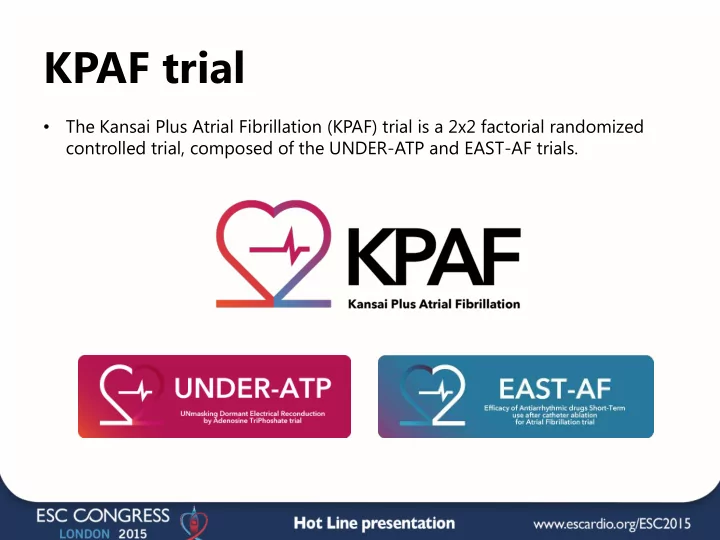
KPAF trial The Kansai Plus Atrial Fibrillation (KPAF) trial is a 2x2 factorial randomized controlled trial, composed of the UNDER-ATP and EAST-AF trials. Efficacy of adenosine triphosphate guided ablation for atrial fibrillation: UNm asking


slide-1
SLIDE 1

KPAF trial

  • The Kansai Plus Atrial Fibrillation (KPAF) trial is a 2x2 factorial randomized

controlled trial, composed of the UNDER-ATP and EAST-AF trials.

slide-2
SLIDE 2
slide-3
SLIDE 3

UNm asking Dorm ant Electrical Reconduction by Adenosine TriPhosphate

Atsushi Kobori, Koichi Inoue, Kazuaki Kaitani, Yuko Nakazawa, Toshiya Kurotobi, Itsuro Morishima, Fumiharu Miura, Takeshi Morimoto, Takeshi Kimura, and Satoshi Shizuta

Kobe City Medical Center General Hospital, Sakurabashi-Watanabe Hospital, Tenri Hospital, Shiroyama Hospital, Ogaki Municipal Hospital, Hiroshima City Hospital, Hyogo College of Medicine, Kyoto University Graduate School of Medicine, Kansai region, Japan.

Efficacy of adenosine triphosphate guided ablation for atrial fibrillation:

slide-4
SLIDE 4

Background

  • Adenosine (triphosphate) has been reported to provoke dormant

electrical conduction between the left atrium and Pulmonary Veins (PV) after an initially successful PV isolation (PVI).

  • Adenosine triphosphate (ATP) guided PVI has been shown to

improve the outcomes of AF ablation.

Hachiya H, et al. J Cardiovasc Electrophysiol. 2007;18(4):392. Matsuo S, et al. J Cardiovasc Electrophysiol. 2007;18(7):704. Kumagai K, et al. J Cardiovasc Electrophysiol. 2010;21(5):494. Macle L, et al. Lancet 2015;386,9994:672.

slide-5
SLIDE 5

Aim

  • The aim of this large-scale (>2,000) randomized controlled trial was to

evaluate the efficacy of ATP-guided PVI as compared with conventional PVI in patients undergoing AF ablation.

slide-6
SLIDE 6

Patients undergoing a 1st catheter ablation for AF, N=3722 Between November 2011 and March 2014 at 19 cardiovascular centers in Japan Excluded, N=1602

ATP-Guided PVI

N=1112

Conventional PVI

N=1001 Withdrawal of consent to participate in the study, N=7

Excluded from EAST-AF trial: N=35 Excluded from EAST-AF trial: N=41

Ablation procedure Conventional PVI N=1007 ATP-Guided PVI N=1113

Death: N=2 Lost to FU: N=3 Death: N=3 Lost to FU: N=3

1-Year FU Data Available

N=995 (99.4%)

EAST-AF trial

UNDER-ATP trial

1-Year FU Data Available

N=1107 (99.5%)

AAD for 90 days

N=457 (41.1%)

Control

N=621 (55.8%)

AAD for 90 days

N=561 (55.7%)

Control

N=405 (40.2%)

slide-7
SLIDE 7

Eligibility

Inclusion criteria

  • Planned De Novo ablation for paroxysmal, persistent or long-lasting AF

Exclusion criteria

  • Age < 20 or >80
  • Contraindications to or intolerance to ATP or AADs

 Severe bronchial asthma  Severe vasospastic angina  Substantial bradycardia

  • Severe heart failure (LVEF < 40% or NYHA VI)
  • Severe LA enlargement (LAD > 55mm)
  • Very long-lasting AF ≥ 5 years
slide-8
SLIDE 8

Style of the PVI

PA view

  • f the reconstructed LA

Endoscopic AP view

  • f the reconstructed LA
slide-9
SLIDE 9

End point of the PVI

I III V5 RSPV RIPV

Disappearance of PV potentials

slide-10
SLIDE 10

ATP test

  • In ATP-guided PVI, 0.4 mg/kg-body-weight of ATP was rapidly

administered.

  • When dormant conduction was provoked, additional ablations were

performed until the disappearance of any dormant conductions.

I III V1 RSPV RIPV CS

Recurrence of PV conduction followed AV block by ATP infusion

slide-11
SLIDE 11

Endpoint

Primary endpoint

Recurrent atrial tachyarrhythmias* at 1-year with a blanking period of 90 days post ablation.

*Recurrent atrial tachyarrhythmias was defined as documented AF/AFL/AT

lasting for >30 seconds or requiring repeat ablation, hospital admission or usage of Vaughan Williams class I or III AADs.

slide-12
SLIDE 12

Clinical Follow-up

  • Periodical visits: @ 3-, 6-, and 12-month

(ECG, blood samples etc.)

  • 2-week ambulatory electrogram recording:

@ hospital-discharge, 6-month and 12-month

  • 24-hour Holter monitoring : @ 6- and 12-month
  • Additional symptom driven ECG-monitoring
slide-13
SLIDE 13

Baseline Characteristics

All Patients (N=2113) ATP-guided PVI (N=1112) Conventional PVI (N=1001) P value Age (years) 63.3±10.0 58.6 ± 8.6 68.5 ± 8.8 <0.001 Male 1589 (74.7) 856 (77.0) 723 (72.7) 0.01 History of AF (m) 25.9 [9.0-62.9] 23.3 [8.8-60.8] 26.4 [9.4-67.5] 0.37 Type of AF 0.34 Paroxysmal 1420 (67.2) 737 (66.3) 683 (68.2) Persistent 479 (22.7) 245 (22.0) 234 (23.4) Long-lasting 214 (10.1) 130 (11.7) 84 (8.4) CHADS2 score <0.001 0, 1 1557 (73.7) 910 (81.8) 647 (64.6) 2 356 (16.8) 141 (12.7) 215 (21.5) ≧3 200 (9.5) 61 (5.5) 139 (13.9) LVEF (%) 64.3±7.6 64.2±7.9 64.6±7.3 0.22 LA dimension (mm) 39.0±6.2 38.9±6.3 39.2±6.2 0.26

slide-14
SLIDE 14

Procedural Characteristics

ATP-guided PVI (N=1112) Conventional PVI (N=1001) P value 3-dimensional mapping system (%) 1112 (100) 1000 (99.9) 0.47 Double circular catheters 820 (73.7) 773 (77.4) 0.05 Deflectable sheath 606 (54.5) 575 (57.4) 0.17 Irrigation catheter (%) 1102 (99.1) 984 (98.3) 0.10 Strategy Extensive encircling PVI (%) 1110 (99.8) 996 (99.5) 0.20 CFAE ablation (%) 131 (11.8) 107 (10.7) 0.43 Left atrial roof line (%) 197 (17.7) 212 (21.2) 0.04 Mitral isthmus line (%) 74 (6.7) 78 (7.8) 0.31 GP ablation (%) 59 (5.3) 59 (5.9) 0.56 Tricuspid valve isthmus ablation (%) 803 (77.0) 745 (74.4) 0.25 SVC isolation (%) 155 (13.9) 140 (14.0) 0.98

slide-15
SLIDE 15

PVI and ATP test

ATP-guided PVI (N=1112) Conventional PVI (N=1001) P value Spontaneous PV reconnection (%) 474 (42.6) 419 (41.9) 0.72 Time from initial PVI to PV reconnection, minutes [IQR] 43 [30-60] 43 [30-60] 0.94 Time from initial PVI to ATP test, minutes [IQR] 57 [33-87]

  • Dormant PV conduction by ATP (%)

307 (27.6)

  • Left sided PV (%)

194 (17.4) Right sided PV (%) 172 (15.5) Number of additional applications for dormant conduction [IQR] 5 [3-9]

  • Elimination of all dormant conduction (%)

302 (98.4)

  • Total duration of energy applications for PVI,

minutes [IQR] 37.1 [28.7-45.6] 35.1 [27.3-44.3] 0.005 Time from initial success to final check in PVI, minutes [IQR] 67 [42-96] 61 [38-91] <0.001

slide-16
SLIDE 16

Procedure and Safety Outcomes

ATP-guided PVI (N=1112) Conventional PVI (N=1001) P value Total number of energy applications 106±61 101±40 0.02 Total duration of energy applications, minutes [IQR] 47.1 [35.3-59.6] 45.5 [34.7-58.8] 0.11 Total procedure time, minutes [IQR] 195 [163-230] 192 [160-230] 0.22 Total fluoroscopy time, minutes [IQR] 58.4 [35.5-86.8] 58.0 [34.1-88.2] 0.99 Total radiation dose, mGy [IQR] 399 [141-756] 370 [164-721] 0.92 Complications Cardiac tamponade requiring drainage (%) 10 (0.9) 12 (1.2) 0.50 Stroke (%) 0 (0) 1 (0.1) 0.47 Asthma attack (%) 0 (0) 0 (0)

  • Ischemic cardiac events (%)

1 (0.1) 4 (0.4) 0.20

slide-17
SLIDE 17

20 40 60 80 100 90 180 270 365 450

Days After First Ablation

ATP-Guided PVI Conventional PVI

Log-rank P=0.19

Adjusted HR 0.89, 95% CI 0.74-1.09, P=0.25

Blanking Period

Event-free Survival from the Primary Endpoint

68.7% 67.1%

Interval 0d 90d 180d 270d 365d 450d

ATP-Guided PVI; N at risk

1112 1111 896 800 625 190

Conventional PVI; N at risk

1001 999 787 701 533 155

Freedom from Atrial Tachyarrhythmias (%)

slide-18
SLIDE 18

20 40 60 80 100 90 180 270 365 450

Days After First Ablation Freedom from Atrial Tachyarrhythmias (%)

Log-rank P=0.23

Adjusted HR 0.93, 95% CI 0.72-1.20, P=0.56

Blanking Period

ATP-Guided PVI Conventional PVI

Paroxysmal AF

20 40 60 80 100 90 180 270 365 450

Days After First Ablation Freedom from Atrial Tachyarrhythmias (%)

Log-rank P=0.40

Adjusted HR 0.86, 95% CI 0.64-1.17, P=0.33

Blanking Period

ATP-Guided PVI Conventional PVI

Persistent / Long-Lasting AF

72.8% 71.4% 60.7% 57.7%

Interval 0d 180d 365d

ATP-Guided PVI; N at risk

737 616 434

AAD group; N at risk

683 562 386 Interval 0d 180d 365d

ATP-Guided PVI; N at risk

375 281 191

AAD group; N at risk

318 225 147

slide-19
SLIDE 19
  • No. of

Patients Adjusted HR (95% CI) HR (95% CI) P for Interaction Age 0.33 ≥ 70 years 631 1.33 (0.52-2.77) < 70 years 1482 0.86 (0.7-1.06) Gender 0.08 Male 1579 0.84 (0.67-1.04) Female 534 1.08 (0.69-1.74) Type of Atrial Fibrillation 0.90 Paroxysmal 1420 0.93 (0.72-1.20) Persistent / Long Lasting 693 0.86 (0.64-1.17) 90-day use of AAD 0.97 AAD 1016 0.89 (0.64-1.26) No AADs 1022 0.87 (0.68-1.11) Left Atrial Dimension 0.78 ≥ 40 mm 952 0.80 (0.61-1.07) < 40 mm 1146 0.99 (0.75-1.31)

ATP-Guided PVI Better Conventional PVI Better

0.0 0.5 1.0 1.5 2.0 2.5 3.0

Primary Endpoint in the Prespecified Patient Subgroups

slide-20
SLIDE 20
  • Randomization programming error regarding age, requiring

adjustment by the Cox proportional hazard model

  • No continuous ECG-monitoring

Limitations

slide-21
SLIDE 21

Conclusions

  • We found no significant reduction in the incidence of recurrent atrial

tachyarrhythmias after catheter ablation of AF with the ATP-guided PVI as compared to the conventional PVI.

slide-22
SLIDE 22

Efficacy of Antiarrhythmic Drugs Short-Term Use After Catheter Ablation for Atrial Fibrillation trial

Kazuaki Kaitani, Koichi Inoue, Atsushi Kobori, Yuko Nakazawa, Toshiya Kurotobi, Itsuro Morishima, Masaki Naito, Takeshi Morimoto, Takeshi Kimura, and Satoshi Shizuta.

Tenri Hospital, Sakurabashi Watanabe Hospital, Kobe City Medical Center General Hospital, Shiga University of Medical Science, Shiroyama Hospital, Ogaki Municipal Hospital, Nara Prefecture Western Medical Center, Hyogo College of Medicine, Kyoto University Graduate School of Medicine Kansai region, Japan.

slide-23
SLIDE 23
  • Transient atrial tachyarrhythmias occur frequently in the first few

months following atrial fibrillation (AF) ablation.

  • A sizable portion of early recurrence is related to the irritability from

the ablation procedure.

  • This phenomenon is a strong predictor of later recurrence of atrial

arrhythmias.

Background

slide-24
SLIDE 24

Hypothesis

  • 90 days use of antiarrhythmic drug (AAD) following AF ablation

could reduce the incidence of early arrhythmia recurrence and thereby promote reverse remodeling of left atrium, leading to improved long-term clinical outcomes.

slide-25
SLIDE 25

Patient flowchart

Withdrawal of consent to participate in the study, N=6

Excluded from EAST-AF trial: N=76 Conventional PVI N=1007 ATP-Guided PVI N=1113

Death: N=3 Lost to FU: N=1 Death: N=2 Lost to FU: N=5

1-Year FU Data Available N=1015 1-Year FU Data Available N=1012 AAD for 90 days N=1018 Control N=1026

EAST-AF trial

N=2044

UNDER-ATP trial

Completed ablation procedure

AAD group

N=1016

Control group

N=1022

slide-26
SLIDE 26

Endpoints

Primary endpoint

  • Recurrent atrial tachyarrhythmias* at 1-year with a blanking period
  • f 90 days post ablation.

Secondary endpoints

  • Recurrent atrial tachyarrhythmias* within the blanking period
  • f 90 days
  • Adverse events/safety

*Recurrent atrial tachyarrhythmias was defined as documented AF/AFL/AT lasting for >30 seconds or

requiring repeat ablation, hospital admission or usage of Vaughan Williams class I or III AADs.

slide-27
SLIDE 27

Baseline Characteristics

AAD group (N=1016) Control group (N=1022) P value Age (years) 65.9 ± 9.6 60.7 ± 9.6 <0.001 Male 741 (72.9) 789 (77.2) 0.03 History of AF (m) 24.7 [8.8-62.8] 26.1 [9.3-62.9] 0.41 Body Weight (kg) 64.7 ± 11.5 67.4 ± 12.7 <0.001 Type of AF 0.48 Paroxysmal 692 (68.1) 684 (66.9) Persistent 232 (22.8) 229 (22.4) Long-lasting 92 (9.1) 109 (10.7) CHADS2 score <0.001 0, 1 711 (81.8) 793 (77.6) 2 192 (18.9) 153 (15.0) e3 113 (11.1) 76 (7.4) LVEF (%) 64.5 ± 7.8 64.2 ± 7.8 0.42 LA dimension (mm) 38.9 ± 6.2 39.0 ± 6.2 0.77

slide-28
SLIDE 28

Rate of medication use at discharge

10 20 30 40 50 60 70 80 90 100

AAD group Control group

slide-29
SLIDE 29

Antiarrhythmic drugs used in the AAD group

Flecanide;

104.1 ± 28.4 mg/d

Pilsicanide;

93.5 ± 31.5mg/d

Propafenone;

325.6 ± 57.1mg/d

Civenzoline;

153.4 ± 69.2mg/d

Disopyramide;

279.6 ± 52.4mg/d

Bepridil;

98.9 ± 24.4

mg/d

Amiodarone;

136.7 ± 44.2mg/d

Sotalol;

110.0 ± 41.4mg/d

ClassⅠ ClassⅢ

AAD; Average dosage mg/d

Aprindine

32.3 ±11.5mg/d

slide-30
SLIDE 30

20 100

Interval 0d 30d 60d 90d

AAD group; N at risk

1016 640 623 600

Control group; N at risk

1022 569 549 532

Days Since First Ablation Log-rank P = 0.002 Adjusted HR 0.84, 95%CI (0.73-0.96), P = 0.01

Secondary endpoint

Freedom from AF/A T during the blanking period

59.0% 52.1% AAD group Control group

80 40 60 30 60 90

Freedom from Atrial Tachyarrhythmias

RRR=14.1%

slide-31
SLIDE 31

100 80 60 40 20

Interval 0d 90d 180d 270d 365d 450d AAD group; N at risk 1016 1016 828 737 570 163 Control group; N at risk 1022 1021 810 723 557 165 Log-rank P = 0.41 Adjusted HR 0.93, 95%CI (0.79-1.09), P = 0.38 Blanking Period

AAD group Control group

Freedom from Atrial Tachyarrhythmias (%)

Days Since First Ablation

Primary endpoint

Freedom from AF/A T at 12-months of follow-up

90 180 270 365 450

69.5% 67.8%

slide-32
SLIDE 32

20 40 60 80 100 90 180 270 365 450

Days After First Ablation

Freedom from Atrial Tachyarrhythmias (%)

Log-rank P = 0.95 Adjusted HR 0.97, 95%CI 0.79-1.20, P=0.80 Blanking Period

AAD group Control group

Paroxysmal AF

20 40 60 80 100 90 180 270 365 450

Days After First Ablation

Freedom from Atrial Tachyarrhythmias (%)

Log-rank P = 0.23 Adjusted HR 0.87, 95%CI 0.68-1.12, P=0.28

Blanking Period

AAD group Control group

Persistent / Long-Lasting AF

72.5% 72.3% 63.0% 58.7%

Interval 0d 180d 365d

AAD group; N at risk

692 582 402

Control group; N at risk

684 565 395 Interval 0d 180d 365d

AAD group; N at risk

324 246 168

Control group; N at risk

338 245 162

slide-33
SLIDE 33

Adverse events

AAD group

(N=1016)

Control group

(N=1022) Death (%) 3 (0.3) 2 (0.2) Cardiovascular death (%) 0 (0) 1 (0.1) Ischemic Stroke / TIA (%) 3 (0.3) 1 (0.1) Systemic embolism (%) 0 (0) 1 (0.1) Intracranial hemorrhage (%) 4 (0.4) 2 (0.2) Myocardial infarction (%) 1 (0.1) 1 (0.1) Hospitalization for heart failure (%) 4 (0.4) 4 (0.4) Cardioversion 113 (11.1) 117 (11.5) ≤ 90 Days 85 (8.4) 104 (10.2) > 90 Days 28 (2.7) 13 (1.3) Side effect of AAD (%) 41 (4.1)

  • Bradycardia

13 (1.3)

  • Ventricular tachyarrhythmias (%)

0 (0)

  • Others

28 (3.0)

slide-34
SLIDE 34
  • Randomization programming error regarding age, requiring

adjustment by the Cox proportional hazard model

  • No continuous ECG-monitoring
  • Differences in the recommended AADs and their dosages between

the present study and the Western AF guidelines

Limitations

slide-35
SLIDE 35
  • Short-term AAD treatment for 90 days following AF ablation

significantly reduced the AT/AF recurrence during the treatment period of 90 days.

  • However, it did not lead to improved clinical outcomes at the 1-year

follow-up.

Conclusions

slide-36
SLIDE 36

Funding

This study was supported by Research Institute for Production Development in Kyoto, Japan.

Acknowledgments

Division of Cardiology, Tenri Hospital/ Cardiovascular center, Sakurabashi Watanabe Hospital/ Division of Cardiology, Kobe City Medical Center General Hospital/ Department of Cardiovascular Medicine, Heart Rhythm Center, Shiga University of Medical Science/ Cardiovascular center, Shiroyama Hospital/ Department of Cardiology, Ogaki Municipal Hospital/ Department of Cardiology, Hiroshima City Hiroshima Citizens Hospital/ Cardiovascular Center, Kansai Rosai Hospital/ Department of Cardiovascular Medicine, Nara Prefecture Western Medical Center/ First Department of Internal Medicine, Nara Medical University/ Division of Cardiology, Osaka General Medical Center/ Department of Cardiovascular Medicine, Kyoto Prefectural University of Medicine/ Department of Cardiology, Japanese Red Cross Society Wakayama Medical Center/ Department of Cardiology, Himeji Cardiovascular Center/ Department of Cardiovascular Medicine, Okamura Memorial Hospital/ Division of Cardiology, Osaka Rosai Hospital/ Division of Arrhythmia and Electrophysiology, Department of Cardiovascular Medicine, National Cerebral and Cardiovascular Center/ Cardiovascular Center, Tazuke Medical Research Institute Kitano Hospital/ Department of Cardiovascular Medicine, Kyoto University Graduate School of Medicine/ Department of Cardiovascular Medicine, Graduate School of Medicine, Nippon Medical School/ Division of General Medicine, Department of Internal Medicine, Hyogo College of Medicine

Acknowledgments and Funding
slide-37
SLIDE 37