Sleep Mike Wu Nov. 8, 2013 Do dolphins sleep? Conscious - - PowerPoint PPT Presentation

sleep
SMART_READER_LITE
LIVE PREVIEW

Sleep Mike Wu Nov. 8, 2013 Do dolphins sleep? Conscious - - PowerPoint PPT Presentation

Sleep Mike Wu Nov. 8, 2013 Do dolphins sleep? Conscious breathers Not fish Dolphins sleeps 8 hours per day! How do dolphins sleep? Rest on the surface of the water Rest half of the brain at a time The awake half keep them


slide-1
SLIDE 1

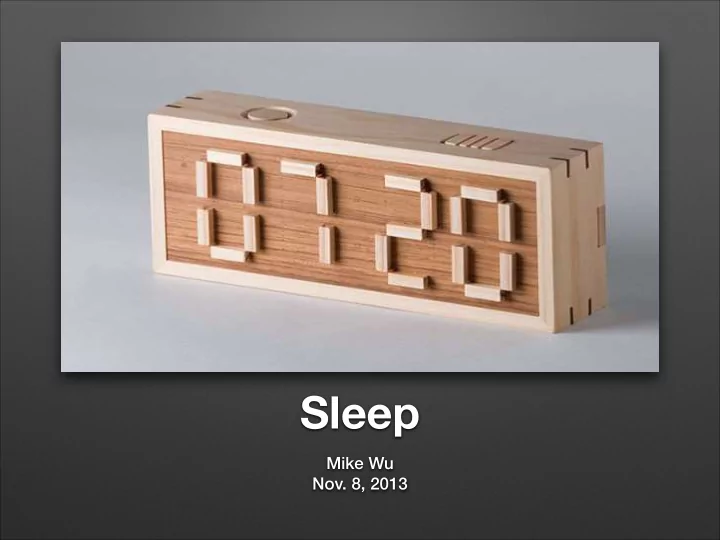
Sleep

Mike Wu

  • Nov. 8, 2013
slide-2
SLIDE 2

Do dolphins sleep?

Conscious breathers Not fish

slide-3
SLIDE 3

Dolphins sleeps 8 hours per day!

slide-4
SLIDE 4

How do dolphins sleep?

  • Rest on the surface of the

water

  • Rest half of the brain at a

time

  • The awake half keep them

swimming, surfacing

  • Can wake up instantly

Unihemisphere sleep

slide-5
SLIDE 5

Unihemisphere Sleep

  • Sea creatures
  • Flying creatures
  • Reptiles
slide-6
SLIDE 6

Who don’t?

Us!

  • Terrestrial mammals
slide-7
SLIDE 7

Predation risk

  • Live at home

locked door 
 + safe community 
 = close both eyes!

  • First night in a hotel room
  • Lower quality sleep
slide-8
SLIDE 8

Sleep is dangerous.

slide-9
SLIDE 9

How do we sleep?

slide-10
SLIDE 10

Are you getting enough sleep?

slide-11
SLIDE 11
  • If you need an alarm clock to get you out
  • f bed in the morning
  • If you are taking a long time to get up
  • If you need lots of stimulants
  • If you’re grumpy
  • If you’re irritable

Chances are you are sleep-deprived

slide-12
SLIDE 12

A good night of sleep

  • Not just the amount
  • Quality!
  • e.g. right timing according

to your circadian rhythms

  • Daylight saving shift…
  • More tips later
slide-13
SLIDE 13

What if we don’t get enough sleep?

slide-14
SLIDE 14
  • Weight gain
  • Sleep loss

→ release of the hormone ghrelin, “the hunger hormone” → the brain says, “I need carbohydrates!” → seek out sugars

slide-15
SLIDE 15

Growth and Rejuvenation

  • Heightened anabolic state
  • Immune, nervous, skeletal,

and muscular systems

  • Flushing out harmful toxins in

the brain.

slide-16
SLIDE 16

Memory, Learning, Creativity

  • Consolidation of memory
  • Stage 3: deep/slow-wave

sleep

  • Sleep helps you remember by

forgetting

  • Insightful behaviour and

flexible reasoning

  • Creative insomnia?
slide-17
SLIDE 17

If you get good sleep,

  • Increases your

concentration, attention, decision- making, creativity, social skills, health

  • Reduces your mood

changes, your stress, your levels of anger, your impulsivity

slide-18
SLIDE 18

Make your bedroom 
 a haven for sleep

  • Make it as dark as you
  • Make it slightly cool
  • Reduce your amount of light

exposure at least half an hour before you go to bed

  • Turn off phones, computers,

all of those things that excite the brain

  • Try not to drink caffeine too

late in the day, ideally not after lunch

slide-19
SLIDE 19

Seek out morning light

slide-20
SLIDE 20

–Wikipedia

The purposes and mechanisms of sleep are

  • nly partially clear and the subject of

substantial ongoing research.

slide-21
SLIDE 21

References

  • Radiolab. http://www.radiolab.org/story/91528-sleep/
  • Wikipedia. http://en.wikipedia.org/wiki/Sleep
  • Ted Talk. http://www.ted.com/talks/

russell_foster_why_do_we_sleep.html

  • Images courtesy of wengenninwonderland.com