Sketching the graph of a function in two variables Let f ( x , y ) = - - PowerPoint PPT Presentation

sketching the graph of a function in two variables
SMART_READER_LITE
LIVE PREVIEW

Sketching the graph of a function in two variables Let f ( x , y ) = - - PowerPoint PPT Presentation

Sketching the graph of a function in two variables Let f ( x , y ) = y 2 . Draw the level sets in the xy -plane for a few choices of z = k . Draw the contour map in the xy -plane. Sketch the surface in R 3 . Compare with your


slide-1
SLIDE 1

Sketching the graph of a function in two variables

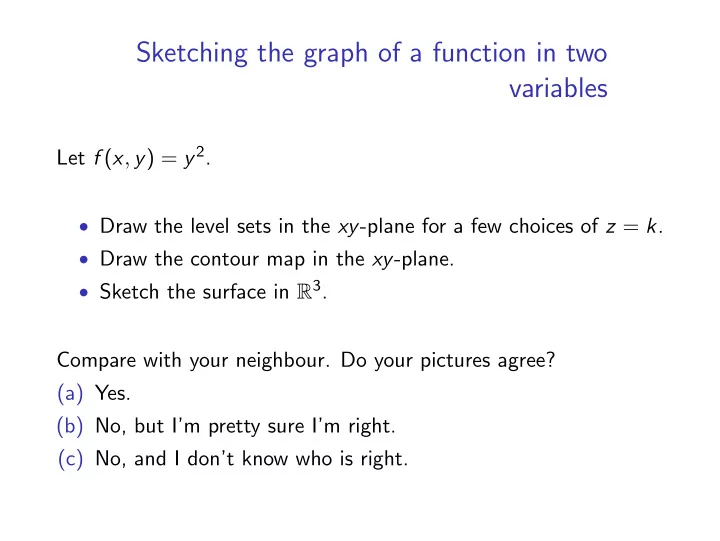
Let f (x, y) = y2.

  • Draw the level sets in the xy-plane for a few choices of z = k.
  • Draw the contour map in the xy-plane.
  • Sketch the surface in R3.

Compare with your neighbour. Do your pictures agree? (a) Yes. (b) No, but I’m pretty sure I’m right. (c) No, and I don’t know who is right.

slide-2
SLIDE 2

Symmetry about an axis

Which of the following functions are symmetric about the y-axis?

  • f (x, y, z) = x2 + y2 + z2;
  • g(x, y, z) = x + 2y2 + z;
  • h(x, y, z) = 3x2 + y + 3z2.

(a) None of them. (b) Only f . (c) All of them. (d) f and h.

slide-3
SLIDE 3

Sketching a quadric surface

Consider the equation x2 + 6x + 2y2 + 2z2 + 7 = 0. Note that (by completing the square and dividing both sides by 2) we can rewrite it as (x + 3)2 2 + y2 + z2 = 1. The level sets z = k are mostly (a) parabolas or circles; (b) ellipses or empty; (c) lines; (d) I’m still trying to remember what “completing the square” means.

slide-4
SLIDE 4

Sketching a quadric surface

Consider the equation (x + 3)2 2 + y2 + z2 = 1. Think about the traces x = k and y = k of this surface. Try to sketch the surface. Does your picture agree with your neighbour’s? (a) I’m not done. (b) Yes. (c) No. If your pictures don’t agree, try to figure out which is right. Change your answer to (b) once you have decided.

slide-5
SLIDE 5

Example: can you find a good choice of δ?

Consider the function E(h) = {︃ 0, h / ∈ Q; h, h ∈ Q. Suppose you are given an error tolerance/challenge of 𝜗 > 0. Which of the following is a good response 𝜀? (a) It might not be possible to find 𝜀 if 𝜗 is very small. (b) Anything will work for 𝜀. (c) 𝜀 = 1

𝜗.

(d) 𝜀 = 𝜗.