Definition of Continuity of a Function of Two Variables A function - - PowerPoint PPT Presentation

definition of continuity of a function of two variables
SMART_READER_LITE
LIVE PREVIEW

Definition of Continuity of a Function of Two Variables A function - - PowerPoint PPT Presentation

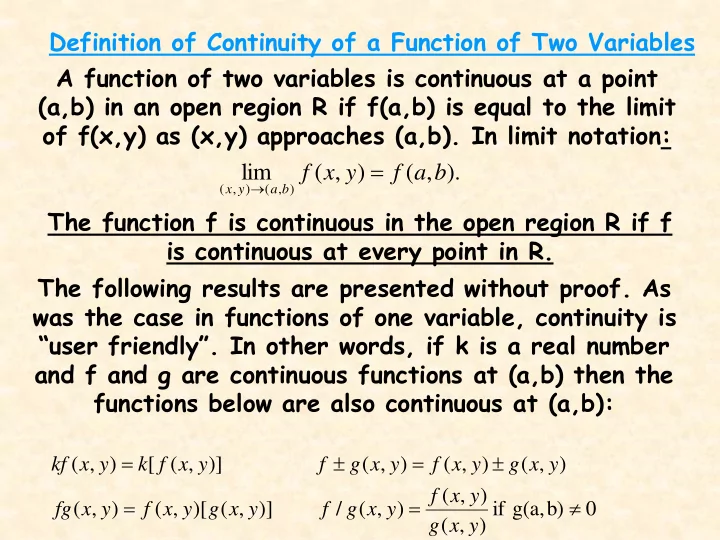
Definition of Continuity of a Function of Two Variables A function of two variables is continuous at a point (a,b) in an open region R if f(a,b) is equal to the limit of f(x,y) as (x,y) approaches (a,b). In limit notation: lim f ( x ,


slide-1
SLIDE 1

Definition of Continuity of a Function of Two Variables A function of two variables is continuous at a point (a,b) in an open region R if f(a,b) is equal to the limit

  • f f(x,y) as (x,y) approaches (a,b). In limit notation:

). , ( ) , ( lim

) , ( ) , (

b a f y x f

b a y x

The function f is continuous in the open region R if f is continuous at every point in R. The following results are presented without proof. As was the case in functions of one variable, continuity is “user friendly”. In other words, if k is a real number and f and g are continuous functions at (a,b) then the functions below are also continuous at (a,b):

b) g(a, if ) , ( ) , ( ) , ( / )] , ( )[ , ( ) , ( ) , ( ) , ( ) , ( )] , ( [ ) , (        y x g y x f y x g f y x g y x f y x fg y x g y x f y x g f y x f k y x kf

slide-2
SLIDE 2

Example 1. Find the limit and discuss the continuity

  • f the function.

y x x

y x

2 lim

) 2 , 1 ( ) , (

Solution 2 1 4 1 2 ) 1 ( 2 1 2 lim

) 2 , 1 ( ) , (

    

y x x

y x

The function will be continuous when 2x+y > 0. Example 2. Find the limit and discuss the continuity

  • f the function.

y x x

y x

2 lim

) 2 , 1 ( ) , (

Solution 4 1 2 ) 1 ( 2 1 2 lim

) 2 , 1 ( ) , (

   

y x x

y x

The function will be continuous when The function will not be defined when y = -2x. . 2   y x

slide-3
SLIDE 3

Partial Derivatives of a Function of Several Variables

The partial derivative, with respect to x of a function

z f x y ( , ) 

is:

( , ) ( , ) lim lim

x x x x

z z f x x y f x y z x x x

   

          

The partial derivative of the function

) , ( y x f z 

with respect to x is the ordinary derivative with respect to x calculated on the assumption that y is constant and vice versa.

slide-4
SLIDE 4

Example

For the following functions, find the partial derivatives:

, z z x y    

 

2 2

ii z x y  

 

2 sin

i z x y 

 

1

tan y iii z x

 

     

 

y

iv z x 

slide-5
SLIDE 5

Solution

 

2 2

ii z x y  

2 2

2 2 z x x x y    

2 2

2 2 z y y x y    

 

2 sin

i z x y  2 sin z x y x   

2 cos

z x y y   

slide-6
SLIDE 6

 

1

tan y iii z x

 

     

2 2

1 z y x x y x      / ( / )

2

1 1 z x y y x     / ( / )

 

y

iv z x 

1 y

z y x x

  

y

z x x y    ln

slide-7
SLIDE 7

Solution

Remark:

The partial derivatives of a function of any number of variables are determined similarly as two variables.

Example

Find the derivatives of

2 2 3

u x y xtz   

with respect to x, y, z and t.

3

2 u x tz x    

2 u y y   

2

3 u xtz z   

3

u xz t   

slide-8
SLIDE 8

Example

If

 

3sin

/ z y x y 

show that

3

x y

xz yz z  

   

2 3 2

3 sin / cos / /

y

z y x y y x y x y   

 

2 cos

/

x

x z x y x y 

Solution

   

3 2

3 sin / cos /

y

y z y x y x y x y  

    

3 2

cos / 1/ cos /

x

z y x y y y x y  

+

 

3

3 sin / 3 y x y z  

slide-9
SLIDE 9

Partial Derivatives of Higher Orders:

The second order partial derivatives of

) , ( y x f z 

if they exist, are written as:

2 2 2 2

( , ) ( , ) ( , )

xx xx x

z f x y z f x y f x y x x x          

2 2 ( ,

) ( , ) ( , )

xy xy x

z f x y z f x y f x y y x y y x            

2 2 ( ,

) ( , ) ( , )

yx yx y

z f x y z f x y f x y x y x x y            

2 2 2 2

( , ) ( , ) ( , )

yy yy y

z f x y z f x y f x y y y y          

slide-10
SLIDE 10

Example

Find the four 2nd order partial derivatives of

.

xy

z e x  

Solution

1

xy

z ye x    

xy

z xe y   

xy

e y x z

2 2 2

  

2 xy xy

z xye e y x     

2 xy xy

z xye e x y     

xy

e x y z

2 2 2

  

slide-11
SLIDE 11

Example

Compute

2 4

x y z u    

if

.

2 2 y x

e z u

Solution

2

2 x y

u z e x

  

2

2 2 2 x y

u z e x

  

2

3 2 2

2

x y

u yz e y x

   

2

4 2

4

x y

u yze z y x

    

slide-12
SLIDE 12

Theorem:

If the function

) , ( y x f z 

and its partial derivatives are defined and continuous at any point and in some neighborhood of it, then at this point

2 2

f f y x x y       

This is true for a function of any number of variables and any number of successive partial derivatives.

slide-13
SLIDE 13

The Chain Rule:

Let z be a function of two independent variables u and v,

( , ) z f u v 

and let u and v be continuous functions of the independent variables x, y :

). , ( ), , ( y x v y x u    

then:

z z u z v x u x v x             z z u z v y u y v y            

slide-14
SLIDE 14

z u v x x y y

u

z

v

z

x

u

y

u

x

v

y

v

slide-15
SLIDE 15

Example

Given

2 3

2 , , y z u v u xy v x    

. Find

. z x  

3 2 4

2 6 y xy x  

2 2

2 6 y uy v x         

Solution

z z u z v x u x v x            

2u y

2

6v

2

y x 

slide-16
SLIDE 16

Example

Given

2

2 2

ln( ), ,

x y

z u v u e v x

   

. Find

. z x  

Solution

2

2

2 ( )

x y

ue x u v

  

2

2 2

2 1 2

x y

u e x u v u v

    z z u z v x u x v x            

2

2u u v 

2

x y

e 

2

1 u v 

2x

slide-17
SLIDE 17