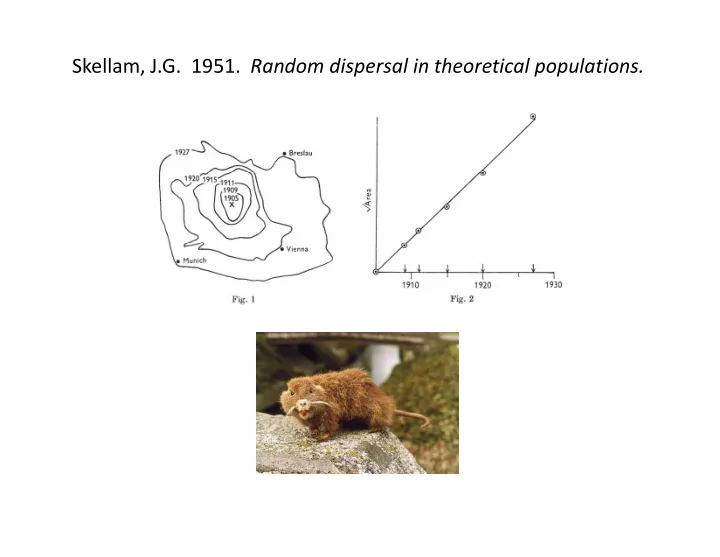
Skellam, J.G. 1951. Random dispersal in theoretical populations. E.E. - - PowerPoint PPT Presentation

skellam j g 1951 random dispersal in theoretical
SMART_READER_LITE
LIVE PREVIEW

Skellam, J.G. 1951. Random dispersal in theoretical populations. E.E. - - PowerPoint PPT Presentation

Skellam, J.G. 1951. Random dispersal in theoretical populations. E.E. Holmes, 1993. Are diffusion models too simple? A comparison with telegraph models of invasion p g p f Motivation: Diffusion models possess weird (non biological)


slide-1
SLIDE 1

Skellam, J.G. 1951. Random dispersal in theoretical populations.

slide-2
SLIDE 2

E.E. Holmes, 1993. Are diffusion models too simple? A comparison with telegraph models of invasion p g p f Motivation: Diffusion models possess weird (non‐biological) microscopic properties. (Ex: infintesimally small chance of infinitely fast movement.) Telegraph dispersal: : constant velocity : stochastic turning rate : stochastic turning rate

slide-3
SLIDE 3
slide-4
SLIDE 4

E.E. Holmes, 1993. Are diffusion models too simple? A comparison with telegraph models of invasion p g p f Invasion speeds predicted by reaction‐diffusion models vs. reaction‐telegraph models: 1 1

tele diff

c r c      1 2

diff

c        

slide-5
SLIDE 5

Stochastic dynamics of invasive Stochastic dynamics of invasive y spread spread

Brett Melbourne & Alan Hastings U i i f C lif i D i University of California, Davis

slide-6
SLIDE 6

Experiment Experiment

4 cm Flour beetle: Tribolium castaneum

slide-7
SLIDE 7

Experiment Experiment

4 cm Hole Tunnel

slide-8
SLIDE 8

Lifecycle in laboratory Lifecycle in laboratory

 Discrete time (35 day cycle)

1) Adults lay eggs (24 hr) 1) Adults lay eggs (24 hr)

 Fences installed; adults removed

2) Larvae grow 2) Larvae grow

 Adults emerge (ca day 30)

3) Adults disperse (48 hr)

 Census after dispersal

slide-9
SLIDE 9

Experiment Experiment

 30 landscapes  Constant  Constant

environment

 13 generations  13 generations