
SLIDE 1
CONVENT OF THE HOLY INFANT JESUS SECONDARY
(TOWN CONVENT)
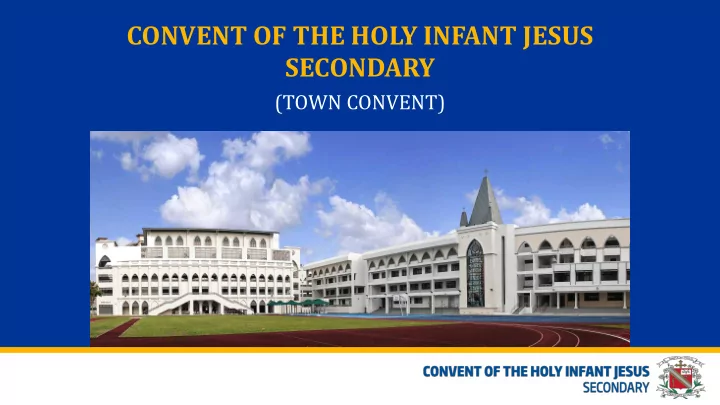
SECONDARY (TOWN CONVENT) School Leaders Principal Mrs Karen Tay - - PowerPoint PPT Presentation
CONVENT OF THE HOLY INFANT JESUS SECONDARY (TOWN CONVENT) School Leaders Principal Mrs Karen Tay Vice-Principals Academic: Ms Candice Seet Ms Teo Geok Sian Admin: Mr Mark Hong CHIJ STAFF Year Head & Assistant Year Heads Key
CONVENT OF THE HOLY INFANT JESUS SECONDARY
(TOWN CONVENT)
School Leaders
Principal Mrs Karen Tay Vice-Principals Academic: Ms Candice Seet Ms Teo Geok Sian Admin: Mr Mark Hong
CHIJ STAFF
Year Head & Assistant Year Heads Key Personnel School Counsellors Form Teachers & Co-Form Teachers
WHO WE ARE
Established in 1854 at Victoria Street Formerly known as Town Convent Mother school of the CHIJ family ( 11 IJ Schools in Singapore) 2nd oldest girls’ school in Singapore
OUR MISSION
A CHIJ school is a Christ-centred school community where all work together for the promotion
with special reference to the needs of persons who are disadvantaged in any way.
Blessed Nicolas Barré Founder of the IJ Sisters
SCHOOL MOTTO Simple in Virtue Steadfast in Duty
OUR VISION
AN IJ GIRL is...
a THINKER, LEADER and COMMUNICATOR who is confident with humility, principled with compassion, and cultured with grace.
School Values Compassion Humility Integrity Perseverance Faith
Programme
7.30am Breakfast 7.45am Principal’s Address 8.10am Address by Year Head 8.20am Sharing on XP 8.30am Sharing by Academic Heads 9.00am Welcome by CHIJ Sec PSG 9.20am Q & A
A HOLISTIC EDUCATION
Twin emphasis on ACADEMIC EXCELLENCE CHARACTER DEVELOPMENT
A HOLISTIC EDUCATION
3Ls@IJ LEARN LIVE LEAD
CHIJ EDUCATION & EXPERIENCE
Level Learning Events / Experience
Sec 1
Orientation and Campfire Learning Journey to CHIJMES General Leadership Programme (Hike) VIA (My School , A Litter-free Environment) Inter-class Drama Competition Story-telling Workshop Study Skills Workshop TGIF IJ FLAIR Financial Literacy IJ Spirit Day & IJ Fiesta Cross Country Retreat
Sec 2
General Leadership Programme (Outdoor Adventure Camp) VIA (Recycling Outreach Project) Specific Leaders Camp Overseas Learning Journey Financial Literacy
CHIJ EDUCATION & EXPERIENCE
Level Learning Events / Experience
Sec 3
General Leadership Programme (Outward Bound Singapore) Student Leaders Camp VIA (Raising Funds for Needy & Befriending the Elderly) Work Attachment Learning Journey to SAFTI Mission Trips
Sec 4
Self-Awareness Camp VIA (Befriending the Elderly) Educational Fair & Career Seminar Graduation Ceremony & Graduation Night
ACADEMIC CORE
CHARACTER DEVELOPMENT
CCE@IJ STRENGTHS OF CHARACTER
Lifelong learner and critical thinker Diligent and capable performer Socially and emotionally skilled leader Responsible and self-disciplined person Contributing community member Spiritual person crafting a purposeful life
CHARACTER DEVELOPMENT
Milestone Checklist of an IJ Girl
The CCE Competency Map is supported by the Milestone Checklist for an IJ
support the student’s growth and development in the key competencies identified, and support her attainment of the Outcomes of the IJ Girl.
LEAPS 2.0
.
Co-Curricular Attainment Details Excellent (2 bonus points) Student who attains a minimum Level 3 in all four domains with at least a Level 4 in one domain. Good (1 bonus point) Student who attains a minimum Level 1 in all four domains with any
a) At least Level 2 in three domains; b) At least Level 2 in one domain and at least Level 3 in another domain; or c) At least Level 4 in one domain. Fair Student’s attainment in co-curricular will not translate into any bonus points.
Recognition of Students’ Level of Attainment
ASSESSMENT
Partnership with Parents
Leaders and Teachers
Address by Year Head
progression to the next level
Contact Time with Form Teachers
23Contact Time with Form Teachers / Character Education Programme
Recess for Breakfast and Lunch
24Recess #1 (to start by 0950, within 2hr from start
Recess #2 (starting 1150, for days with longer hours) Recess on Wed is 1 hour long
Student Well-Being
25PE (AM) and Recess break PE and Recess break (whenever possible only)
Notification on Afternoon Curriculum
26Curriculum lessons up to 1750. Afternoon lessons hours are indicated whenever possible
Academy Programme
27Character Education Programme Acad Prog XP
Trends on Online Usage and Habits
Key Findings from MDA’s Study 2015*
* http://tinyurl.com/mdasurvey2015days per week, and more than 90% started before the age of 10 years old.
Starting age of children using the Internet
Note: Survey was conducted on children up to 14 years old
Frequency of using the Internet (%)
>68% of the children use internet 4-6 days per week
>50% of the children start to use internet <7 yrs old
Key Findings from MDA’s Study 2015*
* http://tinyurl.com/mdasurvey2015>15% increase for children who use social media
Children who have used social media (%)
Average starting age on social media
Average Starting Age: 8.6 years old. Most social media services have recommended minimum age guidelines. E.g. Facebook requires users to be at least 13 years old to start an account.
Key Findings from MDA’s Study 2015*
* http://tinyurl.com/mdasurvey2015Social media networks currently using - by age groups (%)
Online Opportunities and Risks for Students
Online Opportunities : Harnessing Technology for Learning
Deepen Subject Mastery through Communication, Collaboration and Creation
through the power of reach. For example:
Online Opportunities : Harnessing Technology for Learning
– Cyber bullying – Excessive internet use – Accessing inappropriate online content – Danger with online contact
Online Risks
Managing Potential Online Risks
“Balance of individual empowerment with digital technology with the sense of personal, community, global responsibility”
(Author of “ Digital Community, Digital Citizen”, Jason B. Ohler, 2010) MOE’s Cyber Wellness Education
http://ictconnection.moe.edu.sg/cyber-wellness/for-parents
3 Principles 3 Big Ideas 4 Themes 8 Topics Protected Curriculum Time 1) Respect for Self & others 2) Safe & Responsible Use 3) Positive Peer Influence Identity Cyber Identity Healthy self-identity Cyber Use Balanced life and balanced use Online identity and expression Balanced use of ICT Primary Form Teacher Guidance Period since 2014 Secondary Lessons in the CCE CW Guidance Module since 2014 Pre-University Lessons within the CCE curriculum from 2016 Relationships Cyber Relationships Safe and meaningful Netiquette Cyber bullying Online relationships Choices Cyber Citizenship Positive presence About the cyber world Handling online content and behaviour Cyber Contacts Parents as Partners
You can help by reminding your children to:
Academy Programme
39Character Education Programme Acad Prog XP
What is XP?
What is XP?
Brief outline of XP
–Friday 1.50 to 3.20 pm
–Oral communication –Current affairs
–Design thinking –Creative Problem Solving
Design Thinking Process
English Language
Secondary Normal [Technical]
SLIDE TITLE
Aim to raise students’ skills in: Reading Writing Speaking Listening through a competence use of vocabulary and grammar
Focus
communication
usage
Secondary Mathematics
Breakfast Meetings for Secondary 1 - 2017
Mathematics provides the ideal domain to:
Thinking and Communicating with Clarity and Precision
Working for Primary Level 1800 5 = 360 1800 – 360 = 1440 1440 96 = 15 Jane paid for 15 months.
Working for Secondary Level
Deposit paid = 1800 5 = $360 Amount left to be paid = 1800 – 360 = $1440 Number of monthly payments = 1440 96 = 15 months
Homework & Reflective Review
Homework (Cognition) Reflective review (Metacognition)
What did I learn ?
“I learnt to simplify algebraic expressions by adding and subtracting of like terms.” “I learnt to solve real world problems by translating them into algebraic equations.”
What competency did I practise?
“I was striving for accuracy.” “I connected information to arrive at the solution.” “I applied past knowledge to a new situation.”
Syllabus Overview
Mathematics
Number and Algebra Geometry and Measurement Statistics and Probability Mathematical Processes
Lower Secondary Science N(T)
Lower Secondary Modules
Aims
their daily lives
Lower Secondary Modules
3 Modules
Lower Secondary Science NT
Upper Secondary Modules
3 Modules at Upper Secondary
lower secondary)
Upper Secondary Science NT
Curriculum Time
Assessment for Lower Secondary
Written Tests 60% Performance based assessment 40%
Types of Performance based assessment
mindmaps
Types of Performance based assessment
Types of Performance based assessment
Presentation
Social Studies
Overview of Issues Covered
Level Issue Inquiry Focus Lower Secondary Living in a Multicultural Society Is harmony achievable in a multicultural society? Responding to Migration Are migrants welcomed? Resolving Conflict and Building Peace Is peace achievable? Protecting Our Environment Is the environment worth protecting? Lower Secondary Managing Our Financial Resources What does it mean to manage
Caring for Society How can we make Singapore a better place for those in need?
that affect us and the world we live in
Teaching Pedagogy and Strategies
Strategies
current affairs Inquiry Approach
Assessment
– Chapter Tasks/Reflections – Performance Task (Group Task, Group Reflection and Individual Reflection)
pass with distinction
Outcomes
participative citizens
LIFESKILLS (Normal Technical)
Computer Applications (CPA)
OVERVIEW
Students will learn: Information and Communications Technology (ICT) Skills
Sec One students will learn:
a) Microsoft Word, Excel, Power point To create documents for presentations and to do calculations b) Inkscape (software) – draw pictures to be used in documents for presentations
Sec Two students will:
animations using Scratch (software)
ASSESSMENT
DESIGN & TECHNOLOGY
Subjects Sec One 2017 Sec One 2018 Food and Consumer Education (FCE)
Previously known as Home Economics
Design & Technology (D&T) Yes
AIMS OF D&T
aesthetics & technology in design
encourage creativity (ideation) sketch design ideas
realising design through making a product
D&T - CORE AREAS
What is Product design ?
machines & tools
D&T – Semester 1
Shaping Tools and Surface Finishing
Design and make a Wooden Torchlight Keychain
D&T – Semester 2
Drawing
Shaping Tools and Surface Finishing of Wood and Plastics
Design and make a Pencil and Note Holder
ASSESSMENT GUIDELINES
Subject Information Booklet
No Written Exam
Assessment is carried out throughout the year Design & Technology (D&T) Pages 15-16
FOOD & CONSUMER EDUCATION
STRUCTURE OF FCE SYLLABUS
CORE AREAS OF STUDY
consumerism and practical skills of food
ELECTIVE MODULE
To allow students to:
STRUCTURE OF FCE SYLLABUS
Core Areas of Study Elective Modules
(Semester 1)
E.g. Investigate the effects of using different types of fats on the texture, taste and colour of cupcakes
(Semester 2)
E.g. Project work
(Financial Literacy Programme)
PROJECT WORK
E.g. of Task Qn: Your class has been chosen to be the ambassador
the elderly (grandparents or elderly relatives) . Prepare healthy dishes to show how we can prevent Coronary Heart Disease and design an informative leaflet on the prevention of Coronary Heart Disease to be distributed to the elderly.
PROJECT WORK
PROCESSS SKILLS developed by students: 1. Planning & Proposal 2. Preparation & Research 3. Product Outcome 4. Reflection & Evaluation
CULINARY SKILLS
Kebabs
Shepherd’s Pie Soya Sauce Chicken Rice
Sponge Sandwich
Scones
Kueh Dadar
ASSESSMENT GUIDELINES
Subject Information Booklet Food & Consumer Education (FCE) Pages 15
FCE PRACTICAL EXAM
To encourage :
1. Critical & Inventive Thinking 2. Creativity 3. Global Awareness & Cross Cultural Skills
Students are required to cook ONE dish they have decided on
Individually 1 hour to prepare, cook & serve
FCE PRACTICAL EXAM
soya sauce, plain flour
ingredients required for their chosen dish
Shopping & Budget plan for effective management of resources
ART / DRAMA
S E M E S T E R 2
M r T e r e n c e H o u M s S a i g e G a n
S E C O N DA RY 1 N T B R E A K FA S T M E E T I N G
TOTE BAG DESIGN
TERM 3, WEEKS 2-5
Elements of Art – Line, Shape, Space Function Personal Voice
2D
2D
What defines you? * How will your tote bag look like? Have a Purpose
JEWELLERY DESIGN
TERM 3, WEEKS 6-10
Elements of Art – Form, Space, Texture Observe Create
2D
3D
Emphasis on Learning through
Real-Life Application
What defines you? * What does an accessory say about a person?
DRAWING & PAINTING PAPER
Term 4 Week 1: Issue of Question Paper
Teacher Guidance & Student Preparation During lessons
Week 5: 1.5Hour End-of-Year Exam
Create
Ideation
Inspiration
APPROACH
situations
Looking Practising Applying Valuing
T erm 3 T erm 4
IN SUMMARY
STUDENTS WILL BE AWARDED A GRADE AT THE END OF YEAR
T
Planned Weeks Mode of Assessment Marks Tote Bag Design 2 - 5 Final Art Piece 40 Jewellery Design 6 - 10 Final Art Piece + Research Studies 60 T
Planned Weeks Mode of Assessment Marks Drawing & Painting Paper 1 – 5 1.5 Hour Exam with Research studies 100
PARENT SUPPORT GROUP