
SLIDE 1
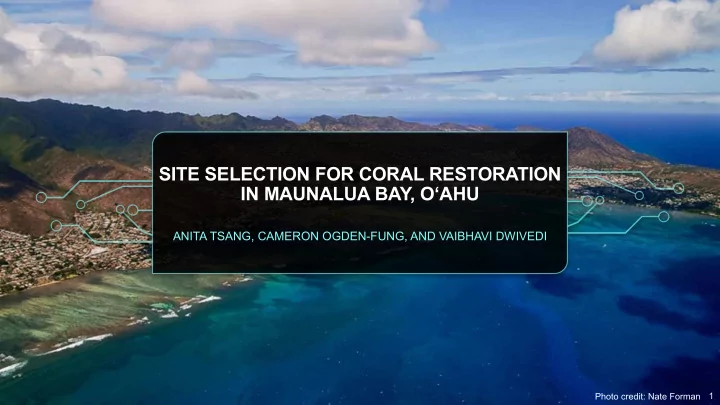
SITE SELECTION FOR CORAL RESTORATION IN MAUNALUA BAY, OʻAHU
ANITA TSANG, CAMERON OGDEN-FUNG, AND VAIBHAVI DWIVEDI
Photo credit: Nate Forman 1
SITE SELECTION FOR CORAL RESTORATION IN MAUNALUA BAY, OAHU ANITA - - PowerPoint PPT Presentation
SITE SELECTION FOR CORAL RESTORATION IN MAUNALUA BAY, OAHU ANITA TSANG, CAMERON OGDEN-FUNG, AND VAIBHAVI DWIVEDI 1 Photo credit: Nate Forman BACKGROUND 2 Photo credit: Matt Kieffer RESEARCH OBJECTIVES 1) Evaluate site criteria 2) Identify
SITE SELECTION FOR CORAL RESTORATION IN MAUNALUA BAY, OʻAHU
ANITA TSANG, CAMERON OGDEN-FUNG, AND VAIBHAVI DWIVEDI
Photo credit: Nate Forman 1
Photo credit: Matt Kieffer 2
3
scenarios
4
Physical Factors
Water Depth (3-9 m) Water Temperature (23-29 °C) Salinity (32-42 ppm) Turbidity (<8.8 NTU) Sedimentation (<200 g/m²/day) Benthic Type (Hard bottom)
Biological Factors
Coral Cover (5-20%) Coral Health (Absent of disease) Invasive Algae (Absent)
Socioeconomic Factors
Distance from: Boat launch (<2 km) Dive site (<2 km) Coral nursery (<2 km) Pollutant sources (>1 km)
5
Source: NOAA 6
Source: Salinity and turbidity data taken from the United States Geological Survey (USGS) technical reports; Bathymetry map provided by The School of Ocean and Earth Science and Technology (SOEST) 7
Source: Temperature data retrieved from USGS technical report; Sewage discharge sites, dive sites, and pre-proposed restoration areas were estimated using Google Earth 8
9
Site Criteria Sub-Criteria Sites
Wailupe Paiko Channel Ku‘i Alternate1 Alternate 2 Alternate 3 Physical Factors Water Depth (m) 3-6 3-8 3-6 0-3 3-8 3-9 3-8 Water Temperature (°C) n.d. 25.25 25.13 n.d. 25.36 25.22 n.d. Salinity (ppm) n.d. 35.04 35.12 n.d. 35.04 35.02 n.d. Sedimentation (g/m²/day) n.d. n.d. n.d. n.d. n.d. n.d. n.d. Turbidity (NTU) n.d. 0.54 n.d. n.d. 1.19 n.d. 0.46 Benthic Cover Turf (50-90%) Turf (50-90%), coralline algae (50-<90%), uncolonized Turf (50-90%), macroalgae (10- <50%), uncolonized Turf (50-<90%), coralline algae (10- <50%) Turf (50-90%), coralline algae (10-<50 %) Turf (50-90%) Turf (10-<90%) Benthic Type Pavement Sand (~50%), pavement with sand channel, aggregate reef Sand (~80%) and pavement Aggregate reef, pavement, rubble Pavement with sand channel Pavement Sand and pavement Biological Factors Coral Cover (%) <10 10-50 <10 <10 <10 <10 <10 Coral Health n.d. n.d. n.d. n.d. n.d. n.d. n.d. Invasive Algae Absent Absent Absent Present Absent Absent Absent Socioeconomic Factors Distance from boat launch (km) 3.20 1.40 1.30 1.80 4.40 2.50 2.10 Distance from nearest dive site (km) 1.30 0.30 1.00 1.30 2.30 0.60 1.00 Distance from coral nursery (km) 2.00 0.00 1.40 1.80 3.10 1.10 1.70 Distance from pollutant sources (km) 0.67 1.02 0.78 0.93 0.67 0.85 1.50
10
Scenarios Weights
Cost Value Educational Value Recreational Value Biophysical Value (1) Cost value is prioritized 0.42 0.17 0.08 0.33 (2) Biophysical value is prioritized 0.33 0.17 0.08 0.42 (3) Educational value is prioritized 0.17 0.42 0.08 0.33 (4) Recreational value is prioritized 0.17 0.08 0.42 0.33 (5) All objectives are valued equally 0.25 0.25 0.25 0.25
11
12
13 Photo credit: Gates Coral Lab
Swing weights and SMART table can be adjusted as needed Update and fill in missing data for environmental parameters “Ground truth” proposed restoration sites
Collaborations Education Center Posters/ Pamphlets
14
Photo credit: Tim Kopra, NASA 15
Andreyka, N., Arnott, C., Tanigawa, S., Yazzie, A. (2017). Economic Analysis Project Component: A Knowledge Domain for Assessing the Value of Maunalua Bay to Recreational Commercial Operators, 2-12. Retrieved from https://scholarspace.manoa.hawaii.edu/bitstream/10125/44555/Maunalua%20Bay%20Economics%20Knowledge%20Domain.pdf Atkinson, A. (2007). A Natural and Cultural History of Maunalua Bay and Its Watershed, 3-25. Retrieved from http://www.imuamaunalua.org/wp-content/uploads/A-Natural-Cultural-History-of- Maunalua-Bay.pdf Brown, K., Adger, W. N., Tompkins, E., Bacon, P., Shim, D., & Young, K. (2001). Trade-off analysis for marine protected area management. Ecological Economics, 37(3), 417–434. https://doi.org/10.1016/S0921-8009(00)00293-7 Gregory, R., Failing, L., Harstone, M., Long, G., McDaniels, T., & Ohlson, D. (2012). Foundations of Structured Decision Making. In Structured Decision Making (pp. 21–46). John Wiley & Sons,
Huang, I. B., Keisler, J., & Linkov, I. (2011). Multi-criteria decision analysis in environmental sciences: Ten years of applications and trends. Science of The Total Environment, 409(19), 3578–
Moberg, F., & Folke, C. (1999). Ecological goods and services of coral reef ecosystems. Ecological Economics, 29(2), 215–233. https://doi.org/10.1016/S0921-8009(99)00009-9 Mustajoki, J., Hämäläinen, R. P., & Salo, A. (2005). Decision Support by Interval SMART/SWING—Incorporating Imprecision in the SMART and SWING Methods. National Academies of Sciences, Engineering, and Medicine, Division on Earth and Life Studies, Board on Life Sciences, Ocean Studies Board, & Committee on Interventions to Increase the Resilience of Coral Reefs. (2019). A Decision Framework for Interventions to Increase the Persistence and Resilience of Coral Reefs. National Academies Press. https://doi.org/10.17226/25424 Presto, M. K., Storlazzi, C. D., Logan, J. B., Reiss, T. E., & Rosenberger, K. J. (2012). Coastal Circulation and Potential Coral-larval Dispersal in Maunalua Bay, Oʻahu, Hawaii—Measurements
Siregar, D., Arisandi, D., Usman, A., Irwan, D., & Rahim, R. (2017). Research of Simple Multi-Attribute Rating Technique for Decision Support. Journal of Physics: Conference Series, 930,
Storlazzi, C. D., Presto, K. M., Logan, J. B., & Field, M. E. (2010). Coastal circulation and sediment dynamics in Maunalua Bay, Oahu, Hawaii. USGS Open-File Report, 1217, 2010. Tait, R. J., E. Guinther, and R. E. Brock. (1975). Preliminary Environmental Impact Studies on the Marine Environment at Maunalua Bay. Honolulu, HI: AECOS, Inc. Wolanski, E., Martinez, J. A., & Richmond, R. H. (2009). Quantifying the impact of watershed urbanization on a coral reef: Maunalua Bay, Hawaii. Estuarine, Coastal and Shelf Science, 84(2), 259–268. https://doi.org/10.1016/j.ecss.2009.06.029
16