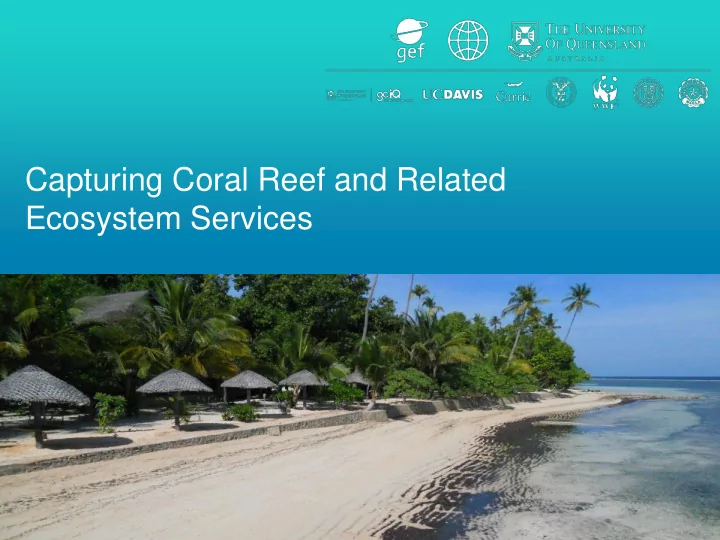
Capturing Coral Reef and Related Ecosystem Services What are - - PowerPoint PPT Presentation

capturing coral reef and related
SMART_READER_LITE
LIVE PREVIEW

Capturing Coral Reef and Related Ecosystem Services What are - - PowerPoint PPT Presentation

Capturing Coral Reef and Related Ecosystem Services What are ecosystem goods and services? Provisioning Regulating Cultural Support Benefits that people get from nature Why value ecosystem services? A. National wealth accounts


slide-1
SLIDE 1

Capturing Coral Reef and Related Ecosystem Services

slide-2
SLIDE 2

What are ecosystem goods and services?

  • Provisioning
  • Regulating
  • Cultural
  • Support
slide-3
SLIDE 3

Benefits that people get from nature

slide-4
SLIDE 4

Why value ecosystem services?

  • A. National wealth accounts (alongside
  • ther forms of capital, e.g., minerals, human,

agriculture)

  • B. Understanding trade-offs
  • C. Incorporate into Marine Spatial Planning

to minimise conflict and improve benefits to people

slide-5
SLIDE 5

CCRES is a technical assistance project that will help coastal communities to secure their future economic and ecological wealth. Develop the tools and knowledge to support decision-making and new opportunities for business development.

What is CCRES?

slide-6
SLIDE 6

Sustainable development challenges

Discounting the future Limited understanding of trade-offs Lack of business innovation

slide-7
SLIDE 7

Project Components

I. Quantifying the value and market potential of coral reef and mangrove ecosystem services

  • II. Generating robust local economies that

capture and sustain marine ecosystem services

  • III. Promoting behavioural change through
  • utreach, decision support and regional

learning

  • IV. Project Management
slide-8
SLIDE 8

reef crest

  • I. Quantifying the value and

market potential of coral reef and mangrove ecosystem services

CORAL REEFS SEAGRASSES MANGROVES

slide-9
SLIDE 9

Effect of reef health on fisheries productivity

What is the value of a management action relative to cost?

Productive Degraded

slide-10
SLIDE 10

Effect of reef health on dive tourism

How much are people willing to pay to access high quality reefs?

slide-11
SLIDE 11

reef crest lagoon

  • II. Identification of Business

Opportunities

Tourism Immigration Demand for timber and fuel Mangrove area Sediment entering lagoon Sediment reaching reef Reef quality and visibility Attractiveness to tourists Tourism

+ +

  • +
  • +

+

Balancing Loop

Business Opportunity (Farm forestry + timber and charcoal businesses) Ecosystem Service Delay Delay Delay Delay Delay

slide-12
SLIDE 12

CCRES Project roll-out

Feb 2014 to June 2015

Surveys, data collation Stakeholder workshops Review of existing businesses Valuation studies Connectivity and marine reserve design framework

July 2015 to 2017

Stakeholder feedback Business model development Early results from initial models

July 2017 to 2018

Business toolkit Inputs to marine spatial plan Outreach tools developed and dissemination

YEAR 1 & 2 YEAR 3 & 4 YEAR 4 & 5

slide-13
SLIDE 13

Who will benefit?

  • Provincial, municipal government agencies

and decision-makers (e.g. PAMB, planning

  • fficers, fisheries and tourism officials)
  • Local businesses and communities
  • Information and decision-support toolkits

for use at the local, national, regional and global levels

slide-14
SLIDE 14

Project deliverables

  • Models for valuation of ecosystem

services

  • Improved planning framework – optimal
  • utcomes for multiple objectives
  • Business decision toolkit
  • Tools and information for incorporation into

planning processes

slide-15
SLIDE 15

Outcomes

  • Robust economic valuation of coastal

natural resources is enhanced

  • Ecosystem services trade-offs are

understood for planning purposes

  • Improved spatial planning
  • Ability to scale up or replicate across

country and region

slide-16
SLIDE 16

Linkages, Opportunities & Challenges

Linkages

  • Global
  • Regional
  • National and sub-national
  • Local

Opportunities

  • Scaling up and replication
  • Integration of tools, models and information

across the projects

  • Building a regional platform of KM
  • Access to integrated networks and

champions/leaders

  • Timing is right – people want tools for

planning decisions

Challenges

  • Achieving uptake of the tools, models and

information by beneficiaries e.g political will and ownership

  • Replication and scaling up
  • How do we get GEF / WB projects talking

and utilising the information

slide-17
SLIDE 17

More information:

Melanie King Project Director CCRES

Global Change Institute The University of Queensland P: +61 (7) 3443 3122 M: +61 (0) 412 952 220 E: m.king4@uq.edu.au W: www.ccres.net