Sino Agro Food Company Presentation Q2 2014 SIAF Cooperate with - - PowerPoint PPT Presentation

sino agro food company presentation
SMART_READER_LITE
LIVE PREVIEW

Sino Agro Food Company Presentation Q2 2014 SIAF Cooperate with - - PowerPoint PPT Presentation

Sino Agro Food Company Presentation Q2 2014 SIAF Cooperate with Local Farmers in the Rearing of Beef Cattle (3/4) 1. SIAF at a glance 2. Company Overview 3. Financial Review 4. Industry Overview Appendix Company overview Vertically


slide-1
SLIDE 1

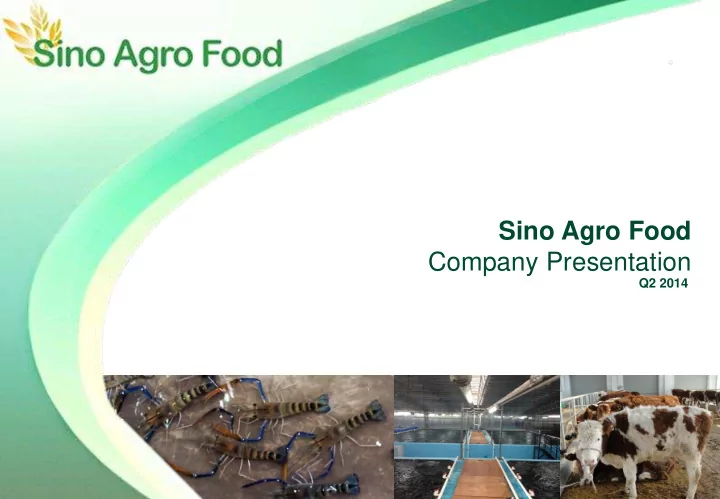
Sino Agro Food Company Presentation

Q2 2014
slide-2
SLIDE 2

SIAF Cooperate with Local Farmers in the Rearing of Beef Cattle (3/4)

  • 1. SIAF at a glance
  • 2. Company Overview
  • 3. Financial Review
  • 4. Industry Overview

Appendix

slide-3
SLIDE 3

Company overview

Geographic presence

Cattle Qinghai Province, Xining City Aquaculture, Cattle, Vegetable plantation Guangdong Province, Enping

Core operations

Division Aquaculture Beef cattle Products Gross margin(1) Share of group revenues(2)

54% 35% 38% 36%

  • Vertically integrated seafood and beef producer in China
  • Development, production and distribution of high quality seafood and beef
  • Operates in high growth food segments seafood & beef due to China's rising middle class

and the urbanized population’s demand for higher value and quality food

  • Benefiting from PRC government policies stimulating food production with tax exemption

and other subsidies

  • Revenue growth from 14 US$m in 2006 to 261 US$m in 2013 - CAGR of 52%
  • 2013 EBITDA margin of 37%
Cattle Hunan Province, Linli District 3 (1)
  • FY13. Includes both Goods sold and Consulting & Services revenue.
(2) Vegetable plantation share of revenue is not depicted.
slide-4
SLIDE 4

History

2006
  • Initiates
business activity in China 2009
  • Acqusition of
Vegetable plantation in Guangdong and SJAP beef cattle farm in Qinghai
  • Construction of 1st
Fish Farm 2010
  • Begins stocking
fish in 1st Fish Farm 2012
  • Development of
wholesale operations and distribution network
  • Founded by Mr. Solomon Lee 2006 in Guangzhou, China
  • 5-year plan initiated in 2010 focussing on recirculating aquaculture and beef cattle production
  • SIAF’s main role has shifted from an agribusiness technology and service provider to a

producer and marketer of food products

4 2013
  • SJAP Beef cattle
farm awarded Dragon Head status
  • Vertical integration
into meat processing 2014
  • Awarded
landmark prawn farm contract in Pearl River delta. 300 000 MT p.a. framework volume

Revenue 2006-2013

slide-5
SLIDE 5

Sideways shareprice development during 2013

Share price development 2013 Shareholder structure 39%

5
slide-6
SLIDE 6

Aquaculture operations

  • SIAF’s largest business division
  • Rearing and distribution of aquatics including fish and prawns
  • Development of Recirculating Aquaculture System (RAS) farms

together with local Chinese investors

  • SIAF is the world’s largest operator and developer of RAS

aquaculture farms (APRAS)

  • Competitive edge vs. traditional outdoor dams
  • 2013 Revenue of 140 US$m, gross profit margin of 33%
Item SIAF’s APRAS aquatic farms Conventional Chinese open dam culture Labour requirement p.a. 1 worker per 50MT* 1 worker per 6MT Dam water usage Water recycled Changed every year Energy requirement 2.5% of production cost No specified records Harvesting All year round Once or twice p.a. Subject to seasonal variation No Yes Subject to disease No Yes Use of antibiotics and chemicals No Yes Mortality rate 8% or less Above 25% Feed to fish conversion rate 2 to 1 4.5 to 1 Aquatic production per land unit p.a. ~1600 MT/acre ~40 MT/acre SIAF’s APRAS vs. conventional open dam aquaculture farming Western White Shrimp Sleepy Cod

Share of group revenue 54%

Grow-out tanks Fish farm 1

54%

Grow-out tanks Prawn Farm 1 6
slide-7
SLIDE 7

Selection of SIAF’s APRAS aquatic farms

7

Grow-out tanks, Fish Farm 1 (FF1) Grow-out tanks, Prawn Farm 1

Zhongshan 1,300 acre prawn & hydroponics farm project area

Hatchery and Nursery grow-out, Prawn Farm 2

slide-8
SLIDE 8

Cattle operations

  • Rearing of beef cattle, slaughter and meat

processing mainly Qinghai province

  • Vertically integrated from fertilizer and

feedstock to value-added meat products

  • Operating high-yield cattle operations in a rural

region with outdated agriculture practices

Livestock feed Cattle Slaughter Deboning Value- added meat sales

Farming model

Fertiliser Current primary production (tax exempt) Completion of slaughterhouse in Q1 2014

Share of group revenue

Beef cattle in SIAF’s cattle houses Livestock feed products

35%

8
slide-9
SLIDE 9

Cattle operations in Qinghai province

Baling of silage Beef Cattle in SJAP’s cattle houses Slaughter at SJAP slaughter and meat processing facility SJAP Beef cattle houses during winter 9
slide-10
SLIDE 10

Financial highlights

Capital Expenditure Revenue and EBITDA Net Tangible Assets Group Revenue (US$m) 5-year plan focusing on cattle and aquaculture 10
slide-11
SLIDE 11
  • 1. SIAF at a glance
  • 2. Corporate Strategy
  • 3. Financial Review
  • 4. Industry Overview

Appendix

slide-12
SLIDE 12

Vertical integration in the food value chain

  • SIAF is vertically integrated from feed and breeding stock production to wholesale distribution of

processed food products.

  • Improved quality, product yield and margins
  • Key to maintaining high food safety and quality assurance in an otherwise low-quality environment
  • Lower dependency on 3rd parties with less exposure to commodity price volatility
  • Unlike Europe and North America, Chinese food and agribusiness groups are highly vertically

integrated

Quality assurance, price control, supply assurance Core revenue generation Margin uplift, end-consumer and marketing control, proprietary brands, increased barriers of entry

Activity type

Production support UPSTREAM Food production

Purpose SIAF activities

  • Aquaculture R&D
  • Rearing of prawn broodstock
  • Feed and Fertilizer production
  • Securing supply of young beef cattle
  • Development and education of
manufacturers and suppliers
  • Food production
  • Project development
  • Meat and vegetable processing
  • Marketing and distribution
  • Treatment and recycling of cattle and fish
waste DOWNSTREAM Processing and wholesaling of food products

Food value chain

12
slide-13
SLIDE 13

Partnering with Chinese joint venture investors in agribusiness projects

  • Agribusiness projects are executed with Joint Venture Partners through Sino Foreign Joint Venture

(SFJV) companies together with targeted local and regional Chinese investors

  • The Chinese investor is responsible for procuring land and local labour, while SIAF provide

technology, engineering expertise, supply chain and a share of the project financing

  • The SFJV model enable the project financing and provide operational flexibility together with PRC

government backing - which is key to the success of the JV’s

  • SIAF have completed five SFJV’s in China with four SFJV project company applications pending

regulatory approval

Process overview
  • 1. Attracting the JV
partner Prospective investors visit established SIAF farms
  • 2. Formation of the JV
SJVC agreements are executed with Chinese investors for project delivery
  • 3. Set up of ownership
structure (1) Chinese investor contributes land while SIAF provides consultancy and project management service (2)SIAF and its JV partner pay for their respective share of capex (3)SIAF is given the option to retain majority ownership
  • 4. SIAF Ownership
increase SIAF normally increases
  • wnership to 75%
SIAF’s main source of income from the project before operations start generating revenues and the JV share is hiked to 75% is derived from management and sales commission fees 13
slide-14
SLIDE 14
  • 1. SIAF at a glance
  • 2. Corporate Strategy
  • 3. Industry Overview
  • 4. Financial Review

Appendix

slide-15
SLIDE 15 1) OECD Economic Outlook No. 92 (database) / OECD economic surveys: China 2013 2) The World Bank; China 2030, Building a Modern, Harmonious, and Creative Society, 2013 3) USITC: China’s Agricultural Trade: Competitive Conditions and Effects on U.S. Exports, March 2011 4) USDA’s GAIN Report Number: CH12073 per 12/28/2012 5) The State of World Fisheries and Aquaculture 2012, FAO 6) China and Hong Kong: Food Opportunities for Maine, March 2012 7) Rabobank 8) Frost & Sullivan: China’s beef market has great growth potential

Industry Overview

Economic

  • utlook in China
  • The OECD expects that China’s real GDP will grow by 8.9% in 2014(1)
  • The strong growth in China has delivered major improvements in living standards and poverty has been reduced
dramatically recently with China graduating from lower to upper middle-income status(2)
  • Agricultural employment has been falling for a decade at an average rate of 3.5% annually, with massive migration from
the countryside to cities. Continuing migration of workers out of agriculture is expected to help boost farming profitability, leading to further gains from mechanisation(1)

1

Agriculture in China(3)

  • China is the world’s largest agricultural economy
  • Food is the largest class of household expenditure for all Chinese income groups
  • Government support to the agricultural sector indicates that policymakers are placing strong support on food
production
  • Higher incomes lead to preferences for high-value food such as beef and seafood resulting in significant market
growth

2

The market for aquatic and aquaculture in China(4)

  • China is the world’s largest aquatic producer and its market share has risen from 7% in 1961 to 35% by 2010(5)
  • China is the world largest aquaculture producer with total cultured aquatic production accounting for ~70% of world total
  • Prices for aquatic products are expected to grow in 2013 due to increases in the price of feed and other inputs
  • Development of processing, distribution and improved consumer affluence boosts demand for more diversified diets,
including seafood
  • Demand has increased for imported frozen aquatic products commonly available in supermarkets
– Product identification such as brands and country of origin are important tools to attract consumer interest

3

The market for beef and meat in China

  • By 2015 total meat output is estimated to 85 million tons, of which ~63% is pork(6)
  • Since 2007 China has gradually turned into a net importer of meats from previously maintaining self-sufficiency in meat (6)
  • Beef consumption has risen steadily over the last few years; rising incomes, dietary shift and urbanization are key drivers
– Beef consumption is expected to rise by 24% per capita in the coming decade – Beef is a niche product in China today accounting for only 8% of per capita meat consumption(7)(8)
  • Further regulation of China's beef industry will likely ensure sufficient supply of cattle and promote beef industry
development(8)

4

slide-16
SLIDE 16
  • 2,0
0,0 2,0 4,0 6,0 8,0 10,0 2012A 2013E 2014E Euro Area USA Brazil Russia India China

China’s real GDP growth estimated to 8.9% in 2014 with growth during next 10Y forecasted to average 8%(1)

Economic Outlook in China

1

16 Real GDP growth (%)
  • China’s economy is at present second only to that of the United States, having
  • vertaken Japan’s role as number two in 2010(2)
– China’s real GDP estimated to grow by 8.9% in 2014(1) – China is expected to become the worlds’ largest economy in 2017 with 18.3% of the world economy(3)
  • The strong growth in China has delivered major improvements in living
standards and poverty has been reduced dramatically(4) Based on World Bank classification, China recently graduated from lower to upper middle-income status – A growing emphasis on improving access to health and education as well as high investments in infrastructure has spread the benefits of growth nationally including rural areas, where incomes have enjoyed consistently strong gains – Recent simulations suggest that China could maintain high, though gradually easing, growth during the current decade, averaging 8% in per capita terms
  • The share of the population aged 20 to 64 in the total population is expected to
peak soon, and the elderly dependency ratio will continue to rise, exerting downward pressure on saving rates – Agricultural employment has been falling for a decade at an average rate of 3.5% annually, with migration from the countryside to cities. Continuing migration of workers out of agriculture is expected to boost farming profitability, leading to gains from more mechanisation
  • Consolidation of farms into bigger units may occur provided that the
laws governing the ownership of rural land-use rights are changed to allow the sale of use-rights and favour the rental market for agricultural land(5) 1) OECD Economic Outlook No. 92 (database)/OECD economic surveys: China 2013 2) The World Bank; China 2030, Building a Modern, Harmonious, and Creative Society [pages 3, 376-377], 2013 3) IMF, October 2012 4) The World Bank; China 2030, Building a Modern, Harmonious, and Creative Society, 2013 [pages 3, 376-377 5) OECD Economic Surveys China, March 2013 [Pages 20-21]] Chinese and US share of global GDP (% of global GDP) 5 10 15 20 25 2000 2002 2004 2006 2008 2010 2012 2014E 2016E China USA
slide-17
SLIDE 17 100 200 300 400 500 600 1984 1989 1994 1999 2004 2009

Agriculture in China (1/2)

2

17 Agriculture in Chinese economy
  • China is the world’s largest agricultural economy. It is the leading producer and consumer of many
agricultural commodities such as pork and rice – China has historically been successful in meeting its rapidly rising demand for food and fiber by increasing domestic production, but has now emerged as a leading global importer of several agricultural commodities
  • About 40% of China’s population of 1.3 billion is employed in the agricultural sector with agriculture
contributing ~11% to China’s GDP(1) Government support for agriculture
  • The Chinese central government’s current producer and consumer support(2) policy incentivises the
transition from grain self-sufficiency and low consumer prices toward raising farm household incomes, placing a renewed emphasis on the rural economy – Indirect support, in the form of general services, is very high relative to similar support programs in other countries, due largely to investments in agricultural infrastructure
  • General services include modern research and extension services, food safety agencies,
and agricultural price information services which provide benefits to producers and consumers throughout the economy(1) Agricultural consumption
  • China is a major global consumer of agricultural products
  • The traditional Chinese diet centers around grains and starches staple foods which account for nearly
  • ne-half of the daily caloric intake
  • Chinese food consumption is influenced by factors including population size, demographics, income,
food prices, and general preferences – Per capita income growth and urbanization are the main factors responsible for altering recent consumption patterns
  • Rising income translates into higher per capita food consumption
  • Increasing urbanization is driving diversification of food choices because of greater
availability and choice offered through increasingly diverse sales outlet. Urban diets contain less grain and more processed non staple food items compared to the rural diet. Rural migrants to cities tend to adopt the urban diet (1) Investment into agricultural sector central government budget support(3) Per capita food consumption development 1980 - 2009(3) (Billion Yuan in 2008 prices) (kg/person) 20 40 60 80 100 120 1980 1990 2000 2009 Rice Wheat Other grains 20 40 60 1980 1990 2000 2009 Milk Meat Fish

Government support to the agricultural sector indicates that policymakers are placing a renewed emphasis on the rural economy

(1) USITC: China’s Agricultural Trade: Competitive Conditions and Effects on U.S. Exports, March 2011 [pages 1-1 and1-8] (2) OECD: Producer and Consumer Support (PSE) is defined as the estimated monetary value of transfers from consumers and taxpayers to farmers, expressed as a percentage of gross farm receipts (defined as the value of total farm production at farmgate prices), plus budgetary support (3) Feeding Growing Food Demand in China , Jikun Huang Center for Chinese Agricultural Policy Chinese Academy of Sciences, April 2012
slide-18
SLIDE 18 Expenditure on food
  • Food is the largest class of household expenditure for all Chinese income groups
  • Urban residents spend substantially more on food than their rural counterparts
  • Higher incomes lead to an increase in both the quantity and quality of food demanded
  • Demand for higher quantities of food stabilise in top income households while demand for higher-
quality foods continues to rise with income
  • Spending on food consumed outside the home is rising
– Most expenditures are made in restaurants. Although consumption away from the household is increasing, most foods are still eaten at home. The exception is meat, with about half of all meat consumed outside the home Food preferences
  • Higher incomes lead to changing food preferences, including demand for better quality, safer and more
varied food – Income growth and urbanisation is expected to increase demand for a variety of higher quality foods
  • Similar to other developing countries, the traditional Chinese diet comprises mostly of grains and other
starch staples – Consumption of non-staple, higher-value foods such as meat (especially pork), dairy, fruits, vegetables, and processed food has grown significantly in the past three decades
  • 30% of the food currently consumed in China has been processed in some way
  • The Chinese consume about four times as much pork as poultry, the second most popular animal
protein – Pork consumption has been encouraged by improved cold storage distribution, as the product can be transported greater distances to reach more customers – Pork consumption levels are also high due to government support programs, including purchasing pork for reserves and occasionally subsidizing pork purchases for low-income consumers
  • Food quality and safety are important factors affecting Chinese food preferences
– High income urban groups that focus their expenditure on high-quality products also seek assurance that their food is safe – Safety concerns can determine where certain foods are bought: fresh produce is usually purchased at a wet market because fresher produce is perceived to be safer, while meats are increasingly bought at a supermarket because of the availability of cold storage(1) Food; 36% Clothing; 10% Residence; 10% Household Facilities, Articles and Services ; 6% Healthcare and Medical Services; 7% Transport & Communications ; 14% Education, Cultural and Recreation Services; 13% Miscellanous goods and services ; 4%

Agriculture in China (2/2)

2

18 Average per capita annual expenditure of urban households, 2009(2) Per capita food consumption in 2009, Urban and Rural split(3) (kg)

Higher incomes and urbanisation are leading to changing food preferences, including the demand for better quality and safer foods

20 40 60 80 100 120 Rice Wheat Fruits Red meat and poultry Milk Urban Rural (1) USITC: China’s Agricultural Trade: Competitive Conditions and Effects on U.S. Exports, March 2011 [pages 1-1 and1-8] (2) China Statistical Yearbook 2011 (3) Feeding Growing Food Demand in China , Jikun Huang Center for Chinese Agricultural Policy Chinese Academy of Sciences, April 2012
slide-19
SLIDE 19

The Market for Aquatic and Aquaculture in China

2,1% 5,6% 4,6% Wild catch Fish Farming Total Aquatic Production

3

19
  • China has the world’s largest aquatic production and its market share has risen from 7% in 1961
to 35% by 2010(1) Aquaculture
  • After China opened up to the outside world in the 1980's, the aquaculture sector has been
growing dramatically, becoming one of the fastest growing agriculture sectors(2)
  • China is the world largest aquaculture producer accounting for ~70% of global aquaculture
production
  • Aquaculture acreage and investments in production expansion is slowing overall
– Government officials relate that environmental concerns and the rapid industrialization/urbanization of China’s coastal regions hamper further aquaculture expansion
  • Fish is the most common type of seafood cultivated through aquaculture with a total production
  • f 22.8 million tons, accounting for 69% of all aquatic fish production in 2011
– Carp remains the most popular cultured freshwater fish accounting for 72% of total freshwater cultured fish production Aquatic Consumption
  • Development of processing, distribution and improved consumer affluence boosts demand for
more diversified diets, including seafood
  • Per capita consumption of aquatic products was 14.6 Kg per urban dweller and 5.4 Kg per rural
inhabitant in 2011 – Per capita consumption is expected to increase steadily, with strong growth potential in the rural sector – The per capita consumption of aquatic products is highest in coastal regions, such as Shanghai and Guangdong, and locations with relatively high disposable income
  • Prices for aquatic products are expected to grow in 2013, reflecting increases in the price of feed
and other inputs Marketing
  • Demand has increased for imported frozen aquatic products commonly available in supermarkets
– Product identification such as brands and country of origin are important tools to attract consumer interest – With the proper display, high-value imported items can be promoted to customers – Importers claim high value U.S. seafood products are easy to sell in both first and second tier cities(3) Aquatic CAGR by production method 2008-2011 Consumption Trends for Fish and other food types in China(4) ,0 5,000 10,000 15,000 20,000 25,000 2009 2010 2011 Other Algae Shrimp, Prawn & Crab Shellfish Fish
  • China is the world largest aquaculture producer with production accounting for ~70% of world total
(1) The State of World Fisheries and Aquaculture 2012, FAO (2) FAO – National Aquaculture Sector Overview China (3) USDA’s GAIN Report Number: CH12073 per 12/28/2012
slide-20
SLIDE 20 6 12 18 24 30 36 2006 2007 2008 2009 2010 2011 Urban Rural Asia and Pacific 56% North America 8% Europe 6% Other 4% Africa 8% Latin America and Caribbean 18%

China is the world’s largest producer and consumer of meat including pork, poultry and beef with a 27% market share

The Market for Meat and Beef in China

4

20
  • China is the world’s largest producer and consumer of meat including pork, poultry and beef with
a 27% market share – 2011 Meat production amounted to 79 million tons consisting of ~63% pork
  • 2015 meat production in is targeted to reach 85 million tons, consisting of ~63% pork
according to the Government’s 5-year plan – Since 2007 China has gradually turned into a net importer of meat from previously maintaining self-sufficiency in meat(1) Meat Market Drivers
  • Improved consumer purchasing power stimulate the growth of beef markets as beef sells
at premium prices and traditionally goes beyond the population's affordable level – Rising purchasing power has led to a dietary pattern change switching from consumption of traditional food grain to an increase in consumption of meat products – Chinese traditionally employ pork and chicken as meat sources due to beef being considered expensive
  • With the improvement of living standards Chinese have upgraded their meat
consumption to include more beef – Consumption of red meat is perceived to have higher status than consumption of poultry or pork
  • Chinese people's diet is becoming more diversified and healthy, introducing larger
amounts of beef as beef has nutritional benefits to pork – Beef has high protein content, low fat content with unsaturated fatty acids, thus making it a healthier kind of meat compared to pork
  • Additional regulation of China's beef industry will likely strive to ensure sufficient supply
  • f cattle and promote the development of the beef industry
– Chinese government policies are expected to support the adequate supply of cattle and improve the quality of beef products resulting in safer and healthier beef products and a more sophisticated beef consumption(2) 1 2 3 1) China’s growing appetite for meats: Implications for World meat trade. A Multi-Client Study, April 2012 2) China and Hong Kong: Food Opportunities for Maine, Maine International Trade Center, March 2012 Frost & Sullivan: China’s beef market has great growth potential China’s growing appetite for meats: Implications for World meat trade. A Multi-Client Study, April 2012 3) Meat - OECD-FAO Agricultural Outlook 2012-2021 4) 2011 China Statistical Yearbook Table 10-9 and 10-33 Expected increase in meat demand between 2012 and 2021 by region(3) Consumption Trends for Pork, Beef, Poultry and Mutton in China(4) (Per Capita Consumption in kilogram per year)
slide-21
SLIDE 21
  • 1. SIAF at a glance
  • 2. Corporate Strategy
  • 3. Industry Overview
  • 4. Financial Review

Appendix

slide-22
SLIDE 22

Income statement

  • Significant revenue growth with maintained

profitability

  • Rising COGS, increased production capacity

and focus on high-growth food niche segments

  • Slight above-peer margins due to sale of

premium products and cost-efficient production

  • Lower GP margin FY13 due to lower share of

high-margin Consulting & Services sales

  • Low SG&A expense due to slim organizational

structure with small HQ overhead

  • No tax expense due to government stimulus of

food production sector through tax exemption policies

22

Income statement

US$m 2011 2012 2013 Sales 51,9 138,6 261,4 COGS (26,4) (68,2) (158,6) Gross profit 25,5 70,4 102,8 SG&A (4,4) (6,6) (6,6) EBITDA 21,1 63,8 96,2 D&A (1,5) (2,4) (3,5) EBIT 19,6 61,4 92,7 Extinguishment of debts 1,0 1,7 1,3 Net other income/expenses 0,4 0,4 0,8 Interest Expense (0,0) (0,3) (0,4) Taxes 0,0 0,0 0,0 Net Income 21,1 63,3 94,4 Key Ratios Sales Growth 375% 167% 89% Gross profit Margin 49% 51% 39% EBITDA Margin 41% 46% 37% Net Margin 41% 46% 36%
slide-23
SLIDE 23

Balance sheet

  • Prudent financing policy with very limited

financial leverage

  • Equity ratio of 90%
  • ND / EBITDA of 0,05x
  • Growth in NTA due to increases in both retained

earnings and additional paid-in capital

  • High NWC/ Sales ratio due to generous credit

terms to rural beef cattle farmers and inclusion

  • f paid-up capital to future SFJV’s for equity

stake investments in Deposits and prepaid expenses

23

Balance sheet

US$m 2011 2012 2013 Current assets Cash and cash equivalents 1 8 1 Inventories 4 17 8 Deposits and prepaid expenses 15 47 92 Accounts receivable 28 53 82 Other current assets 26 8 4 Fixed assets Property and equipment 63 100 166 Goodwill 1 1 1 Other fixed assets 14 8 12 TOTAL ASSETS 152 243 368 Current liabilitites Accounts payable, accrued expenses 1 6 11 Interest bearing debt 3 4 Other current liabilities 15 14 19 Non-current liabilities Deferred dividends payable
  • 3
  • Long term interest bearing debt
  • 2
Total liabilities 16 26 36 Equity 135 217 332 TOTAL LIABILITIES AND EQUITY 152 243 368 Net Debt (1,4) (1,9) 4,7 ND / LTM EBITDA 0,0x 0,0x 0,05x Equity ratio 89% 89% 90% NWC / Sales 44% 63% 59%
slide-24
SLIDE 24

Cash flow statement

  • Increased goods production has improved
  • perating cash flow generation very significantly

since 2011

  • Operating cash flow and to a lesser extent

external equity finances aggressive expansion capex outlay in order to sustain high growth and capitalize on current favourable conditions for beef and prawn production projects – Capex / sales of 36%

  • Cash conversion of 88% due to less build-up of

NWC despite significant expansion

24

Statement of cash flows

US$m 2011 2012 2013 Net Income 21 63 94 Non-cash adjustments 2 3 3 Operating CF before ΔNWC 23 66 97 ΔNWC (19) (22) (13) Operating CF 5 44 84 Acquisition of property and equipment (0) (11) (7) Payment for investment in future SFJV's c
  • (6)
(35) Payment for construction in progress (1) (7) (51) CF from Investing Activities (5) (44) (93) Short term bank loan raised
  • 3
4 Short term bank loan repaid
  • (3)
Net proceeds of bonds
  • 1
Dividends paid (1) (0) (1) CF from Financing Activities (1) 3 1 Effects of FX rate changes on cash (1) 1 ΔCash and cash equivalents (3) 3 (7) Cash beginning of period 4 1 8 Cash end of period 1 8 1 Stock issued for settlement of debts 12 18 17 Stock issued for services and employees c 4,3 0,4 0,3 Non-cash equity financing transactions 16 18 17 Capex / Sales 10% 32% 36% ΔNWC / Sales 36% 16% 5% Cash conversion 22% 70% 88%
slide-25
SLIDE 25
  • 1. SIAF at a glance
  • 2. Corporate Strategy
  • 3. Industry Overview
  • 4. Financial Review

Appendix

slide-26
SLIDE 26

Corporate governance

Corporate / legal structure

Sino Agro Food USA Macau EIJI Macau A Power Agriculture Development Macau Capital Award Belize Fish Farm 1 China Prawn Farm 2 China Prawn Farm 1 China HU Plantation(1) China Cattle Farm 1 China SJAP Beef China Cattle Farm 2 China HSA Beef China Aquaculture Cattle
  • Founder, CEO and chairman of the board, Solomon Lee
  • SEC reporting since 2011
  • Contemplated NASDAQ listing with secondary listing on NASDAQ OMX Stockholm
  • Swedish investment group network with over 300 private and 20 corporate members
  • Sponsored private placements and ensuing listings of companies such as Nexam and

Cassandra Oil

  • Main contributor to Swedish ownership
26 (1) HU Plantation is an independent business area from cattle operations. Sino Agro Food Sweden Aktiebolag (publ) Tri-way Industries Hong Kong Other
slide-27
SLIDE 27

Board of directors and management

Board of directors Key management team

Solomon Lee Chairman, founder and CEO Australian citizen
  • B.A. Major in Accounting and
Economics from Monash University , Australia
  • 45 years of business and project
development experience
  • Involved in building RAS facilities
since 1986
  • Managed own businesses since
the 1980’s, including export of primary produce and seafood from Australia to Asia since 1987
  • CEO of Malaysian aquaculture
developer 1993-2004 George Yap Independent Director, Chair of Aduit Committee Malaysian citizen
  • Chartered accountant with >30
years of experience
  • Member of Institute of Chartered
Accountants in England and Wales since 1984
  • Head of banking at CSFB in
Sydney in 1990-1992
  • CFO of the property and
privatisation division of the Australian Department of Finance 1999-2000
  • CFO of the Australian Parliament
in 2000 Nils-Erik Sandberg Independent Director Chair of Compensation Committee Swedish citizen
  • President of the Jordan Fund, a
Swedish investment group network, since 1990
  • Adviser for Gustavia Energy and
Commodities Fund since 2008
  • Founded Hydrocarbon
International HCI AB and Grauten Oil AB, both publicly traded Swedish oil companies, and served as their CEO in 1986-1993
  • Previously director at International
Petroleum Corporation, later Lundin Petroleum Solomon Lee Chairman, founder and CEO Australian citizen
  • B.A. Major in Accounting and Economics from Monash
University , Australia
  • 45 years of business and project development
experience
  • Involved in building RAS facilities since 1986
  • Managed own businesses since the 1980’s, including
export of primary produce and seafood from Australia to Asia since 1987
  • CEO of Malaysian aquaculture developer 1993-2004
Peter Tan Chief Marketing Officer and Director Malaysian citizen
  • Head of the aquaculture division
  • BA Major in Accounting and Economics in 1972
  • 28 yrs of food industry experience
  • MD of Malaysian gas appliance manufacturer since 2005
  • Operating representative on board of directors
Michael Chen Secretary and Director Taiwanese citizen
  • Director and business development manager of Capital
Award since 2004
  • Supervisor of Malaysian aquaculture developer 1995-
2004
  • Operating representative on board of directors
27 Daniel Ritchey Independent Director US citizen
  • MBA in Finance from Ohio State
University
  • Partner in DC Capital LLC, 3-D Oil
& Gas and 3-D Ranch, a 2,200 head of cattle/1,500 head pig farm
  • Previous positions as investment
analyst and advisor for venture capital firms Anthony Soh Independent Director Malaysian citizen
  • LL.B (Hons) degree from
University of Hull, England
  • Partner in the law firm Edwin Lim
Suren & Soh, Kuala Lumpur, Malaysia
  • CEO and deputy CEO of Pontian
United Plantations Berhad 2005- 2013, a 39 000 acre palm oil plantation and palm mill
slide-28
SLIDE 28

Q&A