D. Other Reimbursable Expenses 1. Conference/ Meeting Registration - - PDF document

d
SMART_READER_LITE
LIVE PREVIEW

D. Other Reimbursable Expenses 1. Conference/ Meeting Registration - - PDF document

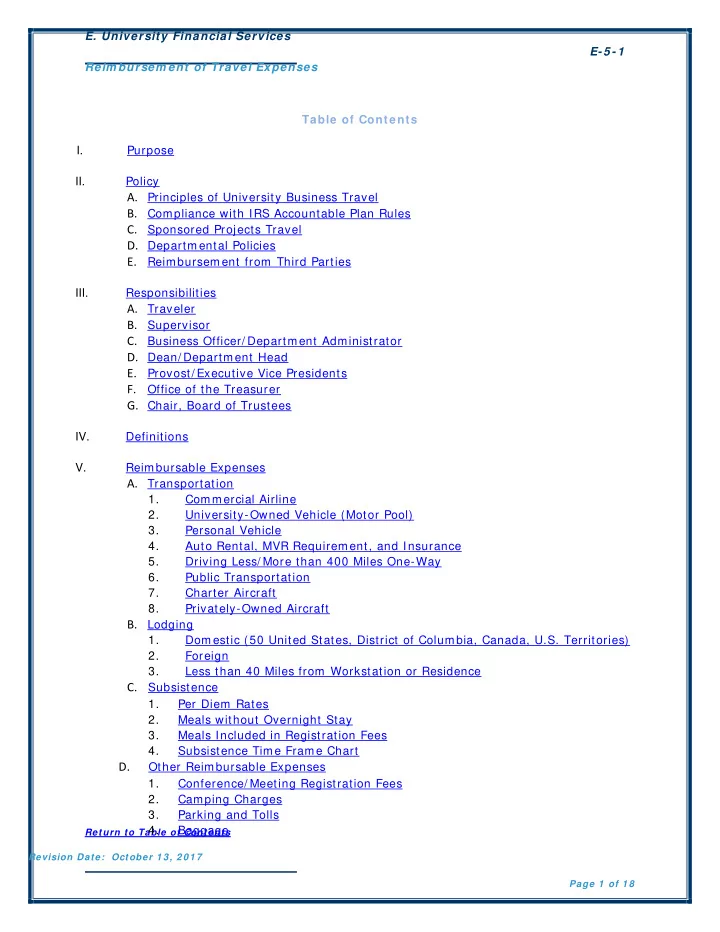
E. University Financial Services E-5 - 1 Reim bursem ent of Travel Expenses Table of Contents I. Purpose II. Policy A. Principles of University Business Travel B. Compliance with IRS Accountable Plan Rules C. Sponsored Projects Travel D. Departm


slide-1
SLIDE 1
  • E. University Financial Services

E-5 - 1 Reim bursem ent of Travel Expenses

Return to Table of Contents Revision Date: October 13, 2 017 Page 1

  • f

1 8

Table of Contents I. Purpose II. Policy

  • A. Principles of University Business Travel
  • B. Compliance with IRS Accountable Plan Rules
  • C. Sponsored Projects Travel
  • D. Departm ental Policies
  • E. Reimbursem ent from Third Parties

III. Responsibilities

  • A. Traveler
  • B. Supervisor
  • C. Business Officer/ Department Administrator
  • D. Dean/ Department Head
  • E. Provost/ Executive Vice Presidents
  • F. Office of the Treasurer
  • G. Chair, Board of Trustees

IV. Definitions V. Reimbursable Expenses

  • A. Transportation

1. Comm ercial Airline 2. University-Owned Vehicle (Motor Pool) 3. Personal Vehicle 4. Auto Rental, MVR Requirem ent, and Insurance 5. Driving Less/ More than 400 Miles One-Way 6. Public Transportation 7. Charter Aircraft 8. Privately-Owned Aircraft

  • B. Lodging

1. Dom estic (50 United States, District of Columbia, Canada, U.S. Territories) 2. Foreign 3. Less than 40 Miles from Workstation or Residence

  • C. Subsistence

1. Per Diem Rates 2. Meals without Overnight Stay 3. Meals Included in Registration Fees 4. Subsistence Time Fram e Chart

D.

Other Reimbursable Expenses 1. Conference/ Meeting Registration Fees 2. Camping Charges 3. Parking and Tolls 4. Baggage

slide-2
SLIDE 2
  • E. University Financial Services

E-5 - 1 Reim bursem ent of Travel Expenses

Return to Table of Contents Revision Date: October 13, 2 017 Page 2

  • f

1 8

5. Tips and Gratuities 6. Communications 7. Vaccinations for International Travel 8. Laundry 9. Visas and Miscellaneous Reimbursable Expenses VI. Nonreimbursable Expenses VII. Special Items

  • A. Official Guest Expenses while in Travel Status
  • B. Working Meals while in Travel Status
  • C. President’s Spouse Travel
  • D. Other Spouse Travel
  • E. Travel for Faculty on Sabbatical or During Non-Contract Periods

VIII. Procedures

  • A. TRIP Reimbursement for Faculty, Staff and Student Employees

1. TRIP Travel Request Document 2. TRIP Travel Expense Report

  • B. TRIP Access for Temporary and STEPS Employees
  • C. Advance Paym ent of Travel Expenses
  • D. Fiscal Year-End Closing Policy
slide-3
SLIDE 3
  • E. University Financial Services

E-5 - 1 Reim bursem ent of Travel Expenses

Return to Table of Contents Revision Date: October 13, 2 017 Page 3

  • f

1 8

I.

Purpose To provide guidance to faculty and staff traveling on behalf of the University of Kentucky and its affiliated corporations that will:

  • safeguard the assets and reputation of the University,
  • describe expenditures that are reimbursable in accordance with Internal

Revenue Service (IRS) guidelines, and

  • inform employees and TRIP travel expense report approvers of their

responsibilities regarding the managem ent of official University travel. This policy applies to all units, regardless of source of funds; however, additional sponsor-imposed regulations may apply to travel on sponsored projects.

  • II. Policy A.

General: 1. Official University travel must be in support of the University’s mission and consistent with the business and professional needs of the institution. 2. Written approval must be secured prior to travel at the level required by departm ent or division. Employees must disclose plans for combining personal with business travel. 3. Advance travel approval utilizing the University’s online TRIP travel request document is recomm ended and encouraged for all travel. 4. Travelers are strongly encouraged to utilize UK Travel Services for arranging official University travel, in support of vendor contracts, to take advantage of travel discounts, and to be included in the University risk management tracking system . 5. Travelers are strongly encouraged to utilize the University Procurement Card as allowed by University policy. Travelers using personal funds for expenses will be reimbursed after the trip has been taken, and after the airline ticket has been used. 6. Travelers must register their international travel on the UK International Travel Registry prior to departure. Activities overseas that must be registered include, but are not limited to: official University business, conference attendance/ presentations, research, community service, and

  • sabbaticals. To ensure coverage under UK’s international insurance plan, all

University travel outside of the United States and to the U.S. territories as defined in IRS Publication 570 should be registered here. Note: While Canada is considered domestic travel with regard to lodging reimbursem ent, the trip classification is still international for this registry. 7. Travel expenses are reimbursed through the TRIP travel expense report. Each traveler must submit a travel expense report for his or her expenses

  • nly. If a traveler chooses to pay an expense for another traveler, the

expense must still be claimed by the second traveler, and then settled between the travelers after reimbursem ent. 8. Travel expenses are limited to actual and necessary expenditures for transportation, lodging, meals and selected incidental travel expenses. 9. Travelers must use the most direct and usually traveled routes, incur the lowest reasonable travel expenses, and exercise care to avoid impropriety and/ or the appearance of impropriety. Expenses incurred by traveling

slide-4
SLIDE 4
  • E. University Financial Services

E-5 - 1 Reim bursem ent of Travel Expenses

Return to Table of Contents Revision Date: October 13, 2 017 Page 4

  • f

1 8

alternate routes or using less economical sources are the responsibility of the traveler. 10. Travel dates are based upon when University business starts and ends, the actual business location (distance from workstation), and transportation

  • schedules. Reasonable judgment must be given to travel only on dates that

are necessary to complete University business. For example, traveling from Lexington to California for a morning meeting would require arriving the day before; however, traveling from Lexington to Atlanta for an afternoon meeting or evening event would not require arriving the day before. Travelers are expected to return home on the same day that business concludes if transportation schedules allow arriving home by end of the calendar day. 11. Travel reimbursement must be reduced by any amount credited to the individual by airlines, hotels or other travel vendors. Airline tickets or other travel expenses acquired with airline frequent flyer or credit card points/ awards are not reimbursable, as only out-of-pocket expenses are

  • reimbursed. Service fees to secure these tickets are reimbursable.

12. Foreign reimbursable expenses must be submitted in US Dollars (USD) using the exchange rate(s) in effect at the time of travel. a. If US Dollars (USD) are exchanged for foreign currency, the exchange rate listed on the receipt can be used to convert expenses for the trip. Attach the receipt to the voucher as documentation. b. OANDA.com may be used as a resource to obtain historical foreign exchange rates. The traveler may use the average rate for the travel period or the daily rate. Print and attach the page to document the exchange rate used. c. If expenses are charged on a credit card, the credit card company converts the expenses and that rate must be used if known at the time the TRIP travel expense report is submitted.

  • 13. All employee reimbursements for travel expenses processed through TRIP

will be by ACH deposit to the primary bank shown on the employee payroll

  • record. Paper travel documents during the TRIP implementation phase will

continue as checks. B. The University complies with IRS rules on accountable plans. The requirem ents

  • f a valid accountable plan are:

1. Reimbursem ents can only be made for legitimate business expenses incurred by employees in connection with performance of their duties. 2. Employees must substantiate the am ount, date, place, and business purpose

  • f the expenses and be reimbursed within a reasonable period of time,

regardless of source of funds. Substantiation requires that receipts must be attached when required. 3. Employees must complete and approve the TRIP travel expense report for all business expenses within 60 calendar days of the date when business travel ends to be considered a reasonable period of time. Employees who do not complete and approve the TRIP travel expense report within these 60 calendar days will be reimbursed and the am ounts considered taxable

slide-5
SLIDE 5
  • E. University Financial Services

E-5 - 1 Reim bursem ent of Travel Expenses

Return to Table of Contents Revision Date: October 13, 2 017 Page 5

  • f

1 8

  • wages. In rare situations, exemptions from taxation may be approved –

complete the Request for Exemption from Taxation. 4. Multiple trips without an overnight stay (day trips) may be reported on a single TRIP travel expense report on a monthly basis. 5. Lack of available funds, as when a sponsored project budget has not been approved or an anticipated gift not received, is not an acceptable reason to delay reimbursement to an employee beyond the 60-day limit. In those cases, the reimbursement must be made from another source. In accordance with cost transfer policies, a journal voucher may be used to move expenses when funds becom e available. 6. In the rare instances where travel advances are obtained, employees m ust repay any travel advance to the University within 60 calendar days or less from the date of travel return. The traveler will be notified by letter from the Treasury Services Department of a delinquent travel advance, and a copy of the notification will also be sent to the appropriate Dean, Departm ent Chairperson or Director. Failure to repay the travel advance within 14 calendar days after notification may result in the Payroll Departm ent withholding traveler’s wages until the outstanding advance has been repaid. See E-5-2 Travel Advances and Repayments for additional information on travel advances. C. Sponsored projects are generally subject to University travel policy; however, the term s and conditions of the granting agency must be considered in addition to the University policy to determine if the expense is allowable. Some sponsors impose additional rules including, but not limited to: 1. Travel by air on sponsored projects that include federal funds, directly or indirectly, is subject to the Fly America Act. 2. Reimbursem ent of travel funded by projects sponsored by the Commonwealth of Kentucky, directly or indirectly, is limited to rates authorized for state em ployees. Principal investigators and department administrators are responsible for adherence to the State Employee Travel

  • Policy. There are a num ber of differences between the University and the

State travel policies including, but not limited to, the following: a. Airline travel is required to be the lowest coach class airfare for state funded travel. b. Meal per diems are at rates set by the state rather than the federal rates used by the University. There are two rates, low and high, with a list of high-rate localities referenced at the above web address. c. Mileage rates are less than the federal rate used by the University. 3. Travel expenses charged to all sponsored projects are limited to the lesser of the rates specified by the award or the prevailing University rates. If a departm ent wants to reimburse an employee traveling on a sponsored project using higher University rates, the full amount must be charged to a departm ental cost object, and a cost transfer Journal Voucher (JV) prepared to charge the sponsored project at the State rate. 4. If insufficient funds are available to cover the costs of travel on a sponsored project, the difference in cost must be charged to a departm ental cost

slide-6
SLIDE 6
  • E. University Financial Services

E-5 - 1 Reim bursem ent of Travel Expenses

Return to Table of Contents Revision Date: October 13, 2 017 Page 6

  • f

1 8

  • bject. In accordance with cost transfer policies, a journal voucher may be

used to move expenses when funds become available. D. Individual colleges, divisions, and departments may establish policies that are more restrictive than this policy and opt to reimburse travelers less than the rates and am ounts allowed in this policy. However, travelers must be notified of the restrictions in writing and the restricted rates and allowances must be applied to all travel, regardless of the funding source. E. Employees must not request reimbursem ent from the University for expenses reimbursed by any other entity such as a government, corporation, or

  • rganization. Any reimbursem ent from a third party must be reported on the

TRIP travel expense report.

  • III. Responsibilities

Refer to E-1-3 Fiscal Roles and Responsibilities for additional information on employee responsibilities. A. Traveler 1. Travel only when it is in the best interest of the University. 2. Obtain written approval prior to travel at the level required by the college, division, or department. If applicable, disclose plans for combining business with personal travel. Advance travel approval utilizing the University’s online TRIP travel request document is recomm ended and encouraged for all travel. 3. Complete the appropriate leave request in advance of any business travel using the applicable departmental method such as through the Employee Self Service portal (ESS) on myUK, paper form s, or other electronic routing form. 4. Read, understand, and comply with the University’s travel policy and procedures. 5. Travelers are strongly encouraged to utilize UK Travel Services for arranging official University travel, in support of vendor contracts, to take advantage of travel discounts, and to be included in the University risk management tracking system . 6. Travel by the m ost economical means feasible, including compliance with the terms of sponsored project awards and the Fly America Act when applicable. 7. If an alternate vendor is used for airfare, the airfare must be purchased using a personal credit card and a valid cost comparison from Concur must be provided with the TRIP travel expense report. See UK Travel Services – Alternate Vendors for full details and procedures for purchasing UK business airline tickets from alternate vendors. 8. When personal travel and University business travel are combined on an airline ticket, the ticket must be purchased with a personal credit card. The traveler will be reimbursed the lesser of the actual ticket value or the airfare cost comparison from Concur showing the lowest fare for what the ticket would have cost for official University travel (no personal travel included). See UK Travel Services – Combining Business with Personal

slide-7
SLIDE 7
  • E. University Financial Services

E-5 - 1 Reim bursem ent of Travel Expenses

Return to Table of Contents Revision Date: October 13, 2 017 Page 7

  • f

1 8

Travel for full details and procedures for combining personal with business travel. 9. Ensure reimbursement amount only includes items not paid by University funds or a third party. Additionally, third party payments must be documented on the TRIP travel expense report. 10. Travel reimbursement must be reduced by any amount credited to the individual by airlines, hotels or other travel vendors. Airline tickets or other travel expenses acquired with airline frequent flyer or credit card points/ awards are not reimbursable, as only out-of-pocket expenses are

  • reimbursed. Service fees to secure these tickets are reimbursable.

11. Have a Motor Vehicle Record (MVR) Release and Information Form on file with the University’s Risk Managem ent Departm ent before driving a motor vehicle (personal, rental or motor pool) on University business. 12. Retain original receipts, itineraries, and a page from the brochure or website or an agenda showing dates of the event and a detailed listing of items (meals, banquets and other activities) included with the registration fee to attach to the TRIP travel expense report. 13. Finalize/ complete the TRIP travel expense report immediately upon return from the trip to ensure proper substantiation of expenses within the 60 calendar day timeframe. Traveler must not delegate approval of own TRIP travel expense report. 14. Initiate, sign and obtain approval of a Request for Exception to Business Procedures form if any part of travel is non-compliant with University policy. B. Supervisor 1. Ensure that all employees understand and com ply with University travel policy, including compliance with the terms of sponsored project awards. 2. Verify that the purpose of travel is supportive of the University mission and a necessary business expense of the University. 3. Verify that travel is by the most economical means unless compliance with the Fly America Act requires a higher airfare. 4. Check reimbursem ent request against conference or event agenda to ensure that dates of travel are consistent with conference or event dates and that reimbursem ent is not requested for provided meals, such as m eals included in conference registration fees. 5. Approve TRIP travel expense reports in a timely manner. C. Business Officer/ Departm ent Adm inistrator 1. Ensure that all employees understand and com ply with University travel policy, including compliance with the terms of sponsored project awards. 2. Ensure that the cost object being charged is appropriate for the purpose of the trip, and that when travel is charged to a sponsored project, funds are available in the correct budget line. 3. Process and approve TRIP travel expense reports in a timely manner. 4. Ensure that reimbursem ents are reasonable and proper.

slide-8
SLIDE 8
  • E. University Financial Services

E-5 - 1 Reim bursem ent of Travel Expenses

Return to Table of Contents Revision Date: October 13, 2 017 Page 8

  • f

1 8

5. Approve Request for Exception to Business Procedures forms when appropriate. D. Dean/ Departm ent Head Inform all new faculty and staff of University travel policies. E. Provost/ Executive Vice President (or designee) Ensure compliance with University travel policy within the respective area. F. University Financial Services 1. Administer University travel policy. 2. Approve or deny TRIP travel expense reports after auditing documentation for compliance to University policy resulting in timely processing. 3. Approve Request for Exception to Procedures forms when appropriate. Decisions related to requests for unusual and/ or excessive am ounts may be made in concurrence with the Provost or appropriate Executive Vice President. 4. University Treasurer reviews travel by the University President and the President’s spouse and then prepares a report for quarterly submission to the Chair of the Board of Trustees, Chair of the Board’s Finance Committee, and the Chair of the Board’s Audit and Compliance Committee. G. Chair, Board of Trustees, Chair of Finance Com m ittee and Chair of Audit and Com pliance Com m ittee Review quarterly after-the-fact travel reimbursements to the President and the President’s spouse.

  • IV. Definitions
  • CONUS: An acronym used by the U.S. Government for the 48 contiguous

“continental United States.” The CONUS table is used to obtain per diem meal reimbursem ent rates for this area.

  • Fly Am erica Act: A federal regulation that requires the use of U.S. flag

carriers for travel on federally funded sponsored projects.

  • Motor Vehicle Record ( MVR) Release and I nform ation Form : A form

used by the University’s Risk Managem ent Department to obtain information about the driver to verify the driving records of employees traveling on behalf

  • f the institution. This form must be on file with the University’s Risk

Management Department before driving a motor vehicle (personal, rental or motor pool) on University business.

  • OCONUS: An acronym used by the U.S. Government for areas “outside

continental United States” including Alaska, Hawaii, U. S. territories as defined by IRS Publication 570, and foreign countries - OCONUS table is used to obtain per diem m eal reimbursement rates for these localities and maximum lodging rates for areas other than the 50 United States and U. S. territories.

  • Per diem allow ance: The fixed amount paid for subsistence in lieu of actual

expenditures.

  • Receipt: The printed acknowledgem ent of payment received. Receipts must

include the name and location of the establishment, an itemized list of the goods or services provided, the date of the transaction and the amount paid.

slide-9
SLIDE 9
  • E. University Financial Services

E-5 - 1 Reim bursem ent of Travel Expenses

Return to Table of Contents Revision Date: October 13, 2 017 Page 9

  • f

1 8

For airline tickets, the receipt must show the ticket number (13 or m ore digits), issue/ purchase date, issuing travel vendor, detailed itinerary with dates/ flight times/ destinations, purchase price including service fee, and form of payment.

  • Reasonable expense: An expense that is ordinary and reflects a prudent

decision to incur the expense on behalf of University business. Reasonable expenses are not excessive in usual and ordinary circumstances.

  • Request for Historical Airfare Cost Com parison: Use this form to request a

historical airfare when a traveler fails to secure a valid cost comparison for purchasing an airline ticket from alternative vendor, combining personal with business travel, or for driving to a destination more than 400 miles from their

  • workstation. The lowest historical airfare will be used as the cost comparison,

which may result in reduction in reimbursem ent.

  • Residence: The address of the employee contained in the official records of

the University Human Resources system .

  • Subsistence: The am ount expended for m eals, including tax and tips, while

traveling on official University business, but excluding any meals included in registration fees.

  • Type of trip: The field on TRIP primarily used for determining appropriate

general ledger codes when completing a TRIP travel expense report − In-state (dom estic): travel within the state of Kentucky − Out-of-state (dom estic): travel outside of Kentucky, but within the 50 United States including the District of Columbia, Canada, and the U.S. territories as defined in IRS Publication 570 − Foreign: all other locations other than in-state and out-of-state

  • Travel Vendor:

− UK Travel Vendor: AAA Corporate Travel Services, Avant Travel and Concur Travel online booking tool − Alternate Travel Vendor: any travel vendor other than a UK Travel vendor (i.e. examples are Delta.com , Expedia, Orbitz, Travelocity, ABC Travel International, etc.)

  • TRI P: The SAP-delivered online solution for creating and processing travel

requests and travel expense reports. TRIP is accessible through the Employee Self Service portal (ESS) on myUK.

  • W orkstation: The street address of the office where the employee normally

performs regularly scheduled duties. The official workstation of field employees is established by the department head, based solely on the best interest of the

  • University. If an employee is permanently re-assigned, or is stationed at a new

location for two or m ore months, the new location will become that em ployee’s workstation.

V.

Reim bursable Expenses A. Transportation 1. Comm ercial airline a. General

1)

Tickets purchased for commercial airline travel must be nonrefundable coach class or other similarly reduced airfare.

slide-10
SLIDE 10
  • E. University Financial Services

E-5 - 1 Reim bursem ent of Travel Expenses

Return to Table of Contents Revision Date: October 13, 2 017 Page 1

  • f

1 8

2)

Business class tickets and/ or seat charge expenses will be reimbursed when the travel requires uninterrupted flight service of 8 hours or m ore. For example: Flying from Detroit to Shanghai nonstop (no connections) taking 14 hours would qualify for business class.

3)

Additional expense incurred for first class and business class travel

  • r ability to upgrade will not be reimbursed except as allowed in

item V.A.1.a.2.

4)

Expenses related to paying an individual seat fee or a higher airfare to secure a confirmed coach seat assignment at the point

  • f ticket purchase (UK business only) are considered allowable to

be reimbursed or paid by procard. Higher airfares can only be paid by procard if the ticket is purchased through UK Travel.

5)

Air travel on sponsored projects that include federal funds, directly

  • r indirectly, must com ply with the Fly America Act. Note that

travel booked through Concur Travel indicates itineraries compliant with the Fly America Act with a checkmark (see legend

  • n Concur).

6)

When personal and University business travel are combined on an airline ticket, the ticket must be purchased with a personal credit

  • card. The traveler will be reimbursed the lesser of either the

actual ticket value or the airfare cost comparison from Concur showing the lowest fare for what the ticket would have cost for

  • fficial University business travel only (no personal travel

included). See UK Travel Services – Combining Business with Personal Travel full details and procedures for combining personal with business travel. b. UK Travel Services - The preferred m ethod of arranging official University business air travel is through UK Travel using the University procurement card. A personal credit card is optional, and reimbursem ent will be processed after the ticket is used. See UK Travel Services – Travel Vendors for full details and procedures for arranging travel through UK Travel. c. Alternate Vendors - Although the University prefers that all University business travel arrangements be made through UK Travel, travelers have the option of using an alternate vendor. If a traveler finds that UK Travel is not competitive with an airfare found through an alternate vendor, it is highly recommended that the traveler contact UK’s Director of Travel Services for assistance. Alternate vendor airline tickets must be purchased with a personal credit card and a valid airfare cost comparison from Concur must be printed on the sam e day the ticket is issued. See UK Travel Services – Alternate Vendors for full details and procedures for purchasing UK business airline tickets from alternate vendors. 2. University-owned vehicle (Motor Pool) a. Vehicles must be used when available and feasible.

slide-11
SLIDE 11
  • E. University Financial Services

E-5 - 1 Reim bursem ent of Travel Expenses

Return to Table of Contents Revision Date: October 13, 2 017 Page 1 1

  • f

1 8

b. The traveler must have a Motor Vehicle Record (MVR) Release and Information Form on file with the University’s Risk Management Departm ent. c. Mileage for University-owned vehicles will not be reimbursed. d. See section V.A.6 regarding maximum reimbursem ent of travel expenses. 3. Personal vehicle a. The traveler must have a Motor Vehicle Record (MVR) Release and Information Form on file with the University’s Risk Management Departm ent. b. The current reimbursem ent rate for a privately owned vehicle is 53.5 cents per mile as of January 1, 2017. This rate is based on the IRS Standard Business Mileage Rates. c. Mileage from the traveler’s residence to workstation is considered commuting and is not reimbursable. d. Mileage is reim bursed from the traveler’s w orkstation to the destination unless driving from the traveler’s residence is

  • closer. Mileage from the traveler’s workstation to an airport is

computed as follows:

1)

For travelers whose workstation is Lexington, mileage reimbursem ent is limited to 15 miles one-way to the Lexington Blue Grass Airport. Should a traveler’s workstation in Lexington be further away than 15 miles from this airport, then the traveler must confirm the distance with MapQuest documentation and mileage reimbursem ent is limited to this distance.

2)

For travelers whose workstation is not Lexington, the distance from their workstations to their airports must be confirmed with MapQuest documentation and mileage reimbursement is limited to this distance. e. Vicinity travel and authorized travel within the traveler’s workstation area must be listed on separate lines on the TRIP travel expense report. f. See section V.A.6 regarding maximum reimbursem ent of travel expenses. 4. Auto rental – NOT PREPAID a. The traveler must have a Motor Vehicle Record (MVR) Release and Information Form on file with the University’s Risk Management Departm ent. b. The University prefers that rental car reservations be made through UK Travel, as UK Travel offers rental car discounts not available through

  • ther vendors.

c. The m ost economical car feasible must be rented. d. Mileage for rental cars will not be reimbursed. Only the actual rental car cost and gas are reimbursable expenses. e. See section V.A.6 regarding maximum reimbursem ent of travel expenses. f. Rental car insurance

slide-12
SLIDE 12
  • E. University Financial Services

E-5 - 1 Reim bursem ent of Travel Expenses

Return to Table of Contents Revision Date: October 13, 2 017 Page 1 2

  • f

1 8

1)

Insurance on dom estic rental vehicles is provided by the University’s Actual Cash Value Comprehensive and Collision coverage plan. Collision deductible waiver (CDW) or any other additional insurance is not a reimbursable dom estic travel expense.

2)

Comprehensive, collision, and liability insurance on vehicles rented

  • utside the United States, including the District of Columbia,

Canada, and U.S. territories as defined in IRS Publication 570 is a reimbursable expense, per the University’s Risk Managem ent Departm ent.

3)

The University receives Kentucky state discounts on Enterprise and National rental cars (discounts only available through UK Travel), which includes insurance as well. Therefore, if there is an incident with the vehicle, UK’s insurance will not be required to settle the claim. 5. Driving Less/ More than 400 Miles One-Way When using ground transportation (personal vehicle, rental car, or m otor pool vehicle), the maximum reimbursement for all travel expenses will be calculated as follows: a. When the destination is 400 miles or less one-way from the traveler’s workstation or residence, expenses incurred while traveling to and from the destination are limited to tolls, subsistence, mileage for a personal vehicle, or actual costs for a rental car or motor pool vehicle. Lodging expenses are limited to overnight stays at the business destination

  • nly. Any lodging expenses incurred when the traveler is en route to

and from the business destination will not be reimbursed. b. When the destination is over 400 miles one-way from the traveler’s workstation or residence, the maximum reimbursement, including any ground transportation costs (mileage for personal vehicle, actual costs for a rental car or m otor pool vehicle), tolls, lodging and subsistence, is limited to no more than the norm al expenses that would have been incurred if comm ercial air had been used. A valid airline cost comparison must be printed from Concur at least three weeks before travel, showing the lowest airfare for business travel. An Air vs. Auto Travel Expense Form m ust be completed and submitted with the TRIP travel expense report, comparing actual driving expenses to airfare

  • expenses. The traveler will be reimbursed the lesser of either actual

driving expenses or the comparative airfare expenses. 6. Public transportation a. For city travel, travelers are encouraged to use buses and subways. Taxi fare and ride-sharing services (Uber, Lyft, etc.) may be allowed when more economical transportation is not feasible. b. Receipts are required for am ounts over $10. 7. Charter aircraft may be used if it is determined to be advantageous to the University, measured by travel costs and travel time. Written justification prior to travel must be submitted to and approved by the departm ent head

  • r a designated representative.
slide-13
SLIDE 13
  • E. University Financial Services

E-5 - 1 Reim bursem ent of Travel Expenses

Return to Table of Contents Revision Date: October 13, 2 017 Page 1 3

  • f

1 8

8. Privately-owned aircraft may be used if it is determined to be cost effective and travel efficient for the University, as compared with commercial airline

  • travel. Written justification prior to travel must be submitted to and

approved by the department head or a designated representative, and also approved by the University’s Risk Managem ent Departm ent. B. Lodging 1. The University does not pay lodging expenses for an overnight stay within 40 miles of the traveler’s official workstation or residence. 2. Facilities that provide discounts or special government, commercial or educational institution rates must be used when feasible. 3. The University prefers that hotel reservations be made through UK Travel except when conference hotel rates are required to be booked through alternate means. 4. Actual lodging expenses will be reimbursed for travel within the 50 United States, the District of Columbia, Canada and the U. S. territories as defined in IRS Publication 570, based upon the traveler’s destination on that date. Although Canada and U.S. territories will be reported on the TRIP travel expense report as “dom estic” lodging, the per diem allowance will still be entered based on the OCONUS (international) federal rates. Lodging amounts over the OCONUS federal rates must be entered on a separate line

  • n TRIP and can be approved at the departm ent head/ dean level.

5. Foreign lodging will be reimbursed for original itemized receipts (converted to US Dollars) up to the amount allowed by the OCONUS federal rates, based upon the traveler’s destination for that date. Lodging amounts over the OCONUS federal rates must be entered on a separate line in TRIP. Foreign lodging amounts up to 10% over the OCONUS federal rates can be approved at the department head/ dean level. Amounts over 10% must be approved in advance of travel through an E-1-2 Request for Exception to Business Procedures. 6. State-owned facilities are encouraged to be used for m eetings and lodging if available, practicable, and economical. 7. Reimbursem ent for lodging must not exceed the cost of a single room rate. 8. An itemized original receipted bill showing a zero balance and m ethod of payment must be attached to the TRIP travel expense report for all lodging reimbursem ents. 9. Travelers sharing lodging will be reimbursed a pro rata share of the room

  • charge. Notify the hotel at check-in that each traveler will require a receipt

with the individual’s name on it. 10. The University is sales tax exempt for Kentucky hotels, and other out-

  • fstate hotels as well. See Purchasing’s tax exempt information for

Kentucky and other applicable states. C. Subsistence 1. Subsistence for dom estic and foreign travel is reimbursed using per diem rates established by the U.S. federal government, based upon the traveler’s destination for that date. TRIP will automatically populate per diem rates from CONUS or OCONUS into the TRIP travel expense report.

slide-14
SLIDE 14
  • E. University Financial Services

E-5 - 1 Reim bursem ent of Travel Expenses

Return to Table of Contents Revision Date: October 13, 2 017 Page 1 4

  • f

1 8

2. Receipts are not required for subsistence reimbursem ents. 3. Subsistence is only paid when the traveler’s authorized work requires an

  • vernight stay. Lodging receipts or suitable documentation is required.

4. Subsistence paym ent for a m eal requires the traveler to be in travel status for the entirety of the time fram e established for that meal by the subsistence chart below. 5. Subsistence cannot be claimed for meals included in registration fees or

  • therwise provided at no cost to the traveler as part of the event.

6. Subsistence time frames: Meal Begin Tim e End Tim e Breakfast 6: 30 a.m. 9 a.m. Lunch 11 a.m. 2 p.m. Dinner 5 p.m. 9 p.m. 7. A traveler attending a function such as a luncheon or dinner meeting may be reimbursed for actual meal cost instead of subsistence when the traveler’s attendance is required. The traveler must submit the receipt for the m eal and a mem orandum from a supervisor noting the traveler's required attendance. D. Other Reim bursable Expenses 1. Registration fees for meetings/ conferences, workshops and other events a. Meeting/ conference registration fees are encouraged to be paid in advance of the trip by procurement card or by PRD if the procurem ent card is not an accepted method of payment. b. When the traveler pays the fees from personal funds and seeks reimbursem ent, proof of paym ent must be attached to the TRIP travel expense report. c. Meals included in registration fees must be deducted from subsistence reimbursem ent requests. d. In all cases, documentation supporting the registration fee and the events covered by the registration fee (e.g. a page from the conference brochure, a copy of a webpage, an agenda showing dates of the event

  • r other item that provides a detailed listing of the items covered in the

fees) must be filed with the TRIP travel expense report. 2. Charges for camping vehicles a. A maximum of $20 per night for parking and camping charges for camping vehicles will be reimbursed. b. A receipt for parking or camping charges must be submitted with the TRIP travel expense report. 3. Parking and tolls a. Actual parking charges will be reimbursed if receipts are submitted with the TRIP travel expense report. b. Tolls for bridges and highways will be reimbursed. Receipts are required for out-of-state travel only. 4. Baggage

slide-15
SLIDE 15
  • E. University Financial Services

E-5 - 1 Reim bursem ent of Travel Expenses

Return to Table of Contents Revision Date: October 13, 2 017 Page 1 5

  • f

1 8

a. Airline charges for checking reasonable baggage can be paid for with a University procurem ent card or a personal credit card (and reimbursed after travel). b. Reimbursem ent will be made for reasonable charges for delivery of baggage to or from a common carrier, storage of bags and overweight baggage charges if the charges relate to official University business. c. Receipts are required for am ounts over $10. 5. Tips and gratuities Restaurant wait staff gratuities are included in the per diem reimbursement amount and must not be claimed separately. Reasonable tips and gratuities for other services are allowable and must be itemized on the TRIP travel expense report. Guidelines are: Service Am ount Baggage handling $1-$2 per bag Housekeeping $1-$3 per night Shuttle drivers $1-$2 per person Taxi drivers 15% 6. Communications a. Telephone charges for necessary official business will normally be reimbursed only if the traveler is not using a University-issued cell phone, or not receiving the University allowance for cell phones. b. Incremental expense incurred during international travel for official business calls and data transfer is reimbursable. c. Internet charges will be reimbursed if required to conduct official University business. d. Receipts are required for all reimbursement. 7. Vaccinations a. Vaccination expenses for international travel may be reimbursed if they are required or recom m ended by the Centers for Disease Control and Prevention (CDC). b. The required and recom mended vaccinations for each country may be viewed online at the Centers for Disease Control and Prevention. c. Receipts are required for reimbursem ent. 8. Laundry a. Reasonable laundry expenses may be reimbursed when the trip is seven days or more. b. Receipts are required for am ounts over $10. 9. Other reasonable business expenses such as visas, copies, and emergency business supplies may be reimbursed with proper docum entation.

  • VI. Nonreim bursable Expenses (not an all-inclusive list)

A. Items requiring a receipt when one is not attached to the TRIP travel expense report. B. Incremental cost for first class or business class airfare over coach cost except as allowed for when uninterrupted flight service is 8 or more hours (see V.A.1.a.2). C. Airline, hotel or alternate vendor credits.

slide-16
SLIDE 16
  • E. University Financial Services

E-5 - 1 Reim bursem ent of Travel Expenses

Return to Table of Contents Revision Date: October 13, 2 017 Page 1 6

  • f

1 8

D. Airline tickets acquired with airline frequent flyer or credit card points/ awards (service fees to secure these tickets are reimbursable). E. Additional fees associated with changes to airline tickets for personal reasons. F. Additional baggage costs incurred for personal items such as golf clubs and skis. G. Flight, trip or rental car insurance except for foreign car rentals. H. Travel between workstation and residence. I. Automobile expenses such as repairs, towing, and rental fees or mileage for sightseeing or other personal travel. J. Traffic citations, parking tickets and other fines. K. Incremental costs for additional person(s) in room. L. Personal entertainment such as pay-per-view m ovies in room, sightseeing tours and golf outings. M. Hotel late checkout charges or “no show” charges for guaranteed reservations that are not cancelled (unless justified). N. Lodging within 40 miles of the traveler’s official workstation or residence, unless approved in advance as an exception to policy by the departm ent head and the President or the appropriate Provost or Executive Vice President - see E-1-2 Request for Exception to Business Procedures. O. Meals when included in registration fees or provided as part of the event at no cost to the traveler. P. Meals when the traveler is not in travel status for the entire time fram e allowed in Section V.C.6. Q. Laundry when trip is less than seven days. R. Airline, car, hotel and corporate card club membership dues. S. Personal items and services such as luggage, toiletries, haircuts, phone calls, lost personal property, etc. T. Passports. U. Any other expense considered to be excessive or personal in nature.

  • VII. Special I tem s

A. Official guest expenses 1. Guest travel expenses must be reimbursed by PRD, not a TRIP travel expense report, and must be in accordance with the University’s discretionary policy. 2. Employee m eal expenses reimbursed in this manner must not be claimed on the TRIP travel expense report; see E-7-10 Discretionary Expenditures. 3. The reimbursement PRD must reference the travel TRIP travel expense report for all employees included in the official function. B. Working meals 1. Breakfast, lunch or dinner meetings when groups of employees in travel status use personal time to conduct University of Kentucky business m ay be reimbursed by PRD for actual expenses in accordance with E-7-10 Discretionary Expenditures. 2. Employee m eal expenses reimbursed in this manner must not be claimed on the TRIP travel expense report. 3. The reimbursement PRD must reference the TRIP travel expense report for all employees participating in the working meal.

slide-17
SLIDE 17
  • E. University Financial Services

E-5 - 1 Reim bursem ent of Travel Expenses

Return to Table of Contents Revision Date: October 13, 2 017 Page 1 7

  • f

1 8

C. The President is often required to have extensive and unique contact with the public on behalf of the University. When he/ she is performing official duties in such areas as development, alumni and governmental relations, the University will pay the spouse’s travel expenses with discretionary funds if the following conditions are m et: 1. The spouse attends and contributes to the official function. This includes events when the spouses of the University’s guests are expected to be present. 2. The purpose of the travel and the expenses incurred are fully documented. 3. The spouse’s travel expenses will be included on the President’s TRIP travel expense report. D. The paym ent of travel expenses for spouses of other University employees is not permitted unless prior approval for the travel and estimated expenses is granted by the President. Such payments must be paid from discretionary funds. E. Travel by faculty on sabbatical or during non-contract periods requires advance approval, including approval of airfare cost com parisons for travel departures

  • ther than the academic year workstation.
  • VIII. Procedures

A. The TRIP system is used for travel requests and travel reimbursem ent for all regular faculty, staff and student employee travel. 1. TRIP travel request document a. Written approval must be secured prior to travel at the level required by department or division. Employees must disclose plans for combining personal travel with business travel. b. Advance travel approval utilizing the University’s online TRIP travel request document is recommended and encouraged for all travel. c. If a TRIP travel request document is approved and the actual expenses do not exceed 10% or $100 maximum of the approved Trip travel request document, then the TRIP travel expense report will be routed directly to Office of Treasurer for processing. No additional approvals are required. d. Instructions for completing a TRIP travel request docum ent are located in myUK ESS training materials. 2. TRIP travel expense report a. Travel expenses are reimbursed through the TRIP travel expense

  • report. Instructions for preparing the TRIP travel expense report are

located in myUK ESS training materials. b. All regular faculty, staff and student employee reimbursem ents for travel expenses processed through TRIP will be by ACH deposit to the primary bank shown on the employee payroll record. All other travel reimbursem ents will continue by check during TRIP implementation phase. B. Temporary and STEPS employees may not have access to the TRIP system. If a temporary employee needs access to the TRIP module, the supervisor must

slide-18
SLIDE 18
  • E. University Financial Services

E-5 - 1 Reim bursem ent of Travel Expenses

Return to Table of Contents Revision Date: October 13, 2 017 Page 1 8

  • f

1 8

contact the department payroll administrator to request the addition of info-type (IT) 0017 to this person’s HR record. C. Advance payment of travel expenses by the University is allowed in the following cases: 1. Business air travel booked through UK Travel m ay be charged to a University procurem ent card and charged to the appropriate cost object prior to travel. 2. Lodging deposits may be paid by procurem ent card prior to travel. 3. Meeting/ conference registration fees are encouraged to be paid in advance

  • f the trip by procurem ent card or by PRD if the procurem ent card is not an

accepted m ethod of payment. 4. Employees using personal funds for advance payments will only be reimbursed after the trip takes place. D. Fiscal year-end closing policy 1. In accordance with Business Procedure E-10-1 Fiscal Year-End Closing – Accounting Transactions, expenses for all travel taken through June 30 of each year must be recorded in the appropriate accounting year using a TRIP travel expense report or, in the case of a trip spanning fiscal years, an accrual docum ent. 2. TRIP travel expense reports must be submitted or accruals requested by the published deadline.