1 PRESE PRESENT NTATION TION ON ON MUNIC MUNICIP IPAL AL BOUN - - PowerPoint PPT Presentation

1
SMART_READER_LITE
LIVE PREVIEW

1 PRESE PRESENT NTATION TION ON ON MUNIC MUNICIP IPAL AL BOUN - - PowerPoint PPT Presentation

Beyond Boundaries 1 PRESE PRESENT NTATION TION ON ON MUNIC MUNICIP IPAL AL BOUN BOUNDAR ARY Y RE RE-DETERMIN DETERMINATIO TION, N, WAR WARD D DELIMIT DELIMITATION TION PR PROCESSE OCESSES AND S AND MDB MDB CONFERENCE


slide-1
SLIDE 1

Beyond Boundaries

1
slide-2
SLIDE 2

Beyond Boundaries

PRESE PRESENT NTATION TION ON ON MUNIC MUNICIP IPAL AL BOUN BOUNDAR ARY Y RE RE-DETERMIN DETERMINATIO TION, N, WAR WARD D DELIMIT DELIMITATION TION PR PROCESSE OCESSES AND S AND MDB MDB CONFERENCE CONFERENCE

Presentation to SALGA: NATIONAL MUNICIPAL MANAGERS FORUM

By Oupa Nkoane

CEO: Municipal Demarcation Board

2

slide-3
SLIDE 3

Beyond Boundaries

PURPOSE

To:

  • Provide information on the completion of the

determination of municipal boundaries;

  • Provide information on the completion of

ward delimitation.

  • Share information on the forthcoming MDB

conference.

3

slide-4
SLIDE 4

Beyond Boundaries

4

SECTION 22 RE-DETERMINATION AND DETERMINATION OF MUNICIPAL BOUNDARIES (2015)

slide-5
SLIDE 5

Beyond Boundaries

RE-DETERMINATION AND DETERMINATION OF MUNICIPAL BOUNDARIES Number of municipalities on election day 2016

5

PROVINCE CATEGORY A CATEGORY B CATEGORY C TOTAL EC 2 31 6 39 FS 1 18 4 23 GT 3 6 2 11 KZN 1 43 10 54 LIM 22 5 27 MP 17 3 20 NC 26 5 31 NW 18 4 22 WC 1 24 5 30 TOTAL 8 205 44 257

slide-6
SLIDE 6

Beyond Boundaries

6

WARDS STATISTICS 2000 – 2016 PER PROVINCE

Province Wards 2000 Wards 2006 Wards 2011 Wards 2016 Eastern Cape 601 636 715 705 Free State 291 300 317 309 Gauteng 446 423 508 529 KwaZulu-Natal 748 771 828 870 Limpopo 437 513 543 566 Mpumalanga 401 365 402 400 North West 338 365 383 407 Northern Cape 162 174 194 204 Western Cape 330 348 387 402 Total 3754 3895 4 277 4392

slide-7
SLIDE 7

Beyond Boundaries

Challenges and lessons that may inform legislative review and organizational transformation

  • Broad inputs into legislative review being finalized for submission to
  • COGTA. Following, amongst others being critical:

– Frequency of boundary re-determinations – Small margin of variation for wards undermines public role in the process; – Non legislation of the service delivery role of wards undermines aspect municipal planning; – Increasing public voice against the use of number of registered voters in ward delimitation. – Need to regulate time frames taking into account IEC programme in preparation for elections e.g. Board activities, publication of formulae by Minister and publication of number of councillors by MECs

  • Systems

to enhance communication, public education and participation beyond basic legislative requirements.

  • Focus on technology and research to inform boundary decisions.
  • Regionalization to improve Board’s connection with the public and

understanding of local dynamics.

7

slide-8
SLIDE 8

Beyond Boundaries

8

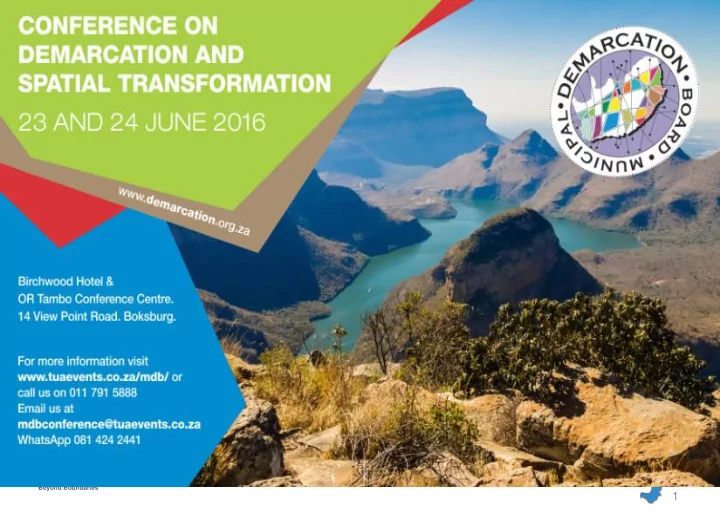
“Demarcation lessons and challenges: Reviewing the Past and Mapping the Future”

23 -24 June 2016 Birchwood Conference & Hotel Gauteng South Africa

slide-9
SLIDE 9

Beyond Boundaries

9

The primary objectives of the conference are as follows:

  • To take stock of the lessons learnt and challenges encountered by the MDB during the past demarcation

processes;

  • To gain a deeper understanding of challenges and experiences faced by communities, municipalities

and other stakeholders during the past demarcation processes;

  • To develop a framework to better manage the demarcation process;
  • To develop proposals for legislative reforms;
  • To sketch future demarcation scenarios taking lessons from other countries and international

experiences;

  • To use lessons from the conference to develop proposals for future MDB research agenda.

OBJECTIVES OF THE CONFERENCE

slide-10
SLIDE 10

Beyond Boundaries

10

The main theme of the conference is “Demarcation lessons and challenges: Reviewing the Past and Mapping the Future’”

  • Municipal demarcation: Challenges and opportunities for Spatial Transformation:

This theme will, amongst others, deal with the following issues:

  • Understanding the role of municipal boundary demarcation and its impact on developmental

responsibilities of municipalities.

  • Highlighting the extent to which entities created by the MDB in the past have been able to deal with the

inherited large areas of underdevelopment and spatial injustices.

  • Understanding local and international thinking and perspectives around the frequency of boundary
  • redeterminations. What have we learned from the past experiences and practices?
  • The relationship between demarcations and problems faced by municipalities. Should demarcations be

used to solve problems such as functionality, service delivery, poor governance, political instability, ethnicity, and other matters faced by municipalities?

  • Reviewing the current criteria for determining municipal boundaries.
  • Assessing the adequacy of the existing processes and procedures for municipal boundary change

applications, and how to improve them.

  • Discussions on the gaps in the demarcation legislation and tease out proposal for improvement.

CONFERENCE THEMES and KEY QUESTIONS

slide-11
SLIDE 11

Beyond Boundaries

11

Financial functionality and viability, and sustainability of municipalities-Beyond Demarcation Instrument: This theme will, amongst others, deal with the following issues:

  • Is the demarcation process the right instrument for achieving financial functionality/viability in a municipality?
  • Calculating the financial, service delivery and transitional costs resulting from boundary demarcations, particularly in the

amalgamation of municipalities.

  • To what extent have previous demarcations yielded desired results?
  • Understanding the relationship between demarcations and local government stability.
  • Is there a common understanding of the concept of financial viability for it to be elevated to the top in the demarcation

criteria?

  • Can re-demarcating boundaries eliminate dysfunctionality, and should dysfunctionality be a factor when determining

municipalities to be amalgamated?

  • What is the link between financial viability, economic viability and dysfunctionality?

CONFERENCE THEMES and KEY QUESTIONS

slide-12
SLIDE 12

Beyond Boundaries

12

Towards a comprehensive municipal capacity assessment: This theme will, amongst others, deal with the following issues:

  • Understanding the value of the current municipal capacity assessments.
  • Should the capacity assessments serve a different purpose? What should be entailed in this capacity assessments and the
  • utcomes expected from these exercises?
  • Aligning the MDB capacity assessments with other capacity appraisals performed by other state entities. What are the gaps

in the existing process and how can these be addressed in future capacity assessments?

  • Understanding the relationship between capacity assessment and process of redetermining municipal boundaries.
  • The frequency of municipal capacity assessments.
  • Discuss the value and purpose for MDB municipal capacity assessments.
  • Understanding the role and functions of municipalities and the issues of powers, functions and capacity (i.e. a rethink of the

role and functions of municipalities).

CONFERENCE THEMES and KEY QUESTIONS

slide-13
SLIDE 13

Beyond Boundaries

13

Public and stakeholder participation in the demarcation: One of the members of the panel: This theme will, amongst others, deal with the following issues:

  • Defining the minimum requirements and standards for those who initiate the redetermination

process, namely, the Minister, MEC, Municipalities, group, individual members of the public or MDB’s

  • wn initiative – as stipulated in the Act. What are the minimum requirements for boundary changes?
  • To what extent can the MDB be compelled to change municipal boundaries as a result of other

factors such as service delivery protests, petitions, ethnic issues, and other related matters?

  • Distinguishing between individual versus group or institutional submissions for boundary change.

Which submissions or whose views should carry more weight?

  • Reviewing the mechanisms the MDB public participation takes during the boundary redetermination
  • processes. What are new mechanisms of participation that should be considered, e.g. input,

influence, interaction, etc.?

  • The impact of local political dynamics on demarcation.
  • The role and involvement of traditional leaders in demarcation. Traditional areas and demarcation.

CONFERENCE THEMES and KEY QUESTIONS

slide-14
SLIDE 14

Beyond Boundaries

14

Metropolitan system of governance: issues and challenges: This theme will, amongst others, deal with the following issues:

  • Since the inception of the MDB in 1999, the redetermination of municipal boundaries resulted in larger

municipalities comprising a mix of urban and rural areas. Is this strategy still appropriate or does it need to be reviewed?

  • Can a small urban core financially support the surrounding municipality with a rural component?
  • How does creating a metro municipality with a rural component affect the governance, participatory

democracy and service delivery?

  • Is the criteria for metros – as espoused in section 2 of Municipal Structures Act - still relevant and

efficient after 15 years? The required norms and standards, data and defined indicators for categorisation criteria? What should be the basis for creating metropolitan areas in the future?

  • What are the local and international perspectives for the declaration of metropolitan areas?
  • Understanding the practical implications of categorising metropolitan areas particularly for the existing

structures (two tier systems – e.g. implications of including an area into a metro may have practical consequences for the district and other surrounding municipalities).

  • Idea of many metros, and also a province of metros, e.g. Gauteng City Region.

CONFERENCE THEMES and KEY QUESTIONS

slide-15
SLIDE 15

Beyond Boundaries

15

Ward delimitation: Impact on sub-metro service delivery; One of the members of the panel This theme will, amongst others, deal with the following issues:

  • Do we still need to delimit wards every five years and what are some of the implications of the regular

five-year cycle of ward delimitation on local government stability? What have we learned from the past?

  • The discussion about the use of registered voters versus population. Understanding practical

problems associated with the use of the norm for ward representation, viz. fragmentation of communities and splitting of voting districts.

  • Using wards for local planning and democratic participation: practical challenges.
  • Overcoming vast wards and increasing public participation: highlighting key challenges and concerns.
  • Clarifying the relevance of the current criteria for wards, identifying alternative criteria, and adopting

international best practices.

  • Understanding the impact of multiple stakeholder roles in the quality and efficiency of the ward

delimitation process and the subsequent local elections preparations, e.g. Minister for COGTA determining the formula for number of councillors, MEC for local government determining number of councillors, etc.

CONFERENCE THEMES AND KEY QUESTIONS

slide-16
SLIDE 16

Beyond Boundaries

16

  • The conference is targeted at all local government practitioners in both private and

public sectors, relevant political leadership in all spheres of government i.e. national, provincial and local governments and academics.

  • These includes: Ministers, Mayors, Municipal Managers, members of relevant

parliamentary committees, leadership of institutions such as IEC, SALGA, FFC, National House of Traditional Leaders, academics and researchers from institutions such as DBSA, HSRC, South African Cities Network and many others.

  • You

are all invited and you can register by visiting

  • ur

website at, www.demarcation.org.za or call 081 424 2441 or contact Ms Vanie Naidoo at 012 342 2481.

AUDIENCE AND PARTICIPANTS

slide-17
SLIDE 17

Beyond Boundaries

17