Simplify to Grow! Reduce Bad Complexity European Manufacturing - - PowerPoint PPT Presentation

simplify to grow reduce
SMART_READER_LITE
LIVE PREVIEW

Simplify to Grow! Reduce Bad Complexity European Manufacturing - - PowerPoint PPT Presentation

ia er Simplify to Grow! Reduce Bad Complexity European Manufacturing Strategies Summit 28 November 2017 Martin Berg Former Business Development Director Group Operations & Technology ROCKWOOL International A/S Click View and


slide-1
SLIDE 1

ia er Click “View” and select

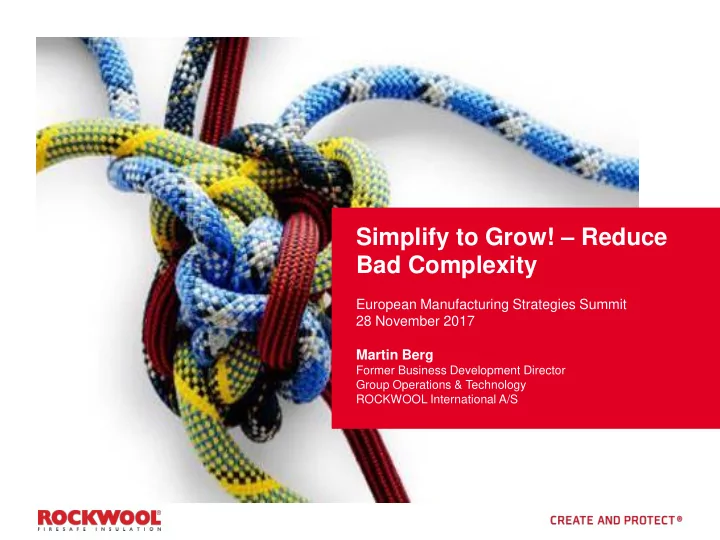
Simplify to Grow! – Reduce Bad Complexity

European Manufacturing Strategies Summit 28 November 2017 Martin Berg

Former Business Development Director Group Operations & Technology ROCKWOOL International A/S

MB

slide-2
SLIDE 2

ia er Click “View” and select

Disclaimer The presentation draws from previously experience with managing complexity in The ROCKWOOL Group The points expressed in this presentation is solely my own opinions, as I am no longer employed with The ROCKWOOL Group, but recently changed position and joined Valcon Consulting as a partner.

slide-3
SLIDE 3

ia er Click “View” and select

Agenda

What is complexity in ROCKWOOL and how does it affect our company? How do we manage complexity? What benefits do we get? Introduction to ROCKWOOL Group

1 2 3 4

3

slide-4
SLIDE 4

ia er Click “View” and select

Agenda

What is complexity in ROCKWOOL and how does it affect our company? How do we manage complexity? What benefits do we get? Introduction to ROCKWOOL Group

1 2 3 4

4

slide-5
SLIDE 5

ia er Click “View” and select

Founded in 1937 Now the ROCKWOOL Group is the world’s leading supplier of innovative products and systems based on stone wool

2.2 billion EUR turnover 28 factories 10,500 employees 38 countries 4.6 billion tonnes of CO2 savings

MB

5

slide-6
SLIDE 6

ia er Click “View” and select

MB

6

slide-7
SLIDE 7

ia er Click “View” and select

Source: McKinsey Global Institute: “The carbon productivity Challenge”, June 2008

MB

Fuel efficient commercial vehicles Lighting systems Fuel efficient vehicles Wind Solar Industrial motor systems Biodiesel

  • 150
  • 100
  • 50

50 100

Insulation improvements €/tonnes CO2 equivalents

Costs Savings

Insulation improvements are the most profitable CO2 saving according to a McKinsey/Vattenfall study

7

slide-8
SLIDE 8

8 8

MB

8

slide-9
SLIDE 9

ia er Click “View” and select

MB

9

slide-10
SLIDE 10

ia er Click “View” and select

MB

10

slide-11
SLIDE 11

ia er Click “View” and select

Agenda

What is complexity in ROCKWOOL and how does it affect our company? How do we manage complexity? What benefits do we get? Introduction to ROCKWOOL Group

1 2 3 4

11

slide-12
SLIDE 12

ia er Click “View” and select

MaBe

Around the clock 24/7/365, our 28 factories produce ~4,6 tons of ROCKWOOL insulation every minute…

12

slide-13
SLIDE 13

ia er Click “View” and select Complexity Management at ROCKWOOL - EMS Summit, Berlin, November 28, 2017

13

slide-14
SLIDE 14

14 14

200,000 full truck loads annually makes ROCKWOOL

  • ne of the top 10 manufacturers in Europe when it

comes to transporting cubic meter volume

slide-15
SLIDE 15

ia er Click “View” and select

Beginning of 2015, we had more than SKUs in ROCKWOOL and more were added every day

100.000

15

slide-16
SLIDE 16

ia er Click “View” and select

Now, we have around than SKUs in ROCKWOOL

47.000

16

and more are removed every day

slide-17
SLIDE 17

ia er Click “View” and select

The average unprofitable C product in Market A, B and C sells

  • nly 6 tons per year, which is about...

1 Full truck of light building insulation: ½ Truck of heavy roof insulation: 30 minutes of Production:

Does it make sense to produce these products?

AM

17

Complexity Management at ROCKWOOL - January 11, 2016, Technical University of Denmark

slide-18
SLIDE 18

ia er Click “View” and select

Normal ”Peanut butter approach” ”Complexity adjusted cost approach” Unit costs – high volume vs. low volume products

We realized that profitable products covered over unprofitable products

MB

Complexity Management at ROCKWOOL

18

slide-19
SLIDE 19

ia er Click “View” and select

x 1/2 x 3

Run length waste % High runner Slow mover

ABN

Slow moving products have shorter run lengths and higher perecentages of changeover waste

Complexity Management at ROCKWOOL

19

slide-20
SLIDE 20

ia er Click “View” and select

Using advanced analytics we found that run length and sequence are significant factors in affecting productivity

Roof Insulation

20

Roof Insulation R

  • f

In su lat io n More product variety  Shorter production runs  More variable

  • utput rates
slide-21
SLIDE 21

ia er Click “View” and select

Agenda

What is complexity in ROCKWOOL and how does it affect our company? How do we manage complexity? What benefits do we get? Introduction to ROCKWOOL Group

1 2 3 4

21

slide-22
SLIDE 22

ia er Click “View” and select

The Complexity Management process is used to guide our operating companies through the stages of the assortment review

Analysis Review Target Setting Assort. Design Signoff Execute and Followup

Review market requirements and competitor

  • fferings.

Perform ABC analysis on Net Sales / Group CM per product. Perform XYZ anlaysis on sales frequency per

  • product. (details

in Appendix) Review information for all SKUs. Check for:

  • New materials
  • Growth

materials

  • Closing

Set strategic direction for the assortment. Set target for CM %. Set target for reducing SKUs. Propose new assortment (i.e. which products to remove and priceup). Link delivery conditions to material classifications. Create action list (detailed version in Appendix) Obtain approval from the management team on the assortment, delivery conditions and the action list. Perform agreed actions. Quantify 2nd

  • rder effects.

Track progress with Complexity Management KPIs.

Note: Performed once per year per product segment (PH1)

22

slide-23
SLIDE 23

ia er Click “View” and select

The process uses a cross-functional approach involving Sales, Product Management, Production, Supply Chain, Master Data Team and Senior Management

Source: Simon-Kucher based on BEAT PCPM wave 1

Analysis Review Target setting Assortment Design Sign Off Execution KPI Followup

Managing Director Marketing/ Prod. Managem. Sales Supply Chain Pro-duction Master Data Group Supply Chain

Week 1/2 Week 3-4 Week 5-8

Perform competitor analysis and identify market trends Perform detailed ABC and XYZ class- ification for SKUs Prepare knowledge
  • f current
portfolio logic and price positioning Contribute to competitor analysis and identify market trends Con- solidate information for assortment review Define assort- ment strategy Perform initial ABC analysis and suggest initial targets Set targets for portfolio size, profitability and production efficiency(e.g. CR%, CM, # SKUs) Prepare suggestions for standard dimensions, packaging, etc. Review SKUs for removal, price up, con- solidation (e.g. packaging, thicknesse s, etc.) and set delivery conditions Define new assortment , determine the price increases and create action list Quantify impact of new assortment (effect of price up) Prepare proposal for new assortment Publish and distribute new product assortment Update price lists Communicate price changes, new assortment and delivery conditions Capture 2nd-
  • rder effects
Update planning rules and delivery conditions Remove SKUs from warehouse Capture 2nd-order effects Create new SKUs, close old SKUs Assist with 2nd
  • rder effects
calculation (as needed) Track complexity reduction with EINSTEIN KPIs (Quarterly Report on EINSTEIN KPIs to MT (Quarterly) Approve additional materials to product assortment ) Approve new assort- ment No Yes Note: The diagram shows those responsible for tasks. Those consulted and informed on various tasks are not shown (e.g. Pricing Champion and Finance from the OPCO will support the pricing tasks as needed).

23

slide-24
SLIDE 24

ia er Click “View” and select

Group CM

ABC classification Order frequency analysis

Categorization of profitability and sales by material per country Stable (X): Fast movers Erratic (Y): Medium movers Lumpy (Z): Slow movers (often MTO) Categorization of order patterns by material per country A Products High sales B Products Medium sales C Products Low sales and low profitability

Two product classification schemes are used for complexity management and assortment review in the RW Group: ABC and XYZ

Net Sales Order Pattern

24

slide-25
SLIDE 25

ia er Click “View” and select

The Group-wide ABC Classification method is used to segment products for the assortment review

Threshold set to cover hidden complexity costs (e.g. Inventory and changeover cost) Considers customer perspective (Outside In) Considers

  • perational

perspective (Inside Out)

25

slide-26
SLIDE 26

ia er Click “View” and select

Example of ABC classification of SKUs for a market in the ROCKWOOL Group

26

slide-27
SLIDE 27

ia er Click “View” and select

Different strategies are applied based on the ABC classification to improve the profitability of the assortment

CM % Target

slide-28
SLIDE 28

ia er Click “View” and select

Each SKU is reviewed by a cross-functional team for inclusion in the assortment and an action plan is created

SKU ABC Order pattern Net Sales Group CM CR % Action plan ROCKWOOL10… A Stable 408.226 194.314 48% No price change ROCKWOOL20… B Lumpy 50.107 2.692 5% Price up 10% FLOORROCK30... C Lumpy 25.906 1.169 5% Keep, strategical SKU, increase price by 20% FLOORROCK40 … C Lumpy 623 53 9% Discontinue, Remove from published price list and phase out

Conceptual

2 8

28

slide-29
SLIDE 29

ia er Click “View” and select

Example of general building insulation product strategies in a market

Materials = 80 (16%) Net Sales = €12 mio (36%) Group CM = €3 mio (26%) Materials = 163 (32%) Net Sales = €2 mio (6%) Group CM = (€25k) (0%) Materials = 271 (53%) Net Sales = €20 mio (58%) Group CM = €8,4 mio (74%)

29

slide-30
SLIDE 30

ia er Click “View” and select

During the review, the ABC and XYZ classification are combined to show where the complexity lies

Stable (X) Erratic (Y) Lumpy (Z) A B C

ABC Classification Order pattern

ILLUSTRATIVE 30

slide-31
SLIDE 31

ia er Click “View” and select

Example from Market A showing a high number

  • f C products with lumpy demand

“Discontinue / consolidate": Can be removed New material: Will be kept with no price change Customer special: To be evaluated for elimination if below 2 K€. In any case, price mark-up will be applied; may be driven by special packaging Combination products: e.g. strips for cut-fall products Strategic products: e.g. for high end products to continue to offer all thicknesses Review of materials # SKU Stable / fast (X) Erratic / medium (Y) Lumpy / slow (Z) A 112 52 8 B 22 15 5 C 17 66 121

ABC classification* Order patterns*

31

slide-32
SLIDE 32

ia er Click “View” and select

The assortment is designed so that higher price markups are applied to products with low sales/profitability and to products with lumpy demand

Anchor SKU for PH4

Price mark-up Stable / fast (X) Erratic / medium (Y) Lumpy / slow (Z) A Anchor price +5% +10% B +5% +10% +15% C +10% +15% +25%

ABC classification Order patterns

Set-up of price logic per country and segment considering ▪ Margin targets ▪ Country specifics e.g. local standard thicknesses, imports Application steps ▪ Definition of anchor SKU per PH4, e.g. highest ABC classification and most stable

  • rder pattern

▪ Price up of other SKUs in PH4 relative to anchor price

ILLUSTRATIVE 32

slide-33
SLIDE 33

ia er Click “View” and select

Strategic aspects are also considered when reviewing products

Which products can substitute one another? Which products have linked revenue or are door

  • peners?

Where are the products in their life cycle? Are there any other strategic aspects we should consider?

Sale in kg

34

slide-34
SLIDE 34

ia er Click “View” and select

An example of flat roof board thicknesses in Market B show that 7 thicknesses account for 65% of Net Sales

We can simplify the portfolio by substituting thicknesses and gain higher efficiency in operations

  • 500

1.000 1.500 2.000 2.500 3.000 3.500 4.000 4.500 100 120 140 160 180 200 220 240 260 Net sales (x1.000 Eur) Product thickness (mm)

7 thicknesses accounts for 65% of net sales 35

Complexity Management at ROCKWOOL

slide-35
SLIDE 35

ia er Click “View” and select

  • 1.000

2.000 3.000 4.000 5.000 6.000 100 150 200 250

By substituting thicknesses, higher sales will be realized and longer run lengths in production can be used

  • 1.000

2.000 3.000 4.000 5.000 6.000 100 150 200 250

Thickness Thickness Net sales (x1.000 Eur) Net sales (x1.000 Eur)

Example: Sales from products with thickness 105, 110 and 115 mm will be converted into sales of 100&120 mm (50% to each)

36

Complexity Management at ROCKWOOL -

slide-36
SLIDE 36

ia er Click “View” and select

Agenda

What is complexity in ROCKWOOL and how does it affect our company? How do we manage complexity? What benefits do we get? Introduction to ROCKWOOL Group

1 2 3 4

slide-37
SLIDE 37

ia er Click “View” and select

641 472 1.126 1.122 406 508

  • 3%

Today (Sep. 2017) 2.173 Baseline (Oct. 2016) 2.102 Unsold SKUs Sold SKUs > €2k CM/yr Sold SKUs < €2k CM/yr

RW-G RW-F

702 568 949 1.055 583 346 Baseline (Oct. 2016) 2.234 Today (Sep. 2017) 1.969

  • 12%

RW-E

866 796 727 753 1.384 837

  • 20%

Today (Sep. 2017) 2.386 Baseline (Oct. 2016) 2.977

RW-A

1.297 2.362 504 682 1.481 Baseline (Oct. 2016) Today (Sep. 2017) 2.098 4.525

  • 54%

297 400 453 469 662 339 299 1.107

  • 27%

Today (Sep. 2017) 1.515 Baseline (Oct. 2016)

RW-B RW-H

1.079 1.043 2.301 2.335 507 592

  • 2%

Today (Sep. 2017) 3.885 Baseline (Oct. 2016) 3.972 1.601 1.647 1.731 4.280 2.392 1.485 Baseline (Oct. 2016) 5.608 7.528

  • 26%

Today (Sep. 2017)

RW-C

1.652 1.847 2.036 820 458 413 3.080 Baseline (Oct. 2016)

  • 26%

Today (Sep. 2017) 4.146

RW-D All above operating companies reduced unprofitable SKUs

A Complexity Management Report to track the level and trend

  • f complexity on a monthly basis across the Group
slide-38
SLIDE 38

ia er Click “View” and select

Last 12 months, ROCKWOOL has reduced SKUs by 19% and Unprofitable SKUs by 5%

13.008 11.469 10.939 8.987 15.270 15.707 16.133 27.684 31.223 20.525 17.929 29.381 Today (Sep. 2017)

  • 19%

Target (Dec. 2017) 43.049 47.171 57.962 Baseline (Oct. 2016) 70.073 Baseline December 2015

17.929 20.525 31.223

  • 34%
  • Dec. 2017
  • Oct. 2016
  • Sep. 2017

26.739

  • Oct. 2016

25.120

0%

  • Dec. 2017
  • Sep. 2017

26.646 8.987 10.939 11.469

  • Oct. 2016
  • 5%
  • Sep. 2017
  • Dec. 2017

Unsold SKUs Sold SKUs > €2k CM/yr Sold SKUs < €2k CM/yr Sold SKUs < €2k CM/yr Sold SKUs Unsold SKUs

slide-39
SLIDE 39

ia er Click “View” and select

Production runs below 60 minutes has decreased by 10%- points since starting complexity management, but there is still work to be done

AKo MB

Complexity Management at ROCKWOOL

4

40

slide-40
SLIDE 40

ia er Click “View” and select

Case: Complexity Reduction in Market X

42

Complexity Management at ROCKWOOL - EMS Summit, Berlin, November 28, 2017

slide-41
SLIDE 41

ia er Click “View” and select

Significant Complexity Reduction in Market X

501 240 591 Under Perfoming 2015 Remaining SKU’s 2016 Without Sales Total SKU’s 2015 1,332

  • Total reduction of

62% of Active SKU’s

  • 240 underperforming

SKU’s removed with Sales in 2015

  • Remaining focused

portfolio meeting customers needs

  • Latest figures Q3-17

shows only 438 SKUs

  • CM/SKU increased

by 77%

43

Complexity Management at ROCKWOOL - EMS Summit, Berlin, November 28, 2017

slide-42
SLIDE 42

ia er Click “View” and select

Complexity Reduction is Creating Value in production….

  • Average Run hours are

up 40% from Q1….

1,7 1,4 1,5 1,3 1,3 1,3 1,3 1,2 1,2 0,0 0,5 1,0 1,5 2,0 Jan Sep +40% Line 1 Apr Jul Jun May Aug Feb Mar 13 16 16 16 18 17 18 19 19 5 10 15 20 Line 1 Jul Sep

  • 33%

Aug Jan Jun May Apr Mar Feb

  • Changeovers per day

are down 33% from Q1….

Complexity Management at ROCKWOOL - EMS Summit, Berlin, November 28, 2017

44

slide-43
SLIDE 43

ia er Click “View” and select

Customer Service is improving... From To

Order Confirmation with 24hrs at ~60% in 2015…. …..to greater than 99% in 2016…. Order Accuracy at ~95% in 2015…. …..to greater than 99% in 2016….

Complexity Management at ROCKWOOL - EMS Summit, Berlin, November 28, 2017

45

slide-44
SLIDE 44

ia er Click “View” and select

Increasing our ability to execute with excellence

  • Concerns are down

48% YTD

  • Customer Service

errors and Warehouse errors are dramatically down

Complexity Management at ROCKWOOL - EMS Summit, Berlin, November 28, 2017

46

slide-45
SLIDE 45

ia er Click “View” and select

Key Learnings & Next Steps

HOW TO MAKE IT STICK – MUST WIN BATTLES

Must be supported from Managing Director - need to believe in this

Must have conviction - and commitment - hold firm on changes for the first 3 mths

After 3 months…. Listen - and make reasonable adjustments as needed, but:

Avoid slowly growing the portfolio back

OUR EXPERIENCE IN MARKET X

Entire Management Team stood behind the plan

Sales Managers had cold feet

We made some mistakes, but corrected them immediately

Set goals/targets and measure progress

Committed to a formal portfolio review every quarter - add some in - take some out

One-in - One-out

Complexity Management at ROCKWOOL - EMS Summit, Berlin, November 28, 2017

47
slide-46
SLIDE 46

ia er Click “View” and select

Key take aways from today’s presentation

 Get commitment in your management

team

 Successful complexity management

depends on the process to manage it.

 Create transparency – make a complete

  • verview of the assortment as basis for

decision making.

 Document progress using KPIs –

“CM/SKU” is the King !!!

 Cost savings and additional capacity

becomes available by removing expensive C-products with low margins, but require extra efforts to harvest the full benefit.

MB

48

4 8

slide-47
SLIDE 47

SIMPLIFY TO GROW - REDUCE BAD COMPLEXITY

THANK YOU FOR YOUR ATTENTION – DO YOU WANT TO CONTINUE THE DIALOGUE?

28 November 2017

Martin Berg

Former Director, Group Operations & Technology ROCKWOOL International A/S Now a Partner at Valcon Consulting Mobile (+45) 22 56 94 58 mbg@valconconsulting.com

Alexandria Trattner

Supply Chain Specialist (Industrial PhD @ DTU) ROCKWOOL International A/S Mobile: (+45) 61 89 30 02 Email: alexandria.trattner@rockwool.com