Upstate Comprehensive Plan Analysis Prepared by the Clemson - - PowerPoint PPT Presentation

upstate comprehensive plan analysis
SMART_READER_LITE
LIVE PREVIEW

Upstate Comprehensive Plan Analysis Prepared by the Clemson - - PowerPoint PPT Presentation

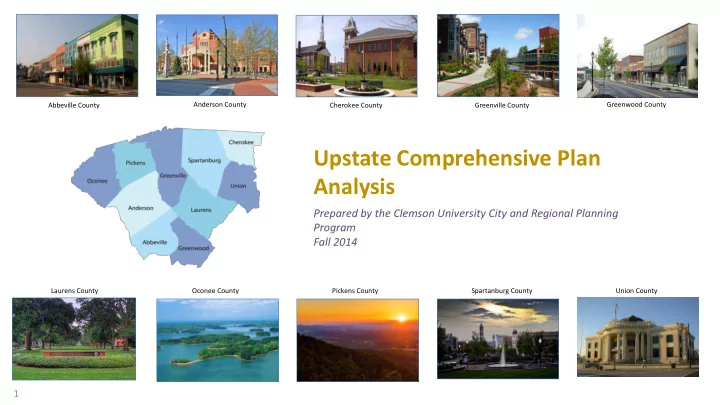
Anderson County Greenwood County Abbeville County Cherokee County Greenville County Upstate Comprehensive Plan Analysis Prepared by the Clemson University City and Regional Planning Program Fall 2014 Laurens County Oconee County Pickens


slide-1
SLIDE 1

Upstate Comprehensive Plan Analysis

Prepared by the Clemson University City and Regional Planning Program Fall 2014

Greenville County Pickens County Oconee County Abbeville County Greenwood County Union County Spartanburg County Cherokee County Anderson County Laurens County

1

slide-2
SLIDE 2

Table of Contents

Itodutio……………………………………………………. What it Meas to e the Upstate……………..…. Cout “apshots…………………………………………… Copehesie Pla Aalsis ad Mati……… Upstate Futue Lad Use………………………………. Lad Coe Assesset………………………………… Regioal “WOT Aalsis……………………………….. Colusios………………………………………………….. Pojet Liitatios……………………………………….. Futue Reseah…………………………………………… Appedi………………………………………………………

2

slide-3
SLIDE 3

Introduction

The Cit ad Regioal Plaig Maste’s poga at Cleso Uiesit is the ol pofessioal graduate program accredited by the Planning Accreditation Board in South Carolina. It has produced more than 530 graduates since achieving full accreditation in 1973. With a stated focus on integrating both theory and practice into its curriculum, the program prepares students to engage the critical planning issues that face communities in the 21st century. During their tenure at Clemson, students apply theoretical knowledge to local issues through projects that integrate both Geographic Information Systems (GIS) technology and fieldwork. Students further engage the Upstate planning context through public assistantships at local agencies and participation in events sponsored by the South Carolina chapter of the American Planning Association. The project team consists of 6 second-ea Maste’s adidates ith a range of professional backgrounds including Anthropology, Psychology, Public Policy, and Computer Science. The uet pojet is a aalsis of eah of the te out’s opehesie plas to highlight regional trends. Although it does not include content of additional planning documents within each county, it can be used in conjunction with those documents as a tool to promote regional

  • esatio aout oo issues. This stud’s olusios ae liited the fat that its

findings are based on comprehensive plans that were written at different points in time, opening up the possibility that some of the plans no longer reflect the reality of their communities. In addition, the study is limited by the fact that one county does not have a comprehensive plan and several counties were unable to provide future land use data. Nevertheless, we hope this will be a useful product for Ten at the Top and Upstate planners to foster discussion of issues that affect the region as a whole. It is the first effort of its kind to compile data from the Upstate counties and analyze them from a regional perspective.

3

slide-4
SLIDE 4

What it Means to be the Upstate

Oigiall ko as the Upout, the te outies that ake up the peset da Upstate have always played an important role in South Carolina history. From the Revolutionary War battlefields of Cherokee to the antebellum homes of Abbeville, the Upstate is proud to retain a strong sense of this history. The South Carolina National Heritage Corridor stretches from the coast up to the western corner of the Upstate, drawing tourists to its historic, natural, and cultural resources. Many of the counties have capitalized on these resources as economic development opportunities by promoting cultural tourism. The Upstate has abundant natural resources, such as Lake Keowee and Lake Hartwell, which are assets both for their scenic beauty and their recreational draw. Residents enjoy these lakes for camping, fishing, and boating. The Cherokee Foothills Scenic Highway and the recent proliferation of multi-use trails in several counties provide opportunities to enjoy “outh Caolia’s atual eaut. The Upstate has a long-standing reputation for its industriousness and entrepreneurial

  • italit. I the late ’s, the egio ega its ise to eoig the tetile apital of the
  • ld, led Geeille at its ete. Mill illages popped up aoud the egio ad

developed into close-knit and thriving communities. For nearly a century these villages served as a framework for life in the Upstate, organizing their own sports leagues, churches, and neighborhoods.

Lake Hartwell, Anderson County Union Cotton Mills, Union County

4

slide-5
SLIDE 5

As economic realities and technology have changed around the country, the Upstate has shown resilience in its ability to adapt. With the influx of international companies such as Robert Bosch in Anderson and BMW in Spartanburg, the Upstate has successfully re- invented itself with a focus on high-tech manufacturing and research. In addition to reviving the economy of the Upstate, these companies have enriched its culture by bringing thousands of international employees to live and work in the region. They have added their own traditions to those that South Carolinians have always celebrated, resulting in a more diverse set of cultural offerings in the Upstate. Given the strength of its economy and its location along the growth corridor of Interstate 85, the Upstate is poised for continued development in the coming decades. Recently completed projects like the inland port will ensure that the Upstate remains competitive moving forward. Since the formation of Ten at the Top in 2010, the unique counties and municipalities of the Upstate have begun a renewed effort to share information and ideas to address multi- jurisdictional issues such as the transportation network, air quality, and economic development of the ten upstate counties. This ability to work together comes from an understanding that many of these issues affect the Upstate as a whole. Similarly, a positive change in one of the Upstate’s outies is a positive change for the other nine upstate counties. An Upstate Mao aptued this e spiit pefetl he he espoded to esidets’ iuiies aout attatig thei it’s o aseall tea saig, We alead hae oe, ad its ae is the Geeille Die.

What it Means to be the Upstate

Fluor Field, Greenville County BMW plant, Spartanburg County

5

slide-6
SLIDE 6

Greenwood should celebrate the opening of a new factory in Laurens. Cleaner air in Pickens means cleaner air in Oconee. This new wave of regional cooperation is a recognition of the interconnectedness of the ten counties. It does not mean that every issue ill hae a lea oe-size-fits-all appoah, ut it does ea that the etie Upstate benefits when each upstate county shares its point of view and seeks mutual gains with the

  • thers.

Ten at the Top has convened many meetings over the past several years to foster discussion among various stakeholders of the ten-county region. These conversations are centered on fie die aeas, hih hae ee idetified as ipotat fous aeas fo the Upstate. This project is an important step in continuing these conversations, as it is the first time a goup of people has gatheed all the Upstate’s opehesie plas ad eleat data i

  • ne place to analyze them.

At its heart, the project has been designed to highlight trends and issues facing the Upstate, based on comprehensive plans and GIS data. It begins with an inventory of each of the

  • ut’s opehesie plas, hih is a ojetie a to displa the tpes of pojets

and policies that the community would like pursued. The inventory is a quick way to assess the efforts being made across all ten counties, and what is unique to each county.

What it Means to be the Upstate

Presbyterian College, Laurens County Clemson University, Pickens County

6

slide-7
SLIDE 7

The oied Futue Lad Use ap is a oela ap of eah out’s idiidual futue land use map, for the counties that had a future land use map. There were 4 counties that did not have future land use maps so the current land use of those counties were used for

  • evaluation. It also includes the maps of the largest municipality in each county. This

podut is a isualizatio of the Upstate’s plaed goth pattes ad ill allo eah county to see the compatibility of its future plans with neighboring counties and

  • uiipalities. The goud truthing aps ae a a to oie out-level data to

paint a regional picture of multi-jurisdictional issues. These maps offer a finer level of detail than the comprehensive plans or future land use maps. The SWOT analysis is an analysis of the strengths, weaknesses, opportunities, and threats facing the Upstate, based on the information gathered from the previous steps. It synthesizes these data into regional trends. Fiall, this epot iludes out sapshots fo eah of the Upstate’s outies. These ae desiged as eadale suaies of eah out’s ke assets ad defiig featues. They will also point out any specific issues or opportunities that each county may want to consider as they relate to adjacent counties. This report is a valuable step in furthering regional cooperation in Upstate, South Carolina. The authors hope that it will provide a framework for discussion and that it will lead to further research and collaboration. They would like to thank Ten at the Top staff members, Upstate planners and stakeholders, and Clemson faculty who provided input and guidance throughout this process.

What it Means to be the Upstate

Gaffney Prime Outlets, Cherokee County Burt-Stark Mansion, Abbeville County

7

slide-8
SLIDE 8

County Snapshots

An analysis of the full scope of issues surrounding planning in the Upstate is provided in this report, but there are often occasions in which planners have limited windows of opportunity to communicate planning issues with policymakers and the public. For this purpose, county snapshots have been developed as one-page summary documents for each county. These documents show where each county is located within the Upstate and highlight its main points

  • f interest, including its most populous municipalities.

In addition, the snapshots list some of the most important themes for each county as evidenced by the comprehensive plans. The snapshots can be shared with the general public to promote discussion and generate policy ideas.

8

slide-9
SLIDE 9

County Snapshot: Abbeville County

Key Themes from the Comprehensive Plan

  • Desire to retain small-town feel and

character

  • Takes pride in historic homes and

architecture

  • Highway 72 near Greenwood is key growth

area

  • Effectively marketing for industry and

tourism

  • Land is mostly preserved open space

County Characteristics

County Population: 25,417 County Seat: City of Abbeville Municipal Populations > 1,000:

  • Abbeville – 5,237 (County Seat)
  • Calhoun Falls – 2,004
  • Due West – 1,247
  • Honea Path – 3,597
  • Ware Shoals – 2,170

Points of Interest:

  • Abbeville Opera House
  • Erskine College
  • The Civic Center

9

slide-10
SLIDE 10

County Snapshot: Anderson County

Key Themes from the Comprehensive Plan*

  • Significant growth along Highway 153 near

Greenville

  • Maintenance of water quality through

stormwater management

  • Diversification of housing to accommodate

young professionals and older adults

  • Preservation of agricultural land to support

local food production

  • Interest in multi-jurisdictional cooperation

to address air quality issues

County Characteristics

County Population: 187,126 County Seat: City of Anderson Most Populous Cities & Towns:

  • Anderson – 26,686 (County Seat)
  • Belton – 4,134
  • Honea Path – 3,597
  • Williamston – 3,934
  • Pendleton – 2,964

Points of Interest:

  • Anderson University
  • Adeso Fae’s Maket
  • Tri-County Technical College, Pendleton

and Anderson Campuses

  • Ashtabula Plantation

10

*The Anderson County comprehensive plan analysis was produced using the draft document written in 2010. The document has not been approved by the Anderson County Council to date.

slide-11
SLIDE 11

County Snapshot: Cherokee County

Key Themes from the Comprehensive Plan

  • Desire to attract industry for job growth
  • Historic/scenic corridors and sites
  • Ideal location for new businesses based on

existing transportation network

  • Cultural activities
  • Focus on rural land uses

County Characteristics

County Population: 55,342 County Seat: City of Gaffney Most Populous Cities & Towns:

  • Gaffney – 12,414 (County Seat)
  • Blacksburg – 1,848
  • Chesnee – 868
  • Smyrna – 45

Points of Interest:

  • Gaffney Regional Shopping Outlet
  • Cowpens National Battlefield
  • Kings Mountain National Military Park
  • Veterans Museum

11

slide-12
SLIDE 12

County Snapshot: Greenville County

Key Themes from the Comprehensive Plan

  • Most populous county in South Carolina
  • Regional hub for medical facilities
  • Consistently low unemployment compared

to the rest of the State

  • Concerned about air quality and congestion

levels

  • Regional employment hub, attracting

50,000+ in-commuters

  • Most farms in the Upstate, 4th most in the

State

County Characteristics

County Population: 474,266 County Seat: City of Greenville Most Populous Cities & Towns:

  • Greenville – 60,709 (County Seat)
  • Greer – 25,515
  • Mauldin– 23,808
  • Simpsonville – 19,056
  • Fountain Inn – 7,898

Points of Interest:

  • Downtown Greenville
  • Paris Mountain State Park
  • Swamp Rabbit Trail
  • Furman University
  • North Greenville University

12

slide-13
SLIDE 13

County Snapshot: Greenwood County

Key Themes from the Comprehensive Plan

  • Focused on energy conservation
  • Significant interest in airport improvements

and expansion of alternative transportation

  • pportunities
  • Fous o Upto edeelopet ad

revitalization

  • A robust health care and R&D cluster
  • Concerned with protecting forest land and

areas with historic significance

County Characteristics

County Population: 69,661 County Seat: City of Greenwood Most Populous Cities & Towns:

  • Greenwood – 23,222 (County Seat)
  • Ware Shoals – 2,170
  • Ninety Six – 1,998
  • Hodges – 155
  • Troy – 93

Points of Interest:

  • Lander University
  • The Greenwood Civic Center
  • Heritage Trail
  • Lake Greenwood
  • Piedmont Technical College

13

slide-14
SLIDE 14

County Snapshot: Laurens County

Key Themes from the Comprehensive Plan

  • Interested in developing a public

transportation system

  • Focus on expanding water capacity to

support new growth

  • Focus on better marketing of historic sites
  • Working to decrease soil erosion
  • Focus on expanding economic partnerships

in the region

County Characteristics

County Population: 66,537 County Seat: City of Laurens Most Populous Cities & Towns:

  • Laurens – 9,139 (County Seat)
  • Clinton – 8,091
  • Fountain Inn– 6,017
  • Ware Shoals – 2,170
  • Gray Court – 1,021

Points of Interest:

  • Sumter National Forest
  • Presbyterian College
  • Lake Greenwood
  • Musgoe’s Mill
  • Haod’s “toe
  • Hayes Station

14

slide-15
SLIDE 15

County Snapshot: Oconee County

Key Themes from the Comprehensive Plan

  • Interested in regional collaboration through

shared initiatives and shared services on projects such as watershed and solid waste management

  • Interested in growing public transportation

system

  • Abundance of recreational and cultural
  • pportunities to support eco-tourism

industry

  • Concerted effort to use utilities as a guide

for development siting

County Characteristics

County Population: 74,273 County Seat: City of Walhalla Most Populous Cities & Towns:

  • Seneca – 8,102
  • Walhalla – 3,801 (County Seat)
  • Westminster – 2,418
  • West Union – 291
  • Salem – 135

Points of Interest:

  • Oconee State Park
  • Lakes Jocassee, Hartwell, and

Keowee

  • Issaqueena Falls
  • Duke Poe’s Wold of Eeg
  • The Chattooga River

15

slide-16
SLIDE 16

County Snapshot: Pickens County

Key Themes from the Comprehensive Plan*

  • Focusing sewer expansion along US 123

and US 93

  • Goal to build off of existing public

transportation system to service aging and disabled populations, as well as students

  • Desire to coordinate multi-county effort for

cultural events and facilities

  • Highest percentage of residential land use

in the Upstate

  • Interested in regional collaboration to

improve I-85 corridor

County Characteristics

County Population: 119,224 County Seat: City of Pickens Most Populous Cities & Towns:

  • Easley – 20,098
  • Clemson – 13,905
  • Central – 5,159
  • Liberty – 3,269
  • Pickens – 3,126 (County Seat)

Points of Interest:

  • Clemson University
  • Southern Wesleyan
  • Cherokee Foothills Scenic Byway
  • Table Rock State Park
  • Tri-County Technical College (Easley

Campus)

16

*The Pickens County comprehensive plan analysis was produced using the draft document written in 2010. The document has not been approved by the Pickens County Council to date.

slide-17
SLIDE 17

County Snapshot: Spartanburg County

Key Themes from the Comprehensive Plan

  • Goal to reduce congestion by increasing

public transportation and bike-ped options

  • Looking to increase growth management in

unincorporated areas

  • Beautification of gateway entrances from

primary highway access points into downtowns and CBDs

  • Preservation of scenic areas and creation of

more greenways and trails

County Characteristics

County Population: 284,307 County Seat: City of Spartanburg Most Populous Cities & Towns:

  • Spartanburg – 37,013 (County Seat)
  • Greer – 25,515
  • Woodruff – 4,090
  • Lyman – 3,243
  • Duncan – 3,181

Points of Interest:

  • Greenville-Spartanburg Airport
  • BMW Manufacturing Facility
  • Cherokee Foothills Scenic Highway
  • Wofford College
  • USC Upstate
  • Converse College

17

slide-18
SLIDE 18

County Snapshot: Union County

Key Themes from the Comprehensive Plan

  • Union County does not have a current

Comprehensive Plan

County Characteristics

County Population: 28,961 County Seat: Union Most Populous Cities & Towns:

  • Union – 8,393 (County Seat)
  • Jonesville – 911
  • Lockhart – 488
  • Carlisle – 436

Points of Interest:

  • Sumter National Park
  • Rose Hill Plantation State Park
  • Rose Hill Mansion
  • Broad River

18

slide-19
SLIDE 19

Comprehensive Plan Analysis and Matrix

To guide the team assessment of multiple planning documents, as well as to present results in a format that will be simple to navigate for final document users, a matrix for key planning elements will be used to evaluate the extent to which each comprehensive plan supports specific strategies. The plans will be evaluated for the type of coverage they provide for each sub-element. The evaluation criteria are detailed in a legend on the following page. In order to generate the matrix by which all plans were evaluated, the research team began with eight

  • f the nine elements mandated by the South Carolina legislature, and created sub elements within

each according to a review of a diverse selection of comprehensive planning guides. The Priority Investment element was not evaluated given that several of the counties did not include the element in their comprehensive plans, while the counties that did include the element addressed it in different

  • ways. Commonly included information, as well as frequently utilized planning strategies among this

literature, became the basis for which the breadth of content of each element within each county plan would come to be evaluated. However, this was an iterative process as each team member, beginning with a baseline of sub-elements for each planning element, would update the sub-elements as new relevant categories emerged throughout the course of the review. For each individual planning element, a single team member was assigned to complete the analysis. The rationale for this process was to maintain the greatest degree of consistency across the different county plans. Another level of consistency built into the model was the criteria for which each planning sub-element was judged for its level of coverage. To minimize the subjectivity of individual interpretations, criteria were generated for which the team member could judge either their presence

  • r absence within the sub-element, as opposed judging based on a scale or various degrees of
  • completion. These criteria were thoroughly vetted in a group training process to ensure that the team

had a uniform understanding of how the criteria were to be applied. The intended benefit of this system is to make it easier to recognize which elements are in agreement among the majority of plans, and therefore presenting opportunities for collaboration on critical issues between the jurisdictions. Furthermore, if many counties display a lack of support for a key planning element, this may indicate the need for investigation of the issue at regional meetings and conferences.

Planning Elements

Population Economic Natural Resources Cultural Resources

Community Facilities Housing Land Use Transportation

19

slide-20
SLIDE 20

Comprehensive Plan Analysis and Matrix

A

Plans mentions or describes the issue

B

Plan demonstrates data analysis regarding issue

C

Plan describes previous or ongoing efforts to accommodate or adapt to the issue

D

Plan suggests general goals for adaptation

E

Plan sets specific methods for improvement or adaptation

F

Plan establishes monitoring and metric for evaluation of specific programs

Matrix Legend

20

slide-21
SLIDE 21

Comprehensive Plan Analysis and Matrix

POPULATION

Abbeville County Anderson County* Cherokee County Greenville County Greenwood County Laurens County Oconee County Pickens County** Spartanburg County Minority Populations AB AB AB AB AB AB AB AB AB Educational Attainment AB AB ABC AB AB ABE Growth Management AB AB AB AB AB AB AB AB ABE Attraction/expansion/retention AB Aging ABDE ABCDE AB AB AB ABDE ABC ABC ABCD Densification AB AB AB AB AB AB AB Poverty AB A ABC AB AB ABE Concentrated Poverty AB ABE Segregation/Enclaves

21

**The Pickens County Comprehensive Plan Analysis was produced using the draft document written in 2010. The document has not been approved by the Pickens County Council to date. *The Anderson County comprehensive plan analysis was produced using the draft document written in 2012. The document has not been approved by the Anderson County Council to date.

slide-22
SLIDE 22

Comprehensive Plan Analysis and Matrix

POPULATION

Factors Described in Each of the Comprehensive Plans  Minority Populations  Aging Population  Growth Management

100000 200000 300000 400000 500000 600000 1990 2000 2010 2020 2030

Population Projections for the Upstate

Abbeville Anderson Cherokee Greenville Greenwood Laurens Oconee Pickens Spartanburg Union

22

slide-23
SLIDE 23

Comprehensive Plan Analysis and Matrix

ECONOMIC

Abbeville County Anderson County* Cherokee County Greenville County Greenwood County Laurens County Oconee County Pickens County** Spartanburg County Aging Workforce AB Agricultural Development AB AD AD ABCDE AE AD AD Below Poverty Line AB AB AB AB AB Brownfield ABCD Business Retention/Expansion A D AC A AD Chamber of Commerce AD AB A Citizen Participation AD Clusters AB ABD AD Commercial/Retail Development AB ABD ABCD A AD A Cost of Living ABD AB AB AB AD Culture AD ABCDE A Diversification A ABD AD ABCD A AD AD Downtown Revitalization A ABCDE A AC Economic Development Corporations/Organizations ACDE ACD ACD ABC A Education ABD ADE ABCD ABD ABDE AC Entrepreneurial Development AD ABCD AD Equitable Growth A AD AD ACD A AD AB Executive Housing Export base ABCD A A ABC AD Exporting Labor AB AB A Funds and Grants ADE Greyfield/Vacancy ABCDE Hispanic Population AB GIS A ADE Growth Impacts AD AE AD ABCDE AD ADE ABDE Housing/Workforce AD AB ADE Housing/Jobs Balance A Infill AD ABCDE AD AD Importing Labor AB AB Incentives ABDE ABCDE AD Incubators ABC Industrial Recruitment AD ABCD AD ABCD AD AD ABD Industrial Site Inventory AE ABDE AE AD Industrial/Business Park ABE AB ABCD AD Inter-Jurisdictional Partnerships ADE AD ABCDE ACD ABCDE A Labor Force Participation ABD Land Use/ Controls/Zoning AD ADE AD ABDE AD ADE AD Low Income/Wages ABD ABD AB A ABD AB ABD

23

slide-24
SLIDE 24

Comprehensive Plan Analysis and Matrix

ECONOMIC

Abbeville County Anderson County* Cherokee County Greenville County Greenwood County Laurens County Oconee County Pickens County** Spartanburg County Marketing AD AD ACD ADE Mixed Use AD Organizational and Leadership Development AD ACDE AD AD Outdoor Recreation AB ABCDE AB AD Permiting and Approval AD AD Planning AD ADE Public/Private Infrastructure ABE ABCD AD Quality of Life/Amenities AD AD AD AD A A Residential Development/Attraction A AD AB A Retail Leakage A Road Network AB Small Business ABCD STEM Education AD AD Tax Revenue AD AD ABD ABC TIF Districts Tourism A ABCDEF A ABD ADE Transit /Housing/Jobs AB Transport infrastructure ADE ABD AD AB AD ABCDE AD Unemployment AB AB AB AB AB AB A Unions AB AB AD Workforce Development AD ABD ABCD AD A Young Graduates AD ABD AD Utilities General Development AD AD ACD ACD AD Water AD AB AD ABCDEF Sewer AD AB AD ACDE AC Solid Waste ABDE Stormwater AD Gas AB Electricity AB Telecommunications AB Air AB AB ACDE A Rail AB AD Agriculture AB AB ABDE AB AB ABD Administration and Government AB AB AB AB AB AB AB Certified Trades A AB Construction ABD AB A AB AB ABD AB Education Services AB A AB AB AB Entertainment, Art AB AB AB AB Environmental Services AB AB

24

slide-25
SLIDE 25

Comprehensive Plan Analysis and Matrix

ECONOMIC

Abbeville County Anderson County* Cherokee County Greenville County Greenwood County Laurens County Oconee County Pickens County** Spartanburg County Finance and Insurance ABD AB AB ABD ABD AB Headquarters ABE A AD Knowedge/High tech, Information Technology AB ABD AB ABD AB A AD Manufacturing AB ABCD AB AB AB A AB ABD Medical/Health AB AB AB ABCD AB A Natural Resources/Mining AB AB AB AB Real Estate AB AB AB ABD AB Professional Services, Science, Management AB AB AB AB AB AB ADE Services/Retail/Hospitality ABD AB AB AB ABD ABD AB Textiles AB AB AB ABD A AB Transportation/distribution ABD ABD AB AB AB ABD AB Utilities AB AB AB AB Wholesale ABD AB AB AB AB ABD AB

25

**The Pickens County Comprehensive Plan Analysis was produced using the draft document written in 2010. The document has not been approved by the Pickens County Council to date. *The Anderson County comprehensive plan analysis was produced using the draft document written in 2012. The document has not been approved by the Anderson County Council to date.

slide-26
SLIDE 26

Comprehensive Plan Analysis and Matrix

33% 33% 33% 22% 22% 22% 22% 0% 20% 40% 60% 80% 100% Growth Impacts Inter-jurisdictional Boundaries Land Use/ Controls/Zoning Education Incentives Tourism Transport Infrastructure

Percentage of Upstate Plans With Goals AND Methods for Adoption by Factor

ECONOMIC

Dominant Regional Strategies  Agricultural Development  Diversification  Industrial Recruitment  Transport Infrastructure  Unemployment  Administration and Government  Manufacturing  Transportation and Distribution  Wholesale

26

slide-27
SLIDE 27

Comprehensive Plan Analysis and Matrix

NATURAL RESOURCES

Abbeville County Anderson County* Cherokee County Greenville County Greenwood County Laurens County Oconee County Pickens County** Spartanburg County Food Systems Agricultural Preservation ABCD ABD AD ABDE AB Surface Water AB ABCDE AB ABC ABCDE AD ABCDEF ABCD ABCDE Impervious Surface AD AD ABE Air Quality ABCDE ABCF ABDE AD A Regional Parks Expansion and Preservation A ABC AB Soil Quality ABD ABCDE A A ABDE ABDE ABDE AB ABDE Floodplains AD ABCD A A AD AD ABDE Wetlands ABD ABCD A A ABCDE Stormwater and Nonpoint Source Pollution ABCD ADE ADE AC A Point Source Pollution A Groundwater ABCD ABD AD AB ABDE Water Supply A A A Forests ABD ABCD AB ABDE ABD ABD ABCDE Habitats ABDE A ABCD ABDE Corridors Biodiversity A AB AB A ABD AB Invasive Species A Endangered Species ABD A AB AB AB ABC ABD ABDE Scenic Resources and Eco-Tourism AD ABDE AB A AB ABD ABD Mineral Extraction AB AB AB Land Conservation A ABCDE ABCD ABD

27

**The Pickens County Comprehensive Plan Analysis was produced using the draft document written in 2010. The document has not been approved by the Pickens County Council to date. *The Anderson County comprehensive plan analysis was produced using the draft document written in 2012. The document has not been approved by the Anderson County Council to date.

slide-28
SLIDE 28

Comprehensive Plan Analysis and Matrix

55% 44% 22% 22% 22% 22% 0% 20% 40% 60% 80% 100% Soil Quality Watershed Health/Surface Air Quality Stormwater/ Nonpoint Forests Habitats

Percentage of Upstate Plans With Goals AND Methods for Adoption by Factor

NATURAL RESOURCES

Factors Described in Each of the Comprehensive Plans  Watershed Health; Surface Water  Soil Quality

28

slide-29
SLIDE 29

Comprehensive Plan Analysis and Matrix

CULTURAL RESOURCES

Abbeville County Anderson County* Cherokee County Greenville County Greenwood County Laurens County Oconee County Pickens County** Spartanburg County Performing Arts AB ABD AB A AB AB AB ABDE Fine Arts A A AB AE A ABE AB A Arts Center AB AB AB ABCE AE AB AB Museum ABC AB ABCDE AE AE AB AE Library AB ABCD AB ABC AB AE AB Historic Preservation ABD AE AE ABCD AD ADE ABE ABCDE Archaeological Resources ABE A Federal and State Funding AE A ABC A A A Regional Partnerships D ABE AE A Community Organizations AB A AE A AD ABC Community Centers A A Historic Sites ABE ABCE AB AB ABD ABD ABDE ABCDE AB Historic Districts ABE ABE ABDE AB AB Community Festivals AB A ABE ABE A ABE AB Scenic Byways and Trails AD A ABDE AB Public Art AE Arts Incubators Sports Leagues A Historic Preservation Overlay Districts A A

29

**The Pickens County Comprehensive Plan Analysis was produced using the draft document written in 2010. The document has not been approved by the Pickens County Council to date. *The Anderson County comprehensive plan analysis was produced using the draft document written in 2012. The document has not been approved by the Anderson County Council to date.

slide-30
SLIDE 30

Comprehensive Plan Analysis and Matrix

22% 22% 11% 11% 11% 11% 0% 20% 40% 60% 80% 100% Historic Preservation Historic Sites Performing Arts Museum Historic Districts Scenic Byways/Trials

Percentage of Upstate Plans With Goals AND Methods for Adoption by Factor

CULTURAL RESOURCES

Factors Described in Each of the Comprehensive Plans  Historic Sites

30

slide-31
SLIDE 31

Comprehensive Plan Analysis and Matrix

COMMUNITY FACILITIES

Abbeville County Anderson County* Cherokee County Greenville County Greenwood County Laurens County Oconee County Pickens County** Spartanburg County Stormwater Structure ABDE AE ABD AE A AB EMS ABF ABDEF A AB ABD ABE ABE ABD Water Quality ABCDEF AE AE A ABDEF ABDF Water Conservation AE AE ABDE ABE Water Utilities ABC ABC ABCE ABD ABEF ABCD ABDE ABDE ABCD Police Service ABF AB A ABF AB ABE ABE ABCDF Fire Service ABEF ABDF AE AB ABEF ABDF AB ABCDEF Recreation ABCF ABDE ABDE ABF ABCDF ACE ABE ABDE ABCDEF Schools K-12 ABD ABCD ABEF ABDEF ABCDE ABC ABEF ABC ABDEF Higher ED AB ABCD AB ABD ABC AB ABC Health Systems AB AB AB ABE ABC ABE ABCD Solid Waste Facilities ABC ABD A AB ABCD AE ABDE AB ABD Recycling AB ABE A ABF AB AE AE ABC Sanitary Sewer ABD AB ABE ABDEF ABDE ABCD ABDE ABCD ABDE Libraries AB ABCDEF AB AB ABC ABCE AB ABD Public Parks ABDF ABDEF ABD ABF ABCDF AC AE ABCDE AB Regional Partnerships AD ADE ACE Prisons AB ABCE ABDE AE A ABDE Dispatch Centers A ABC A Emergency Services AB AB Multi-Use Trails AC AB AD AB ABE ABF Federal and State Funding A ADE ABE Courthouses A A AD A AB A ABD Administrative Buildings A AE ADE AB ABD Electrical Utility ABE A Nursing Homes and Assisted Living Facilities ABE Natural Gas AE ABE

31

**The Pickens County Comprehensive Plan Analysis was produced using the draft document written in 2010. The document has not been approved by the Pickens County Council to date. *The Anderson County comprehensive plan analysis was produced using the draft document written in 2012. The document has not been approved by the Anderson County Council to date.

slide-32
SLIDE 32

Comprehensive Plan Analysis and Matrix

44% 44% 33% 22% 22% 22% 22% 0% 20% 40% 60% 80% 100% Recreation Sanitary Sewer Schools K-12 Water Quality Water Utility Public Parks Prisons

Percentage of Upstate Plans With Goals AND Methods for Adoption by Factor

COMMUNITY FACILITIES

Factors Described in Each of the Comprehensive Plans  Water Utility  Recreation  Schools (K-12)  Solid Waste Facilities  Sanitary Sewer  Libraries  Parks

32

slide-33
SLIDE 33

Comprehensive Plan Analysis and Matrix

HOUSING

Abbeville County Anderson County Cherokee County Greenville County Greenwood County Laurens County Oconee County Pickens County* Spartanburg County Affordable Housing A ABD AD AD ABCDF A ABD ABCD ABD Aging Stock AB AB AB AB AB Architecture Review AE ACE Brownfields ABC Code Enforcement AC ACD AD AD ACDE ACDE Cost-Burdened Renters AB AB AB AB AB Cost-Burden Owners AB AB AB AB Densification ADE AD AB Diversification ADE AD AD ABD AD AD AB Elderly Housing A AD AD ABD A A ABC AC Energy-Efficiency ABC Foreclosures A AB AD Historic Preservation AD ABCDE AE Housing Agency and Committee ADE ADE A ABCD Housing For Special Needs AD A ABD AD AC Housing Funds and Grants AD ACDE AD AD AC ABCD Housing and Jobs AD A AD Incentives AD AD ACD AD AD Inclusionary Zoning ADE Infill AD AD AD AD AD A A Inspection AE Infrastructure AD A ABCDE AD ADE A ADE Inter-jurisdictional Cooperation AD AE ADE AD ABCD Land Development Regulations AD AD AD Lakes A AD A Land Conservation AD A AD AD ABDE A Land Cost A A Lending A A A AC AC Low Values AB AB AB AB

33

slide-34
SLIDE 34

Comprehensive Plan Analysis and Matrix

HOUSING

Abbeville County Anderson County* Cherokee County Greenville County Greenwood County Laurens County Oconee County Pickens County** Spartanburg County Manufactured Housing Standards ADE ABC ADE AB ACDE Middle-Income Housing ADE A A AB Mill Villages ABD Mixed-Income Neighborhoods AD A Mixed-Use ACD AD AE Neighborhood Associations ACD Neighborhood Plans AD ADE AD Non-Profits AD AD ABC Overcrowding AB AB Ownership A AB AB AB ABD AB AB AB AB Parks, Open Space Expansion and Development AD AD ADE Pedestrian Shed AD Public Housing Assistance AB A A ABCD Public Housing AB A ABCDE Regulatory Barriers to Affordable Housing ADE AD ADE Rental Market AB AB Regional Partnerships AD AE Rehabilitation AD AD ACD AD AD ABCD Road Network A Sprawl AD AD AD AD AD Substandard AB ABC ACD AB AB ABD ABD ABD A Transit AD AD Utility Service A A ADE Vacancies ABD AB AB AB AB ABD Vehicle Ownership AB Zoning Controls and Compatible Uses ADE AD ADE AD AD Zoning Controls and Affordable Housing AD AD AD

34

**The Pickens County Comprehensive Plan Analysis was produced using the draft document written in 2010. The document has not been approved by the Pickens County Council to date. *The Anderson County comprehensive plan analysis was produced using the draft document written in 2012. The document has not been approved by the Anderson County Council to date.

slide-35
SLIDE 35

Comprehensive Plan Analysis and Matrix

33% 33% 22% 22% 22% 22% 0% 20% 40% 60% 80% 100% Infrastructure Manufactured Housing Standards Code Enforcement Housing Agency/Committee Regulatory Barriers to Affordable Housing Zoning Controls/Compatible Uses

Percentage of Upstate Plans With Goals AND Methods for Adoption by Factor

HOUSING

Factors Described in Each of the Comprehensive Plans  Affordable Housing  Home Ownership  Substandard Dwellings

35

slide-36
SLIDE 36

Comprehensive Plan Analysis and Matrix

LAND USE

Abbeville County Anderson County* Cherokee County Greenville County Greenwood County Laurens County Oconee County Pickens County** Spartanburg County Residential Expansion AC ABC AC ABCE ABCDE AC ABCDE ABC ABCDE Commercial Expansion AC ABCDE ABCDEF ABCDEF AC ABCDEF ABCDE ABCDE Commercial Strip Development AC AC A Industrial Expansion AC ABCD A ABCDE ABCDE AC ABCDEF ABCDE ABCDE Utility Service Expansion A A ABCDE A A AE Public Service Expansion A AE Mixed-Use Development ACE ABCD ABCD ABCDE ACE ABCDE ADE ABCDEF Infill and Redevelopment AC AC A ACE Smart Growth ABCD A ACD ABCDEF ABCDEF Agricultural Preservation AC ABCDEF ABCDE ABCDF AC ABCDE ABCDE ABCDE Open Space Preservation AC AB A A ABCDE AC ABC ABE Hazard Areas Classification ABCDE A Environmental Sensitivity AE A A ABC AE AB ABCD ABC Existing Land Use Issues ABCE A ABCDE ABCDE A ABCDE ABCDE ABCDE Future Land Use ACE AB ADE ABCDEF ABCDE ACE ABCDEF ABCDEF ABCDE Existing Zoning District ABC Highway Corridors AE ABCE Land Development Suitability AE AB Urbanized Areas A AE A ADE AC Rural Townships ABE AE AC

36

**The Pickens County Comprehensive Plan Analysis was produced using the draft document written in 2010. The document has not been approved by the Pickens County Council to date. *The Anderson County comprehensive plan analysis was produced using the draft document written in 2012. The document has not been approved by the Anderson County Council to date.

slide-37
SLIDE 37

Comprehensive Plan Analysis and Matrix

67% 67% 56% 56% 56% 44% 33% 22% 0% 20% 40% 60% 80% 100% Commercial Expansion Future Land Use Industrial Expansion Agricultural Preservation Existing Land Use Issues Mixed Use Development Residential Expansion Smart Growth

Percentage of Upstate Plans With Goals AND Methods for Adoption by Factor

LAND USE

Factors Described in Each of the Comprehensive Plans  Residential Expansion  Industrial Expansion  Future Land Use

37

slide-38
SLIDE 38

Comprehensive Plan Analysis and Matrix

TRANSPORTATION

Abbeville County Anderson County* Cherokee County Greenville County Greenwood County Laurens County Oconee County Pickens County** Spartanburg County Public Transit AB AB ABDE ABCDE ABCDE AD ABDE Freight and Passenger Rail AB AB AB ABCDE ABD ABCD AD AB Bikeways and Bikes AB ABE A ABCDE ABCDE AD ADE Sidewalks, Pedestrians, Walkability AB ABE A ABCDE ABCDE ABD ADE Trails and Greenways ABE ABD ABCDE ACDE ABCD ADE Regional & Local Connectivity, Street Patterns, Commuting Patterns AB A AB AB ABCD ABD ABD AD AB Scenic Corridors, Street Plantings, Aesthetics A ABE ABCD ABDE ABCDE ABD ABCDE Industry & Employment Connections AB ADE ABCD ABCD ABD ADE A ABD Bridges and Culverts ABCE ABE Transit-Oriented Development AB Right-of-Way Acquisition and Preservation A ABCDE AD Road and Infrastructure Improvements ABC ABCDE ABCDE A ABCDEF ABCDE ABCDE ABDE ABCDE Demand Management, LOS, Road Classifications, Safety ABCDEF ABCDE ABC ABCDE ABCDE ABDE ABCDEF ABD ABCDE Greenhouse Gas Reduction, Air Quality A ADE ABCDE ADE ABCD A Parking AB A ADE AB Complete Streets A Traffic Signals, Intersections, Signal Timing A A ABC Air Transport ABDE ABCDE ABCD ABCDE ABC General Financing ABCE ADE AB ABCDE ABCDE ABCD ABCD ABDE

38

**The Pickens County Comprehensive Plan Analysis was produced using the draft document written in 2010. The document has not been approved by the Pickens County Council to date. *The Anderson County comprehensive plan analysis was produced using the draft document written in 2012. The document has not been approved by the Anderson County Council to date.

slide-39
SLIDE 39

Comprehensive Plan Analysis and Matrix

78% 78% 45% 45% 33% 33% 33% 33% 0% 20% 40% 60% 80% 100% Demand Management Infrastructure Improvements Public Transit General Financing Scenic Corridors Air Quality Bikeways Sidewalks and Walkability

Percentage of Upstate Plans With Goals AND Methods for Adoption by Factor

TRANSPORTATION

Factors Described in Each of the Comprehensive Plans  Regional and Local Connectivity; Street Patterns; Commuting Patterns  Demand Management; Level of Service; Road Classifications; Safety  Road and Infrastructure Improvements

39

slide-40
SLIDE 40

Upstate Future Land Use

The project team retrieved ArcGIS Future Land Use files from the counties that were able to provide them. Each county has a different approach to its future land use

  • map. In order to make the combined map more useful,

the tea ollapsed eah of the out’s uiue lad use categories into the following:

  • Low-Density Residential
  • Medium-Density Residential
  • High-Density Residential
  • Commercial
  • Industrial
  • Public
  • Open Space, Recreation, and Agriculture
  • U.S. Forest
  • Municipal

Cherokee, Union, Laurens, and Abbeville County did not have future land use maps. The land uses represented in the model are representative of the current land uses for each of those respective counties. This map allows planners to compare land use patterns across jurisdictional borders and sheds light on current development strategies. It is a tool to identify key challenges and opportunities, such as incompatible development patterns or potential inter-jurisdictional partnerships for community facilities.

40

slide-41
SLIDE 41

Land Cover Assessment

Comprehensive Plans and Future Land Use Maps are intended for use as a guide to direct short-term and long-term local development. Using the United “tates Geologial “ue’s U“G“ Natioal Lad Cover Data Base, planners can understand where development has occurred over time. USGS uses increments of five and ten year studies of land

  • development. For the purposes of this analysis, the

time periods from 1992-2001 and from 2001-2011 were selected to provide the most up-to-date analysis of land coverage in the Upstate. New development was defined as any land classification that changed to developed open space, low density, medium density, or high density. Because there are a wide variety of classes in the National Land Cover Database, any other changes to lad oe ee ategoized as othe hages. Between 1992 and 2011, the majority of new development occurred along major transportation corridors and around existing urban areas. Within this time period, the majority of growth in the Upstate occurred between 1992-2001. Full statistics for land cover change can be found in the Appendix.

41

slide-42
SLIDE 42

Land Cover Assessment

42

slide-43
SLIDE 43

43

slide-44
SLIDE 44

44

slide-45
SLIDE 45

45

slide-46
SLIDE 46

46

slide-47
SLIDE 47

47

slide-48
SLIDE 48

48

slide-49
SLIDE 49

49

slide-50
SLIDE 50

50

slide-51
SLIDE 51

51

slide-52
SLIDE 52

52

slide-53
SLIDE 53

Regional SWOT Analysis

Using information gathered from the county comprehensive plans and the first four parts of this project as a guide, the team conducted a series of regional analyses to highlight the strengths, weaknesses, opportunities, and threats (SWOT) to the Upstate region by element. Specifically, the SWOT Analysis focuses on cross-jurisdictional topics such as the transportation network, watershed quality, and economic development strategies. Although some of these topics are more relevant to some counties than others, the current analysis attempts to analyze how some of these trends will positively or negative affect the Upstate. Copehesie plas eist as a efletio of a ouit’s olletie isio. The “WOT aalsis focuses on the issues that are most consistently identified in the comprehensive plans of the

  • Upstate. It can be used in conjunction with other planning documents and data to inform

proactive public policy and to foster regional partnerships.

53

slide-54
SLIDE 54

Population

Strengths

  • Projected population growth for the region
  • Increasing ethnic diversity enriches range of

cultural offerings in the Upstate

Weaknesses

  • Uneven levels of educational attainment
  • Decline of population in municipalities to

suburban and rural areas

  • Unemployment rates consistently above state

and national averages

Opportunities

  • Increased immigration into the region
  • Workforce development programs to meet

needs of incoming industry

Threats

  • Need for expanded facilities and services to

accommodate the aging population

  • Challenge of retaining young, educated

graduates

  • Lack of coordinated strategies to combat

concentrated poverty

54

slide-55
SLIDE 55

Economic

Strengths

  • Strong regional development organizations such as Upstate

Alliance

  • Widespread development of local Economic Development
  • rganizations
  • Widespread support for industrial recruitment strategies
  • Common recognition of the potential impacts of

development

  • Public Private partnerships for R&D
  • Infrastructure support industrial development
  • Strong support for workforce development through

educational strategies

  • Quality higher education institutions

Weaknesses

  • Little mention of business expansion and retention strategies
  • Low wages and income compared to state averages.
  • Programs for entrepreneurs/small business fairly absent in

planning elements

  • Low retention rate for young graduates
  • Lack of housing near places of employment
  • Lack of specificity of economic development strategies

Opportunities

  • Planning for agricultural development
  • Marketing for outdoor recreation and tourism
  • Increased land use controls to assure the availability of

industrial/commercial land

  • Inter-jurisdictional partnerships for industrial parks
  • Attraction of industry based on improved quality of

life/amenities

  • Concentration of industry on existing infrastructure/infill

development

Threats

  • Uncertain funding for future transportation improvements
  • Increased mechanization of industry
  • Shrinking manufacturing employment
  • Diminished air quality potential impediment to growth

55

slide-56
SLIDE 56

Natural Resources

Strengths

  • Widespread support for strategies supporting soil

quality

  • Abundance of water for utilities and recreational

purposes

  • Awareness of watershed health and methods for

adaptation

  • Strong presence of regional/local conservation
  • rganizations
  • Awareness and documentation of endangered

species

Weaknesses

  • No comprehensive inventory of point source

water pollution outfalls

  • Need for greater groundwater awareness and

preservation

  • General lack of discussion of stormwater

management regulations

Opportunities

  • Desire for regional air quality improvement

strategies

  • Prospect for regional approaches to watershed

health

  • Joint marketing of opportunities for eco-

tourism

Threats

  • Development pressures on environmentally

sensitive and scenic areas

  • Loss of forest and habitat
  • Increased runoff and associated water quality

concerns

  • Loss of prime farmland to development

56

slide-57
SLIDE 57

Cultural Resources

Strengths

  • Abundance of historic sites dating back to

Revolutionary and Civil Wars

  • Public support for protection of historic sites
  • Performing and fine arts centers clustered in

municipalities

  • Many unique local festivals and traditions

Weaknesses

  • Lack of public art
  • Some counties lack inventory of cultural and/or

historic resources

  • General under-marketing of cultural resources
  • Lack of cultural opportunities for diverse age

groups

Opportunities

  • National Heritage Corridor as vehicle to market

counties' cultural and historic resources

  • Openness to use of historic preservation
  • verlay districts
  • Libraries could offer training for the aging

population

Threats

  • Many historic sites are on the National Register

but lack funding for maintenance

57

slide-58
SLIDE 58

Community Facilities

Strengths

  • Consensus to develop a regional multi-use trail

system

  • Strong presence of higher education

institutions

  • Extensive health care system
  • Several state and national parks

Weaknesses

  • Aging sewer and water infrastructure
  • Number and complexity of special service

districts

  • Uneven geographic distribution of community

parks

Opportunities

  • Workforce development programs through

local colleges

  • Better coordination of sewer expansion for

future growth

  • Desire to create locally-tailored evaluation

metrics for community facilities

  • Regional partnerships to support expanded

recycling

Threats

  • Narrow rural roads in some counties make it

difficult for emergency vehicles to pass

  • Little mention of planning for assisted living

facilities despite aging population

58

slide-59
SLIDE 59

Housing

Strengths

  • Natural resources promote strong residential

growth

  • Strong support for equitable housing growth
  • Robust home ownership
  • Overall support for infill development
  • Planners oriented toward land conservation
  • Awareness and planning for diverse housing

needs

Weaknesses

  • Scarcity of affordable housing
  • Lack of housing for the elderly
  • Cost burdens (Tenants paying more than 30% of

their income in rent)

  • Concentrations of manufactured housing
  • Uneven support for mixed use development
  • Historical preservation of housing infrequently

emphasized

  • Lack of emphasis on credit and lending

Opportunities

  • Growing housing market for retirees
  • Breadth of support for inter-jurisdictional

partnerships

  • Exploring incentives for affordable housing

development

Threats

  • Under-regulated residential growth
  • Lack of energy efficiency contributing to

housing cost

  • Uncertainty of future housing funds/grants
  • Low growth in family households
  • Regulatory barriers to affordable housing

development

59

slide-60
SLIDE 60

Land Use

Strengths

  • Increasing consciousness of sustainable,

compact development patterns

  • Abundant supply of open space
  • Regulations support industrial/commercial

development

Weaknesses

  • Sprawling land use patterns dominate much of

the Upstate

  • Development patterns outpacing community

facilities and services

  • General lack of zoning

Opportunities

  • Large tracts of undeveloped land provide

flexibility

  • Better integration of transportation and land

use planning

  • Focus on redeveloping and revitalizing

downtowns

Threats

  • Development pressure on prime farmland
  • Insufficient protection for established

residential areas from incompatible development

  • Incompatible land uses across county borders

60

slide-61
SLIDE 61

Transportation

Strengths

  • Interstate 85 connects the Upstate to Atlanta

and Charlotte

  • Extensive freight rail network
  • Greenville-Spartanburg Airport and smaller,

regional airports facilitate connections to local and national markets

  • Wide variety of scenic highways

Weaknesses

  • Limited public transit coverage
  • Abundance of automobile-oriented

development

  • Lack of pedestrian and bicycle facilities
  • Poor road quality
  • Absence of transit oriented development (TOD)

Opportunities

  • Open space and waterways could act as

corridors for a regional greenway and multi- use trail network

  • Commuting patterns create demand for cross-

county transit

Threats

  • Lack of sufficient funding for infrastructure

improvements despite increased usage of roadways

  • Increased congestion leads to poor air quality

and the possibility of falling out of attainment

  • Sprawling land use patterns are not pedestrian

friendly

61

slide-62
SLIDE 62

Conclusions

One of the fundamental goals of this project was to identify trends in the comprehensive plans of the Upstate counties. The first step

  • f this analysis was to distill the content of the plans into the standardized framework of the planning element matrices. The matrices

are a quick and easy way to identify the topics that counties are focusing on and the ways in which they discuss them. The team used the details of the matrices to communicate the overarching themes affecting each policy area in the Upstate. There is a substantial amount of overlap between some of the elements, demonstrating the holistic nature of the planning profession. Poor air quality is an environmental concern, but it is equally concerning from a public health and economic development point of view. Promoting infill development over sprawl is efficient in terms of community facilities, but it may also benefit public transit and reduce development pressure on sensitive environmental areas. Regional Environmental Resources Environmental quality has emerged both from the comprehensive plans and from conversations with local planners as an issue that is both cross-jurisdictional and related to many of the planning

  • elements. The Upstate is fortunate to have tremendous assets in its

hydrological systems, prime farmland, and scenic beauty, which contribute significantly to the ecological and economic health of the

  • region. The comprehensive plans indicate both the value and

vulnerability of these resources, suggesting a need to mitigate the impacts of development in the region through land use controls and coordinated public policy.

Lake Keowee 62

slide-63
SLIDE 63

Conclusions

All nine of the plans discussed watershed health, with six of the plans describing previous efforts to address the issue and general plans to improve water quality. Four of the plans recommend specific water policy strategies, including land development regulations to reduce stormwater runoff. Watershed health was most thoroughly covered by the counties in the northwest corner of the region, as this is the location of Lakes Jocassee, Keowee, Hartwell, and Greenwood. The quality of these water sources will depend heavily on cross-jurisdictional efforts to reduce the impact of development. Even the counties that are not directly adjacent to a lake must be included in these efforts, as the tributaries extend across political boundaries. A number of counties rely on the lakes for drinking water, and the regional economic impact of their recreational draw is significant. . The comprehensive plans indicated the need for a comprehensive inventory of point source pollution outfalls in the area. Five plans address non-point sources of pollution through stormwater management in their natural resources element. One plan discusses previous efforts to address the issue and two plans set specific goals for future remediation. New impervious surfaces such as roads and parking lots contribute to non-point source pollution by preventing water from naturally filtering through soil and vegetation before reaching ground and surface water supplies. Although an increase in impervious surface is inevitable with new development, there are strategies to reduce runoff. Three plans raised the issue of increasing impervious surfaces and established goals to address it in the future. For example, Geeood Cout set the epliit stateg of ieasig the ipeious sufae atio euieets fo itial atesheds of the out as ell as eouagig development with pervious surface (Greenwood County, 2011). Any long-term strategy to improve watershed health will need to include all stakeholders within the

  • watershed. Planners could help facilitate this process.

Furman University Rain Garden (Greenville County) 63

slide-64
SLIDE 64

Conclusions

Another regional concern that emerged from both the natural resources and economic elements was the wealth of prime agricultural land, the continuing economic importance of the agricultural sector, and the need to protect prime farmland and soil from the impacts of unregulated development. All nine plans engaged soil quality, with five of them recommending specific goals. In Anderson Cout, hee % soils ae lassified as pie falad o falad of stateide ipotae, stategies hae eoled to ephasize the importance of this resource in land development, such as the maintenance of agricultural districts as well as the future requirement that infrastructure projects minimize their impact on prime agricultural land (Anderson County, 2013). Seven plans discussed agriculture in terms of economic development and six offered goals to support the sector. This topic was covered most extensively by Greenwood County, which pointed out that its farms have increased in productivity even as the aggregate number of farms has decreased. The increasing consolidation of agricultural markets could create economic challenges for small and mid-size

  • producers. Some counties have begun regional efforts to preserve smaller-scale farmland. For example, Greenwood County

describes its five-out pateship ith the Heitage Coido Faes Assoiatio, ad the ogaizatio’s effots to itodue an agriculture component to the National Heritage Corridor. With the regional presence of several major agricultural institutions, the Upstate could create regional partnerships to support agricultural development and the preservation of important soil. Air quality is a significant issue facing the Upstate, not only for physical health of residents, but the also the economic well-being of the region. If portions of the Upstate fall into non-attainment for EPA air quality standards, as they have done in the past, it will be more difficult for the Upstate to attract industry. Despite the regional importance of the issue, our research found only five counties engaging the topic in comprehensive planning. This may be a reflection of the fact that critical areas for ground level ozone are surrounding the I-85 corridor that intersects five counties in the study area. However, with the regional importance of this corridor and the role it plays in transporting goods and the workforce throughout the region, a broad-based effort to manage travel demand may be one way to reduce emissions. Eight of the plans include goals to reduce congestion through travel demand, with five of these including goals to increase the provision of public transit. The significant level of commuting between counties might be an

  • pportunity to reduce demand through expanded transit service.

64

slide-65
SLIDE 65

Conclusions

Ma of the plas disuss the potetial to apitalize o the egio’s atual resources for recreation and tourism. Seven plans mention ecotourism in their atual esoues setio, hih ould fo a pat of the egio’s oeall touis and marketing strategy. A common theme in the cultural resources sections was that the counties are rich in historical sites, but they often lack a comprehensive inventory or marketing strategy to promote them. Five plans discuss tourism in relation to economic development, with three of them including goals to enhance current efforts. Oconee County includes ecotourism as one approach for diversifying its economic base, observing that the tourism industry is the second largest employer statewide. Directly related to this plan is an explicitly defined set of strategies for the protection of natural resources and scenic areas, with special emphasis on the Highway 11 corridor. This highway begins in southern Oconee County and runs northeast through Pickens, Greenville, Spartanburg, and Cherokee County. Scenic Highway 11 is frequently mentioned in the comprehensive plans as an important natural resource, and is another opportunity for inter-jurisdictional cooperation in terms of its maintenance and marketing efforts outside the region. The Cherokee County plan warned of unfettered housing development near the highway, and the potential degradation of its scenic qualities. Taking these factors into account, the Upstate seems to be aware of how these resources contribute to the overall wealth

  • f the region and determined to protect them.

Laurel Fork Falls (Pickens County) 65

slide-66
SLIDE 66

Conclusions

Economic and Human Potential The most frequently cited economic development tools in the Upstate are the diversification of the economic base and strategies for targeted industrial recruitment, with seven plans discussing these approaches. The regional focus on these strategies is attributed to the decline of textile manufacturing over the past few decades. The Upstate has retained its interest in manufacturing, but has narrowed its focus to include sectors with advanced technology, high growth potential, and high wages. It has benefited from its location and strong transportation links to the larger regional markets of Atlanta and Charlotte. However, in order to successfully recruit advanced manufacturing firms, professional services, and knowledge-based industries, the Upstate must also prepare its workforce with adequate skills and education to fill the jobs. Six plans mentioned the link between education and economic deelopet, ad the all eithe desied futue goals o peious effots to iease thei out’s eduatioal attaiet. This is encouraging because parts of the Upstate have traditionally lagged in both educational attainment and educational funding per pupil. The increasing presence of higher education institutions and new research and development facilities connected to industry clusters, suh as those etioed i Adeso ad Geeood’s plas, suggest ieased oppotuities fo okfoe deelopet i the Upstate. Another component of the regional economic strategy is future land use planning. Seven plans identified land use controls as a critical tool to promote the development of industry. Proactive planning prevents prime industrial land from conversion to other uses and allows for the coordinated development of infrastructure. In addition, this type of planning reduces future conflicts between incompatible land uses. These discussions tended to under represent goals and strategies for small business and entrepreneurial

  • development. Because a vast number of jobs are created by small businesses, it was surprising not to see a more robust coverage of

the area. However, it may be that small business development is relegated to smaller area plans and community development, while county-wide plans focus on a broader view.

66

slide-67
SLIDE 67

Limitations

The fundamental focus of the research was the analysis of land use and development strategies in the Upstate region by comparing comprehensive plans, one of the fundamental documents that guide these processes from a public policy perspective. Certainly, there is significant insight to be derived from an examination of the essential components of these plans, identifying the primary differences and commonalities in order to illuminate the potential for collaboration, as well as possible areas of disagreement as multiple jurisdictions navigate through collective challenges and manage common resources. The team would like to extend our sincerest gratitude to all of the planners and professionals who contributed their time, resources, and expertise to this project. The majority of the data for this project was derived solely from these documents, while a robust and voluminous trove of regional data and designs, there were limitations in relying solely on comprehensive plans to generalize about regional trends. For example, if a particular strategy or concept is missing from the majority of plans, this may either indicate that it is irrelevant to the upstate planning context, or that it was overlooked or intentionally omitted. Two very different conclusions derive from either scenario, presenting a challenge to the team in interpretation. There was a significant issue presented by the age of several plans reviewed by the team. With the amount of time elapsed since the drafting of several comprehensive plans, the team was at times concerned in regard to the potential obsolescence of certain data. Comprehensive plans, while in general are future oriented documents, are drafted at a point in time and may heavily reflect the most salient concerns of that particular moment. Therefore, this analysis reflects a synthesis of numerous points in time, which complicates the comparability of these documents. In certain cases the team was tempted to reach beyond the comprehensive plan, to update the data presented with more contemporary information applicable to the material discussed in the document. However, to carry out this process consistently throughout the analysis of all nine plans would have expanded the scope of the project significantly, in addition to fundamentally altering the nature of the inquiry.

67

slide-68
SLIDE 68

Limitations

Incomplete data was also a barrier to a fully realized product. The absence of one county plan as well as missing elements and land use maps from several counties reduced the breadth of analysis in the final document. The priority investment element was excluded from analysis in the matrix due to the insurmountable differences in the presentation of the data, in addition to being excluded from several plans. It is infrequently the case in which a research study has perfect data on which to rely, but it is imperative that the shortcomings be acknowledged at the outset in order to fully inform the reader in generating their own conclusions from the material

  • presented. Despite these deficiencies in specific sources, there was sufficient information to present a substantive exploration of the

significant themes of county-wide planning in the Upstate region.

68

slide-69
SLIDE 69

Future Research

For a more holistic view of comprehensive planning in the ten counties, future research should take into consideration the comprehensive plans of the major municipalities in the study area, in addition to the county seats. The fact that a significant amount of the growth in the study area has occurred in unincorporated places, and the vast amount of land is covered in county planning makes our project a necessary first step to assessing the dominant land use trends and planning issues in the

  • region. The opportunities for collaboration that were discussed in the county plans were frequently made in reference to

their municipalities. Therefore, the ability to magnify the future land patterns of the county and municipal boundaries would demonstrate how these partnerships are borne out in reality. As we have drawn in our conclusion, some of the sub-elements that we have investigated within the nine planning elements could be potentially more oriented toward municipal planning processes than county wide planning. Taking these factors into account, exploring the plans of the major municipalities in the ten counties would provide a more robust view of how our sub-elements and associated criteria are represented in the upstate.

69

slide-70
SLIDE 70

Appendix

  • 50.00

100.00 150.00 200.00 250.00 Abbeville Anderson Cherokee Greenville Greenwood Laurens Oconee Pickens Spartanburg Union

Urban Land Cover (miles2)

TATT Urban Land Cover Change

1992 2001 2011

Source: U.S.G.S.

70

slide-71
SLIDE 71

Appendix

County 1992 2001 2011 Change (92 – 11) Abbeville 29.02 34.86 35.67 6.65 Anderson 102.69 130.21 139.71 37.01 Cherokee 36.12 43.95 45.42 9.29 Greenville 170.74 205.38 227.28 56.55 Greenwood 45.80 55.39 57.85 12.04 Laurens 54.69 70.50 73.08 18.39 Oconee 42.26 63.20 68.01 25.75 Pickens 56.42 76.76 80.66 24.25 Spartanburg 144.99 170.57 185.51 40.52 Union 25.67 27.74 28.57 2.90 Total 708.41 878.56 941.75 233.34

TATT Urban Land Cover Change (in miles2)

Source: U.S.G.S.

71

slide-72
SLIDE 72

Appendix

0.0% 2.0% 4.0% 6.0% 8.0% 10.0% 12.0% 14.0% 16.0% 18.0% USA South Carolina TATT

Population Growth Rate

TATT Population Growth Rate

1990-2000 2000-2010

Source: U.S. Census

72

slide-73
SLIDE 73

County 1990 2000 % Change 2010 % Change2 Abbeville County 23,862 26,167 9.7% 25,417

  • 2.9%

Anderson County 145,196 165,740 14.1% 187,126 12.9% Cherokee County 44,506 52,537 18.0% 55,342 5.3% Greenville County 320,167 379,616 18.6% 451,225 18.9% Greenwood County 59,567 66,271 11.3% 69,661 5.1% Laurens County 69,567 70,293 1.0% 66,537

  • 5.3%

Oconee County 57,494 66,215 15.2% 74,273 12.2% Pickens County 93,894 110,757 18.0% 119,224 7.6% Spartanburg County 226,800 253,791 11.9% 284,307 12.0% Union County 30,337 28,539

  • 5.9%

28,961 1.5% TATT 1,071,390 1,219,926 13.9% 1,362,073 11.7% South Carolina 3,486,703 4,012,012 15.1% 4,625,364 15.3% USA 248,709,873 281,421,906 13.2% 308,745,538 9.7%

Appendix

TATT Population Growth Rate

Source: U.S. Census

73
slide-74
SLIDE 74

Appendix

  • 500.0

1,000.0 1,500.0 2,000.0 2,500.0

Population Density (Persons/mile2)

TATT Population Density Change

1990 2000 2010

Source: U.S. Census

74

slide-75
SLIDE 75

Appendix

Source: U.S. Census

1,300 1,350 1,400 1,450 1,500 1,550 1990 2000 2010

Population Density (Persons/mile2) Year

Cumulative TATT Population Density Change

75

slide-76
SLIDE 76

County 1990 2000 2010 Abbeville 822.2 750.7 712.6 Anderson 1,413.9 1,272.9 1,339.4 Cherokee 1,232.1 1,195.4 1,218.6 Greenville 1,875.2 1,848.4 1,985.3 Greenwood 1,300.5 1,196.4 1,204.2 Laurens 1,272.1 997.1 910.5 Oconee 1,360.6 1,047.7 1,092.1 Pickens 1,664.3 1,442.9 1,478.0 Spartanburg 1,564.2 1,487.9 1,532.5 Union 1,181.7 1,028.6 1,013.6 Total 1,512.4 1,388.6 1,446.3

Appendix

TATT Population Density (Persons/mile2)

Source: U.S. Census

76

slide-77
SLIDE 77

County Last Update Abbeville County 2007 Anderson County 2012/2007* Cherokee County 2004 Greenville County 2009 Greenwood County 2011 Laurens County 2011 Oconee County 2010 Pickens County 2010/2004** Spartanburg County 1998 Union County None***

77

Upstate County Comprehensive Plans – All comprehensive plans can be accessed by clicking here.

**The Pickens County comprehensive plan analysis was produced using the draft document written in 2010. The document has not been approved by the Pickens County Council to date. *The Anderson County comprehensive plan analysis was produced using the draft document written in 2012. The document has not been approved by the Anderson County Council to date. ***Union County does not currently have an adopted comprehensive plan for the county.

Appendix