SIMNET SIMNET SIMNET NSA SIMNET NSA Technical Technical - - PDF document

simnet simnet simnet nsa simnet nsa
SMART_READER_LITE
LIVE PREVIEW

SIMNET SIMNET SIMNET NSA SIMNET NSA Technical Technical - - PDF document

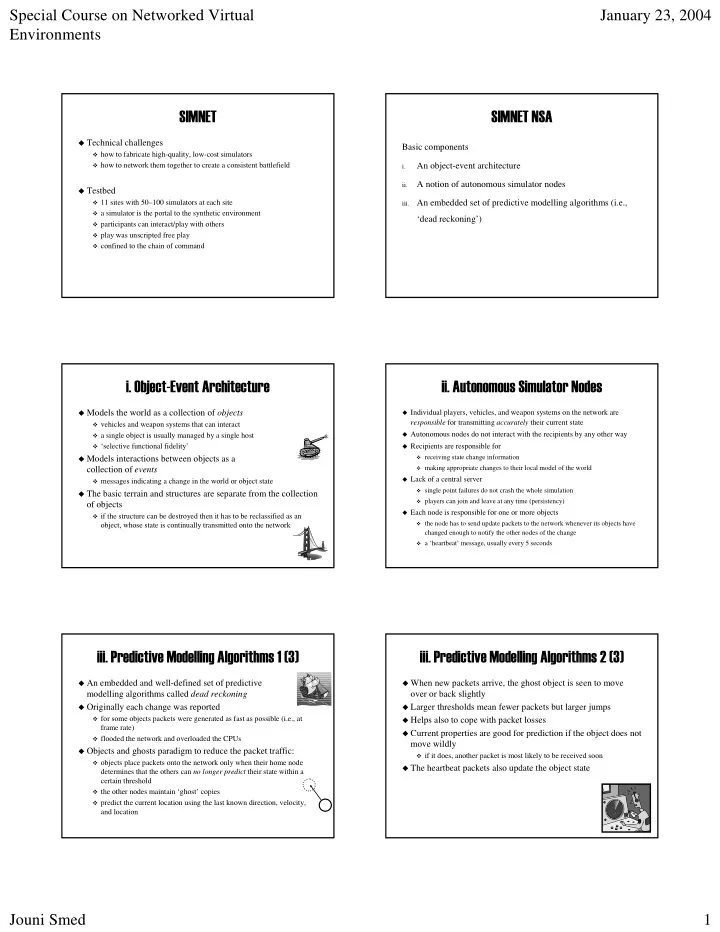
Special Course on Networked Virtual January 23, 2004 Environments SIMNET SIMNET SIMNET NSA SIMNET NSA Technical Technical challenges challenges Basic components Basic components how to fabricate high how to fabricate


slide-1
SLIDE 1

Special Course on Networked Virtual Environments January 23, 2004 Jouni Smed 1

SIMNET SIMNET

  • Technical

Technical challenges challenges

  • how to fabricate high

how to fabricate high-

  • quality, low

quality, low-

  • cost simulators

cost simulators

  • how to network them

how to network them together to create a consistent battlefield together to create a consistent battlefield

  • Testbed

Testbed

  • 11 sites with

11 sites with 50 50– –100 100 simulators at each site simulators at each site

  • a simulator

a simulator is is the portal to the synthetic environment the portal to the synthetic environment

  • participants

participants can interact/play with others can interact/play with others

  • play was

play was unscripted unscripted free play free play

  • confined to

confined to the chain the chain of command

  • f command

SIMNET NSA SIMNET NSA

Basic Basic components components

i. i.

An object An object-

  • event architecture

event architecture

ii. ii.

A notion of autonomous simulator nodes A notion of autonomous simulator nodes

iii. iii.

An embedded set of predictive An embedded set of predictive modelling modelling algorithms algorithms (i.e., (i.e., ‘dead ‘dead reckoning’) reckoning’)

  • i. Object
  • i. Object-
  • Event

Event Architecture Architecture

  • Models

Models the world as a collection of the world as a collection of objects

  • bjects
  • vehicles and weapon systems that can interact

vehicles and weapon systems that can interact

  • a single object is usually managed by a single

a single object is usually managed by a single host host

  • ‘selective functional fidelity’

‘selective functional fidelity’

  • Models

Models interactions between objects as a interactions between objects as a collection collection of

  • f events

events

  • messages indicating a change in the world or object state

messages indicating a change in the world or object state

  • The basic terrain and structures are separate from the collectio

The basic terrain and structures are separate from the collection n

  • f objects
  • f objects
  • if the structure can be destroyed then it has to be reclassified

if the structure can be destroyed then it has to be reclassified as an as an

  • bject,
  • bject, whose state

whose state is continually transmitted onto the is continually transmitted onto the network network

  • ii. Autonomous
  • ii. Autonomous Simulator Nodes

Simulator Nodes

  • Individual players, vehicles, and weapon systems on the network

Individual players, vehicles, and weapon systems on the network are are responsible responsible for transmitting for transmitting accurately accurately their current state their current state

  • Autonomous nodes do not interact with the recipients by any othe

Autonomous nodes do not interact with the recipients by any other way r way

  • Recipients are responsible for

Recipients are responsible for

  • receiving state change information

receiving state change information

  • making appropriate

making appropriate changes to their local model of the world changes to their local model of the world

  • Lack of a central server

Lack of a central server

  • single point

single point failures do not crash the whole simulation failures do not crash the whole simulation

  • players can join and leave at any

players can join and leave at any time (persistency) time (persistency)

  • Each node is responsible for one or more objects

Each node is responsible for one or more objects

  • the node

the node has to has to send send update packets update packets to to the network whenever its objects have the network whenever its objects have changed enough changed enough to notify the other nodes to notify the other nodes of the

  • f the change

change

  • a ‘heartbeat’

a ‘heartbeat’ message, usually every 5 seconds message, usually every 5 seconds

  • iii. Predictive
  • iii. Predictive Modelling

Modelling Algorithms 1 (3) Algorithms 1 (3)

  • An embedded and well

An embedded and well-

  • defined set of

defined set of predictive predictive modelling modelling algorithms algorithms called called dead dead reckoning reckoning

  • Originally each change was reported

Originally each change was reported

  • for some objects packets were generated as fast as possible

for some objects packets were generated as fast as possible (i.e., at (i.e., at frame frame rate) rate)

  • flooded

flooded the network and the network and overloaded

  • verloaded the CPUs

the CPUs

  • Objects and ghosts

Objects and ghosts paradigm to reduce the packet traffic: paradigm to reduce the packet traffic:

  • bjects
  • bjects place packets onto the network only when their home node

place packets onto the network only when their home node determines that the others can determines that the others can no longer predict no longer predict their state within a their state within a certain threshold certain threshold

  • the other

the other nodes maintain nodes maintain ‘ghost’ ‘ghost’ copies copies

  • predict

predict the current the current location using location using the last the last known direction known direction, velocity, , velocity, and location and location

  • iii. Predictive
  • iii. Predictive Modelling

Modelling Algorithms 2 (3) Algorithms 2 (3)

  • When new packets arrive, the ghost object is seen to move

When new packets arrive, the ghost object is seen to move

  • ver or back slightly
  • ver or back slightly
  • Larger

Larger thresholds mean fewer packets but larger jumps thresholds mean fewer packets but larger jumps

  • Helps also to cope with packet losses

Helps also to cope with packet losses

  • Current properties are good for prediction if the object does no

Current properties are good for prediction if the object does not t move wildly move wildly

  • if

if it does, another packet is most likely it does, another packet is most likely to be received to be received soon soon

  • The heartbeat

The heartbeat packets packets also update also update the object the object state state

slide-2
SLIDE 2

Special Course on Networked Virtual Environments January 23, 2004 Jouni Smed 2

  • iii. Predictive
  • iii. Predictive Modelling

Modelling Algorithms 3 (3) Algorithms 3 (3)

  • Average SIMNET

Average SIMNET packet packet rates: rates:

  • 1 per second for slow

1 per second for slow-

  • moving ground vehicles

moving ground vehicles

  • 3 per second for air vehicles

3 per second for air vehicles

  • Some of the information is relatively static

Some of the information is relatively static

  • single bit for indicating whether

single bit for indicating whether the the vehicle is stationary vehicle is stationary

  • if stationary, the ghost

if stationary, the ghost computations are turned off computations are turned off

  • Other packets

Other packets

  • fire: a weapon has been launced

fire: a weapon has been launced

  • indirect

indirect fire: a ballistic weapon has been launced fire: a ballistic weapon has been launced

  • collision: a vehicle hits an object

collision: a vehicle hits an object

  • impact: a weapon hits an object

impact: a weapon hits an object

SIMNET Major Software Modules SIMNET Major Software Modules

Computer Image Computer Image-

  • Generator

Generator Software Software Other Other-

  • Vehicle

Vehicle State Table State Table Network Interface Network Interface Software Software Control and Control and Interface Software Interface Software Own Own-

  • Vehicle

Vehicle Dynamics Dynamics Sound Sound-

  • Generator

Generator Software Software

Local Area Local Area Network Network

Distributed Interactive Simulation (DIS) Distributed Interactive Simulation (DIS)

  • SIMNET protocol was designed to satisfy a contract with

SIMNET protocol was designed to satisfy a contract with the the U.S. U.S. government government

  • did

did not define the NSA for general purpose simulation not define the NSA for general purpose simulation

  • lack

lack of documentation

  • f documentation
  • DIS

DIS was an attempt to formally generalize and extend the was an attempt to formally generalize and extend the SIMNET protocol SIMNET protocol

  • First version of the IEEE standard for DIS appeared 1993

First version of the IEEE standard for DIS appeared 1993

  • Goals

Goals

  • to allow

to allow any type of any type of player, player, on any type of machine

  • n any type of machine
  • to

to achieve larger achieve larger simulations simulations

DIS NSA DIS NSA

  • Derived from SIMNET

Derived from SIMNET

  • bject
  • bject-
  • event

event architecture architecture

  • autonomous

autonomous distributed simulation nodes distributed simulation nodes

  • predictive

predictive modeling algorithms modeling algorithms

  • Covers more simulation requirements

Covers more simulation requirements

  • Protocol data unit (PDU)

Protocol data unit (PDU)

  • determine when

determine when each vehicle (node) should issue a each vehicle (node) should issue a PDU PDU

  • the DIS

the DIS standard standard defines 27 different defines 27 different PDUs PDUs

  • nly 4 of them interact with
  • nly 4 of them interact with the environment

the environment

  • entity state, fire, detonation, and collision

entity state, fire, detonation, and collision

  • the rest

the rest of

  • f the defined

the defined PDUs PDUs

  • simulation control, electronic emanations, and supporting

simulation control, electronic emanations, and supporting actions actions

  • not supported and disregarded by most DIS applications

not supported and disregarded by most DIS applications

Issuing Issuing PDUs PDUs

  • The vehicle’s node is responsible

The vehicle’s node is responsible of

  • f issuing

issuing PDUs PDUs

  • entity state PDU

entity state PDU

  • when

when position position, orientation, , orientation, velocity changes velocity changes sufficiently (i.e., sufficiently (i.e., others

  • thers

cannot accurately predict the cannot accurately predict the position any more) position any more)

  • as a heartbeat if

as a heartbeat if the time the time threshold (5 threshold (5 seconds) is seconds) is reached after reached after the last the last entity state PDU entity state PDU

  • fire PDU

fire PDU

  • detonation PDU

detonation PDU

  • a fired projectile explodes

a fired projectile explodes

  • node’s vehicle has died (death self

node’s vehicle has died (death self-

  • determination)

determination)

  • collision PDU

collision PDU

  • vehicle has collided with something

vehicle has collided with something

  • detection is

detection is left up left up to the individual node to the individual node

Receiving Receiving PDUs PDUs

  • The recipient is responsible

The recipient is responsible for for

  • receiving

receiving the PDU the PDU

  • changing

changing the appropriate state tables the appropriate state tables

  • updating

updating the display the display

  • entity state PDU

entity state PDU

  • update the other

update the other-

  • vehicle state table

vehicle state table

  • fire PDU

fire PDU

  • create a new vehicle

create a new vehicle

  • detonation PDU

detonation PDU

  • compute the effects

compute the effects

  • change the other

change the other-

  • vehicle and own

vehicle and own-

  • vehicle state tables

vehicle state tables

  • collision PDU

collision PDU

  • process similarly

process similarly

Computer Image- Generator Software Other- Vehicle State Table Network Interface Software Control and Interface Software Own- Vehicle Dynamics Sound- Generator Software

Local Area Network

slide-3
SLIDE 3

Special Course on Networked Virtual Environments January 23, 2004 Jouni Smed 3

Lost Lost PDUs PDUs 1 (2) 1 (2)

  • Packets are sent via unreliable UDP broadcast

Packets are sent via unreliable UDP broadcast

  • State tables may differ among the hosts

State tables may differ among the hosts

  • Lost detonation PDU

Lost detonation PDU

‘ ‘from from the the afterlife’ afterlife’

Lost Lost PDUs PDUs 2 (2) 2 (2)

  • Lost entity state

Lost entity state PDU PDU

  • not a big problem

not a big problem

  • larger jumps on the display

larger jumps on the display

  • Lost fire

Lost fire PDU PDU

  • receive entity state PDU for which no ghost entry exists

receive entity state PDU for which no ghost entry exists

  • Lost collision

Lost collision PDU PDU

  • continue to display a vehicle as live

continue to display a vehicle as live

  • next heartbeat packet solves the situation

next heartbeat packet solves the situation

The Fully The Fully Distributed, Heterogeneous Distributed, Heterogeneous Nature Nature of DIS

  • f DIS
  • Any computer that

Any computer that reads/writes reads/writes PDUs PDUs and manages the state of and manages the state of those those PDUs PDUs can can participate a DIS environment participate a DIS environment

  • The virtual environment can include

The virtual environment can include

  • virtual players

virtual players (humans (humans at at computer computer consoles) consoles)

  • constructive players (computer

constructive players (computer-

  • driven players)

driven players)

  • live players (actual weapon systems)

live players (actual weapon systems)

  • Problem of the advantages of the low

Problem of the advantages of the low-

  • end

end machines machines

  • the less details in the scenery, the better visuality

the less details in the scenery, the better visuality

  • Problems with

Problems with modelling modelling

  • dynamic terrain

dynamic terrain

  • soil

soil movement movement

  • environmental effects

environmental effects

  • weather, smoke,

weather, smoke, dust,… dust,…

Additional Properties Additional Properties

  • DIS

DIS standard defines 9 dead reckoning algorithms standard defines 9 dead reckoning algorithms

  • fields in the entity state PDU

fields in the entity state PDU

  • dead

dead reckoning reckoning will be will be discussed discussed later in the course later in the course

  • DIS

DIS packets are larger than SIMNET packets packets are larger than SIMNET packets

  • the entity state PDU has a lot of static information

the entity state PDU has a lot of static information

  • position of a vehicle can be expressed in

position of a vehicle can be expressed in a subnanometer a subnanometer resolution resolution (64 (64-

  • bit

bit co co-

  • ordinate
  • rdinate field)

field)

  • could

could be redesigned to 20% of the current size be redesigned to 20% of the current size

  • Designed

Designed for fewer than 300 for fewer than 300 units units but DoD but DoD wants even wants even 300,000 units 300,000 units

  • Does not define how to define new types of information nor

Does not define how to define new types of information nor how to modify the DIS NSA how to modify the DIS NSA

High High-

  • Level Architecture (HLA)

Level Architecture (HLA)

  • Aims at providing a general architecture and services for

Aims at providing a general architecture and services for distributed data exchange. distributed data exchange.

  • While the DIS protocol is closely linked with the properties of

While the DIS protocol is closely linked with the properties of military military units and vehicles, HLA does not prescribe any units and vehicles, HLA does not prescribe any specific implementation or technology. specific implementation or technology.

  • could be used also with non

could be used also with non-

  • military applications (e.g., computer

military applications (e.g., computer games) games)

  • targeted towards new simulation developments

targeted towards new simulation developments

  • HLA was issued as IEEE Standard 1516 in 2000.

HLA was issued as IEEE Standard 1516 in 2000.

Academic Academic NVEs NVEs

  • DoD’s projects

DoD’s projects

  • large

large-

  • scale

scale NVEs NVEs

  • most

most of the research is unavailable

  • f the research is unavailable
  • lack

lack-

  • of
  • f-
  • availability

availability, lack , lack-

  • of
  • f-
  • generality

generality

  • Academic community has reinvented, extended, and

Academic community has reinvented, extended, and documented what documented what DoD DoD has done has done

  • NPSNET

NPSNET

  • PARADISE

PARADISE

  • DIVE

DIVE

  • BrickNet

BrickNet

slide-4
SLIDE 4

Special Course on Networked Virtual Environments January 23, 2004 Jouni Smed 4

NPSNET NPSNET

  • Naval Postgraduate School (

Naval Postgraduate School (NPS NPS), Monterey, California ), Monterey, California

  • ‘Longest

‘Longest continuing academic research effort in continuing academic research effort in NVEs’ NVEs’

  • ‘The

‘The complete breadth of human complete breadth of human-

  • computer interaction and software

computer interaction and software technology’ technology’

…that can be useful for that can be useful for DoD DoD

(Guess where our course books authors come from...) (Guess where our course books authors come from...)

Evolution Evolution of NPSNET

  • f NPSNET

NPSNET-1 NPS-Stealth NPSNET-2 & 3 NPSNET-IV NPSNET-V

NPS invented protocol for LANs only SIMNET protocol and Bridged LAN for WAN communications DIS protocol and IP Multicast for WAN communications vrtp and HLA for communications

PARADISE PARADISE

  • Performance Architecture for Advanced Distributed Interactive

Performance Architecture for Advanced Distributed Interactive Simulations Environments (PARADISE) Simulations Environments (PARADISE)

  • Initiated in 1993 at Stanford University

Initiated in 1993 at Stanford University

  • Explicitly addressed NSA issues in the case of thousands users

Explicitly addressed NSA issues in the case of thousands users

  • Assign a different multicast address to each active object

Assign a different multicast address to each active object

  • Object updates similar

Object updates similar to to SIMNET and DIS SIMNET and DIS

  • A hierarchy of

A hierarchy of area area-

  • of
  • f-
  • interest

interest servers servers

  • monitor the positions of objects

monitor the positions of objects

  • which multicast addresses are relevant

which multicast addresses are relevant

S

PARADISE PARADISE (cont’d) (cont’d)

  • All objects, including terrain, are capable of transmitting stat

All objects, including terrain, are capable of transmitting state e updates updates

  • Recognizes that update need varies for objects

Recognizes that update need varies for objects

  • Improved

Improved dead reckoning protocols dead reckoning protocols

  • position

position history history-

  • based

based dead dead reckoning reckoning

  • Support for multiple communication flows per object

Support for multiple communication flows per object

  • unique dead reckoning for each flow

unique dead reckoning for each flow

  • Combine information about groups of objects

Combine information about groups of objects

  • based on their

based on their location location and on their type and on their type

  • Support for slowly changing entities

Support for slowly changing entities

  • to eliminate the heartbeat messages of DIS

to eliminate the heartbeat messages of DIS

DIVE DIVE

  • Distributed Interactive Virtual

Distributed Interactive Virtual Environment (DIVE) Environment (DIVE)

  • Swedish Institute of Computer

Swedish Institute of Computer Science Science

  • To solve problems of

To solve problems of collaboration and interaction collaboration and interaction

  • Simulate a large shared memory

Simulate a large shared memory

  • ver a network
  • ver a network
  • Distributed, fully replicated

Distributed, fully replicated database database

  • Entire database is dynamic

Entire database is dynamic

  • add new objects

add new objects

  • modify the existing databases

modify the existing databases

  • reliability

reliability and and consistency consistency

BrickNet BrickNet

  • National

National University of Singapore, University of Singapore, started in 1991 started in 1991

  • Support for graphical,

Support for graphical, behavioural behavioural, and network , and network modelling modelling of virtual worlds

  • f virtual worlds
  • Allows objects to be shared by

Allows objects to be shared by multiple multiple virtual worlds virtual worlds

  • No replicated database

No replicated database

  • The virtual world is partitioned

The virtual world is partitioned among the various clients among the various clients

PowerPC 7 1 3 7