Silica Dust: It will take your breath away Enforms Exposure Control - - PowerPoint PPT Presentation

silica dust
SMART_READER_LITE
LIVE PREVIEW

Silica Dust: It will take your breath away Enforms Exposure Control - - PowerPoint PPT Presentation

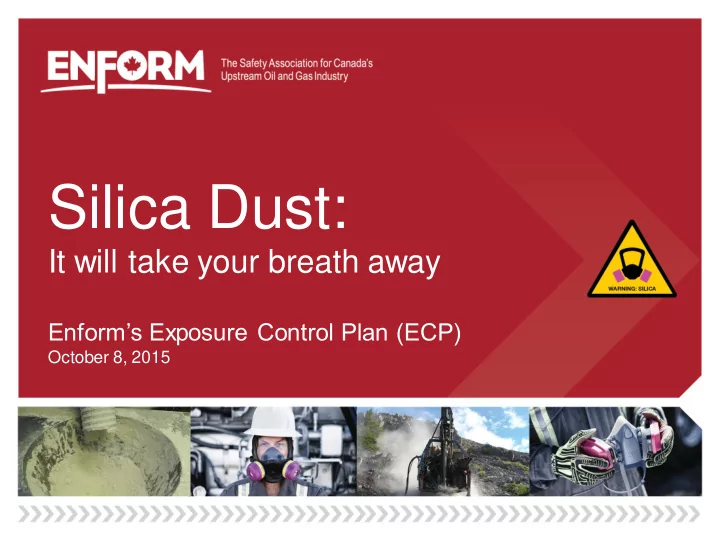
Silica Dust: It will take your breath away Enforms Exposure Control Plan (ECP) October 8, 2015 Outline What is silica? Why should I care? Exposure risk Exposure control Enforms approach Questions? 2 What is silica


slide-1
SLIDE 1

Silica Dust:

It will take your breath away

Enform’s Exposure Control Plan (ECP)

October 8, 2015
slide-2
SLIDE 2

Outline

  • What is silica?
  • Why should I care?
  • Exposure risk
  • Exposure control
  • Enform’s approach
  • Questions?

2

slide-3
SLIDE 3

What is silica

  • Silica is naturally occurring and can be found

everywhere (SiO2)

  • Silica can be crystalline (quartz) or non-crystalline

(amorphous)

  • Crystalline silica can be found in:

– Rock – Sand – Products like cement, etc.

3

Photo: Wikipedia, http://upload.wikimedia.org/wikipedia/commons/1/14/Quartz%2C_Tibet.jpg

slide-4
SLIDE 4

Why should I care?

  • Silica is a hazard (primarily chronic) when it is

breathed deep into the lungs (respirable)

  • Silica causes the following illnesses:

– Silicosis - lung scar tissue – Lung cancer – Bronchitis – Kidney disease

  • Irreversible and progressive

4

slide-5
SLIDE 5

Exposure risk

  • Silica’s OEL

– 8-hour TWA – What does that mean? – 2X lower than lead (0.05 mg/m3) – 400X lower than nuisance dust (10 mg/m3) – If it’s silica and it’s visible, overexposure is just a matter of time!

5

2 X 8-hour OEL

0.025 mg/m3

(respirable fraction)

slide-6
SLIDE 6

Exposure risk

  • How do we re-think our perceptions of risk?

6

Photo Courtesy of NIOSH

slide-7
SLIDE 7

Exposure risk

  • You may be thinking that I am exposed for only a

few days, weeks or months, I will be ok, right?

  • A worker at 100X the Silica OEL

– With no respirator they get a working lifetime in 90 days

  • Even at 100X, acute health effects may not provide

adequate warning

  • After 100X, risks are likely not linear,

– i.e. high exposures for even short periods have more risk

7

slide-8
SLIDE 8

Where could I be exposed?

Frack

Proppant Handling and Storage

Seismic

Air-hammer Drilling

Drilling

Drilling Mud Additives

8

Photos courtesy of a Industry company, NIOSH and OSHA

slide-9
SLIDE 9

Fracking - Exposure Sources

  • Proppant (sand: 30-99% quartz)

– The high percentage of quartz and amount of energy imparted into the sand makes this hazard unique – Any transfer points

  • Rail to truck
  • Truck to sand tent or site sand storage (vertical or horizontal)
  • Site sand storage to hopper
  • Pneumatic in-loading on site

– Working in visible frack dust?

9

slide-10
SLIDE 10

Drilling - Exposure Sources

  • Handling and adding drilling mud

dry-product additives

– Barites, Graphite, etc… – If it’s naturally sourced, be suspicious

  • Cement In-loading

– Portland cement verses additives

  • Cuttings Dryers

– Most of cuttings are rock = silica

  • Shaker Mist

– Rock dust and fluid additives

10

Photo: Eelgin Industries

slide-11
SLIDE 11

Seismic - Exposure Sources

  • Main source is hard rock such as sandstone,

granite and shale

– Depends on shot hole parameters

  • Depth and diameter of hole

– Wet or Dry Environment

  • Up on hill or next to river

11

slide-12
SLIDE 12

Other Sources

  • Refractory brick removal - furnaces*
  • Construction - road and lease
  • Abrasive blasting - sand substitutes*
  • Cement handling
  • Cutting, grinding, and drilling concrete

12

slide-13
SLIDE 13

Controls - Engineering

  • The answer to many silica exposures is

engineering and administrative controls

– This does not have to be expensive/difficult

  • Wet materials
  • Distance/time etc.
  • Look for opportunities to make a difference!

– Take some action (action = caring)

13

slide-14
SLIDE 14
  • Different dust levels = different protection levels

– Respirator protection factors

  • Half-face - 10
  • Full-face - 50 and 100
  • PAPR or Supply Air - 1,000

– Why? Leakage, where the respirator meets the face – Coveralls

Controls - PPE

14

slide-15
SLIDE 15

So what do I need to do?

  • Fracking

– Depends on the presence of engineering controls and where you are working – What is needed?

  • Consistently applied engineering controls

15

Photo: Industrial Vacuum Equipment Corp.

slide-16
SLIDE 16

So what do I need to do?

  • Fracking

– Some workers need a ½ mask

  • Not in dust on an on-going basis
  • At least 3 meters from source

– Some workers need full-face or better

  • On-going and close to source
  • Handling frack dust (powders)

– Adjacent workers may be at risk

  • If you are breathing visible frack dust you need a respirator

(micro-seismic, flow back, medics etc.)

16

Photo: NIOSH

slide-17
SLIDE 17

So what do I need to do?

  • Drilling - Dry-Product Additive Handling

– Use engineering ventilation controls

  • Direct exhaust ventilation into mud tanks

– Add product slowly - one bag per minute

  • Reduces dust generation (energy)
  • Ensures complete incorporation into drilling fluid

– Wear a respirator (minimum half mask) – Keep your distance from cement in-loading and use a dust capture bag on exhaust – Follow Invert exposure control plan

17

slide-18
SLIDE 18

So what do I need to do?

  • Air-hammer Drilling

– Engineering controls

  • Venturi
  • Vacuum
  • Water injection
  • Blower fan

– Stay upwind of dust when ever possible – Use respirator

  • No engineering controls? You may need a full-face respirator

18

Photo: Sun Machinery Corp.

slide-19
SLIDE 19

Enform’s Approach

  • Silica ECP template

– Modular approach

  • Guidance Sheets

– Sources – Controls – Hazard Assessment

19

slide-20
SLIDE 20

What Now?

  • Silica ECP and Guidance sheets

(frack) available at enform.ca

  • Worker tools and resources are

being completed

  • The CCH Guideline update for

release later this year

  • Pick up the Fall issue of Frontline

20

slide-21
SLIDE 21

Summary

  • Silica is not nuisance dust!
  • Silica is everywhere
  • What you don’t know will still hurt you
  • Enform’s Controlling Chemical Hazards Guideline

has the answers you need

  • Solutions by industry - for industry

21

slide-22
SLIDE 22

Is your worker’s future clear?

22

Photo: https://www.pinterest.com/pin/262968065712044291/ and Wikipedia, http://commons.wikimedia.org/wiki/File:8.- _Miner%27s_lung_with_silicosis_and_tuberculosis.jpg

Healthy Lung Silicosis Lung

slide-23
SLIDE 23

Questions

Contact: Robert Waterhouse Email: robert.waterhouse@enform.ca

23