Signed Distance Fields Conventional anti-aliasing can only smooth - - PowerPoint PPT Presentation

signed distance fields
SMART_READER_LITE
LIVE PREVIEW

Signed Distance Fields Conventional anti-aliasing can only smooth - - PowerPoint PPT Presentation

Signed Distance Fields Conventional anti-aliasing can only smooth pixels immediately adjacent to the source values. Signed distance fields represent monochrome pixelated data as a distance map instead of as pixels. This allows per-pixel


slide-1
SLIDE 1

Signed Distance Fields

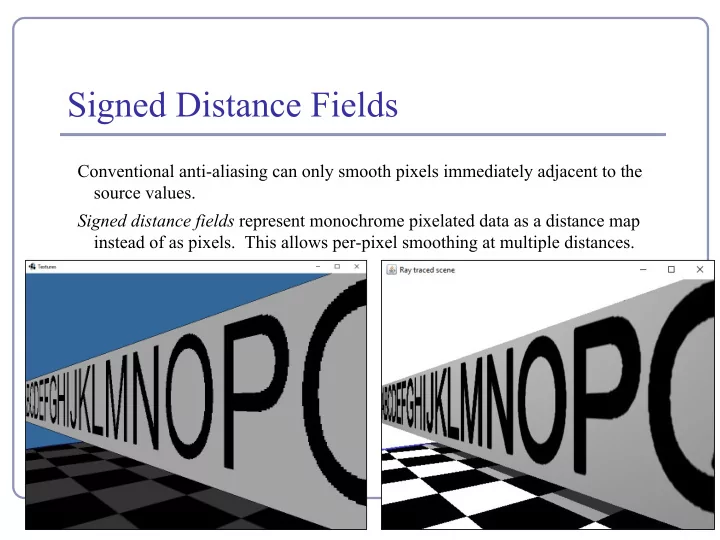
Conventional anti-aliasing can only smooth pixels immediately adjacent to the source values. Signed distance fields represent monochrome pixelated data as a distance map instead of as pixels. This allows per-pixel smoothing at multiple distances.

slide-2
SLIDE 2

3.6 2.8 2 1

  • 1

3.1 2.2 1.4 1

  • 1

2.8 2 1

  • 1
  • 1.4

2.2 1.4 1

  • 1
  • 2

2 1

  • 1
  • 1.4
  • 2.2

2 1

  • 1
  • 2
  • 2.8

Signed Distance Fields

The bitmap becomes a height map. Each pixel stores the distance to the closest black pixel (if white) or white pixel (if black). Distance from white is negative.

Conventional antialiasing Signed distance field

slide-3
SLIDE 3

Signed Distance Fields

Conventional bilinear filtering computes a weighted average of color, but an SDF computes a weighted average of distances. This means that a small step away from the original values we find smoother, straighter lines where the slope of the isocline is perpendicular to the slope of the source data. By smoothing the isocline of the distance threshold, we achieve smoother edges and nifty edge effects.

low = 0.02; high = 0.035; double dist = bilinearSample(tex coords); double t = (dist - low) / (high - low); return (dist < low) ? BLACK : (dist > high) ? WHITE : BLACK*(1 - t) + WHITE*(t);

Adding a second isocline enables colored borders.