Raymarching Signed Distance Fields To raytrace or raycast implicit - - PowerPoint PPT Presentation

raymarching signed distance fields
SMART_READER_LITE
LIVE PREVIEW

Raymarching Signed Distance Fields To raytrace or raycast implicit - - PowerPoint PPT Presentation

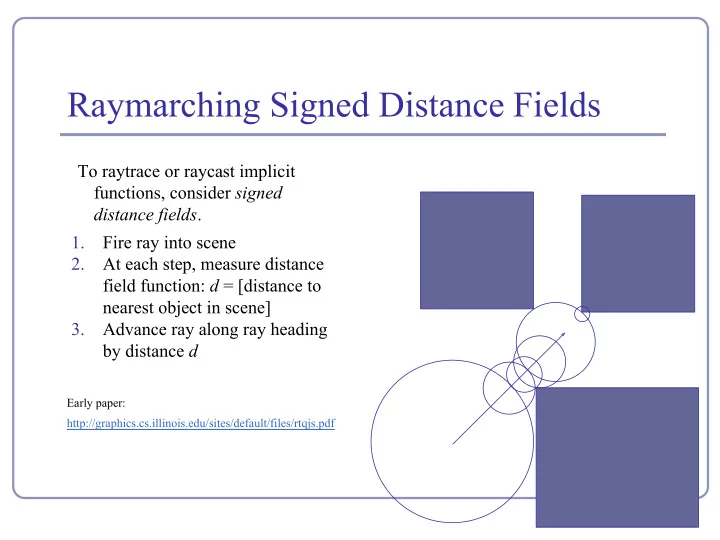
Raymarching Signed Distance Fields To raytrace or raycast implicit functions, consider signed distance fields . 1. Fire ray into scene 2. At each step, measure distance field function: d = [distance to nearest object in scene] 3. Advance ray


slide-1
SLIDE 1

Raymarching Signed Distance Fields

To raytrace or raycast implicit functions, consider signed distance fields. 1. Fire ray into scene 2. At each step, measure distance field function: d = [distance to nearest object in scene] 3. Advance ray along ray heading by distance d

Early paper: http://graphics.cs.illinois.edu/sites/default/files/rtqjs.pdf

slide-2
SLIDE 2

Raymarching Signed Distance Fields

Sample distance functions

float sdSphere( vec3 p, float s) { return length(p)-s; } float sdBox( vec3 p, vec3 b) { vec3 d = abs(p) - b; return min(max(d.x,max(d.y,d.z)), 0.0) + length(max(d,0.0)); }

Sample distance functions

float sdCylinder( vec3 p, vec3 c) { return length(p.xz-c.xy)- c.z; } float sdTorus( vec3 p, vec2 t) { vec2 q = vec2(length(p.xz)- t.x,p.y); return length(q)-t.y; }

Source: http://iquilezles.org/www/articles/distfunctions/distfunctions.htm

slide-3
SLIDE 3

Raymarching Signed Distance Fields

vec3 raymarch(vec3 pos, vec3 raydir) { int step = 0; float d = getSdf(pos); while (abs(d) > 0.001 && step < 50) { pos = pos + raydir * d; d = getSdf(pos); step++; } return (step < 50) ? illuminate(pos, rayorig)) : background; }

slide-4
SLIDE 4

Raymarching Signed Distance Fields

Finding the normal: compute the local gradient

float d = getSdf(hitpoint); vec3 normal = normalize(vec3( getSdf(vec3(pt.x + 0.0001, pt.y, pt.z)) - d, getSdf(vec3(pt.x, pt.y + 0.0001, pt.z)) - d, getSdf(vec3(pt.x, pt.y, pt.z + 0.0001)) - d));