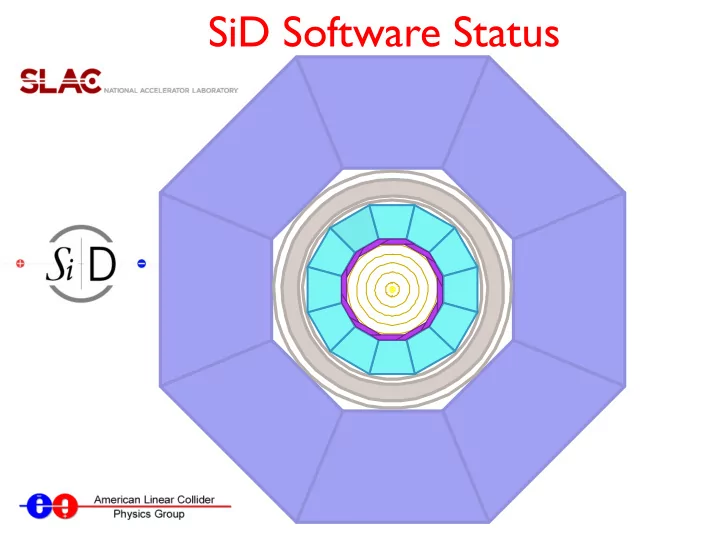
SiD Software Status Framework Overview DETECTOR APPLICATIONS DATA - - PowerPoint PPT Presentation

sid software status framework overview
SMART_READER_LITE
LIVE PREVIEW

SiD Software Status Framework Overview DETECTOR APPLICATIONS DATA - - PowerPoint PPT Presentation

SiD Software Status Framework Overview DETECTOR APPLICATIONS DATA DESCR Pythia, Pythia, Event Gen StdHep StdHep WHIZARD, etc. WHIZARD, etc. LCIO LCIO Simulation SLIC SLIC LCDD LCDD Events Events LCIO LCIO Tracking, PFA,


slide-1
SLIDE 1

SiD Software Status

slide-2
SLIDE 2

Framework Overview

Pythia, WHIZARD, etc. Pythia, WHIZARD, etc.

SLIC SLIC

Tracking, PFA, etc. Tracking, PFA, etc.

LCSim LCSim StdHep StdHep LCIO Events LCIO Events JAS3

(or any AIDA tool)

JAS3

(or any AIDA tool)

LCIO PFOs LCIO PFOs AIDA AIDA

Event Gen Simulation

Reconstruction Analysis Visualization

LCDD LCDD

Compact Compact

APPLICATIONS DATA DETECTOR DESCR

3/20/2011 2 Jeremy McCormick, SLAC – ALCPG 2011

slide-3
SLIDE 3

Event Generation

  • Physics event generation is performed externally to general

framework (e.g. slic & lcsim).

  • WHIZARD /w Guinea Pig, Pythia, or other legacy event

generators (HERWIG, ISAJET).

  • StdHep binary format used for persistency.
  • Extensive sets of physics events and diagnostic events

available via FTP.

  • Physics events at 100 GeV – 1 TeV
  • Single particles at wide range of energies, angular

distributions

  • ftp://ftp-lcd.slac.stanford.edu/lcd/ILC/singleParticle/stdhep/

3/20/2011 3 Jeremy McCormick, SLAC – ALCPG 2011

slide-4
SLIDE 4

(Diagrams from Frank Gaede, DESY)

  • Common Data Model and

API

  • Persistency using SIO

(Simple Input Output)

  • C++, Java, Fortran, and

Python Bindings

  • Generic data with

LCIOGenericObjects

  • Supported in all ILC

software frameworks (ILD, SiD)

  • Allows “mix and match” of

software components from different frameworks

  • Facilitates exchange of data

between users

http://lcio.desy.de

LCIO

3/20/2011 4 Jeremy McCormick, SLAC – ALCPG 2011

slide-5
SLIDE 5

LCDD

<lcdd/> <header/> <iddict/> <sensitive_detectors/> <limits/> <regions/> <display/> <gdml/> <define/> <materials/> <solids/> <structure/> <fields/> root element meta data ID definitions detectors physics limits detector regions visualization settings GDML root element variable definitions material definitions geometric solids nested volumes magnetic fields

  • Detailed geometry and detector

description format (XML)

  • Full description of detector
  • No additional information required

at runtime

  • Embedded GDML section
  • Binds XML elements to Geant4 data

structures (G4LogicalVolume, etc.)

  • Fast load using SAX parser
  • Takes < 1 second to load complex ILC

detector geometry

  • Possible to write by hand but not

recommended (verbose/redundant)

  • Easiest way to generate is converting from

compact to LCDD using GeomConverter. http://www.lcsim.org/software/lcdd/

3/20/2011 5 Jeremy McCormick, SLAC – ALCPG 2011

slide-6
SLIDE 6

SLIC

SLIC Frontend SLIC Frontend

Geant4 Geant4

LCDD LCDD LCIO LCIO

HepPDT HepPDT

LCDD Geometry <xml/> LCDD Geometry <xml/> StdHep Events StdHep Events LCIO Events LCIO Events

slic –g geometry.lcdd –m stuff.mac –i events.stdhep –o output.slcio –l QGSP_BERT –r 1000 slic –h # print help slic –m run.mac # run with macro only slic –n # run interactively Example Command Line Usage:

  • Flexible command-line

simulation tool with Geant4 backend

  • StdHep event input
  • LCIO event output
  • Grid ready (no ext. DB or

internet connection required)

  • Fully descriptive runtime

geometry with no “magic numbers” (LCDD)

  • Extended particle set from

HepPDT (SUSY, resonances, etc.) with generic tracking + edep

  • Maintained by SLAC
  • Also used by non-ILC

experiments

3/20/2011 6 Jeremy McCormick, SLAC – ALCPG 2011

slide-7
SLIDE 7

GeomConverter

Compact Detector

<xml/>

Compact Detector

<xml/>

GeomConverter

HepRep GDML / LCDD Pandora XML Java Runtime

Wired SLIC, ROOT, Geant4 SlicPandora

(PandoraPFANew)

LCSim

java –jar GeomConverter-bin.jar –o lcdd compact.xml mydet.lcdd Convertor Example:

3/20/2011 7 Jeremy McCormick, SLAC – ALCPG 2011

  • Compact subdetector types

added as needed/requested.

slide-8
SLIDE 8

Compact Description

<lccdd/> <info/> <define/> <materials/> <limits/> <regions/> <display/> <detectors/> <readouts/> <fields/>

<detector id=“1” name=“ECB” type=“EcalBarrel” readout=“ECBHits” vis=“ECBVis” type=“EM_BARREL”> <dimensions numsides=“12” rmin=“EcalBarrel_rmin” z=“EcalBarrel_zmin”/> <layer repeat=“30”> <slice material=“Silicon” thickness=“0.25*mm” /> <slice material=“Tungsten” thickness=“2.5*mm”/> </layer> </detector>

Example Detector: detector meta data variable definitions custom materials physics limits detector regions visualization settings detector description segmentation and IDs magnetic fields root element

  • High level detector description

format geared towards end users

  • Can be converted into various

useful data formats and Java runtime

  • bjects
  • New detector types can be

supported by adding the appropriate classes to GeomConverter.

  • LCDetectors is data repository

for compact detectors and their conditions.

3/20/2011 8 Jeremy McCormick, SLAC – ALCPG 2011

slide-9
SLIDE 9

LCDetectors

3/20/2011 9 Jeremy McCormick, SLAC – ALCPG 2011

Example Detector Data

  • CVS module containing detector data

for GeomConverter/LCSim.

  • At a minimum, each detector must have

a compact.xml file.

  • Conditions are stored in a detector’s

directory and can be read in using the LCSim ConditionsManager.

  • Detector data is packaged into zip files

and distributed via the WWW.

  • Sampling fractions
  • Tracking strategies
  • etc.
  • Makefile contains helper commands for

generating data files, running common Geant4 commands (such as geometric

  • verlap checking), and for packaging data.
  • Detectors can also be packaged into a

single jar file using Maven. http://www.lcsim.org/detectors

slide-10
SLIDE 10

Trackers

3/20/2011 10 Jeremy McCormick, SLAC – ALCPG 2011

slide-11
SLIDE 11

Calorimeters

3/20/2011 11 Jeremy McCormick, SLAC – ALCPG 2011

slide-12
SLIDE 12

LCSim

3/20/2011 12 Jeremy McCormick, SLAC – ALCPG 2011

event event

GeomConv GeomConv conditions conditions

Reconstruction Reconstruction clustering clustering tracking tracking util util lcio lcio

  • Java-based reconstruction and

analysis framework

  • Built with Maven
  • Easy build/installation/use
  • One build command gets

you up and running.

  • Reads LCIO files
  • UIowa PFA
  • Seedtracker
  • Contrib module for non-

essential user code contributions

  • Packaged into single jar file
  • Grid ready
  • XML steering files
  • JAS3 Plugin

https://confluence.slac.stanford.edu/display/ilc/org.lcsim

slide-13
SLIDE 13

SLIC Pandora

3/20/2011 13 Jeremy McCormick, SLAC – ALCPG 2011

PandoraFrontend geometry.xml settings.xml input.slcio output.slcio nevents nskip

Command Line Syntax <pandoraSetup> <detector> <calorimeters> <calorimeter> <id> <layers> <coil> <tracking> Geometry Format

  • Frontend to Pandora PFA that takes SLIC output

plus LCSim Tracks

  • Outputs LCIO PFO collections
  • Runs on both digital and analog calorimeters
  • Optional PandoraMonitoring for visualization
  • Work ongoing to improve performance

https://confluence.slac.stanford.edu/display/ilc/Running+SLIC+Events+in+Pandora+PFA+New

slide-14
SLIDE 14

JAS3

3/20/2011 14 Jeremy McCormick, SLAC – ALCPG 2011

Wired LCSim Event Browser LCIO Record Source

  • Java-based analysis

program

  • AIDA compliant
  • Can use plugins for

data visualization and

  • ther purposes.
  • See talk by

Tony Johnson

slide-15
SLIDE 15

Grid

3/20/2011 15 Jeremy McCormick, SLAC – ALCPG 2011

  • All primary ALCPG software tools can be run on grid. (slic, lcsim, slicPandora)
  • Need to get grid certificate first to use and join ILC

VO

  • Two main grid sites are accessible.
  • LHC grid (CLiC)
  • Dirac toolkit with command line tools
  • Online monitoring tool
  • Python scripts for job submission
  • Job chaining
  • Large number of accessible machines (14k)
  • Use lxplus machines for environment
  • Grid data catalog for file storage.
  • Fermi grid (SiD)
  • Use Open Science Grid (OSG)
  • Uses Condor commands for job submission with JDF files
  • Good resource allocation (500 concurrent jobs)
  • Doc DB to access output: http://docdb.fnal.gov/ILC/sid/
  • Use ilcsim2 machine for environment and virtual grid file system
slide-16
SLIDE 16

Conclusions

  • SiD software chain is complete and robust, from event generation

through analysis.

  • Used for generation and analysis of ~20 million events for LOI
  • Also used by non-ILC collaborations
  • Work still remains to be done for the DBD.
  • Detailed simulation of RPC response
  • Track fitting
  • Data set generation for DBD using detailed detector models
  • Detector optimization
  • See other talks
  • Contributions welcome
  • Easy to add and integrate your own code or software packages
  • Java code is easily built/integrated/debugged.
  • Analysis & reconstruction code can be added to lcsim-contrib and

immediately accessed in lcsim jobs.

slide-17
SLIDE 17

Documentation & Links

3/20/2011 17 Jeremy McCormick, SLAC – ALCPG 2011

  • ILC Wiki

https://confluence.slac.stanford.edu/display/ilc/Home

  • LCSim Website

http://www.lcsim.org/

  • FTP for Event Data

ftp://ftp-lcd.slac.stanford.edu/lcd/ILC/

  • SLIC FAQ

https://confluence.slac.stanford.edu/display/ilc/SLIC+FAQ

  • LCSim Job XML

https://confluence.slac.stanford.edu/display/ilc/lcsim+xml

  • Detector Data

http://www.lcsim.org/detectors

  • SimDist Instructions

https://confluence.slac.stanford.edu/display/ilc/Simulation+Software+Distribution

  • Forums

http://forum.linearcollider.org/