Shoreland zoning history The Wisconsin Constitution, adopted in - - PowerPoint PPT Presentation

shoreland zoning history the wisconsin constitution
SMART_READER_LITE
LIVE PREVIEW

Shoreland zoning history The Wisconsin Constitution, adopted in - - PowerPoint PPT Presentation

Shoreland zoning history The Wisconsin Constitution, adopted in 1848, says navigable waters are common highways and forever free This led to The waters of WI belong to the people of WI which is the basis of the Public Trust


slide-1
SLIDE 1

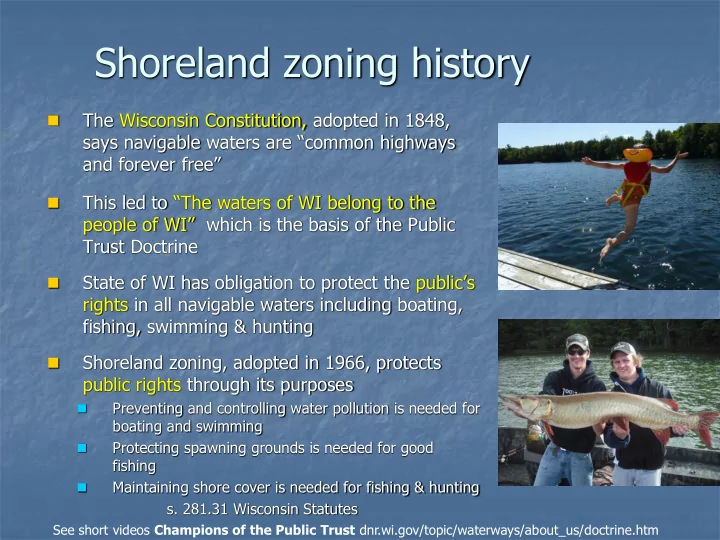
Shoreland zoning history

The Wisconsin Constitution, adopted in 1848, says navigable waters are “common highways and forever free”

This led to “The waters of WI belong to the people of WI” which is the basis of the Public Trust Doctrine

State of WI has obligation to protect the public’s rights in all navigable waters including boating, fishing, swimming & hunting

Shoreland zoning, adopted in 1966, protects public rights through its purposes

Preventing and controlling water pollution is needed for boating and swimming

Protecting spawning grounds is needed for good fishing

Maintaining shore cover is needed for fishing & hunting

  • s. 281.31 Wisconsin Statutes

See short videos Champions of the Public Trust dnr.wi.gov/topic/waterways/about_us/doctrine.htm

slide-2
SLIDE 2

Shoreland zoning standards protect property values

Less clear water = Lower waterfront property values

 A study of over 1200 waterfront properties in

Minnesota found when water clarity went down by 3 feet, waterfront property values around these lakes went down by tens of thousands to millions of dollars What shoreland practices make water less clear?

 Soil erosion  Rooftops and pavement

close to the water cause runoff that carries pollutants to waterway

 No shoreline buffer to

filter runoff

See Protecting Your Waterfront Investment at uwsp.edu/cnr-ap/clue/Documents/Water/ShorelandInvestment2013.pdf

slide-3
SLIDE 3

Impacts of phosphorus

aerial photo of lake split in half down to lake bottom

  • More algae & aquatic plant growth
  • Less oxygen
  • More rough fish, less game fish
  • Yucky for swimming

Cleaning up a lake with too much P is very difficult and

  • expensive. For example, over $5 million has been spent

to clean up Delavan Lake, and it’s still not “fixed”.

Phosphorus (P) added here

slide-4
SLIDE 4

How do shoreland zoning standards keep phosphorus and other pollutants out of lakes & streams?

1.

Curb pollutants at their source: Limits on filling and grading reduce the amount of soil erosion

Many soils in WI have high levels of phosphorus (P). For 80% of lakes in WI, if you add more P, you get more algae & aquatic plant growth. One pound of P in a lake can cause up to 500 pounds of algae growth.

2.

Cut runoff: Limits on impervious surfaces reduce the amount of runoff going to the waterway

3.

Capture and cleanse: Shoreline buffers and rain gardens catch pollutant-carrying runoff

slide-5
SLIDE 5

References

Many soils in WI have high levels of phosphorus.

 Average soil test phosphorus and potassium levels decline in Wisconsin.

  • 2011. John Peters. ipcm.wisc.edu/blog/2011/01/average-soil-test-

phosphorus-and-potassium-levels-decline-in-wisconsin/ Average soil test P for all Wisconsin farm soils in the 2005-2009 period was 53 ppm.

 Optimum soils test levels for Wisconsin. 1999. K.A. Kelling et al. University

  • f Wisconsin Extension. Page 6.

learningstore.uwex.edu/Assets/pdfs/A3030.pdf High phosphorus levels for corn are 16-42 ppm.

For 80% of lakes in WI, if you add more P, you get more algae & aquatic plant growth.

 Understanding Lake Data. 2004. Byron Shaw. University of Wisconsin

  • Extension. Page 6. learningstore.uwex.edu/Assets/pdfs/G3582.pdf

One pound of P in a lake can cause up to 500 pounds of algae growth.

 Lakescaping for Wildlife and Water Quality. Carrol L. Henderson et al.

Minnesota Department of Natural Resources. Page 27.

slide-6
SLIDE 6

Shoreline buffers

35

Blue grass roots are 1-2 inches deep Native plant roots are 5-15 feet deep, holding much more soil and P in place

Blue grass cannot hold as much soil in place as native plants because blue grass has much shorter roots. Blue grass can lead to loss of shoreline, erosion, and sediment covering fish spawning beds.

6 foot tall person

slide-7
SLIDE 7

What happens when a shoreline is clear cut?

Shoreline bank is destabilized, resulting in loss of land

Soil erosion covers spawning beds, reduces fish habitat, and feeds algae growth

Loss of shade, so warmer water temperatures, especially in streams

Loss of habitat for birds, frogs and other wildlife

Loss of natural scenic beauty

slide-8
SLIDE 8

Recommended Shoreline Buffer Widths A Research Summary

100 200 300 400 500 600 700

Wildlife habitat Sediment control Fecal bacteria Stormw ater runoff control Nutrient control Range of recommended buffer w idths in feet based on (x) studies Review of 52 U.S. studies by Aquatic Resource Consultants, Seattle WA 35 ft. NR115 buffer 13-141 49-148 76-302 10-401 33-657

from poop phosphorus, nitrogen covers spawning beds

What can buffers do if they’re big enough?

A 35 foot deep shoreline buffer does not keep bacteria from poop out of the water. In many situations, it doesn’t keep P and sediment out of the water, and isn’t enough for wildlife.

slide-9
SLIDE 9

References

Bar graph for shoreline buffers

 A Literature Review of Recommended Buffer Widths to Maintain Various

Functions of Stream Riparian Areas. 1992. Johnson, Alan W. (Aquatic Resource Consultants, Seattle, WA) and Diane M. Ryba. Prepared for King County Surface Water Management Division. 29 pages.

What happens if a shoreline is clear cut? No shoreline buffer.

 Determining if Maine’s Mandatory Shoreland Zoning Act Standards are

Effective at Protecting Aquatic Habitat, March 14, 2013 by the Vermont Department of Environmental Conservation. anr.state.vt.us/dec/waterq/lakes/docs/lp_mainezoning.pdf

 Study is summarized in Does shoreland zoning work? at uwsp.edu/cnr-

ap/clue/Documents/Water/MaineVermontSLzoningresults.pdf

slide-10
SLIDE 10

 Shoreline buffers provide habitat for  Eagles, loons, great blue herons,

wood ducks and more Lawns provide habitat for

Canada geese

Geese avoid buffers because they can conceal predators such as coyotes, foxes and raccoons

Goose video at youtube.com/watch?v=9Oef1C_kPNI

Buffers affect birds

slide-11
SLIDE 11

Wisconsin Loons More Likely Found on Lakes with Clearer Water

0.1 0.2 0.3 0.4 0.5 0.6 0.7 0.8 <5' 5-9.9' 10-19.9' >20'

July Secchi Disk Depth (feet) Proportion of Lakes Occupied

Photo credit Doug Killian

slide-12
SLIDE 12

References

WI Loon study based on water clarity

 Meyer, Michael W. 2006. Final Report: Evaluating the impact of multiple

stressors on common loon population demographics-an integrated laboratory and field approach. Wisconsin Department of Natural Resources. EPA Grant Number R82-9085

slide-13
SLIDE 13

Why shoreline setbacks?

Shoreline buffer 35 ft.

 To keep the

home/structure on stable ground

 To keep the shoreline

buffer intact during and after home construction

 To reduce pollutant-

carrying runoff entering lake or stream

 To maintain habitat

for birds and other wildlife, and natural scenic beauty

Area for heavy equipment during construction

slide-14
SLIDE 14

2008 study

  • f 164 WI

lakes found the same trend 2008 study

  • f 164 WI

lakes found the same trend

Impervious surfaces are hard surfaces like roofs, driveways, parking areas and patios

See Impervious Surfaces: How They Impact Fish, Wildlife and Waterfront Property Values – handout and video at uwsp.edu/cnr-ap/clue/Pages/publications-resources/water.aspx

slide-15
SLIDE 15

References

A study of 47 streams in southeastern Wisconsin found that when impervious surfaces covered 8-12% of a watershed – the land that drains to the stream – the number of fish species was reduced.10 In watersheds with impervious surface coverage even slightly above 12%, researchers found that the overall number of fish species plummeted. The same study also indicated that impervious surfaces immediately adjacent to the water, especially within the first 150 feet, had a significant impact on streams.

Wang, Lizhu, John Lyons, P. Kanehl, Paul Kanehl, Roger Bannerman and Edward

  • Emmons. 2000. Watershed urbanization and changes in fish communities in

southeastern Wisconsin streams. Journal of the American Water Resources Association. 36(5):1173-1187.

Wang, Lizhu, John Lyons, and Paul Kanehl. 2001. Impacts of urbanization on stream habitat across multiple spatial scales. Environmental Management. 28(2):255-266.

Researchers found that both the number of fish species and the number of small-bodied intolerant fishes was lower when there were higher levels of impervious surfaces within 330 ft of the water or within the entire watershed of the lake, when adjusted for lake type and location in the watershed. Intolerant fish are species that are sensitive to diminished water quality, sedimentation, and other forms of habitat degradation.

Garrison, Paul et al. Implementation and interpretation of lakes assessment data for the Upper Midwest. Final report to the U.S. EPA. Grant No. X7-83254601. November 2008. pp.47-48.

For additional references on this topic see Impervious Surfaces: How They Impact Fish, Wildlife and Waterfront Property Values at uwsp.edu/cnr- ap/clue/Documents/Water/ImperviousSurfaces2013.pdf
slide-16
SLIDE 16

 More sediments and

algae growth make it difficult for some predator species that hunt by sight to find their food

 More sediments

cover spawning beds

  • f fish such as walleye

and smallmouth bass, depriving eggs of

  • xygen

 More runoff leads to

warmer waters that eliminate fish like northern pike & trout

More Impervious Surface = Less Fish

slide-17
SLIDE 17

Why 35’ height standard on shoreline buildings?

 Limit intensity of

development to something that won’t degrade the lake or river

 Boats/personal

watercraft

 Parking  Maintain buffer &

natural scenic beauty

Lake of the Ozarks, Missouri