
SLIDE 1
The final stages of low- and intermediate-mass stars
Paola Marigo Department of Physics and Astronomy G. Galilei University of Padova, Italy
Quenching and Quiescence MPIA Heidelberg July 17, 2014
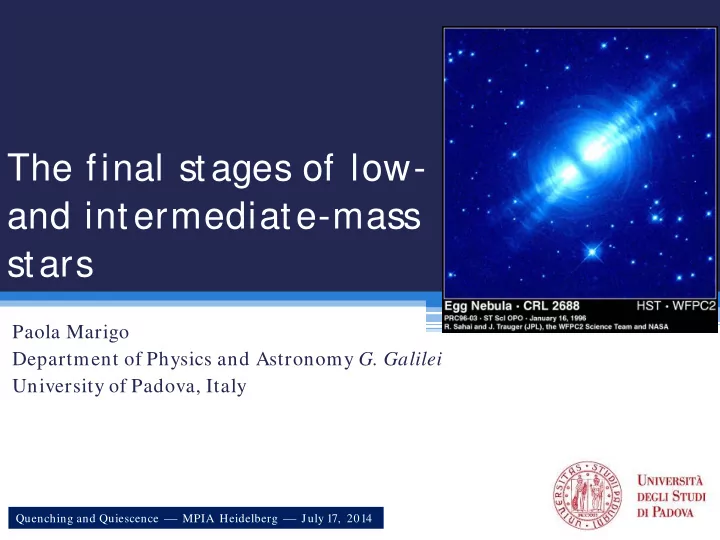
The final stages of low- and intermediate-mass stars Paola Marigo - - PowerPoint PPT Presentation
The final stages of low- and intermediate-mass stars Paola Marigo Department of Physics and Astronomy G. Galilei University of Padova, Italy Quenching and Quiescence MPIA Heidelberg July 17, 2014 Origin of the hot gas and silicate
Quenching and Quiescence MPIA Heidelberg July 17, 2014
2D hydrodynamical simulations of the interaction between the ambient ISM and the AGB wind + PN ejection
Parriott & Bregman, 2008, ApJ, 681, 1215 Bregman & Parriott 2009, ApJ, 699, 923
Input stellar parameters:
Spitzer spectra of early-type galaxies in Virgo
Bressan et al. 2006, ApJ, 639, L55
Silicate emission at 10𝜈𝜈 due to O-rich mass-losing dusty AGB stars?
Cid Fernandes R et al. MNRAS 2011;413:1687-1699
Debate on ionizing sources:
stars (Stasińska et al. 2008, MNRAS ,
391, L29)
massive star CSPN
Cid Fernandes R et al. MNRAS 2011;413:1687-1699
Post-AGB stars:
than massive OB stars
magnitude in qH at ages ∼ 10 8 yr, then flat evolution. Agreement between different SSPs models
Variations in qH by up to 1 dex for ages > 10 8 yr. m assive stars Post-AGB
Quenching and Quiescence MPIA Heidelberg July 17, 2014
Start of superwind Ionization Fast wind Extinction of H-shell burning Herwig 2005, ARA&A, 43, 435
Hot evolved low-mass stars:
Quenching and Quiescence MPIA Heidelberg July 17, 2014
Post-AGB (P-AGB) stars:
populations Initial masses 0.8 -8 M MS lifetimes: 108- 1010 yr PE-AGB and AGB-manqué stars:
masses to allow a full AGB phase.
prominent at high helium or α abundances when the mass loss on the RGB is high. Initial masses < 2 M MS lifetimes ≳ 0.6 109 yr PAGB: Vassiliadis & Wood ’94 All others: Bressan,Marigo,Girardi et al.2012
10 6-10 7 yr 10 3-10 4 yr 10 5-10 6 yr
knee of the track deceleration
More massive CS:
MAIN PARAMETERS:
⇒post-AGB evolution
Marigo et al. 2001
62 white dwarfs, most in open clusters Extension to the low-mass end: CPMPs Catalan et al. 2008
change of slope at 𝑁i ≈ 4 𝑁⨀ 𝑁WD and 𝑢cooling: spectral fitting (Teff and g) + grid of WD models and theoretical M-R relation 𝑁i: 𝜐 𝑁i = τ cluster − 𝑢cooling(WD) Uncertainties due to stellar evolution Age and metallicity of clusters
Thickness of the WD H/He layers Composition of the WD core (He, C-O, O-Ne) Initial-Final Mass Relation
The longer the AGB lifetime, the larger the final mass
exponential increase Superwind ⇒ PN ejection
vexp 𝑁 ̇ Pulsation-assisted dust-driven wind
Ramstedt et al. 2009 Vassiliadis & Wood 1993.
The efficiency 𝜇 = Δ𝜈du Δ𝜈H is poorly known Reduction of the core mass
The ACS Nearby Galaxy Survey Treasury
62 dwarf galaxies d < 4 Mpc All metallicities down to very low
AGB LFs ⇒ lifetimes initial-final mass relation
progenitors ⇒ core mass growth
Rosenfield et al. 2014, 2014arXiv1406.0676R Kalirai et al. 2014, ApJ, 782, 17
H-ionization (few 10 2 – few 10 4 yr)
t tr t cr
fast wind Depends on erosion rate of the envelope = At the top: stellar wind (uncertain) + At the bottom: displacement of the H-shell
LTP LTP LTP
LTP = Late Therm al Pulse
Luminosity and evolutionary speed affected by TPC phase φ at which the star leaves the AGB:
He-burners (15-25%) more prone to experience a LTP Slower evolution Less luminous
He-burners have longer timescales than H-burners
H-burner VW93 He-burner VW93 H-burner B95
Different models: different timescales
An example: a post-AGB star with M∼0.6 M The He burner emitts more ionizing photons than the H-burner does (factor of a few).
Cum ulative num ber of ionizing photons
He-burner VW93 H-burner VW93 H-burner B95
Mi-Mf relation:Weidemann 2000 Mi-Mf relation:Williams 2007 Mi-Mf relation:Kalirai et al. 2008
Marigo et al. 2013, MNRAS, 434, 488
Sample output of a TP-AGB model (Mi=5 M , Zi=0.008) computed up to the ejection of the envelope Specific rate of m ass loss from SSPs
Athey et al. 2002, ApJ, 571, 272
𝑵 ̇ ∗ 𝟐𝟐 𝐇𝐇𝐇 = 𝟒. 𝟕 𝟐𝟐−𝟐𝟐 𝑴𝑪 𝑴𝑪,⨀ 𝑵⨀ 𝐇𝐇−𝟐 (ongoing calibration) 𝑵 ̇ ∗ 𝟐𝟐 𝐇𝐇𝐇 = 𝟓. 𝟐 𝟐𝟐−𝟐𝟐 𝑴𝑪 𝑴𝑪,⨀ 𝑵⨀ 𝐇𝐇−𝟐 𝑵 ̇ 𝑻𝑻𝑻𝑻 𝟐𝟐 𝐇𝐇𝐇 = 𝟐. 𝟐 𝟐𝟐−𝟐𝟒 𝑴𝑪 𝑴𝑪,⨀ 𝑵⨀ 𝐇𝐇−𝟐
This research is supported under ERC Consolidator Grant funding scheme (project STARKEY)
Quenching and Quiescence MPIA Heidelberg July 17, 2014
HST/ WFC3-UVIS GALEX
Evolutionary tracks
PHAT data of M31
Globular Clusters
Rosenfield et al. 2012, ApJ, 755, 131 Schiavon et al., 2012, ApJ, 143, 121
Chul et al. 2011, ApJ., 740, L45
HR diagrams and SEDs
population [Fe/H] = −0.9 age=11 Gyr Helium-rich stars evolve faster ⇒ they have lower masses at given age. <Teff> of HB stars with Y = 0.33 is ∼ 11,500 K higher than for Y = 0.23 Y=0.23 normal helium Y=0.33 enhanced helium