Shared Access Networks Media Access Protocols More than two nodes - - PowerPoint PPT Presentation

shared access networks media access protocols
SMART_READER_LITE
LIVE PREVIEW

Shared Access Networks Media Access Protocols More than two nodes - - PowerPoint PPT Presentation

Shared Access Networks Media Access Protocols More than two nodes are attached to the same physical medium Normally span a small geographical area Referred to as Local Area


slide-1
SLIDE 1

Media Access Protocols

Kameswari Chebrolu

  • Dept. of Electrical Engineering, IIT Kanpur

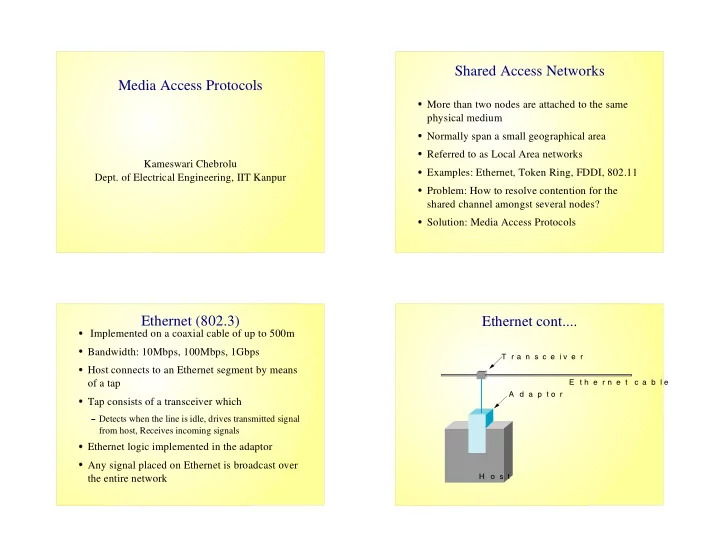
Shared Access Networks

  • More than two nodes are attached to the same

physical medium

  • Normally span a small geographical area
  • Referred to as Local Area networks
  • Examples: Ethernet, Token Ring, FDDI, 802.11
  • Problem: How to resolve contention for the

shared channel amongst several nodes?

  • Solution: Media Access Protocols

Ethernet (802.3)

  • Implemented on a coaxial cable of up to 500m
  • Bandwidth: 10Mbps, 100Mbps, 1Gbps
  • Host connects to an Ethernet segment by means
  • f a tap
  • Tap consists of a transceiver which

Detects when the line is idle, drives transmitted signal from host, Receives incoming signals

  • Ethernet logic implemented in the adaptor
  • Any signal placed on Ethernet is broadcast over

the entire network

Ethernet cont....

T r a n s c e i v e r E t h e r n e t c a b l e A d a p t o r H o s t

slide-2
SLIDE 2

Ethernet Repeater

Repeater Host

Frame Format

  • Preamble: 64 bit sequence of alternating 0's and 1's
  • Destination/Source Address: 48 bit address used to

identify hosts

Example: 00:0F:1F:D2:00:BB

  • Type: Identifies which of the higher layer protocols

this frame should be delivered

Dest addr 64 48 32 CRC Preamble Src addr Type Body 16 48

CSMA/CD Access Protocol

  • CSMA/CD: Carrier Sense Multiple Access with

Collision Detection

  • Carrier Sense means

All nodes can distinguish between an idle and busy link

  • Collision Detect means

A node listens as it transmits

It can detect interference from other node transmissions

  • Under heavy loads, utilization is only 30%

Maximum hosts limited to 1024

Receiver Side Algorithm

  • Each frame transmitted on the Ethernet is

received by every adaptor connected to it

  • An adaptors accepts only those frames

addressed to its own address

addressed to the broadcast address

addressed to multicast address it belongs to

all frames, if placed in promiscuous mode (special mode)

slide-3
SLIDE 3

Transmitter Side

  • If the line is idle, send immediately
  • If the line is busy, wait for it to become idle and

transmit immediately (1-persistent protocol)

  • If collision

Jam for 32 bits and stop transmission

To detect collisions, minimum frame size is set to 512 bits

Wait some time and try again (exponential back off)

  • 1st time: 0, 51.2 us
  • 2nd time: 0, 51.2, 102.4 or 153.6 us
  • nth time: waits k * 51.2us, k random between 0 and 2n - 1
  • Report a transmission error after 16 attempts

Token Rings (802.5, FDDI)

  • A set of hosts connected in a ring
  • Data flows in a particular direction around the ring

Each node receives from upstream neighbor and forward to downstream neighbor

  • Like in Ethernet, the ring is viewed as a single

shared medium

  • Bandwidths: 4Mbps, 16Mbps or 100Mbps
  • 250 stations per Ring

Token Ring Network Multistation Access Units

Host Host Host Host From previous MSAU

T To next

MSAU MSAU

slide-4
SLIDE 4

Basic Idea

  • A special bit pattern (24 bit token) rotates round the

ring

  • A host must capture token before transmitting a packet
  • As the packet flows past each node on the ring

Only the intended receiver copies the packet into its buffer

Only the sending host can remove the packet from the ring

  • After finishing transmission, sending host release token

back into the ring

Immediate release

Delayed release

  • Hosts get a Round-Robin service

Frame Format

  • Access control: Includes frame priority
  • Frame Control: Identifies higher layer protocol
  • Address fields: Similar to Ethernet, 48 bits long
  • Frame Status Byte: Provides reliability info.

“A” bit is set if the intended recipient sees the frame

“C” bit is set if the intended recipient copies the frame into its buffer successfully

Body Checksum Src addr Variable 48 Dest addr 48 32 End delimiter 8 Frame status 8 Frame control 8 Access control 8 Start delimiter 8

Token Ring Maintenance

  • A host acts as a “Monitor” to ensure the health of

the ring

  • A Monitor periodically transmits a special

control message

  • A Monitor is elected by transmitting a “claim”

token

Contention is broken by some well defined rule like “highest address wins”

Role of the Monitor

  • Ensures that there is always a token in the ring

A token can vanish due to bit errors, crash of a machine holding the token

Monitor employs a Timer and watches for a passing token

If timer expires before the token is seen, it creates a new one

Timer: NumStations * TokenHoldingTime + RingLatency

  • Checks for corrupted or orphaned frames

They are detected using the “monitor” bit in the header

At transmission, this bit is set to 0, first time monitor sees the packet, this bit is set to 1

Monitor drains off the ring any packet with monitor bit set to 1

slide-5
SLIDE 5

Summary

  • Looked at how to mediate access to a shared link
  • Two different protocols: Ethernet CSMA/CD

and token ring

Protocols are distributed in nature

  • Moving on to “How to make two hosts talk

when they are not directly connected?”