Summary of MAC protocols What do you do with a shared media? - - PDF document

summary of mac protocols
SMART_READER_LITE
LIVE PREVIEW

Summary of MAC protocols What do you do with a shared media? - - PDF document

Summary of MAC protocols What do you do with a shared media? Channel Partitioning, by time, frequency or code Time Division,Code Division, Frequency Division Random partitioning (dynamic), Medium Access Protocols ALOHA,


slide-1
SLIDE 1

Medium Access Protocols Summary of MAC protocols

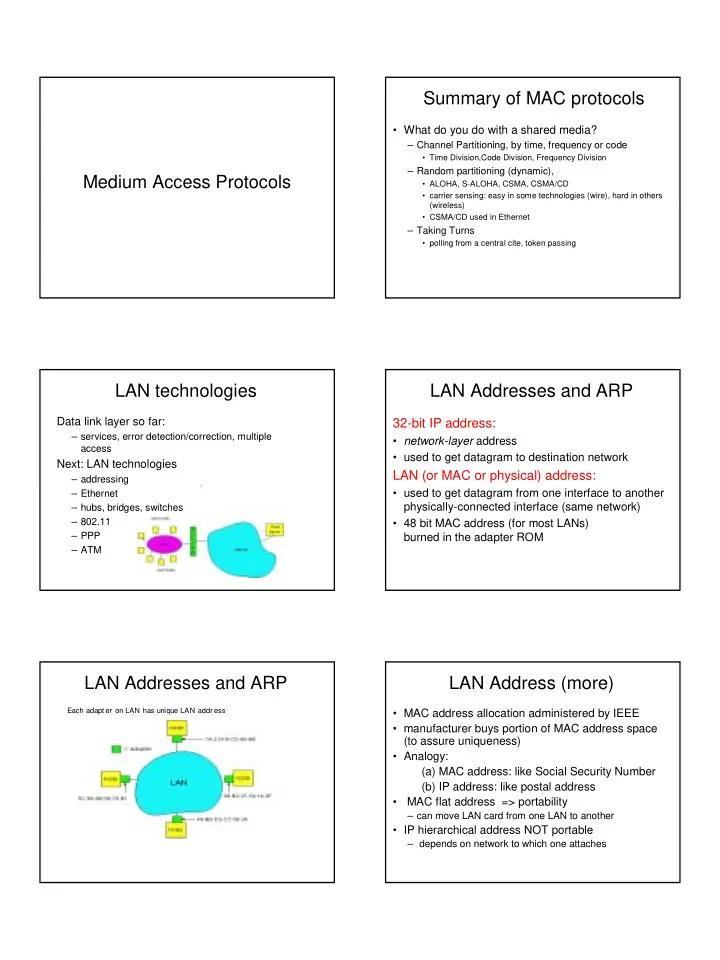
  • What do you do with a shared media?

– Channel Partitioning, by time, frequency or code

  • Time Division,Code Division, Frequency Division

– Random partitioning (dynamic),

  • ALOHA, S-ALOHA, CSMA, CSMA/CD
  • carrier sensing: easy in some technologies (wire), hard in others

(wireless)

  • CSMA/CD used in Ethernet

– Taking Turns

  • polling from a central cite, token passing

LAN technologies

Data link layer so far:

– services, error detection/correction, multiple access

Next: LAN technologies

– addressing – Ethernet – hubs, bridges, switches – 802.11 – PPP – ATM

LAN Addresses and ARP

32-bit IP address:

  • network-layer address
  • used to get datagram to destination network

LAN (or MAC or physical) address:

  • used to get datagram from one interface to another

physically-connected interface (same network)

  • 48 bit MAC address (for most LANs)

burned in the adapter ROM

LAN Addresses and ARP

Each adapt er on LAN has unique LAN addr ess

LAN Address (more)

  • MAC address allocation administered by IEEE
  • manufacturer buys portion of MAC address space

(to assure uniqueness)

  • Analogy:

(a) MAC address: like Social Security Number (b) IP address: like postal address

  • MAC flat address => portability

– can move LAN card from one LAN to another

  • IP hierarchical address NOT portable

– depends on network to which one attaches

slide-2
SLIDE 2

Ethernet IP Source IP: 130.245.20.1 Ethernet: 0A:03:21:60:09:FA IP Destination IP: 130.245.20.2 Ethernet: 0A:03:23:65:09:FB ARP Query What is the Ethernet Address of 130.245.20.2 ARP Response 0A:03:23:65:09:FB

Address Resolution Protocol (ARP)

  • Maps IP addresses to Ethernet Addresses
  • ARP responses are cached

ARP protocol

  • A knows B's IP address, wants to learn

physical address of B

  • A broadcasts ARP query pkt, containing B's

IP address – all machines on LAN receive ARP query

  • B receives ARP packet, replies to A with its

(B's) physical layer address

  • A caches (saves) IP-to-physical address pairs

until information becomes old (times out) – soft state: information that times out (goes away) unless refreshed

Ethernet

“dominant” LAN technology:

  • cheap $20 for 100Mbs!
  • first widely used LAN technology
  • Simpler, cheaper than token ring LANs and ATM
  • Kept up with speed race: 10, 100, 1000 Mbps

Met calf e’s Et her net sket ch

Ethernet Frame Structure

Sending adapter encapsulates IP datagram (or

  • ther network layer protocol packet) in

Ethernet frame Preamble:

  • 7 bytes with pattern 10101010 followed by
  • ne byte with pattern 10101011
  • used to synchronize receiver, sender clock

rates

Ethernet Frame Structure (more)

  • Addresses: 6 bytes, frame is received by all

adapters on a LAN and dropped if address does not match

  • Type/length: indicates the higher layer protocol,

mostly IP but others may be supported such as Novell IPX and AppleTalk)

  • CRC: checked at receiver, if error is detected, the

frame is simply dropped

Ethernet: uses CSMA/CD

A: sense channel, if idle

then { transmit and monitor the channel;

I f det ect anot her t r ansmission then { abor t and send j am signal; updat e # collisions; delay as r equir ed by exponent ial backof f algor it hm; got o A } else {done wit h t he f r ame; set collisions t o zer o}

}

else {wait until ongoing transmission is over and goto A}

slide-3
SLIDE 3

Ethernet’s CSMA/CD (more)

Jam Signal: make sure all other transmitters are aware

  • f collision; 48 bits;

Exponential Backoff:

  • Goal: adapt retransmission attempts to estimated

current load

– heavy load: random wait will be longer

  • first collision: choose K from {0,1}; delay is K x 512

bit transmission times

  • after second collision: choose K from {0,1,2,3}…
  • after ten or more collisions, choose K from

{0,1,2,3,4,…,1023}

Ethernet Technologies: 10Base2

  • 10: 10Mbps; 2: under 200 meters max cable length
  • thin coaxial cable in a bus topology
  • repeaters used to connect up to multiple segments
  • repeater repeats bits it hears on one interface to its
  • ther interfaces: physical layer device only!

10BaseT and 100BaseT

  • 10/100 Mbps rate; latter called “fast ethernet”
  • T stands for Twisted Pair
  • Hub to which nodes are connected by twisted pair,

thus “star topology”

  • CSMA/CD implemented at hub

10BaseT and 100BaseT (more)

  • Max distance from node to Hub is 100 meters
  • Hub can disconnect “jabbering adapter
  • Hub can gather monitoring information, statistics for

display to LAN administrators

Gbit Ethernet

  • use standard Ethernet frame format
  • allows for point-to-point links and shared broadcast

channels

  • in shared mode, CSMA/CD is used; short distances

between nodes to be efficient

  • uses hubs, called “Buffered Distributors”
  • Full-Duplex at 1 Gbps for point-to-point links

Token Passing: IEEE802.5 standard

  • 4 Mbps
  • max token holding time: 10 ms, limiting frame length
  • SD, ED mark start, end of packet
  • AC: access control byte:

– token bit: value 0 means token can be seized, value 1 means data follows FC – priority bits: priority of packet – reservation bits: station can write these bits to prevent stations with lower priority packet from seizing token after token becomes free

slide-4
SLIDE 4

Token Passing: IEEE802.5 standard

  • FC: frame control used for monitoring and

maintenance

  • source, destination address: 48 bit physical address,

as in Ethernet

  • data: packet from network layer
  • checksum: CRC
  • FS: frame status: set by dest., read by sender

– set to indicate destination up, frame copied OK from ring – DLC-level ACKing

Interconnecting LANs

Q: Why not just one big LAN?

  • Limited amount of supportable traffic: on single LAN,

all stations must share bandwidth

  • limited length: 802.3 specifies maximum cable

length

  • large “collision domain” (can collide with many

stations)

  • limited number of stations: 802.5 have token

passing delays at each station

Hubs

  • Physical Layer devices: essentially repeaters
  • perating at bit levels: repeat received bits on
  • ne interface to all other interfaces
  • Hubs can be arranged in a hierarchy (or

multi-tier design), with backbone hub at its top

Hubs (more)

  • Each connected LAN referred to as LAN segment
  • Hubs do not isolate collision domains: node may collide

with any node residing at any segment in LAN

  • Hub Advantages:

– simple, inexpensive device – Multi-tier provides graceful degradation: portions of the LAN continue to operate if one hub malfunctions – extends maximum distance between node pairs (100m per Hub)

Hub limitations

  • single collision domain results in no increase in max

throughput – multi-tier throughput same as single segment throughput

  • individual LAN restrictions pose limits on number of nodes in

same collision domain and on total allowed geographical coverage

  • cannot connect different Ethernet types (e.g., 10BaseT and

100baseT)

Bridges

  • Link Layer devices: operate on Ethernet frames,

examining frame header and selectively forwarding frame based on its destination

  • Bridge isolates collision domains since it buffers

frames

  • When frame is to be forwarded on segment, bridge

uses CSMA/CD to access segment and transmit

slide-5
SLIDE 5

Bridges (more)

  • Bridge advantages:

– Isolates collision domains resulting in higher total max throughput, and does not limit the number of nodes nor geographical coverage – Can connect different type Ethernet since it is a store and forward device – Transparent: no need for any change to hosts LAN adapters

Bridges: frame filtering, forwarding

  • bridges filter packets

– same-LAN -segment frames not forwarded onto

  • ther LAN segments
  • forwarding:

– how to know which LAN segment on which to forward frame? – looks like a routing problem (more shortly!)

Backbone Bridge

Interconnection Without Backbone

  • Not recommended for two reasons:
  • single point of failure at Computer Science hub
  • all traffic between EE and SE must path over CS segment

Bridge Filtering

  • bridges learn which hosts can be reached through which

interfaces: maintain filtering tables – when frame received, bridge “learns” location of sender: incoming LAN segment – records sender location in filtering table

  • filtering table entry:

– (Node LAN Address, Bridge Interface, Time Stamp) – stale entries in Filtering Table dropped (TTL can be 60 minutes)

Bridge Filtering

  • filtering procedure:

if destination is on LAN on which frame was received then drop the frame else { lookup filtering table if entry found for destination

then f orwar d t he f rame on int er f ace indicat ed; else f lood; / * f orwar d on all but t he int er f ace on which t he f r ame arr ived* / }

slide-6
SLIDE 6

Bridge Learning: example

Suppose C sends frame to D and D replies back with frame to C

  • C sends frame, bridge has no info about D,

so floods to both LANs

– bridge notes that C is on port 1 – frame ignored on upper LAN – frame received by D

Bridge Learning: example

  • D generates reply to C, sends

– bridge sees frame from D – bridge notes that D is on interface 2 – bridge knows C on interface 1, so selectively forwards frame out via interface 1

Spanning Tree

  • The learning bridge fails when the network topology

has a loop.

– Why?

  • Loops are not necessarily bad. They provide

redundancy that can be used to recover from failures

  • To handle loops, bridges implement the spanning

tree algorithm.

– The spanning tree algorithm imposes a logical tree over the physical topology – Data is only transferred along links that belong to the spanning tree

Spanning Tree Algorithm

  • Each bridge has unique id (e.g., B1, B2, B3)
  • Select bridge with smallest id as root
  • Select bridge on each LAN closest to root as designated bridge (use

id to break ties)

  • Each bridge forwards frames over each LAN for which it is the

designated bridge

B3 A C E D B2 B5 B B7 K F H B4 J B1 B6 G I

Spanning Tree Algorithm (contd.)

  • Bridges exchange configuration messages called

CBPDU’s(Configuration Bridge Protocol Data Unit)

– id for bridge sending the message – id for what the sending bridge believes to be root bridge – distance (hops) from sending bridge to root bridge

  • Each bridge records the current best configuration

message for each port

  • Initially, each bridge believes it is the root

Spanning Tree Algorithm (contd.)

  • When a bridge learns that it is not the root it stops generating

configuration messages

– in steady state, only root generates configuration messages

  • When the bridge learns that it is not the designated bridge, it

stops forwarding configuration messages

– in steady state, only designated bridges forward config messages

  • Root continues to periodically send config messages
  • If any bridge does not receive successive config messages, it

starts generating config messages claiming to be the root – This is used to recover from root failure

slide-7
SLIDE 7

Limitations of Bridges

  • Do not scale

– spanning tree algorithm does not scale – single large broadcast domains do not scale

  • Do not accommodate heterogeneity

– Bridges support ethernet to ethernet, ethernet to 802.5 and 802.5 to 802.5.

  • Caution: beware of transparency

– Applications that assume that they are executing on a single LAN will fail. – Latency increases in large LANs, so does jitter

WWF Bridges vs. Routers

  • both store-and-forward devices

– routers: network layer devices (examine network layer headers) – bridges are Link Layer devices

  • routers maintain routing tables, implement

routing algorithms

  • bridges maintain filtering tables, implement

filtering, learning and spanning tree algorithms

Routers vs. Bridges

Bridges + and - + Bridge operation is simpler requiring less processing bandwidth

  • Topologies are restricted with bridges: a spanning

tree must be built to avoid cycles

  • Bridges do not offer protection from broadcast

storms (endless broadcasting by a host will be forwarded by a bridge)

Routers vs. Bridges

Routers + and - + arbitrary topologies can be supported, cycling is limited

by TTL counters (and good routing protocols) + provide firewall protection against broadcast storms

  • require IP address configuration (not plug and play)
  • require higher processing bandwidth
  • bridges do well in small (few hundred hosts) while

routers used in large networks (thousands of hosts)