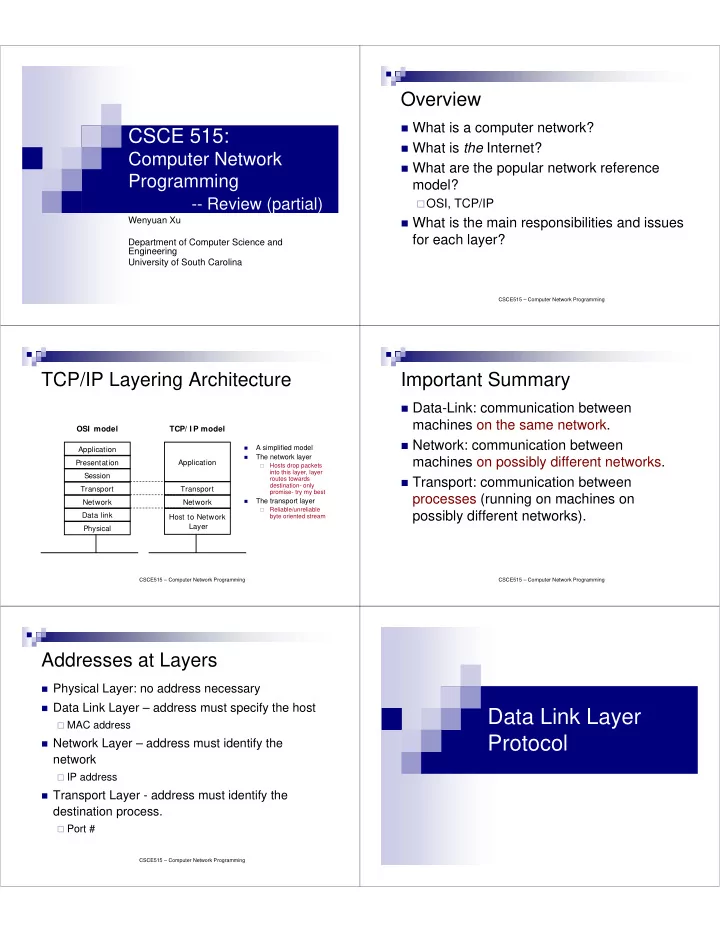
Data Link Layer MAC address Protocol Network Layer address must - - PDF document

data link layer
SMART_READER_LITE
LIVE PREVIEW

Data Link Layer MAC address Protocol Network Layer address must - - PDF document

Overview What is a computer network? CSCE 515: What is the Internet? Computer Network What are the popular network reference Programming model? -- Review (partial) OSI, TCP/IP Wenyuan Xu What is the main responsibilities


slide-1
SLIDE 1

CSCE 515:

Computer Network Programming

  • - Review (partial)

Wenyuan Xu Department of Computer Science and Engineering University of South Carolina

CSCE515 – Computer Network Programming

Overview

What is a computer network? What is the Internet? What are the popular network reference

model?

OSI, TCP/IP

What is the main responsibilities and issues

for each layer?

CSCE515 – Computer Network Programming

TCP/IP Layering Architecture

  • A simplified model
  • The network layer
  • Hosts drop packets

into this layer, layer routes towards destination- only promise- try my best

  • The transport layer
  • Reliable/unreliable

byte oriented stream

Application Presentation Session Transport Network Data link Physical Transport Network Application Host to Network Layer OSI model TCP/ I P model

CSCE515 – Computer Network Programming

Important Summary

Data-Link: communication between

machines on the same network.

Network: communication between

machines on possibly different networks.

Transport: communication between

processes (running on machines on possibly different networks).

CSCE515 – Computer Network Programming

Addresses at Layers

Physical Layer: no address necessary Data Link Layer – address must specify the host

MAC address

Network Layer – address must identify the

network

IP address

Transport Layer - address must identify the

destination process.

Port #

Data Link Layer Protocol

slide-2
SLIDE 2

CSCE515 – Computer Network Programming

Date Link Layer Functionality

What is the main Functionality of date link layer? Provides reliable transfer of information between two adjacent nodes What is the service provided by data link layer? Encoding: Convert bits to signals and recover bits from received signals Framing: decide on a minimum unit for sending bits Error detection and /or correction of frames

Parity, CRC

Flow control

ARQ, Sliding WINDOW

CSCE515 – Computer Network Programming

Framing

A frame is a group of bits, typically in sequence Issues:

Frame creation Frame delineation

Use starting and ending characters (tags) to mark

boundaries of frame

Problem: what if tag characters occur in the date or

control portions of the frame

Use preamble + packet length

CSCE515 – Computer Network Programming

Error Control

No physical link is perfect, bits will be corrupted We can either:

Detect errors and request retransmission Or correct errors without retransmission

Error Detection

Parity bits Polynomial codes or checksums Cyclic Redundancy Check (CRC) Given a polynomial code and a message, what is the

checksummed message

Given a checksummed message, can you determine whether

there are errors.

CSCE515 – Computer Network Programming

Ethernet - A Real Data-Link Layer

What is header of a typical Ethernet frame? How is Ethernet connected? What is the address used in Ethernet?

example: 08:00:e4:b1:20

What is the basic protocol? -- CSMA/CD

Multi-access (shared medium)

many hosts on 1 wire

Carrier sense:

can tell when another host is transmitting

Collision detection:

How can a device detect collision? How to avoid two device collide again? CSCE515 – Computer Network Programming

Transmit Algorithm

If line is idle…

send immediately upper bound message size of 1500 bytes must wait 9.6us between back-to-back frames

If line is busy…

wait until idle and transmit immediately

CSCE515 – Computer Network Programming

Collisions

slide-3
SLIDE 3

CSCE515 – Computer Network Programming

Ethernet Backoff Algorithm

If collision,

How to detect collision? jam for 32 bits, then stop transmitting frame minimum frame is 64 bytes (header + 46 bytes of data)

WHY?

Choose one slot randomly from 2k slots, where k is the

number of collisions the frame has suffered.

One contention slot length = 2 x end-to-end

propagation delay

If 16 backoffs occur, the transmission of the frame is

considered a failure.

IP- Network Layer

CSCE515 – Computer Network Programming

IP - Network Layer

Provide delivery of packets from

  • ne host in the Internet to any
  • ther host in the Internet, even if

the hosts are on different networks

Connectionless Delivery (each

datagram is treated individually).

Unreliable (delivery is not

guaranteed).

Fragmentation / Reassembly

(based on hardware MTU).

Routing. Error detection

Regional Network 3

Regional Network 1

Backbones Regional Network 2

CSCE515 – Computer Network Programming

IP Addresses

IP addresses are not the same as the underlying

data-link (MAC) addresses. WHY?

IP addresses are logical addresses (not physical) 32 bits. Includes a network ID and a host ID. When an organization applies for IP address,

they get a network ID.

CSCE515 – Computer Network Programming

The four formats of IP Addresses

32 bits long: 129.252.138.8

0 NetID 10 110 NetID 1110 Multicast Address HostID NetID HostID HostID

Class Class A A B B C C D D

8 bits 8 bits 8 bits 8 bits

What is this IP address? class B? What is this IP address? class B? How many How many hostIDs hostIDs possible? possible?

CSCE515 – Computer Network Programming

Class A

128 possible network IDs

  • ver 4 million host IDs per network ID

Class A Class A

128 possible network IDs

  • ver 4 million host IDs per network ID

Class B Class B 16K possible network IDs 64K host IDs per network ID Class C Class C

  • ver 2 million possible network IDs

about 256 host IDs per network ID

slide-4
SLIDE 4

CSCE515 – Computer Network Programming

Host and Network Addresses

A single network interface is assigned a single IP

address called the host address.

A host may have multiple interfaces, and

therefore multiple host addresses.

Hosts that share a network all have the same IP

network address (the network ID).

Display all network interface on a host

ifconfig –a netstat -i

CSCE515 – Computer Network Programming

IP Routing

Actual routing table contains: destination IP address, IP address of next-hop router, network interface, Flag

CSCE515 – Computer Network Programming

IP Routing

Forwarding:

When each packet arrives, looking up the outgoing line

to use for it in the routing table

Done on a hop-by-hop basis If destination is directly connected or on a shared

network, send IP datagram directly to destination

Otherwise send datagram to a default router

Routing updates

filling in and updating the routing tables

CSCE515 – Computer Network Programming

Mapping IP Addresses to/from Hardware Addresses

Address Resolution Protocol

How? Why? When?

Reverse Address Resolution

How? Why? When?

CSCE515 – Computer Network Programming

IP Addresses

Subnet Addressing

To make better use of class A and class B

addresses, divide host ID into subnet ID and host ID

14 16 14 8 8

10

NetID

SubnetID HostID

10 NetID HostID

Class B Class B

CSCE515 – Computer Network Programming

Subnet Mask

32-bit value containing “1” bits for network ID and

subnet ID, and “0” bits for host ID

14 8 8

1 1 1 1 1 1 1 1 1 1 1 1 1 1 1 1 1 1 1 1 1 1 1 1 0 0 0 0 0 0 0 0

255.255 .255 .0 0xFFFF FF 00

B B

10

NetID

SubnetID HostID Example: A and B are class B addresses, using the same subnet mask. A = 165.230.82.52 B = 165.230.24.93 Same network? M = 255.255.255.0 Same subnet?

slide-5
SLIDE 5

CSCE515 – Computer Network Programming

Subnetting

It is possible to have a single wire network

with multiple subnets?

CSCE515 – Computer Network Programming

Variable length subnetting

Subnet masks allow power of 2 subnets Use a hierarchy of routers to allow subnets to be

divided with different subnet masks

Another approach:

Variable length subnet masks Allow a subnet to be defined by more than two masks The router applies the masks one after another

mask: 255.255.255.128 255.255.255.192 subnet 1 subnet 2,3 mask: 255.255.255.128 subnet: 221.2.3.0 mask: 255.255.255.192 subnet: 221.2.3.128 subnet: 221.2.3.192 CSCE515 – Computer Network Programming

Question

If an ISP has a 203.6.8.0 Network, he has

5 customers who in turn has a network of 60, 60, 60, 30, 30 hosts. If the ISP wants to assign a subnet to each customer

What should the subnet mask be? What is the address range in each subnet? What should the routing table entries be?

CSCE515 – Computer Network Programming

CIDR - (classless Inter domain routing)

Original addressing schemes (class-based): 32 bits divided into 2 parts: Class A Class B Class C Class C address has max of 254 hosts Not enough for many organizations Too many class C addresses huge routing tables

Use CIDR address mask to aggregate

CIDR introduced to solve 2 problems: exhaustion of IP address space size and growth rate of routing table

0 NetID HostID 10 NetID HostID

110 NetID HostID

CSCE515 – Computer Network Programming

Address Arithmetic: Address Blocks

Address format <IP address/prefix P>.

The prefix denotes the upper P bits of the IP address. Can be used to specify arbitrary blocks of addresses

The <address/prefix> pair defines an address block:

Examples: 200.15.0.0/16 => [ 200.15.0.0 - 200.15.255.255 ] 192.24.0.0/13 => [ 192.24.0.0 - 192.31.255.255 ]

192.00011000.0.0

13th bits fixed Variable

CSCE515 – Computer Network Programming

Example of CIDR

CIDR Block Prefix # Equivalent Class C # of Host Addresses /27 1/8th of a Class C 32 hosts /26 1/4th of a Class C 64 hosts /25 1/2 of a Class C 128 hosts /24 1 Class C 256 hosts /23 2 Class C 512 hosts … /15 512 Class C 131,072 hosts /14 1,024 Class C 262,144 hosts /13 2,048 Class C 524,288 hosts

slide-6
SLIDE 6

CSCE515 – Computer Network Programming

CIDR: Classless Inter-Domain Routing

Q: Say an ISP has 192.5.48.0, 192,5.49.0, 192.5.50.0,

192, 51.0, what should the IP address advertised be? A: 192.5.48.0/22

Q: Say an ISP has 200.8.4/24 address, how many

addresses are included? A: 256 addresses

Q: If a customer needs only 4 addresses from 200.8.4.24,

then what the address should be specified? A: 200.8.4.24/30

CSCE515 – Computer Network Programming

Other Developments: NAT

NAT- Network address translation Why NAT? How NAT work? Hosts need not have unique global IP address

Hosts are assigned private addresses 10.0, 172.16 to 172.31 and 192.168. Are allocated for

private hosts (Hmmm, what if those addresses appear

  • n the Internet themselves?)

Packets from private hosts are replaced with

source address of NAT gateway, use port# to uniquely do the reverse translation.

Transportation Layer

CSCE515 – Computer Network Programming

TCP UDP IP 802.3

Process Layer Transport Layer Network Layer Data-Link Layer

Process Process

ICMP, ARP & RARP

CSCE515 – Computer Network Programming

UDP vs. TCP

What is the difference between UDP & TCP?

Connection oriented VS. Connectionless many others…..

Q: Which protocol is better ? Q: Which protocol is better ? A: It depends on the application. A: It depends on the application. TCP provides a connection TCP provides a connection-

  • oriented, reliable, byte stream
  • riented, reliable, byte stream

service (lots of overhead). service (lots of overhead). UDP offers minimal datagram delivery service (as little UDP offers minimal datagram delivery service (as little

  • verhead as possible).
  • verhead as possible).

CSCE515 – Computer Network Programming

UDP

Datagram Delivery Connectionless Unreliable Minimal

Source Port Destination Port Length Checksum Data

UDP Datagram Format UDP Datagram Format

The term datagram is also used to describe the unit of transfer of UDP!

slide-7
SLIDE 7

CSCE515 – Computer Network Programming

TCP

TCP provides the end-to-end reliable

connection that IP alone cannot support

The TCP protocol

Frame format Connection Creation Flow control Congestion control Connection termination

CSCE515 – Computer Network Programming

Addressing in TCP/IP

Each TCP/IP address includes:

Internet Address Protocol (UDP or TCP) Port Number

NOTE: TCP/IP is a protocol suite that includes IP, TCP and UDP.

CSCE515 – Computer Network Programming

  • Hmmmmm. TCP or UDP ?

Electronic commerce? Video server? File transfer? Email ? Chat groups? Robotic surgery controlled remotely over a

network?

CSCE515 – Computer Network Programming

TCP Segment Format

15 16 31 20 bytes

destination port number urgent pointer TCP checksum

  • ption (if any)

source port number window size sequence number acknowledgment number

header length reserved

U R G A C K P S H R S T S Y N F I N

data (if any)

CSCE515 – Computer Network Programming

TCP segment

There are a bunch of control flags:

URG: urgent data included. ACK: this segment is (among other things) an

acknowledgement.

RST: error - abort the session. SYN: Used to establish connection; synchronize

Sequence Numbers (setup)

FIN: polite connection termination.

CSCE515 – Computer Network Programming

Client Server

SYN ISN=X SYN ISN=X

1

SYN ISN=Y ACK=X+1 SYN ISN=Y ACK=X+1

2

ACK=Y+1 ACK=Y+1 3

time

TCP Connection Establishment

– Three-way handshake

“I want to talk, and I’m starting with byte number X+1”. “OK, I’m here and I’ll

  • talk. My first byte will

be called number Y+1, and I know your first byte will be number X+1” “Got it - you start at byte number Y+1”.

slide-8
SLIDE 8

CSCE515 – Computer Network Programming

Why 3-Way?

Why is the third message necessary? HINTS:

TCP is a reliable service. IP delivers each TCP segment. IP is not reliable.

CSCE515 – Computer Network Programming

TCP Flow Control

Sender

Application does a 2K write Application reads 2k Sender is blocked

2K SEQ=0

empty receiver 4K

recv’s buffer

2K

ACK = 2048 WIN = 2048

Application does a 3K write

2K SEQ=2048

Full

ACK = 4096 WIN = 0 ACK = 4096 WIN = 2048 1k SEQ=4096

Sender may send up to 2k

2K 1K 2K

CSCE515 – Computer Network Programming

App1 App2

FIN SN=X FIN SN=X

1

ACK=X+1 ACK=X+1 2 ACK=Y+1 ACK=Y+1 4 FIN SN=Y FIN SN=Y

3

...

“I have no more data for you” FIN_WAIT_1

“OK, I understand you

are done sending.” CLOSE_WAIT “OK - Now I’m also done sending data”. LAST_ACK “Over and Out, Goodbye” TIME_WAIT

TCP Termination

FIN_WAIT_2 CLOSED

CSCE515 – Computer Network Programming

Test Questions

Why is a 3-way handshake necessary? Who sends the first FIN - the server or the

client?

Once the connection is established, what

is the difference between the operation of the server’s TCP layer and the client’s TCP layer?

What happens if a bad guy can guess

ISNs?

Socket Programming

CSCE515 – Computer Network Programming

Socket?

What is Socket? Network API, developed by Berkeley Between which two layers do the socket sit? What is the wish list of a socket? What functions should the socket provide? What are the elements of a Socket? What is a socket descriptor? What are the two typical socket types? Stream sockets Datagram sockets

slide-9
SLIDE 9

CSCE515 – Computer Network Programming

Network API

OSI model I nternet protocol suite Application Presentation Session Transport Network Data link Physical TCP IPv4, IPv6 Application Data link Physical UDP

User processor kernel Application details Communications details

CSCE515 – Computer Network Programming

Socket Descriptor Data Structure

Descriptor Table Descriptor Table

1 2 3 4

Family: PF_INET Service: SOCK_STREAM Local IP: 111.22.3.4 Remote IP: 123.45.6.78 Local Port: 2249 Remote Port: 3726 Family: PF_INET Family: PF_INET Service: SOCK_STREAM Service: SOCK_STREAM Local IP: 111.22.3.4 Local IP: 111.22.3.4 Remote IP: 123.45.6.78 Remote IP: 123.45.6.78 Local Port: 2249 Local Port: 2249 Remote Port: 3726 Remote Port: 3726

int s, family, type, protocol; s = socket(family, type, protocol); etc... cc = read(s, buf, nbytes);

CSCE515 – Computer Network Programming

Socket system calls

General Use

read() write() close()

  • Connection

Connection-

  • oriented (TCP)
  • riented (TCP)

– – socket() socket() – – connect() connect() – – listen() listen() – – accept() accept()

  • Connectionless (UDP)

Connectionless (UDP)

– – send() send()

  • connect()

connect() – – recv recv() ()

  • bind()

bind() – – sendto sendto() ()

  • socket()

socket() – – recvfrom recvfrom() ()

CSCE515 – Computer Network Programming

You should know…

What does each system call do? Can each system call be used in TCP/UDP

socket?

I do not expect you to remember the

sequence of each parameter, but you should know:

How to set each parameter? What is the typical return value?

Can you understand and explain:

myaddr.sin_addr.s_addr = htonl(INADDR_ANY);

Practical issues

How is endpoint address specified? and…

CSCE515 – Computer Network Programming

Network Byte Order

What is network byte order? Why do we need Network Byte Order? When and how should we use the network byte functions? What are network byte order functions:

‘h’ : host byte order ‘n’ : network byte order ‘s’ : short (16bit) ‘l’ : long (32bit) uint16_t htons(uint16_t); uint16_t ntohs(uint_16_t); uint32_t htonl(uint32_t); uint32_t ntohl(uint32_t);

CSCE515 – Computer Network Programming

TCP Sockets Programming

How to create a TCP socket

sock = socket(PF_INET, SOCK_STREAM, 0);

What the typical work flow for a server?

How to establish an passive mode TCP socket? In which function is the following procedure implemented?

Tell the kernel to accept incoming connection requests directed at the

socket address. 3-way handshake

Tell the kernel to queue incoming connections for us.

How to send/receive data. How to terminate a connection.

close()

reading EOF

What the typical work flow for a client?

Where is 3-way handshake done?

slide-10
SLIDE 10

CSCE515 – Computer Network Programming

Client-Server Communication (TCP)

socket() bind() listen() accept() read() write() read() close() socket() connect() write() read() close()

TCP Client TCP Server

well-known port blocks until connection from client process request connection establishment data(request) data(reply) e n d

  • f
  • f

i l e n

  • t

i f i c a t i

  • n

CSCE515 – Computer Network Programming

listen()

Server TCP

3-way handshake complete

accept

arriving SYN Completed connection queue Incomplete connection queue Sum of both queues cannot exceed backlog

UDP Socket

CSCE515 – Computer Network Programming

UDP Sockets Programming

  • How to create UDP sockets?

sock = socket(PF_INET, SOCK_DGRAM,0);

  • What is the typical workflow for:

Client Server

  • How to send data?

sendto()

  • How to receive data?

recvfrom()

  • If buff is not large enough, any extra data is lost forever...
  • Timeout for recvfrom()
  • Connected mode?

Why? How? Who can? CSCE515 – Computer Network Programming

Client-Server Communication (UDP)

socket() bind() recvfrom() sendto() socket() sendto() recvfrom() close()

UDP Client UDP Server

well-known port

blocks until datagram received from client process request

data(request) data(reply)

CSCE515 – Computer Network Programming

recvfrom()and alarm()

signal(SIGALRM, sig_alrm); alarm(max_time_to_wait); if (recvfrom(…)<0) if (errno==EINTR) /* timed out */ else /* some other error */ else /* no error or time out

  • turn off alarm */

alarm(0); There are some other (better) ways to do this - check out section 14.2

static void sig_alrm(int signo) { return; }

slide-11
SLIDE 11

CSCE515 – Computer Network Programming

Connected mode

A UDP socket can be used in a call to. What will OS do after connect()is called?

Register the address of the peer in OS No handshake No data is sent

Once a UDP socket is connected:

can use write() and send() can use read() and recv()

  • nly datagrams from the peer will be returned.

CSCE515 – Computer Network Programming

Connected UDP sockets for TFTP Concurrency

Client 2 UDP

UDP datagram

Client 1 UDP TFTP Server

UDP(69) UDP datagram UDP(9000) UDP(9001)

CSCE515 – Computer Network Programming

Questions

Can UDP socket connected to a broadcast

address?

A: yes, a connected UDP socket exchanges

datagrams with only one IP address

Server A is connected to a broadcast

address, so….

Can this UDP socket send? Can this UDP socket Receive?

IO Multiplexing

CSCE515 – Computer Network Programming

I/O Multiplexing

Why do we need I/O Multiplexing?

need to be able to monitor multiple descriptors

What are the options to achieve IO Multiplexing?

What are the cons and pros for each option?

Use nonblocking I/O.

use fcntl() to set O_NONBLOCK

Use alarm and signal handler to interrupt slow system

calls.

Use multiple processes/threads. Use functions that support checking of multiple input

sources at the same time.

CSCE515 – Computer Network Programming

Using select()

What does select() do?

system call allows us to use blocking I/O on a set of

descriptors (file, socket, …).

How to use select()

Create fd_set Clear the whole thing with FD_ZERO Add each descriptor you want to watch using

FD_SET.

Call select when select returns, use FD_ISSET to see if I/O

is possible on each descriptor.

slide-12
SLIDE 12

CSCE515 – Computer Network Programming

Advanced programming

JAVA RMI Daemons

daemon initiation system message output mechanism inetd

Multicast socket programming

Applications

CSCE515 – Computer Network Programming

Application list

TELNET RLOGIN FTP TFTP HTTP DNS SMTP, POP3 Q: What are their usage?

  • Remote login? File transfer?

Q: which transportation protocol used? TCP, UDP? Q: How is data being transferred between a server and a client? Q: What are the challenges/design issues for each application? How

have those issues been solved?

CSCE515 – Computer Network Programming

TELNET Client and Server

TELNET client

terminal driver TCP/IP

kernel

user at a terminal

TELNET server

TCP/IP pseudo- terminal driver

kernel

login shell terminal driver

kernel

user at a terminal login shell

Only ONE TCP connection !!! Q: How to distinguish control information

  • vs. data?

CSCE515 – Computer Network Programming

TFTP -- Sorcerer’s Apprentice Syndrome

send DATA[n] (time out) retransmit DATA[n] receive ACK[n] send DATA[n+1] receive ACK[n] (dup) send DATA[n+1](dup) ... receive DATA[n] send ACK[n] receive DATA[n] (dup) send ACK[n] (dup) receive DATA[n+1] send ACK[n+1] receive DATA[n+1] (dup) send ACK[n+1] (dup)

CSCE515 – Computer Network Programming

The Fix

Sender should not resend a data packet in

response to a duplicate ACK.

If sender receives ACK[n] - don’t send

DATA[n+1] if the ACK was a duplicate.

slide-13
SLIDE 13

CSCE515 – Computer Network Programming

Sample question 1

  • Show the execution of Dijkstra’s algorithm on the

following graph, with vertex A as the source vertex. At each step, show the value of the chosen vertex (w) and the updates to the distance and parent vectors.

CSCE515 – Computer Network Programming

Sample question 2

Java port scanner. Write a port scan

  • program. In particular, you are asked to

write a program that will find out (print out) which of the first 1024 ports seem to be hosting TCP servers on a host “broad.cse.sc.edu”

CSCE515 – Computer Network Programming

Sample question 3

Please explain the packet captured in wireshark.